How does very short OCI's hurt an engine?

Status
Not open for further replies.
Originally Posted By: crazyoildude
agree with you on the dry starts!


No joke! As happy as I am to have nice clean oil, I cringe to turn the [censored] key. Torture.
 
Originally Posted By: TFB1
Originally Posted By: meangreen01
Increased wear from dry starts. I've always gotten a pretty nasty sound for a couple seconds before oil pressure builds.


Not if you fill the filter before installing... I haven't installed a dry filter in 40+ years...


+1 but only prefilling for 10 years now.
 
Originally Posted By: OldCowboy
Not all cars/trucks have oil filters in a vertical position with the base up.


I found that even if the filter is facing down on the engine, if you prefil it once, the media absorbs almost all of the oil. if you have a filter as you describe, you must fill it a couple of times to get it "full". Even if only filled once the cold startup noise is reduced or eliminated and the pressure comes up almost instantaneously. Much better than a dry filter. IMHO of course.
 
Hi Guys,
Interesting posts. I propose to take consideration some 'factors' (no scientic research in the background, just thinking):
1. What type oil do you use (synthetic, dyno, blend)?
2. What's the mileage of your car?
3. What's your driving habits?
4. Do you trust the manufacturer recomendation or do you listen to the owners of hugh mileaged cars?
5. What's your think about environment protection (protect your car for long running with shorter OCI with cheaper oil or buy expensive one for higher OCI or you don't take care on OCI, because you will change your old car after 2-3 years - selling for the junkyard)
By the way, good posts are here!
 
Not that it pertains to motor oil, but from reading here I've seen that extended life coolants don't begin to protect until they have some time/mileage/heat cycles in it. Maybe other fluids behave similarly.
 
mjoe; sometimes I wonder if using the Prestone Extended Life; as I am currently, is causing more wear related to the aluminum parts in my engine(yes, it's mostly an aluminum engine I know).

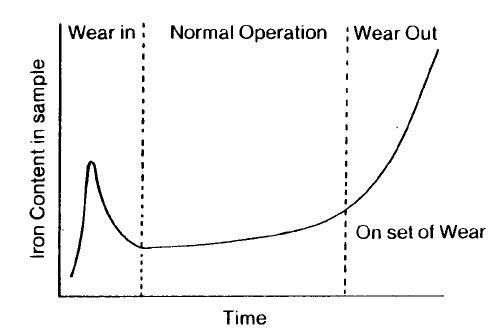
Other than that(wrong fluid for vehicle), your oil choice of correct grade may impact certain wear numbers, but actual/measured wear over the course of an engines life is like the chart shows previously but if as proposed represents 'initial' fill of fresh oil increasing wear within 1,000-1,500 miles I just won't change that frequently.

On the other hand, someone mentioned earlier that too many people don't get their oil changed often enough.

Well, if that's true it wasn't because the 3,000 mile brainwashing overkill wasn't known.

 
Last edited:
Anyone who told you a short OCI would hurt an engine is stupid the only thing you would hurt is your wallet but, thats only if your changing it before the 3k. I would be willing to bet more damage being done with a longer OCI. The deal about the oil breaking in is the funniest [censored] I have ever heard. Think about it fresh oil is always going to be better because it hasn't had blowby,condensation,heat,cold,heat,cold.
 
It appears no one here is grapsing how the detergent package functions, would you jump in your neighbor's swimming pool just seconds after he "shocked" it? Same thing with a fresh detergent package in fresh oil when it highest in Base #. It dissallows the EP package from being as effective as it could be in time. I see the biggest problem here in casual street racers, drag racers and weekend warroirs who would use a high TBN oil say Mobil EP and go out and race with baby fresh oil. They are doing the most harm. They should be using a race specific oil with low detergency. Go to Joe Gibbs Racing and read up, its a Good read for the layperson.
 
Originally Posted By: VR1
Anyone who told you a short OCI would hurt an engine is stupid the only thing you would hurt is your wallet but, thats only if your changing it before the 3k. I would be willing to bet more damage being done with a longer OCI. The deal about the oil breaking in is the funniest [censored] I have ever heard. Think about it fresh oil is always going to be better because it hasn't had blowby,condensation,heat,cold,heat,cold.


Once again, you have no idea what you're talking about.
You really need to research this site and LEARN something before posting.

Continue drinking the 3,000 mile koolaid too. OOH Yeah!
 
Originally Posted By: scurvy
It does matter.

It takes some amount of heat & pressure cycles to activate the anti-wear additives in the oil. The amount of wear has been quantified via radionuclide testing (RNT) while an engine is running. Until activation has taken place the wear rates go up. After the additives become active, wear rates decrease until the additives become depleted, as in this graph from an SAE paper on additive activation:
Additive_activation_cycle.jpg


Prove it yourself: take an oil sample immediately after an oil change and every 500 miles afterwards. Dollars to doughnuts the used oil analysis will show wear rates (ppm/k mile) go up, then down & level off.

Changing your oil too frequently is a waste of money, resources, contributes to premature engine wear and is bad for the environment.


This ^^^
 
Originally Posted By: Zaedock
Originally Posted By: scurvy
It does matter.

It takes some amount of heat & pressure cycles to activate the anti-wear additives in the oil. The amount of wear has been quantified via radionuclide testing (RNT) while an engine is running. Until activation has taken place the wear rates go up. After the additives become active, wear rates decrease until the additives become depleted, as in this graph from an SAE paper on additive activation:
Additive_activation_cycle.jpg


Prove it yourself: take an oil sample immediately after an oil change and every 500 miles afterwards. Dollars to doughnuts the used oil analysis will show wear rates (ppm/k mile) go up, then down & level off.

Changing your oil too frequently is a waste of money, resources, contributes to premature engine wear and is bad for the environment.


This ^^^


Can someone provide a reference for this graph? Frankly, I think it is bogus.

Everything I've read indicates that iron content in used oil continually increases as the oil is used. I'm a facts based person, so I'd like to see the study this came from.
 
Originally Posted By: OldCowboy

Everything I've read indicates that iron content in used oil continually increases as the oil is used. I'm a facts based person


Did you not read my post above?

The iron content increases much more rapidly in the first 3000 miles.

Check out the iron/mile, copper/mile, lead/mile. The bottom scale is thousands of miles on the oil.

lifeg593.gif


This is from the link I posted above and I think it is pretty clear evidence to back up the chart you are questioning.
 
Actually, the graph from http://neptune.spacebears.com/cars/stories/mobil1.html shows a steady increase in iron concentration from 0-12,000 miles. At 12,000 miles, the oil filters were changed and top-up oil was added. The iron levels dropped at that point due to used oil removal and new oil top-up. From 12,000 miles on, the iron concentrations continued to increase, but at a lower rate.

The most interesting points of this study are the dotted curves which show a reduced wear rate for iron, coper, and lead as the mileage on the oil increased. The resulting curve for total wear metals is one of continually increasing accumulations of wear metals, with the rate of increase decreasing over time. It is not, however, a bifurcated graph like the one you presented.

This study is the best argument I've seen for extended OCIs.
 
Originally Posted By: mva
Originally Posted By: OldCowboy

Everything I've read indicates that iron content in used oil continually increases as the oil is used. I'm a facts based person


Did you not read my post above?

The iron content increases much more rapidly in the first 3000 miles.

Check out the iron/mile, copper/mile, lead/mile. The bottom scale is thousands of miles on the oil.

lifeg593.gif


This is from the link I posted above and I think it is pretty clear evidence to back up the chart you are questioning.


The entire test was conducted on a new engine. Can someone tell if it is the oil trend or the new engine wear pattern?

Such test should have been done on a broken in engine with stable wear pattern vs. miles for the data to be conclusive.
 
Originally Posted By: CaspianM


The entire test was conducted on a new engine.


No, it was not a brand new engine. The engine had 2 oil changes and 10,000 miles on it before the study started.

The break-in should have been complete but I agree that it would have been better to use an engine with more mileage.
 
Originally Posted By: OldCowboy
Actually, the graph from http://neptune.spacebears.com/cars/stories/mobil1.html shows a steady increase in iron concentration from 0-12,000 miles. At 12,000 miles, the oil filters were changed and top-up oil was added. The iron levels dropped at that point due to used oil removal and new oil top-up. From 12,000 miles on, the iron concentrations continued to increase, but at a lower rate.

The most interesting points of this study are the dotted curves which show a reduced wear rate for iron, coper, and lead as the mileage on the oil increased. The resulting curve for total wear metals is one of continually increasing accumulations of wear metals, with the rate of increase decreasing over time. It is not, however, a bifurcated graph like the one you presented.

This study is the best argument I've seen for extended OCIs.


Ok, I agree with you - the other chart shows iron disappearing as time goes on. I think it should indicate wear rate versus time instead of iron content in sample versus time.
 
That works.

This is an absolutely fascinating study. I would have bet a lot of money that the wear rate would increase with use.

I'm going to try to replicate this in one of my vehicles.
 
I don't always agree with Arco, but I think he's right on point here.
Way back in the day, I did 3K changes on everything, even using M1.
Wasteful and excessive.
Harmful?
Very probably, although all of the engines involved went on to lead long and happy lives.
Having been here for a bit and learned, I now understand that not only are 3K changes unneeded, they may actually accelerate wear, as the fresh detergents clean all of the established antiwear depositions from all of the contacting internal parts, while the new antiwear additives will need time and heat to redeposit themselves on these same parts.
Overly frequent changes are not only unneeded, but may actually be detrimental.
 
Status
Not open for further replies.
Back
Top Bottom