
You are using an out of date browser. It may not display this or other websites correctly.
You should upgrade or use an alternative browser.
You should upgrade or use an alternative browser.
UA flight #328 loses engine over Broomfield CO.
- Thread starter c502cid
- Start date
- Status
- Not open for further replies.


edyvw
$50 site donor 2026
All engines have failures. All aircrafts have incidents.Look, I get it. But for me, an occasional flyer from EWR to ORD why not pick an aircraft that’s powered by engines that DON’T have fan blades shearing off. I agree, flying is so much safer. Believe it or not I blame Nissan for my anxiety. You guys don’t know what is like to have TWO Nissan cvts.
GE, RR and PW are not Nissan. Aviation is not automotive industry.
Think about this: would you feel better taking road trip if your Nissan had two CVT's? In case one fails, another keeps going and can get you to first service shop without calling tow truck, or worse having accident bcs. failed CVT.

All engines have failures. All aircrafts have incidents.
GE, RR and PW are not Nissan. Aviation is not automotive industry.
Think about this: would you feel better taking road trip if your Nissan had two CVT's? In case one fails, another keeps going and can get you to first service shop without calling tow truck, or worse having accident bcs. failed CVT.
The closest comparison I can think of is a Tesla dual-motor setup. I've heard of one motor failing where it still operated on the other motor. But then again, it's on the ground and not worried about falling from the sky.
Last edited:

I wouldn't avoid P&W engines.Flying UA to ORD out of EWR in a month. Staying away from Pratt and Whitney engines for awhile. Fortunately you can determine what aircraft/engine manufacturer is scheduled to provide service on your particular flight from the UA website.
Keep in mind that the other P&W engine powered the airplane to a safe landing.
Their airliner engines are very well made. My airplane, the 767-300, is running P&W 4000 series engines (4052s, not that it matters) and despite their age, they've been superbly reliable. I routinely fly across the Atlantic on the P&Ws and will continue to do so with confidence.

Dang, she flew 3 hours on 1 engine?We had a fan fail on a 777 a few years back, and it looked like that, but the engines, and the airplane are generally super reliable.
That airplane flew over three hours to get to Hawaii after the engine failed.
Yep!Dang, she flew 3 hours on 1 engine?
That's ETOPS - Extended Twin Operating Procedures Standardization (I think). The ETOPS requirements include engine reliability measures (and the P&W 4000 series meets all of them). The number of minutes refers to the maximum ranges, in minutes, from a suitable airport when operating over water.
We fly up to 180 minute ETOPS in the 757 and 767.
The 777 can go up to 240 minutes. In that particular case, they flew for close to that 240 minutes on one engine, all the way back to Hawaii.
Keep in mind that the point of equal distance is almost never the point of equal time between airports, due to wind. So, our ETOPS flights have designated, suitable, alternate airports that define the ETOPS segment of the flight, and then, a precise point of equal time (now called a critical point) is determined based on wind. Either side of that point - you go to the designated ETOPS alternate airport.
Suitability includes runway length, instrument approach facilities, and current and forecast weather.
Listened to the ATC audio. Any reason why they'd want to run a checklist and turn around rather than land ASAP? The pilot turned down landing on runway 7.
Last edited:
All this talk about how rare this sort of thing is. It doesn't seem so rare anymore, jet engines coming apart mid air seems to be the new norm.
Even older turbine engines didn't have this sort of thing happening. It could be from many things, the cause. Maybe slide rules were better than computers? Or the old timer engineers were better than now. It could be mechanics are too high to work on planes. You know a lot of airliner maintenance is sent to other countries they are way more lax on everything there, and why its cheaper to have them do it.
Even older turbine engines didn't have this sort of thing happening. It could be from many things, the cause. Maybe slide rules were better than computers? Or the old timer engineers were better than now. It could be mechanics are too high to work on planes. You know a lot of airliner maintenance is sent to other countries they are way more lax on everything there, and why its cheaper to have them do it.
The new norm? Please.All this talk about how rare this sort of thing is. It doesn't seem so rare anymore, jet engines coming apart mid air seems to be the new norm.
Even older turbine engines didn't have this sort of thing happening. It could be from many things, the cause. Maybe slide rules were better than computers? Or the old timer engineers were better than now. It could be mechanics are too high to work on planes. You know a lot of airliner maintenance is sent to other countries they are way more lax on everything there, and why its cheaper to have them do it.
All this talk about how rare this sort of thing is. It doesn't seem so rare anymore, jet engines coming apart mid air seems to be the new norm.
Even older turbine engines didn't have this sort of thing happening. It could be from many things, the cause. Maybe slide rules were better than computers? Or the old timer engineers were better than now. It could be mechanics are too high to work on planes. You know a lot of airliner maintenance is sent to other countries they are way more lax on everything there, and why its cheaper to have them do it.
Huh? Where do you get the idea that failure is more common these days? Besides that, this was an older plane and it's not clear how old the engines are, if they were replaced, and how often they were overhauled.

4wd
$50 site donor 2026
This was actually a B773ER and had the big GE90-115‘sI was at the hanger when the Boeing guys tested the B777 on one engine in Newfoundland wind shears … needed 4 hours … after 5.5 hours they got bored …
Last edited:
Running the checklist ensures that all the considerations are taken into account before the single engine landing.Listened to the ATC audio. Any reason why they'd want to run a checklist and turn around rather than land ASAP? The pilot turned down landing on runway 7.
Some things to get squared away before landing:
1. weight
2. approach speed
3. flap setting
4. wind direction and velocity, altimeter setting, weather.
5. runway length required, which is predicated on 1-4.
6. coordination with flight attendants for landing. We brief them on the type of emergency, time remaining, whether or not to prep for evacuation, and any other special instructions.
7. Systems and other settings. For example, the GPWS flap over-ride must be selected, since this will be a flaps 20 landing and the GPWS will start a loud, distracting, continuous warning at 800 feet if the flaps are not in 25 or 30 (normal landing setting - a warning system that makes great sense in a normal landing, but is inappropriate for abnormal configuration landings). Fuel balance must be addressed. Auto-brake setting must be calculated. TCAS should be turned to TA only.
Rushing to land on the very first runway, without completing the checklist, practically ensures that a critical item will be missed and put the airplane, crew and passengers at risk.
The other engine is designed and certified to fly the airplane for hours, so, there is little risk to flying for a few more minutes while completing checklists.
A few minutes to run through all the considerations before landing is professional and prudent.
Last edited:
Rushing to land on the very first runway, without completing the checklist, practically ensures that a critical item will be missed and put the airplane, crew and passengers at risk.
The other engine is designed and certified to fly the airplane for hours, so, there is little risk to flying for a few more minutes while completing checklists.
A few minutes to run through all the considerations before landing is professional and prudent.
Understood. However, I remember the time that a Marine Corp pilot shut down an engine after a carrier takeoff and tried to make it to Miramar (on his superiors' orders) rather than land quickly at NAS North Island. Didn't that end up taking out a couple of homes?
I'm not familiar with that particular crash, but there are many cases of pilots rushing to land the plane, and wrecking it as a result.
For example, an F-14 pilot had an engine failure on takeoff from Cherry Point, MCAS. He quickly turned back, skipped the checklists, and attempted to land on the very first runway he could.
He crashed just short of it, having pulled the fire handle for the good engine, while flying, turning, re-configuring, and trying to complete a checklist. Had he simply climbed up, taken his time, and slowed down, he might have shut down the failed engine and saved a flyable airplane.
For a real tragedy, brought on by rushing, there is this example: https://en.wikipedia.org/wiki/Kegwo...y shut down,and 74 sustained serious injuries.
These guys reacted instantly to an engine failure on takeoff, rushing through the shutdown checklist, and, unfortunately, getting it completely wrong: https://en.wikipedia.org/wiki/TransAsia_Airways_Flight_235

I'm a fan of taking the time to get things right.
For example, an F-14 pilot had an engine failure on takeoff from Cherry Point, MCAS. He quickly turned back, skipped the checklists, and attempted to land on the very first runway he could.
He crashed just short of it, having pulled the fire handle for the good engine, while flying, turning, re-configuring, and trying to complete a checklist. Had he simply climbed up, taken his time, and slowed down, he might have shut down the failed engine and saved a flyable airplane.
For a real tragedy, brought on by rushing, there is this example: https://en.wikipedia.org/wiki/Kegwo...y shut down,and 74 sustained serious injuries.
These guys reacted instantly to an engine failure on takeoff, rushing through the shutdown checklist, and, unfortunately, getting it completely wrong: https://en.wikipedia.org/wiki/TransAsia_Airways_Flight_235
I'm a fan of taking the time to get things right.
I'm not familiar with that particular crash, but there are many cases of pilots rushing to land the plane, and wrecking it as a result.
For example, an F-14 pilot had an engine failure on takeoff from Cherry Point, MCAS. He quickly turned back, skipped the checklists, and attempted to land on the very first runway he could.
He crashed just short of it, having pulled the fire handle for the good engine, while flying, turning, re-configuring, and trying to complete a checklist. Had he simply climbed up, taken his time, and slowed down, he might have shut down the failed engine and saved a flyable airplane.
For a real tragedy, brought on by rushing, there is this example: https://en.wikipedia.org/wiki/Kegworth_air_disaster#:~:text=The pilots mistakenly shut down,and 74 sustained serious injuries.
These guys reacted instantly to an engine failure on takeoff, rushing through the shutdown checklist, and, unfortunately, getting it completely wrong: https://en.wikipedia.org/wiki/TransAsia_Airways_Flight_235
View attachment 46366
I'm a fan of taking the time to get things right.
I'm familiar with that crash. Songshan Airport is in a really crowded location. I guess the old Hong Kong Kai Tak Airport might be the only other one I know that close to downtown.
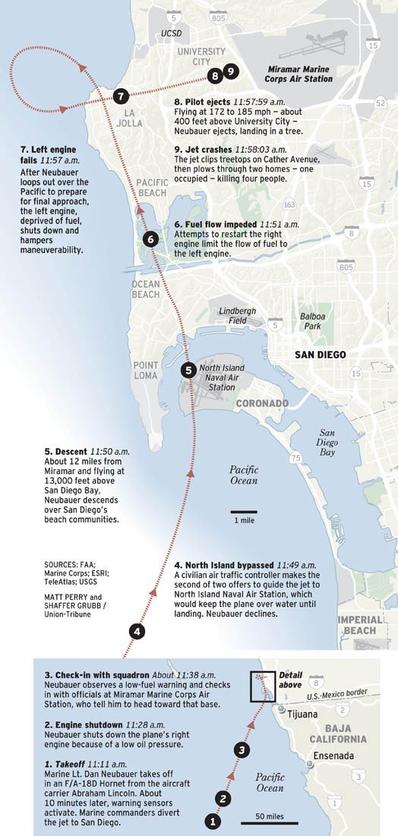
This is a 2018 retrospective on the 2008 University City crash, with audio. You'll probably understand the lingo better than me. Abraham Lincoln and civilian controllers suggested he land at North Field, but apparently his superiors at Miramar ordered him to get to Miramar. Something about continuing his qualifications. The pilot ejected but the plane crashed into a neighborhood in University City. I visited an office in the area a few times. Could hear the noise and saw a few landings from the window.
https://www.sandiegouniontribune.co...fa18-crash-10-years-later-20181208-story.html
There's more on that 2008 crash. Every time I hear of an engine going out I think of it. Apparently the pilot was new to the F/A-18 and for whatever reason was flying a D alone. And he didn't go over a checklist but relied on guidance from the ground.
This was really big news in San Diego. Haven't there been crashes in Virginia Beach?

This was really big news in San Diego. Haven't there been crashes in Virginia Beach?
The F/A-18D suffered engine trouble shortly after Neubauer's 11:11 a.m. takeoff from the carrier about 60 miles southwest of San Diego. He was told to open his safety checklist but didn't do so, Rupp said, and instead relied on guidance from Marines at Miramar who had incomplete knowledge of his situation.
Steve Diamond, a former naval aviator who witnessed the crash and spoke with Neubauer moments after the crash, was stunned to learn that the pilot – as well as his superiors – had neglected to use the checklist.
“Checklists are the most essential things,” Diamond said. “It's almost like a doctor going into surgery and forgetting to wash. It's that basic.”
Even though Neubauer shut down his right engine about 17 minutes into the flight, the fuel transfer problem persisted and activated a low-fuel warning light.
A civilian air traffic controller offered to direct Neubauer's jet – with the call sign SHUTR25 – toward Runway 36 at North Island, according to an audio recording released yesterday by the Federal Aviation Administration. That approach would have kept the aircraft over water until it touched down.
“I'm actually going to try to make it to Miramar if possible,” Neubauer replied as he flew at an altitude of about 13,000 feet nearly 20 miles south of North Island.
There was also this photo taken of him after the crash. I believe the guy talking to him was a former F-14 pilot named Steve Diamond who witnessed the crash.
"Captain" Joe is wearing three stripes...his self-promoting website is annoying. I couldn't watch the video with his voice...ugh...though I didn't see anything objectionable. Juan Brown (blancolirio) usually does a good job with analysis, I would steer folks towards his youtube channel.
Pretty clear that "Captain" Joe was a commuter captain, and is now a major FO, from the uniform. He's young, self-promoting, and annoying. Not the most credible source, in my estimation. I don't know his background, or training, so why should I listen to him?
If an intern, who hadn't yet graduated medical school, listed himself as "Doctor" Joe, would you listen?
Pretty clear that "Captain" Joe was a commuter captain, and is now a major FO, from the uniform. He's young, self-promoting, and annoying. Not the most credible source, in my estimation. I don't know his background, or training, so why should I listen to him?
If an intern, who hadn't yet graduated medical school, listed himself as "Doctor" Joe, would you listen?
Last edited:
- Status
- Not open for further replies.
Similar threads

- Replies
- 36
- Views
- 1K

- Replies
- 66
- Views
- 2K
- Replies
- 72
- Views
- 6K
