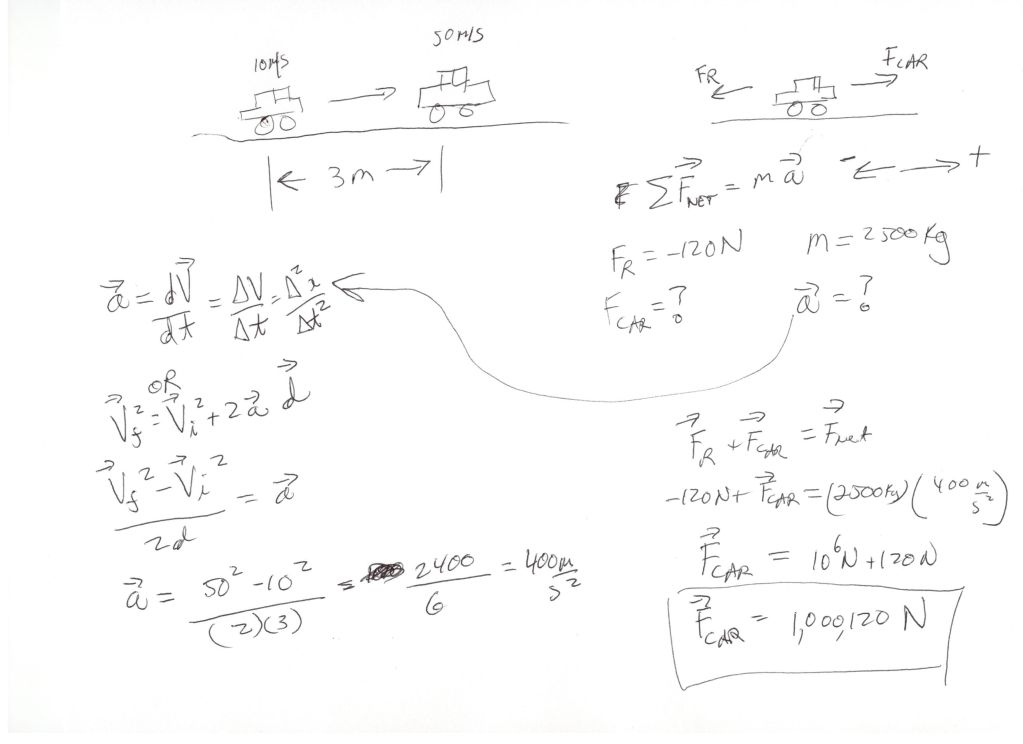
A problem from college physics course :-(

Status
Not open for further replies.
Golly, been forever... I came up with 1 million Newtons, and an acceleration rate of 400m/s^2. Seems like the 120N of drag is inconsequential--or college physics was way too long ago.

If 1G is 9.81m/s^2 then the driver would have felt nearly 41G's pinning him against the seat. I want to say that is past human endurance.

But there are very likely things which accelerate at that rate. Probably not at that weight though.

Of course, I could be way wrong. I haven't played with this stuff in nearly 20 years.
 
At the same current and voltage levels D.C. is more fatal because D.C. can cause the muscel to contract and the body will more likely stay in contact with the source, whereas A.C. will likely lead to a jump reaction from the muscel. Edison lied when he said that A.C. was more fatal as part of his effort to screw Westinghouse and Telsa.
 
Last edited:
Believe AC is more deadly than DC, especially hand-to-hand, the 60 Hz AC makes the heart try to beat 60 times/second, not good for blood flow. Although I'm sure DC is capable of killing too. Where is the 41G race car? What's on the back-Saturn V rocket engine??
 
Originally Posted By: bullwinkle
Where is the 41G race car? What's on the back-Saturn V rocket engine??


I was curious and looked, and it appears that the Saturn V setup that went to the moon only saw about 4G's.
 
Originally Posted By: Vikas
Quote:

12 V in the car is DC
120 V wall socket is AC.


So what were *you* implying by that reply?


I was just trying to say that it is not an apple to apple comparison.
 
Originally Posted By: A_Harman
Originally Posted By: KevGuy
789fd7ab3aee0171b4ea0205849de391_zpsf06e656f.jpg


400m/s^2 * 1G / 9.8m/s^2 = 40.8G's.

Seems like that would be fatal to the occupant of the car. Doesn't the heart rip loose from its moorings in the rib cage at 40 G's?


I noticed that too when I did the numbers, the G force is brutal.
 
Originally Posted By: Andy636
That's a 9th grade physics problem not a college one...just saying..


lol, more like 3rd grade!
 
Originally Posted By: Andy636
That's a 9th grade physics problem not a college one...just saying..

Well, in first year physics, they have to go over such things again, since high schools in North America don't do a great job in teaching math, and one has to relearn these concepts as vectors instead of scalars.
 
IIRC we did this in 12th grade. Could have been 11th, as the school did chemistry one year, physics the next, alternating which class was taught. But we did have to cover it again in college, and had to: high school physics wasn't calculus based. Which meant I didn't know where the 1/2*a*t^2 came from in high school. I don't think we had calculus in high school, it may have stopped at pre-calc.

Been many years, but my recollection was that I could only take one math course per year, and since my math level was set in like the 7th grade... Meant being dropped into calculus in college was a steep steep learning curve!
 
Never had to take any maths in college. Tested out of all I needed.

One course I did need, a financial math course. A joke of a class that I only went to the first day. All exams were in the lab.

I'll never forget I was halfway through an exam and couldnt remember one of the formulas.

Well I wrote out this multi variable equation at the top, used other problems' info, and rederived a passable formula. A solid two pages of lines and lines of work.

I glanced to the right and see the girl next to me near tears.

She'd been trying to copy my work.


Took up through calculus and the second physics in high school. The specifics are all gone now.

When I read your problem, before I could rrealize I didnt remember the formula, the brain said...over 30Gs...dead anyways...no point.
 
To be fairly honest I am a bit disappointed that most of the people took the time to notice how big the acceleration is but nobody noticed that the friction coefficient is 0.004892.

Bitog members are getting soft these days
whistle.gif
whistle.gif
whistle.gif
 
Originally Posted By: Andy636
To be fairly honest I am a bit disappointed that most of the people took the time to notice how big the acceleration is but nobody noticed that the friction coefficient is 0.004892.

Most mechanics problems don't even consider drag. When they do and use such a small force, the professor may be looking for someone to stumble over directions.
 
As a physicist or an engineer, you need to have some intuitive ideas if the results you are getting (or the input parameters that you have been provided) are within ballpark. If you don't have that ability, you need find different career.

Time to open the Resnick&Haliday and if see those two guys had any crazy exercises like this in that book!
 
Originally Posted By: Andy636
To be fairly honest I am a bit disappointed that most of the people took the time to notice how big the acceleration is but nobody noticed that the friction coefficient is 0.004892.

Bitog members are getting soft these days
whistle.gif
whistle.gif
whistle.gif


Wouldn't 0.048m/s^2 be a reasonable coasting decelleration rate for a car at 20m/s?
I'm too lazy calculate how many hp that would be...
 
Originally Posted By: IndyIan

Wouldn't 0.048m/s^2 be a reasonable coasting decelleration rate for a car at 20m/s?
I'm too lazy calculate how many hp that would be...


You would stop in 4.1666666 Km
smile.gif
 
Originally Posted By: Andy636
Originally Posted By: IndyIan

Wouldn't 0.048m/s^2 be a reasonable coasting decelleration rate for a car at 20m/s?
I'm too lazy calculate how many hp that would be...


You would stop in 4.1666666 Km
smile.gif


You don't have a total vacuum lane on your highways over there?
confused.gif
You know, reseved for physicists?

I thought about figuring out how far it would take to stop, but you have to know how the components of the drag change with velocity... I imagine it's actually quite hard to calculate how far a car would roll in real life. It would be a great HS science project I think.
 
Status
Not open for further replies.
Back
Top Bottom