Fram explains cardbard endcaps on their filters.

Status
Not open for further replies.
Originally Posted By: Stelth
The "leaf spring" in a Fram or other similarly-constructed (other than end caps)filters isn't a spring. It's a piece of non-springy steel that acts merely as a rigid spacer.


It is essentially a spring ... a "leaf spring". It deflects and therefore produces force on the center tube as it deflects (that's what a spring does) which holds all the guts of the filter tight together.
 
Originally Posted By: Falken
I may be wrong, but I do think that the entire filter element including the center tube and end caps move forward and backwards constantly during operation.


I don't think the guts of the filter move up & down against the spring in the end cap. The pressure developed by the spring in the end cap is enough to keep the guts tight and not move even under max oil flow conditions. There is also oil pressure trying to push on the dome end cap on the media, so that essentially cancels out the force trying to push the threaded end cap upwards. Only real force on the media cartridge inside the can is against the media as the oil tries to flow from the outside into the center core.

Originally Posted By: Falken
When the car is off, the entire filter element, including the center core, gets forced backwards by the dome end spring to push the ADBV against the inlet holes.


The ADBV is held tight at the inner circle of the center tube. The oil flow causes the outside lip of the ADBV to flex upwards and let oil into the filter. When the engine is off and there is no oil flow, the ADBV naturally wants to sit back down flat and therefore seals itself against the base plate. Here's a photo that shows how it would move when oil is flowing.

DSCF6010-a.jpg
 
Originally Posted By: BlueOvalFitter
Originally Posted By: dishdude
Originally Posted By: Jim Allen
Originally Posted By: dishdude
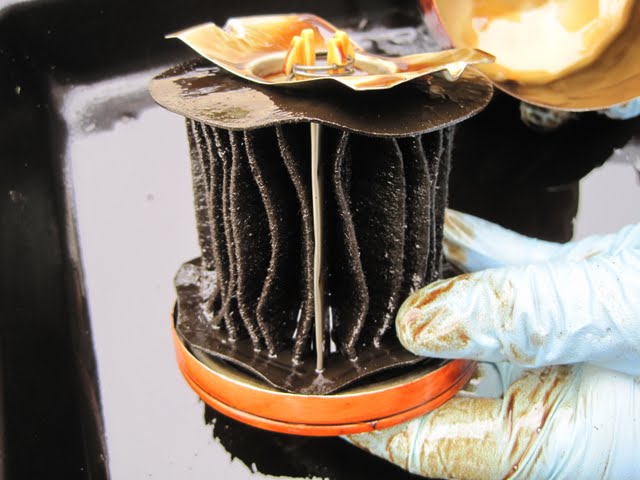
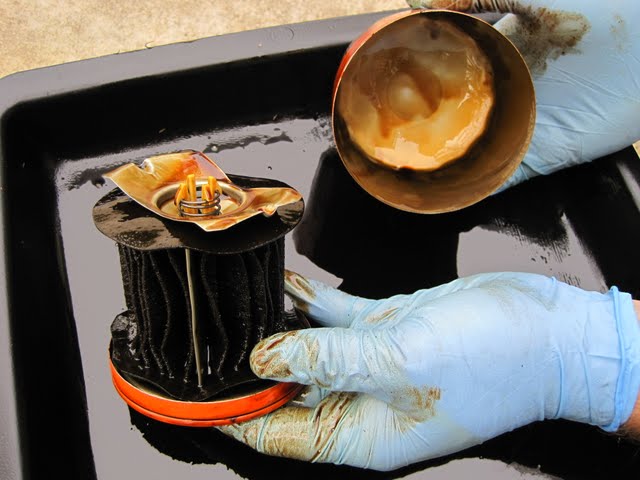
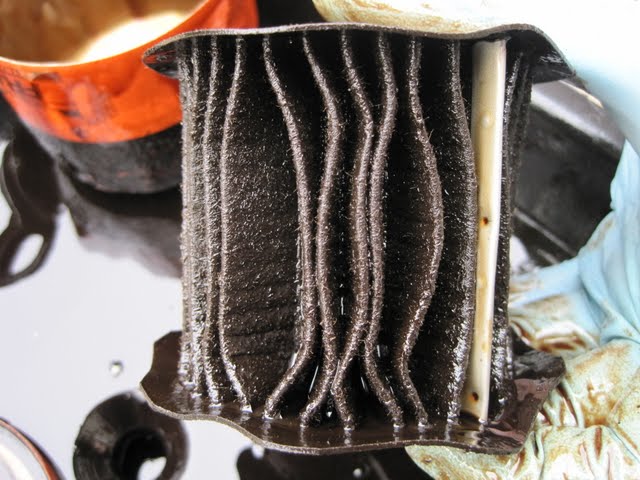
I think that I can deal with the cardboard end caps, I just can't take how little media there is and how bad it looks after use.


The lack of media is a legitimate criticism but you have to keep it in context... it's their bottom dollar filter (which I think is generally overpriced in the market) and designed for a "normal" duration OCI (IIRC the box says 5K miles???). In that context, it has "enough" but I certainly wouldn't buy it. The efficiency of these low rent Frams is good at 95% @ 20um but that doesn't make up for the other shortcomings.

As to how it looks, again you need to take it in context:

-First, what are the particulars of the photo example shown? The oil looks pretty dark, so it is another of those run-the-oil-and-filter-to-death and then take a picture just to badmouth the filter? I presume you took this shot, so you may know the particulars. FYI, all the pics in my post above were taken by me.

-Second, was that filter still doing it's job or not? It's not unusual for a filter, any filter, to get wavy at the end of a FCI, especially if it has widely space pleats. That in and of itself means nothing. Expert after expert, engineer after engineer has told me this and others on Bitog have been told the same thing by their own sources. As long as the central core is sealed and the pleats are unbroken, this filter was still doing it's job.


The picture I posted earlier was the first one I came across, and from an abused OCI - I agree, not fair. I took some time and found one from a 3k interval below.

Is the filter still doing it's job? Probably. I just can't get over how wide the pleats are, and how little media there appears to be. It's just not a pretty sight.

Bottom dollar filters by WIX and Purolator have more media, evenly spaced.

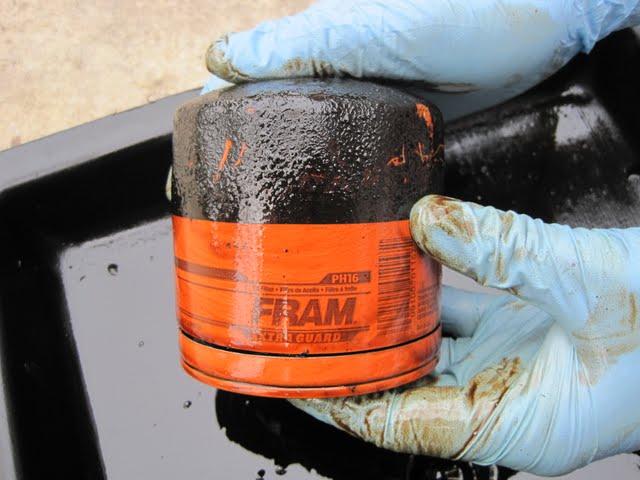
It seems like the PH16 and larger filters are especially bad with the pleats, and amount of media:

IMG_0655.JPG


IMG_0656.JPG


IMG_0657.JPG


IMG_0659.JPG


Pictures are from this thread: https://bobistheoilguy.com/forums/posts/2091077/

Proof positive why it's called the OCOD!


Why. The pleats are still all glued which means oil isn't passing unfiltered. And the wavy end cap is irrelevant. Once pressurized the element moves and everything tightens,sealing the ends.
Sure it looks horrible but its working exactly how it was designed to work,and there isn't any sign of failure.
So do please if you could why that particular filter equals death.
I absolutely agree that for the 5 bucks the orange cans cost here I can grab a purolator which is a bit better value as far as cost vs quality but I can't see where the fram failed.
If you could blue oval could you point out where the filter has failed for me please.
Thanks
 
Originally Posted By: Clevy
Once pressurized the element moves and everything tightens,sealing the ends.


Nothing should be moving inside the filter except for rubber ADBV flexing to let oil into the inlet holes, and the bypass valve opening if it need to. The media assy should not be moving at all unless the leaf or coil spring in the dome has failed for some reason. See my post above too.
 
Thanks for the photo ZeeOSix, now it makes sense to me.

The spring in the dome just keeps everything pinned when the baseplate is crimped on.

Ok so now I don't have such a bad opinion of leaf springs in general.

Maybe I will at one point give the Fram ULTRA a try then.
 
Originally Posted By: dishdude

IMG_0659.JPG


Originally Posted By: KCJeep


I don't mind using a Fram filter with a construction similar to PH3980, but anything similar to PH16 should not even in a worst enemy engine.
 
Originally Posted By: dishdude

It seems like the PH16 and larger filters are especially bad with the pleats, and amount of media...


Exactly. I have no problem with the fram design on their smaller filters where there are a lot of pleats in small area, making for a strong design.

The PH16, and other similarly sized filters, not so much.
 
A lot of agreement here! The PH16 and PH8A's look like a kindergarten project when cut open. I do not use them. I continue to use the PH3980 and it's SAE twin the 3600 series due to positive experiences with them.
 
Originally Posted By: KCJeep
A lot of agreement here! The PH16 and PH8A's look like a kindergarten project when cut open. I do not use them. I continue to use the PH3980 and it's SAE twin the 3600 series due to positive experiences with them.


The PH8As are just the worst. You're right, a 5 year old with construction paper and paste could probably build a better filter element than this. I can't figure out how they can make the PH3600 so even and then build this abomination.

 
Originally Posted By: dishdude
Originally Posted By: KCJeep
A lot of agreement here! The PH16 and PH8A's look like a kindergarten project when cut open. I do not use them. I continue to use the PH3980 and it's SAE twin the 3600 series due to positive experiences with them.


The PH8As are just the worst. You're right, a 5 year old with construction paper and paste could probably build a better filter element than this. I can't figure out how they can make the PH3600 so even and then build this abomination.


WOW! That is just down right ugly!
 
Originally Posted By: ZeeOSix
Originally Posted By: Stelth
The "leaf spring" in a Fram or other similarly-constructed (other than end caps)filters isn't a spring. It's a piece of non-springy steel that acts merely as a rigid spacer.


It is essentially a spring ... a "leaf spring". It deflects and therefore produces force on the center tube as it deflects (that's what a spring does) which holds all the guts of the filter tight together.


I agree with Zee here! I suppose those long, narrow pieces of metal shackled together under my truck are not leaf springs, but "non-springy" steel used as a spacer to keep the bed off the tires ... That must explain why it rides so rough - until I fill it with stuff.


As for the pictures of the OCOD, I'll say this:
Ugly? Yes - it's unsightly.

However ...
Just where did it fail to protect?
The pleats are wavy; so what? They are compressed from the spring, that's all. Do you see any area that shows actual evidence of a leak point?

I'm not a giant Fram OCOD fanatic, but I don't see why so many jump on the hater-wagon. I would agree that straight pleats are pleasing to visualize, but wavy pleats do not automatically infer a failed media package. The fiber top is also wavy, but it's job is to seal against the media, which it apparently did. It will certainly last for the OCI Fram intends.

Were there PC tests conducted of the pictured filter while in application? Did anyone get UOA data that corresponded with the filter OCI? In short, did anyone bother to look at filtration direct or indirect performance indicators? Or are we just focusing on the lack of beauty?

Other than the esthetics and the color of its skin, why be a filter bigot and bash this?
Because it's the predominant BITOG thing to do.

I hope for more; I want "better" for us ... a "better" mindset. We need to do a much more thorough job of analyzing situations for their design intent and actual performance, and not just on what other's peer pressure would indicate.
 
Last edited:
Originally Posted By: dnewton3
As for the pictures of the OCOD, I'll say this:
Ugly? Yes - it's unsightly.

Originally Posted By: BlueOvalFitter
WOW! That is just down right ugly!

It's just a figure of speech.
28.gif
 
Originally Posted By: dnewton3
Originally Posted By: ZeeOSix
Originally Posted By: Stelth
The "leaf spring" in a Fram or other similarly-constructed (other than end caps)filters isn't a spring. It's a piece of non-springy steel that acts merely as a rigid spacer.


It is essentially a spring ... a "leaf spring". It deflects and therefore produces force on the center tube as it deflects (that's what a spring does) which holds all the guts of the filter tight together.


I agree with Zee here! I suppose those long, narrow pieces of metal shackled together under my truck are not leaf springs, but "non-springy" steel used as a spacer to keep the bed off the tires ... That must explain why it rides so rough - until I fill it with stuff.


As for the pictures of the OCOD, I'll say this:
Ugly? Yes - it's unsightly.

However ...
Just where did it fail to protect?
The pleats are wavy; so what? They are compressed from the spring, that's all. Do you see any area that shows actual evidence of a leak point?


Oh my, I did not expect this from you. Your leaf springs on your truck certainly are "springy", they're made of spring steel! If you are going to consider a stamped mild steel spacer to be a spring, then the can and filter element must also be springs, since they all work together to hold the whole works together under tension. If you take the coil spring that is in some filters, and set an anvil on it, when you remove the anvil, it returns to its former shape (possibly somewhat distorted depending on the weight of the anvil). If you take the "leaf spring" spacer from a Fram or other filter that uses it, and set an anvil on it, it will smash, and when the anvil is removed, it will stay smashed.

Also, the element isn't wavy because of spring pressure. The pressure, as it is, is directed from the can through the stamped spacer to the steel element tube, and from there to the base plate. The element itself does not experience this pressure.

Also, if that definition of spring applies, then any bolt that is torqued to a certain value is also a spring, because the "stretch" of the bolt applies pressure to the part being bolted, or to the gasket. But the fact remains that bolts are not springs. And neither is the stamped spacer in a filter.
 
Originally Posted By: Stelth
Also, the element isn't wavy because of spring pressure. The pressure, as it is, is directed from the can through the stamped spacer to the steel element tube, and from there to the base plate. The element itself does not experience this pressure.

What causes the pleats to become wavy like this?
 
Originally Posted By: Stelth
Oh my, I did not expect this from you. Your leaf springs on your truck certainly are "springy", they're made of spring steel! If you are going to consider a stamped mild steel spacer to be a spring, then the can and filter element must also be springs, since they all work together to hold the whole works together under tension. If you take the coil spring that is in some filters, and set an anvil on it, when you remove the anvil, it returns to its former shape (possibly somewhat distorted depending on the weight of the anvil). If you take the "leaf spring" spacer from a Fram or other filter that uses it, and set an anvil on it, it will smash, and when the anvil is removed, it will stay smashed.

Also, the element isn't wavy because of spring pressure. The pressure, as it is, is directed from the can through the stamped spacer to the steel element tube, and from there to the base plate. The element itself does not experience this pressure.

Also, if that definition of spring applies, then any bolt that is torqued to a certain value is also a spring, because the "stretch" of the bolt applies pressure to the part being bolted, or to the gasket. But the fact remains that bolts are not springs. And neither is the stamped spacer in a filter.


Getting into the game of semantics, eh?

Any metal that has resilience where it can travel from and return to a known location could be a "spring". Yes - some headbolts have "stretch" that makes them retain their clamping force, as opposed to TTY bolts which are stretched past their yield return point. Yes - some bolts act as minature springs.

Call it a spacer if you want. But that piece of metal in the OCOD provides not just a "space", but also a compressive force that will self-correct for movement; it has resilience that will return to some location after relieved. If it were only a spacer, providing only a fixed postional attriubute, then I should be able to substitute any manner of other inanimate object for it. I could put in a puck of solid steel, or other such solid piece, and in your estimation, it would perform the same function. But I profess that the "wings" (for a lack of a better term") are what provide a spring effect. And clearly I'm not the only one that sees it that way. In fact, if it were only a spacer, then the entire filter unit and each component would have to be made to exact dimensions. No, make that EXACT KNAT's-BOOTY dimensions. Because if there were ANY tolerance stack up in a negative dimension, then the filter would permanently leak around some component somewhere. If that "spacer" didn't "spring", then any dimensional loss would result in an internal path leak. If it were only a spacer, then even the dimensional growth of the filter can with heat/cool cycles would make it "loose" enough that the "spacer" would promote a leak.

Still think it's not a spring? Then let me ask you this ... Why is it that some companies use a coil spring in that very same location to accomplish that very same task? If Fram and others including Motorcraft and Purolator use a "leaf spacer" because there is no need for a spring, then why do other companies use a "coil spring" and not a "coil spacer"? If the "leaf spring" is only a spacer, then why do others use "springs" where only a "spacer" is needed? Your logic fails miserably here.

BTW - I'm not standing along on an island when I call that (stamped metal thingy) a "spring":
http://www.fleetfilter.com/comparison-motorcraft-filter.html
http://www.fleetfilter.com/comparison-purolator-filter.html


So, "Yes" - I consider some pieces of stamped mild steel to be "springs" depending upon their application. They are used in that manner as inexpensive tools all the time, from childrens toys, to musical instruments, to electronic switches, pressure switches, bolt latch return devices, etc, etc. Ever see a reed-valve for two-stroke induction intack tracks? Some are made of a resilient fiber-infused nylon, and some are made from (hold your breath ....) stamped mild metal.

You may not acknowledge a resilient stamped steel piece as a "spring" but much of the rest of the advanced world does. Even when used in an oil filter.

This is silly ...
But then, this is BITOG after all ...

 
Last edited:
I actually think technically it is a spacer, but has to have some spring action because it is taking up an unknown amount of space due to manufacturing tolerances being so poor.
 
Originally Posted By: Stelth
If you take the coil spring that is in some filters, and set an anvil on it, when you remove the anvil, it returns to its former shape (possibly somewhat distorted depending on the weight of the anvil). If you take the "leaf spring" spacer from a Fram or other filter that uses it, and set an anvil on it, it will smash, and when the anvil is removed, it will stay smashed.


The "spacer" in the dome end certainly is a leaf spring. Next time you cut open a filter put the leaf spring on a flat surface and push on the center of it. It will spring back and forth and not deform - it's quite stiff so it produces some decent force with small deflections. It's not designed to move a whole lot (1/8" or less), just enough to produce enough spring force to hold all the guts inside the filter tight against the base plate.
 
Originally Posted By: Eosyn
Originally Posted By: TTK
Originally Posted By: Eosyn
If it wasn't for my education from BITOG here, I may have actually believe what this Fram Rep says. Not sure if this has been posted before, but here ya go.

Video from Fram about their fiber end discs (caps)

Guess Fram got sick of people putting them down due to the fiber endcaps and decided to set us straight in this video
21.gif


Education? Not really. Probably a bias you picked up here.


Very well may be a bias, but it's an approved bias
grin.gif


Ooops, my bad, about the reposts
33.gif

Not approved. I don't use this filter because there are better options for cheaper, but you nor anyone else on this site who keep using the OCOD term can provide proof of multiple engines destroyed with this filter. I've been asking this question for years....still no proof. You care to provide the proof of the death of a motor using the "OCOD" or are you simply drinking the "kool-aid".
 
Originally Posted By: NightRiderQ45
Not approved. I don't use this filter because there are better options for cheaper, but you nor anyone else on this site who keep using the OCOD term can provide proof of multiple engines destroyed with this filter. I've been asking this question for years....still no proof. You care to provide the proof of the death of a motor using the "OCOD" or are you simply drinking the "kool-aid".


Can't recall the member here on this site, but he has posted a couple of times of a OCOD failing and causing his motor damage.
 
Status
Not open for further replies.
Back
Top Bottom