I have used Toyota and Denso oil filters for years and have never seen any problems with them after six months of service.And yes, they don't have end caps.Regards

You are using an out of date browser. It may not display this or other websites correctly.
You should upgrade or use an alternative browser.
You should upgrade or use an alternative browser.
Fram explains cardbard endcaps on their filters.
- Thread starter Eosyn
- Start date
- Status
- Not open for further replies.

Originally Posted By: Stelth
I don't understand the obsession with Fram end caps. I've cut apart several, and they were all well-bonded to the media, including one that had been submerged in water for some months.
It's not so much the issue of good bonding or not, it's an issue (for me anyway) that the non-metal end caps are not thick enough and tend to warp sometimes, which could lead to oil leaking past the media around where the center core seals. If FRAM used a little thicker/firmer end cap I think it would be a better design.
I don't understand the obsession with Fram end caps. I've cut apart several, and they were all well-bonded to the media, including one that had been submerged in water for some months.
It's not so much the issue of good bonding or not, it's an issue (for me anyway) that the non-metal end caps are not thick enough and tend to warp sometimes, which could lead to oil leaking past the media around where the center core seals. If FRAM used a little thicker/firmer end cap I think it would be a better design.
Originally Posted By: Eosyn
He showed a genuine toyota filter with no end caps at all. Would love to learn about those designs and how it works or benefits w/o the end caps.
In that filter design, each individual pleat is glued together at the end. So if you have 50 pleats, there are 100 glued seams - one on each end of each pleat. I stopped using Toyota filters because they don't have a very good efficiency rating, and plus if there is a pleat or two that wasn't glued well at the end, then you could be unfiltered oil past the media.
He showed a genuine toyota filter with no end caps at all. Would love to learn about those designs and how it works or benefits w/o the end caps.
In that filter design, each individual pleat is glued together at the end. So if you have 50 pleats, there are 100 glued seams - one on each end of each pleat. I stopped using Toyota filters because they don't have a very good efficiency rating, and plus if there is a pleat or two that wasn't glued well at the end, then you could be unfiltered oil past the media.
Originally Posted By: Stelth
I don't understand the obsession with Fram end caps. I've cut apart several, and they were all well-bonded to the media, including one that had been submerged in water for some months. I'm not a Fram fanboy, although I have a number of Frams in my garage; some I got for free in a filter exchange, and some I got for less than 2 bucks from a closeout. If they had been giving away Purolators, I'd be using them. E-cores, not so much.
I cut an ocod open last week and I couldn't get that paper end cap off in one piece it came off in chunks.
I don't understand the obsession with Fram end caps. I've cut apart several, and they were all well-bonded to the media, including one that had been submerged in water for some months. I'm not a Fram fanboy, although I have a number of Frams in my garage; some I got for free in a filter exchange, and some I got for less than 2 bucks from a closeout. If they had been giving away Purolators, I'd be using them. E-cores, not so much.
I cut an ocod open last week and I couldn't get that paper end cap off in one piece it came off in chunks.
Originally Posted By: Jim Allen
Since the sight of a failed Fram endcaps seems to inspire so much erotic arousal among some of you, I thought I would include something to cool you off. Yes, metal endcaps fail too. Sometimes right out of the box, as this one did. I have personally see two others.

Thing is, the ends of the pleats are still sealed up just fine ... kind of like a Toyota filter design. The metal end cap separating like that really doesn't do any harm (as long as the pleat ends are still sealed) when the guts of the filter are all held together tight with the spring in the end dome.
Since the sight of a failed Fram endcaps seems to inspire so much erotic arousal among some of you, I thought I would include something to cool you off. Yes, metal endcaps fail too. Sometimes right out of the box, as this one did. I have personally see two others.
Thing is, the ends of the pleats are still sealed up just fine ... kind of like a Toyota filter design. The metal end cap separating like that really doesn't do any harm (as long as the pleat ends are still sealed) when the guts of the filter are all held together tight with the spring in the end dome.
Originally Posted By: ZeeOSix
Thing is, the ends of the pleats are still sealed up just fine ... kind of like a Toyota filter design. The metal end cap separating like that really doesn't do any harm (as long as the pleat ends are still sealed) when the guts of the filter are all held together tight with the spring in the end dome.
TOUCHE'!

Thing is, the ends of the pleats are still sealed up just fine ... kind of like a Toyota filter design. The metal end cap separating like that really doesn't do any harm (as long as the pleat ends are still sealed) when the guts of the filter are all held together tight with the spring in the end dome.
TOUCHE'!
dishdude said:I think that I can deal with the cardboard end caps, I just can't take how little media there is and how bad it looks after use.
The lack of media is a legitimate criticism but you have to keep it in context... it's their bottom dollar filter (which I think is generally overpriced in the market) and designed for a "normal" duration OCI (IIRC the box says 5K miles???). In that context, it has "enough" but I certainly wouldn't buy it. The efficiency of these low rent Frams is good at 95% @ 20um but that doesn't make up for the other shortcomings.
As to how it looks, again you need to take it in context:
-First, what are the particulars of the photo example shown? The oil looks pretty dark, so it is another of those run-the-oil-and-filter-to-death and then take a picture just to badmouth the filter? I presume you took this shot, so you may know the particulars. FYI, all the pics in my post above were taken by me.
-Second, was that filter still doing it's job or not? It's not unusual for a filter, any filter, to get wavy at the end of a FCI, especially if it has widely space pleats. That in and of itself means nothing. Expert after expert, engineer after engineer has told me this and others on Bitog have been told the same thing by their own sources. As long as the central core is sealed and the pleats are unbroken, this filter was still doing it's job.
Originally Posted By: Jim Allen
dishdude said:I think that I can deal with the cardboard end caps, I just can't take how little media there is and how bad it looks after use.
The lack of media is a legitimate criticism but you have to keep it in context... it's their bottom dollar filter (which I think is generally overpriced in the market) and designed for a "normal" duration OCI (IIRC the box says 5K miles???). In that context, it has "enough" but I certainly wouldn't buy it. The efficiency of these low rent Frams is good at 95% @ 20um but that doesn't make up for the other shortcomings.
As to how it looks, again you need to take it in context:
-First, what are the particulars of the photo example shown? The oil looks pretty dark, so it is another of those run-the-oil-and-filter-to-death and then take a picture just to badmouth the filter? I presume you took this shot, so you may know the particulars. FYI, all the pics in my post above were taken by me.
-Second, was that filter still doing it's job or not? It's not unusual for a filter, any filter, to get wavy at the end of a FCI, especially if it has widely space pleats. That in and of itself means nothing. Expert after expert, engineer after engineer has told me this and others on Bitog have been told the same thing by their own sources. As long as the central core is sealed and the pleats are unbroken, this filter was still doing it's job.
Thanx for that reply and information JA. I am learning so much about oil filters from your reples, along with many others here.
If ever another oil website starts up I will be ready with my oil and filter knowledge.
Originally Posted By: ZeeOSix
Originally Posted By: Jim Allen
Since the sight of a failed Fram endcaps seems to inspire so much erotic arousal among some of you, I thought I would include something to cool you off. Yes, metal endcaps fail too. Sometimes right out of the box, as this one did. I have personally see two others.
Thing is, the ends of the pleats are still sealed up just fine ... kind of like a Toyota filter design. The metal end cap separating like that really doesn't do any harm (as long as the pleat ends are still sealed) when the guts of the filter are all held together tight with the spring in the end dome.
Exactly!
The same thing applies to a fiber endcap filter, more or less. As long as the pleat ends and central core remains sealed and intact, it's still a viable filter. In the case of dissected fiber endcap filters I've seen posted as "evidence" of failure, once the spring tension is released, and some human starts pulling the ADBV or tugging at the endcaps... is what we see really an accurate representation of what was happening when the spring pressure was applied and the filter intact? In many, if not most, cases, I doubt it. The only way to know would be to test an intact filter for internal leakage. That's something most us can't do at home.
Originally Posted By: Jim Allen
Since the sight of a failed Fram endcaps seems to inspire so much erotic arousal among some of you, I thought I would include something to cool you off. Yes, metal endcaps fail too. Sometimes right out of the box, as this one did. I have personally see two others.
Thing is, the ends of the pleats are still sealed up just fine ... kind of like a Toyota filter design. The metal end cap separating like that really doesn't do any harm (as long as the pleat ends are still sealed) when the guts of the filter are all held together tight with the spring in the end dome.
Exactly!
The same thing applies to a fiber endcap filter, more or less. As long as the pleat ends and central core remains sealed and intact, it's still a viable filter. In the case of dissected fiber endcap filters I've seen posted as "evidence" of failure, once the spring tension is released, and some human starts pulling the ADBV or tugging at the endcaps... is what we see really an accurate representation of what was happening when the spring pressure was applied and the filter intact? In many, if not most, cases, I doubt it. The only way to know would be to test an intact filter for internal leakage. That's something most us can't do at home.
Originally Posted By: Jim Allen
Originally Posted By: dishdude
I think that I can deal with the cardboard end caps, I just can't take how little media there is and how bad it looks after use.
The lack of media is a legitimate criticism but you have to keep it in context... it's their bottom dollar filter (which I think is generally overpriced in the market) and designed for a "normal" duration OCI (IIRC the box says 5K miles???). In that context, it has "enough" but I certainly wouldn't buy it. The efficiency of these low rent Frams is good at 95% @ 20um but that doesn't make up for the other shortcomings.
As to how it looks, again you need to take it in context:
-First, what are the particulars of the photo example shown? The oil looks pretty dark, so it is another of those run-the-oil-and-filter-to-death and then take a picture just to badmouth the filter? I presume you took this shot, so you may know the particulars. FYI, all the pics in my post above were taken by me.
-Second, was that filter still doing it's job or not? It's not unusual for a filter, any filter, to get wavy at the end of a FCI, especially if it has widely space pleats. That in and of itself means nothing. Expert after expert, engineer after engineer has told me this and others on Bitog have been told the same thing by their own sources. As long as the central core is sealed and the pleats are unbroken, this filter was still doing it's job.
The picture I posted earlier was the first one I came across, and from an abused OCI - I agree, not fair. I took some time and found one from a 3k interval below.
Is the filter still doing it's job? Probably. I just can't get over how wide the pleats are, and how little media there appears to be. It's just not a pretty sight.
Bottom dollar filters by WIX and Purolator have more media, evenly spaced.
It seems like the PH16 and larger filters are especially bad with the pleats, and amount of media:
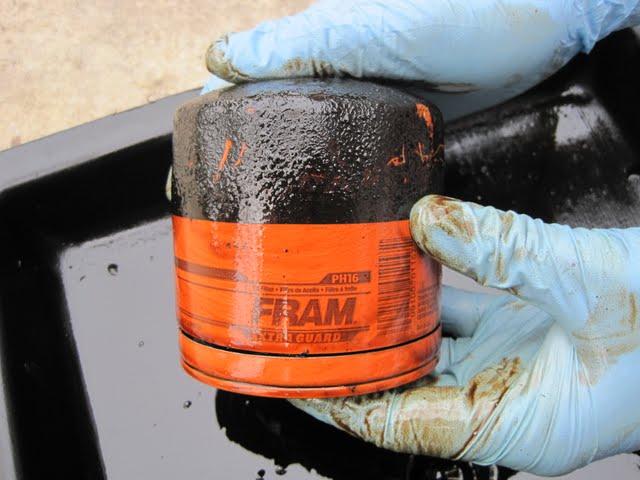
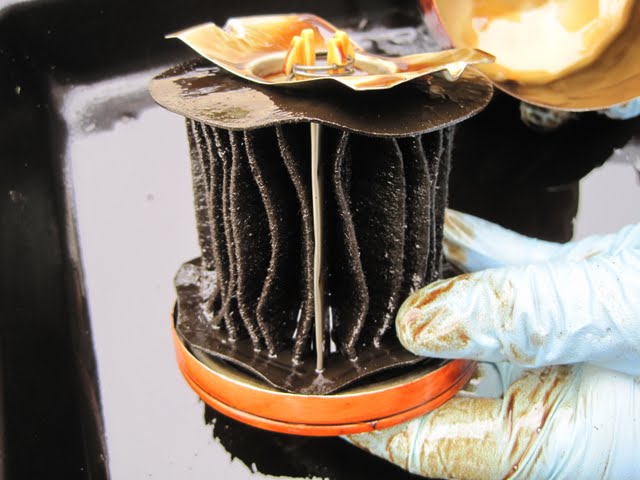
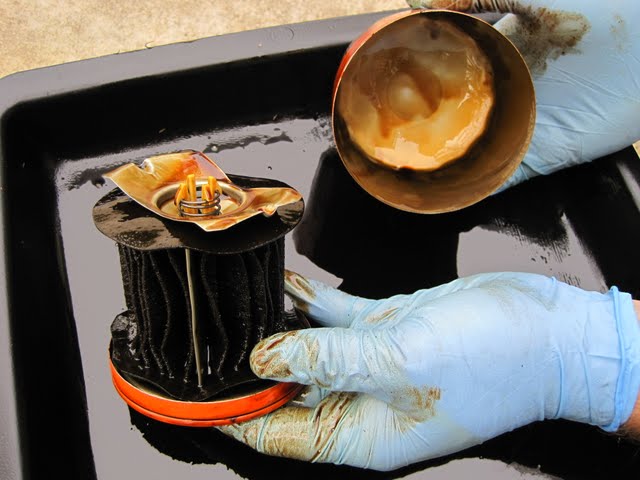
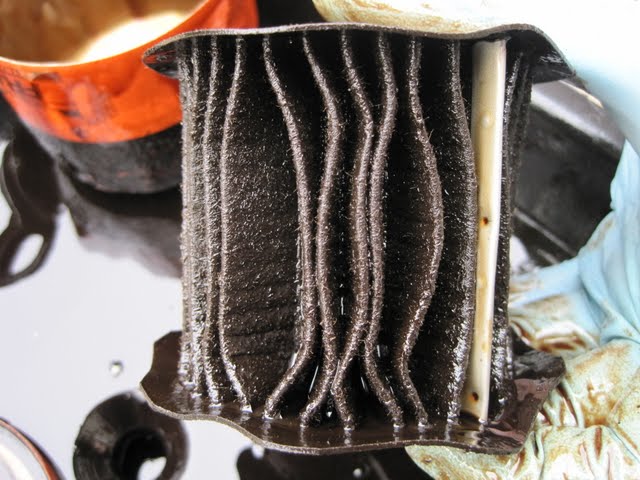
Pictures are from this thread: https://bobistheoilguy.com/forums/posts/2091077/
Originally Posted By: dishdude
I think that I can deal with the cardboard end caps, I just can't take how little media there is and how bad it looks after use.
The lack of media is a legitimate criticism but you have to keep it in context... it's their bottom dollar filter (which I think is generally overpriced in the market) and designed for a "normal" duration OCI (IIRC the box says 5K miles???). In that context, it has "enough" but I certainly wouldn't buy it. The efficiency of these low rent Frams is good at 95% @ 20um but that doesn't make up for the other shortcomings.
As to how it looks, again you need to take it in context:
-First, what are the particulars of the photo example shown? The oil looks pretty dark, so it is another of those run-the-oil-and-filter-to-death and then take a picture just to badmouth the filter? I presume you took this shot, so you may know the particulars. FYI, all the pics in my post above were taken by me.
-Second, was that filter still doing it's job or not? It's not unusual for a filter, any filter, to get wavy at the end of a FCI, especially if it has widely space pleats. That in and of itself means nothing. Expert after expert, engineer after engineer has told me this and others on Bitog have been told the same thing by their own sources. As long as the central core is sealed and the pleats are unbroken, this filter was still doing it's job.
The picture I posted earlier was the first one I came across, and from an abused OCI - I agree, not fair. I took some time and found one from a 3k interval below.
Is the filter still doing it's job? Probably. I just can't get over how wide the pleats are, and how little media there appears to be. It's just not a pretty sight.
Bottom dollar filters by WIX and Purolator have more media, evenly spaced.
It seems like the PH16 and larger filters are especially bad with the pleats, and amount of media:
Pictures are from this thread: https://bobistheoilguy.com/forums/posts/2091077/
Originally Posted By: dishdude
Originally Posted By: Jim Allen
Originally Posted By: dishdude
I think that I can deal with the cardboard end caps, I just can't take how little media there is and how bad it looks after use.
The lack of media is a legitimate criticism but you have to keep it in context... it's their bottom dollar filter (which I think is generally overpriced in the market) and designed for a "normal" duration OCI (IIRC the box says 5K miles???). In that context, it has "enough" but I certainly wouldn't buy it. The efficiency of these low rent Frams is good at 95% @ 20um but that doesn't make up for the other shortcomings.
As to how it looks, again you need to take it in context:
-First, what are the particulars of the photo example shown? The oil looks pretty dark, so it is another of those run-the-oil-and-filter-to-death and then take a picture just to badmouth the filter? I presume you took this shot, so you may know the particulars. FYI, all the pics in my post above were taken by me.
-Second, was that filter still doing it's job or not? It's not unusual for a filter, any filter, to get wavy at the end of a FCI, especially if it has widely space pleats. That in and of itself means nothing. Expert after expert, engineer after engineer has told me this and others on Bitog have been told the same thing by their own sources. As long as the central core is sealed and the pleats are unbroken, this filter was still doing it's job.
The picture I posted earlier was the first one I came across, and from an abused OCI - I agree, not fair. I took some time and found one from a 3k interval below.
Is the filter still doing it's job? Probably. I just can't get over how wide the pleats are, and how little media there appears to be. It's just not a pretty sight.
Bottom dollar filters by WIX and Purolator have more media, evenly spaced.
It seems like the PH16 and larger filters are especially bad with the pleats, and amount of media:
Pictures are from this thread: https://bobistheoilguy.com/forums/posts/2091077/
Proof positive why it's called the OCOD!
Originally Posted By: Jim Allen
Originally Posted By: dishdude
I think that I can deal with the cardboard end caps, I just can't take how little media there is and how bad it looks after use.
The lack of media is a legitimate criticism but you have to keep it in context... it's their bottom dollar filter (which I think is generally overpriced in the market) and designed for a "normal" duration OCI (IIRC the box says 5K miles???). In that context, it has "enough" but I certainly wouldn't buy it. The efficiency of these low rent Frams is good at 95% @ 20um but that doesn't make up for the other shortcomings.
As to how it looks, again you need to take it in context:
-First, what are the particulars of the photo example shown? The oil looks pretty dark, so it is another of those run-the-oil-and-filter-to-death and then take a picture just to badmouth the filter? I presume you took this shot, so you may know the particulars. FYI, all the pics in my post above were taken by me.
-Second, was that filter still doing it's job or not? It's not unusual for a filter, any filter, to get wavy at the end of a FCI, especially if it has widely space pleats. That in and of itself means nothing. Expert after expert, engineer after engineer has told me this and others on Bitog have been told the same thing by their own sources. As long as the central core is sealed and the pleats are unbroken, this filter was still doing it's job.
The picture I posted earlier was the first one I came across, and from an abused OCI - I agree, not fair. I took some time and found one from a 3k interval below.
Is the filter still doing it's job? Probably. I just can't get over how wide the pleats are, and how little media there appears to be. It's just not a pretty sight.
Bottom dollar filters by WIX and Purolator have more media, evenly spaced.
It seems like the PH16 and larger filters are especially bad with the pleats, and amount of media:
Pictures are from this thread: https://bobistheoilguy.com/forums/posts/2091077/
Proof positive why it's called the OCOD!
Yeah, a lot of people are forced to take their car to a garage to have the oil changed.
That wavy gravy cardboard end cap, right there, is a good reason I'd be worried if the tech was just wiping the outside of the filter clean and not putting a new filter on.
When the above filter goes into bypass, how can it if the cardboard is all distorted like someone rolled it into a ball?
There is just no structural integrity that I can see that would allow all the valves to work. There would be too much leakage under pressure.
ADBV? Pffft. No way that is sealing anymore. Dome end bypass? Doubt it would ever work by the time the filter is loaded with enough dirt for the filter to go into bypass to begin with.
They are horrible filters, and fail before the safety features can kick in. All due to the cardboard end caps.
That wavy gravy cardboard end cap, right there, is a good reason I'd be worried if the tech was just wiping the outside of the filter clean and not putting a new filter on.
When the above filter goes into bypass, how can it if the cardboard is all distorted like someone rolled it into a ball?
There is just no structural integrity that I can see that would allow all the valves to work. There would be too much leakage under pressure.
ADBV? Pffft. No way that is sealing anymore. Dome end bypass? Doubt it would ever work by the time the filter is loaded with enough dirt for the filter to go into bypass to begin with.
They are horrible filters, and fail before the safety features can kick in. All due to the cardboard end caps.

I agree the #1 beef I have with the OCOD is the amount of media. But for some reason they are not created equal. As mentioned the PH8A and PH16 filters pictured are some of the worst offenders. Yet the PH3980/PH3600 filters actually look pretty darn good.
Here's a PH3980 that was run a full 5k in an older Chevy with 130 plus k miles. The engine was fairly clean but the UOA came back with bad coolant contamination. You'd never have guessed looking at the filter though.

The PH3980 remains one of my preferred filters for my daughters old Chevy Lumina.
Here's a PH3980 that was run a full 5k in an older Chevy with 130 plus k miles. The engine was fairly clean but the UOA came back with bad coolant contamination. You'd never have guessed looking at the filter though.
The PH3980 remains one of my preferred filters for my daughters old Chevy Lumina.
Originally Posted By: Falken
Yeah, a lot of people are forced to take their car to a garage to have the oil changed.
That wavy gravy cardboard end cap, right there, is a good reason I'd be worried if the tech was just wiping the outside of the filter clean and not putting a new filter on.
When the above filter goes into bypass, how can it if the cardboard is all distorted like someone rolled it into a ball?
There is just no structural integrity that I can see that would allow all the valves to work. There would be too much leakage under pressure.
ADBV? Pffft. No way that is sealing anymore. Dome end bypass? Doubt it would ever work by the time the filter is loaded with enough dirt for the filter to go into bypass to begin with.
They are horrible filters, and fail before the safety features can kick in. All due to the cardboard end caps.
Do you understand how the bypass works? Do you know where it is on the Fram? If not, look closely at the pictures and you'll see that the state of the pleats has no effect on the operation of the bypass valve. If you think it does, feel free to shove your foot even farther into your mouth and explain how.
As to the ADBV, it seals against the base, not the endcap (except a narrow spot near the center tube where everything is clamped together by spring pressure and that is not shown in the pics). Again, waviness matters nothing to the operation of the ADBV. In fact, it matters nothing to the operation of the filter, even it it's unsightly to the untrained eye. Bottom line, unless a performance test showed this filter was leaking internally and bypass dirty oil, this was still an operational filter with no failures.
I'm not arguing that the low-rent Frams are great filters. They're not, especially in light of the available competition. But that fact is not due to their endcap construction. Fram's middle range filters, with more media, are much better in all respects. I'm arguing that the sneering criticism of the fiber endcap design exhibited in this thread is based on ignorance and some visual standard that matters not a whit.
Yeah, a lot of people are forced to take their car to a garage to have the oil changed.
That wavy gravy cardboard end cap, right there, is a good reason I'd be worried if the tech was just wiping the outside of the filter clean and not putting a new filter on.
When the above filter goes into bypass, how can it if the cardboard is all distorted like someone rolled it into a ball?
There is just no structural integrity that I can see that would allow all the valves to work. There would be too much leakage under pressure.
ADBV? Pffft. No way that is sealing anymore. Dome end bypass? Doubt it would ever work by the time the filter is loaded with enough dirt for the filter to go into bypass to begin with.
They are horrible filters, and fail before the safety features can kick in. All due to the cardboard end caps.
Do you understand how the bypass works? Do you know where it is on the Fram? If not, look closely at the pictures and you'll see that the state of the pleats has no effect on the operation of the bypass valve. If you think it does, feel free to shove your foot even farther into your mouth and explain how.
As to the ADBV, it seals against the base, not the endcap (except a narrow spot near the center tube where everything is clamped together by spring pressure and that is not shown in the pics). Again, waviness matters nothing to the operation of the ADBV. In fact, it matters nothing to the operation of the filter, even it it's unsightly to the untrained eye. Bottom line, unless a performance test showed this filter was leaking internally and bypass dirty oil, this was still an operational filter with no failures.
I'm not arguing that the low-rent Frams are great filters. They're not, especially in light of the available competition. But that fact is not due to their endcap construction. Fram's middle range filters, with more media, are much better in all respects. I'm arguing that the sneering criticism of the fiber endcap design exhibited in this thread is based on ignorance and some visual standard that matters not a whit.
Last edited:
Jim, the ADBV is on the tapping (base) plate.
If the cardboard end cap is wavy I don't see how it would give even pressure from the leaf spring in the dome end to block the inlet holes with the Nitrile ADBV. And the lower cardboard that is contacting the ADBV is wavy as well. The ADBV should be evenly pressed against the inlet holes to seal well.
The bypass valve is combo with the leaf spring in the dome. Again, how does it seal well if the cardboard distorts to form a solid seal around the formed leaf spring base that enters into the center tube?
As the filter element gets clogged, the oil coming in through the inlet holes at the base, it can't pass through the media, then goes through the bypass valve to the engine down the center tube.
All this wavy cardboard end-cap business doesn't seem to offer a flat mating surface for all these spring loaded valves.
I just see seepage Jim, probably doesn't harm much but seems to be a bit shoddy.
And I wasn't referring to how straight the pleats were at all.
But, as you pointed out, I need to be shown the value in a FRAM filter as I don't seem to find respect in how it is engineered.
And, I'm not an engineer by a long shot!
A wavy surface pushing against the ADBV is going to leave some inlet holes to leak oil back into the sump, IMO.
If FRAM is great, I'll admit I am wrong and am missing something.
My opinions aren't based on facts, I am only shown pictures that look suspect as to design quality.
I have a basic grasp of a lot of automotive concepts, I will agree that there are definitely some borderline, hair-splitting engineering feats FRAM is accomplishing and apparently getting the job done.
Many of us on this site come here for info, and I don't mind if that is what I find.
I will only agree that FRAM marginally accomplishes it's intended use. The marvel in the engineering is how they do it so minimally and without any flair.
That is impressive to me!
Thanks for your input Jim, but I still wouldn't have the guts to spin a FRAM onto my vehicle. But you are most likely correct in me being wrong and too critical of "looks".
If the cardboard end cap is wavy I don't see how it would give even pressure from the leaf spring in the dome end to block the inlet holes with the Nitrile ADBV. And the lower cardboard that is contacting the ADBV is wavy as well. The ADBV should be evenly pressed against the inlet holes to seal well.
The bypass valve is combo with the leaf spring in the dome. Again, how does it seal well if the cardboard distorts to form a solid seal around the formed leaf spring base that enters into the center tube?
As the filter element gets clogged, the oil coming in through the inlet holes at the base, it can't pass through the media, then goes through the bypass valve to the engine down the center tube.
All this wavy cardboard end-cap business doesn't seem to offer a flat mating surface for all these spring loaded valves.
I just see seepage Jim, probably doesn't harm much but seems to be a bit shoddy.
And I wasn't referring to how straight the pleats were at all.
But, as you pointed out, I need to be shown the value in a FRAM filter as I don't seem to find respect in how it is engineered.
And, I'm not an engineer by a long shot!
A wavy surface pushing against the ADBV is going to leave some inlet holes to leak oil back into the sump, IMO.
If FRAM is great, I'll admit I am wrong and am missing something.
My opinions aren't based on facts, I am only shown pictures that look suspect as to design quality.
I have a basic grasp of a lot of automotive concepts, I will agree that there are definitely some borderline, hair-splitting engineering feats FRAM is accomplishing and apparently getting the job done.
Many of us on this site come here for info, and I don't mind if that is what I find.
I will only agree that FRAM marginally accomplishes it's intended use. The marvel in the engineering is how they do it so minimally and without any flair.
That is impressive to me!
Thanks for your input Jim, but I still wouldn't have the guts to spin a FRAM onto my vehicle. But you are most likely correct in me being wrong and too critical of "looks".
Jim, gave your observations more thought.
I guess the center tube is the key to all the sealing integrity as that is what shuttles back and fourth during the RPM variance (hence oil pressure psi variance).
Well, I'd say I agree then. The filter is just a bag like on a vacuum cleaner, and the cardboard endcaps just close off the chamber.
But it still looks junky. But I see the overall workings of it now. I really understand how an oil filter works, but it takes a really trained eye to see the finer points.
Just a difference between, "Good, and Good Enough".
I guess the center tube is the key to all the sealing integrity as that is what shuttles back and fourth during the RPM variance (hence oil pressure psi variance).
Well, I'd say I agree then. The filter is just a bag like on a vacuum cleaner, and the cardboard endcaps just close off the chamber.
But it still looks junky. But I see the overall workings of it now. I really understand how an oil filter works, but it takes a really trained eye to see the finer points.
Just a difference between, "Good, and Good Enough".
Originally Posted By: Falken
I guess the center tube is the key to all the sealing integrity...
Yes, this. Both the ADBV and bypass valve are firmly seated in the center tube. They also overlap the endcaps by a good 1/8" inch, so if the endcap is not perfectly centered against the center tube it's a non issue, it still seals. All the endcaps really need to do is keep the media spread out in position so oil will flow properly through it.
Some really UGLY Frams posted on here today though...
I guess the center tube is the key to all the sealing integrity...
Yes, this. Both the ADBV and bypass valve are firmly seated in the center tube. They also overlap the endcaps by a good 1/8" inch, so if the endcap is not perfectly centered against the center tube it's a non issue, it still seals. All the endcaps really need to do is keep the media spread out in position so oil will flow properly through it.
Some really UGLY Frams posted on here today though...
Originally Posted By: Falken
Jim, gave your observations more thought.
I guess the center tube is the key to all the sealing integrity as that is what shuttles back and fourth during the RPM variance (hence oil pressure psi variance).
Well, I'd say I agree then. The filter is just a bag like on a vacuum cleaner, and the cardboard endcaps just close off the chamber.
But it still looks junky. But I see the overall workings of it now. I really understand how an oil filter works, but it takes a really trained eye to see the finer points.
Just a difference between, "Good, and Good Enough".
I'm not Jim, but I want to respond to a couple of things. You are quite correct that the center tube is what seals to either the bypass or ADBV. Many filters that have a dome-end bypass use a metal-to-metal fit between the bypass and the center tube. I would imagine that there's some seepage there, whether it's a Fram or something else. But not very much.
The "leaf spring" in a Fram or other similarly-constructed (other than end caps)filters isn't a spring. It's a piece of non-springy steel that acts merely as a rigid spacer. If you look at a Fram that's been taken apart, you can see that the endcaps are compressed on both ends, which shows that pressure is applied during assembly that keeps things tight inside. So the center tube isn't supposed to move at all, and I think that they generally don't. This pressure is what keeps the ADBV in place, and I wouldn't expect any seepage at that end.
Check out the pix I just posted in the Oil Filters forum. You'll see a really ugly low-mileage Fram that looks like it functioned fine.
Jim, gave your observations more thought.
I guess the center tube is the key to all the sealing integrity as that is what shuttles back and fourth during the RPM variance (hence oil pressure psi variance).
Well, I'd say I agree then. The filter is just a bag like on a vacuum cleaner, and the cardboard endcaps just close off the chamber.
But it still looks junky. But I see the overall workings of it now. I really understand how an oil filter works, but it takes a really trained eye to see the finer points.
Just a difference between, "Good, and Good Enough".
I'm not Jim, but I want to respond to a couple of things. You are quite correct that the center tube is what seals to either the bypass or ADBV. Many filters that have a dome-end bypass use a metal-to-metal fit between the bypass and the center tube. I would imagine that there's some seepage there, whether it's a Fram or something else. But not very much.
The "leaf spring" in a Fram or other similarly-constructed (other than end caps)filters isn't a spring. It's a piece of non-springy steel that acts merely as a rigid spacer. If you look at a Fram that's been taken apart, you can see that the endcaps are compressed on both ends, which shows that pressure is applied during assembly that keeps things tight inside. So the center tube isn't supposed to move at all, and I think that they generally don't. This pressure is what keeps the ADBV in place, and I wouldn't expect any seepage at that end.
Check out the pix I just posted in the Oil Filters forum. You'll see a really ugly low-mileage Fram that looks like it functioned fine.
I may be wrong, but I do think that the entire filter element including the center tube and end caps move forward and backwards constantly during operation.
When the car is off, the entire filter element, including the center core, gets forced backwards by the dome end spring to push the ADBV against the inlet holes.
Under moderate engine RPM, the oil pressure forces the ADBV fairly hard forward to open the inlet holes more as it is a rush of fluid pressure.
WOT, wide open throttle, the dome spring is compressed as much as it will go, but the restriction of the media is too great for the amount of oil pressure, so it pops open the dome end bypass so oil goes straight down the center tube into the engine.
Then, when you park the car and turn the engine off, the dome end spring shuttles the entire filter element, center tube and endcaps and all, backwards against the ADBV to close the inlet holes to hold oil in the filter to prevent a dry start.
That is what I gather, but maybe the element stays in place somehow?
When the car is off, the entire filter element, including the center core, gets forced backwards by the dome end spring to push the ADBV against the inlet holes.
Under moderate engine RPM, the oil pressure forces the ADBV fairly hard forward to open the inlet holes more as it is a rush of fluid pressure.
WOT, wide open throttle, the dome spring is compressed as much as it will go, but the restriction of the media is too great for the amount of oil pressure, so it pops open the dome end bypass so oil goes straight down the center tube into the engine.
Then, when you park the car and turn the engine off, the dome end spring shuttles the entire filter element, center tube and endcaps and all, backwards against the ADBV to close the inlet holes to hold oil in the filter to prevent a dry start.
That is what I gather, but maybe the element stays in place somehow?
- Status
- Not open for further replies.
Similar threads


- Replies
- 86
- Views
- 11K

- Replies
- 40
- Views
- 4K
