Why either Supercharging or Turbocharing?

Status
Not open for further replies.
Something that no one has mentioned is that superchargers add low end torque (roots are better than twin screw) when compared to turbos. Ford 4.6 L modular engines were notorious for low end torque, adding a supercharger to the engine made the famous 03-04 Mustang Cobras. There are compound boost aftermarket kits out there, most notably from Helion Turbos in Albuquerque, NM. This will give both low end torque and high end horsepower, perfect combination for kicking butt in 1/4 races. If you don't do that, the next best thing is using a big block engine for low end torque and turbo for high end horsepower. After all, torque is more important in standing 1/4 mile races than horsepower. If you think it isn't, why do most of these turbocharged Supras want to race from a rolling start?
Also, as somewhat covered above turbos are better for road racing as the GTR was designed for continued high rpm races. Also any modern diesel will use turbos for sustained loads at highway speeds.
 
Originally Posted By: 45ACP
Honest question.. how many Super AND Turbocharger setups? I heard of maybe two card that had this.. aftermarket Ford GT and perhaps a Lotis Esprit S4S


Toyota had a supercharged engine in their mid 80s MR2s and many people add a turbo kit to those so they're "twincharged".
 
Because hot exhaust gas is quickly routed away from a supercharged engine, rather than a turbo one, the underhood temperatures are lower. That is one reason they were used.

This is why the Nissan 300ZX and Buick Grand National as well as a few other cars would have problems with components not related to the engine.

The heat of a turbocharger can be harmful to engine oil, especially in turbos that were cooled only by engine oil and used on gasoline engines. This is why the rule of letting the engine idle for a few minutes before shutdown was so critical.

Superchargers aren't without their limitations either. A supercharger costs more to build than a turbo. The most effective way to have an intercooler is to use a liquid->air cooler, and that even adds more expense.

Another problem is that some turbo or supercharged engines just don't have real world fuel mileage increases. Compare similar year Nissan Maxima 3.0L NA engines with Mazda Millenia 2.3L supercharged engines, and you will not see a difference in MPG or horsepower, even though the Mazda costs far more. Actually the price difference would be narrower if Nissan didn't use a cheaper suspension than on the Mazda. I believe the only reason the Mazda got that engine was because in Japan, engines are taxed by displacement, negating the initial price difference over there.

Sometimes an NA engine is maxed out in the amount of power it can hold, and because of that, the auto manufacturer can't add a turbo or supercharger without reliability issues. Other times the auto manufacturer builds it anyway, which is disastrous.

I read about turbo lag and so on, but it also depends on the size of turbo attached to the engine as well as the turbo effeciency. When I had my 180HP VW 1.8T, the turbo was practically invisible. Other engines function in a similar way. It limits the need to use a supercharger.

I am certain that the reason American cars and foreign cars that are popular in the USA don't often get turbos or superchargers is because our cars are not taxed by engine displacement, and that is why in Japan and parts of Europe, turbo engines are more common.
 
i have my ideas about such things. but since i have never had one, i cant say any thing that would be right. i sure would like to have one or the other though. and iam happy for the people that have one.
 
Supercharging versus turbocharging

http://en.wikipedia.org/wiki/Supercharger#Supercharging_versus_turbocharging

Positive-displacement superchargers may absorb as much as a third of the total crankshaft power of the engine, and, in many applications, are less efficient than turbochargers. In applications for which engine response and power are more important than any other consideration, such as top-fuel dragsters and vehicles used in tractor pulling competitions, positive-displacement superchargers are very common.

There are three main categories of superchargers for automotive use:

Centrifugal turbochargers – driven from exhaust gases.
Centrifugal superchargers – driven directly by the engine via a belt-drive.
Positive displacement pumps – such as the Roots, Twin Screw (Lysholm), and TVS (Eaton) blowers.

The thermal efficiency, or fraction of the fuel/air energy that is converted to output power, is less with a mechanically driven supercharger than with a turbocharger, because turbochargers are using energy from the exhaust gases that would normally be wasted. For this reason, both the economy and the power of a turbocharged engine are usually better than with superchargers. The main advantage of an engine with a mechanically driven supercharger is better throttle response, as well as the ability to reach full-boost pressure instantaneously. With the latest turbocharging technology, throttle response on turbocharged cars is nearly as good as with mechanically powered superchargers, but the existing lag time is still considered a major drawback, especially considering that the vast majority of mechanically driven superchargers are now driven off clutched pulleys, much like an air compressor.

Turbochargers suffer (to a greater or lesser extent) from so-called turbo-spool (turbo lag; more correctly, boost lag), in which initial acceleration from low RPM is limited by the lack of sufficient exhaust gas mass flow (pressure). Once engine RPM is sufficient to start the turbine spinning, there is a rapid increase in power, as higher turbo boost causes more exhaust gas production, which spins the turbo yet faster, leading to a belated "surge" of acceleration. This makes the maintenance of smoothly increasing RPM far harder with turbochargers than with engine-driven superchargers, which apply boost in direct proportion to the engine RPM.

Roots blowers tend to be 40–50% efficient at high boost levels. Centrifugal superchargers are 70–85% efficient. Lysholm-style blowers can be nearly as efficient as their centrifugal counterparts over a narrow range of load/speed/boost, for which the system must be specifically designed.

Keeping the air that enters the engine cool is an important part of the design of both superchargers and turbochargers. Compressing air increases its temperature, so it is common to use a small radiator called an intercooler between the pump and the engine to reduce the temperature of the air.

In the 1985 and 1986 World Rally Championships, Lancia ran the Delta S4, which incorporated both a belt-driven supercharger and exhaust-driven turbocharger. The design used a complex series of bypass valves in the induction and exhaust systems as well as an electromagnetic clutch so that, at low engine speeds, boost was derived from the supercharger. In the middle of the rev range, boost was derived from both systems, while at the highest revs the system disconnected drive from the supercharger and isolated the associated ducting.[10] This was done in an attempt to exploit the advantages of each of the charging systems while removing the disadvantages. In turn, this approach brought greater complexity and impacted on the cars reliability in WRC events, as well as increasing the weight of engine ancillaries in the finished design.

The Volkswagen TSI engine (or Twincharger) is a 1.4-litre direct-injection motor that also uses both a supercharger and turbocharger.

 
Originally Posted By: 45ACP
Honest question.. how many Super AND Turbocharger setups? I heard of maybe two card that had this.. aftermarket Ford GT and perhaps a Lotis Esprit S4S


The Lancia Delta S4 had both. I don't recall if it was a tandem or sequential system.

VW had their own unique twist on a super charger -- the spiral/scroll G-lader.
 
Well no matter what, I have a turbo kit on a motorcycle. Those dominate the bike world opposed to a supercharger on a bike. There are not many charger kits for bikes because of the cost, then the need for a belt hanging off the side of the bike. As for lag, in today's world kits turbo wise, there is hardly any. Then you can add a boost controller like an AMS 1000 and have full control in multi stages covering every gear. For a car street type car, it is probably a toss up between the two - with the faster one usually going to the person who is willing to spend more (I mean aftermarket kits).
 
Turbochargers can be tuned to operate best at low revs.
Turbochargers can be tuned to operate best at high revs.
Superchargers can be tuned to operate best at low revs.
Superchargers can be tuned to operate best at high revs.
Turbochargers can be used to create a more efficient engine.
Turbochargers can be used to produce power at the expense of efficiency.
Superchargers can be used to create a more efficient engine.
Superchargers can be used to produce power at the expense of efficiency.

There are good reasons to use certain types of each in the applications they exist within. I think most have been covered here!
 
The GM 3800 is rated at 200 hp.
The GM 3800 s/c engine is rated at 260 hp.
My understanding is that the s/c on my '07 Grand Prix GT is vacuum activated and while belt driven, doesn't produce any drag until the clutch kicks in. Made by Eaton, it has it's own oil, about 12 oz., that is good for around 50,000 miles. There is a boost gauge on the dash which is the only indication the s/c is spinning. So 95% of the time I am driving a 200 hp car and when I hit it I supposedly am running with 60 more. I also realize I am driving a 3600 lb. 4 door sedan - it's not a sports car. The best part about the GT is the heavier HD transmission that comes with it. People who put an aftermarket turbo on a stock 3800 make the trans become the weakest link.

My only experience with a turbo was a 1985 Dodge Lancer ES. The 2.2 liter engine that didn't need a gauge to tell you the turbo was spinning. Tried to avoid hot shutdowns; head gaskets ultimately went. Cute idea but the ES option was only available in '85 and '86 as I recall.
 
The Ford GT's supercharger consumes 100 hp at peak.


As for why?
21.gif
maybe packaging.

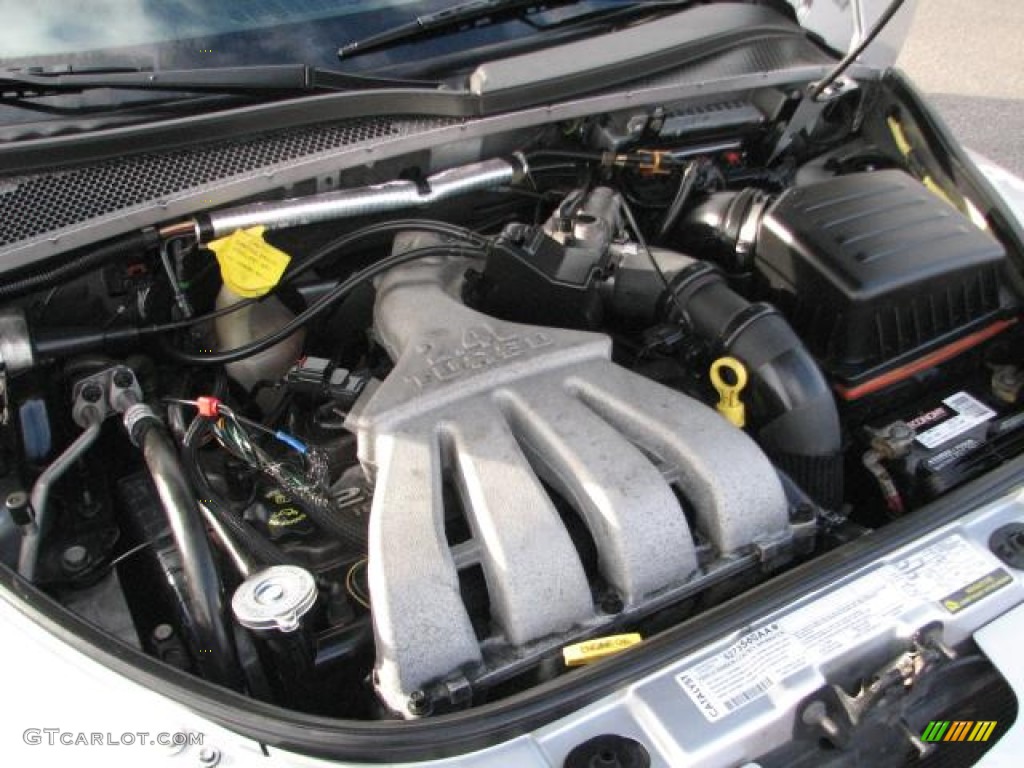
PT Cruiser with aftermarket supercharger:
597large+2002_chrysler_pt_cruiser+engine_view.jpg

PT Cruiser with factory turbocharger:
56886123.jpg

and that's just what you see with the hood open. The turbo plumbing is jammed in there. It's everywhere.
...but at least I can change my Clown Hearse's plugs without removing the intake manifold
lol.gif

Originally Posted By: PhillyJoe
The GM 3800 is rated at 200 hp.
The GM 3800 s/c engine is rated at 260 hp.


Ahhh...you have a Series III
The Series II S/C 3800 made 10 less hp than the Chrysler 300M's Naturally Aspirated 3.5 but produced something like 30 more ft-lbs torque.

Originally Posted By: PhillyJoe

My only experience with a turbo was a 1985 Dodge Lancer ES. The 2.2 liter engine that didn't need a gauge to tell you the turbo was spinning. Tried to avoid hot shutdowns; head gaskets ultimately went. Cute idea but the ES option was only available in '85 and '86 as I recall.

The Lancer was the Dodge version of the LeBaron hatchback. They made a Shelby Lancer in the late '80s.
 
Was never a fan of either in Road vehicles ages ago, as the thermal efficiency of the overall package is lower in general, as compressions need to be lowered, and expansion ratios become way less than compression ratios.

However, having a blown Caprice, I realise that the economy is closer to the V-6, and the power closer to the V-8 with the blower.

Turbodiesel Nissan has great power delivery, and 30% better mileage than the V-6 equivalent...and tows a tonne more.

Originally Posted By: BillyTheKid
One thing to not forget is a supercharger uses power to make power where a turbo does not. A supercharger is spun by the crank, hence using some power to make power. The turbo uses the exhaust flow to spin its wheel to make the power. Both are forced induction systems and do well making the extra power.


The engine still has to do work to force the turbine to spin and turn the compressor, as there's not free lunch when moving power.
 
Originally Posted By: PhillyJoe
My understanding is that the s/c on my '07 Grand Prix GT is vacuum activated and while belt driven, doesn't produce any drag until the clutch kicks in.


Nope, there is no Mad Max clutch.

The "vacuum" bit is a bypass of the supercharger that allows the air at light throttle to either bypass or recirc, so that the supercharger isn't just beating up air and wasting power/making heat.
 
Originally Posted By: Shannow

The engine still has to do work to force the turbine to spin and turn the compressor, as there's not free lunch when moving power.


Agreed, on this comment - but I would think spinning off the crank loses a little more power. Either way, I am a fan of making power. I would take either or if offered to me.
 
Originally Posted By: Spazdog
The Ford GT's supercharger consumes 100 hp at peak.


As for why?
21.gif
maybe packaging.

PT Cruiser with aftermarket supercharger:
597large+2002_chrysler_pt_cruiser+engine_view.jpg

PT Cruiser with factory turbocharger:
56886123.jpg

and that's just what you see with the hood open. The turbo plumbing is jammed in there. It's everywhere.
...but at least I can change my Clown Hearse's plugs without removing the intake manifold
lol.gif

Originally Posted By: PhillyJoe
The GM 3800 is rated at 200 hp.
The GM 3800 s/c engine is rated at 260 hp.


Ahhh...you have a Series III
The Series II S/C 3800 made 10 less hp than the Chrysler 300M's Naturally Aspirated 3.5 but produced something like 30 more ft-lbs torque.

Originally Posted By: PhillyJoe

My only experience with a turbo was a 1985 Dodge Lancer ES. The 2.2 liter engine that didn't need a gauge to tell you the turbo was spinning. Tried to avoid hot shutdowns; head gaskets ultimately went. Cute idea but the ES option was only available in '85 and '86 as I recall.

The Lancer was the Dodge version of the LeBaron hatchback. They made a Shelby Lancer in the late '80s.


Shelby GLH and GLHS, Omni as a Shelby version. I sought that car out and you can usually find ALL of these cars for sale with a google if not Autotrader search.

Remember the Conquest and Starion? Which was Mistubishi which was Dodge?
 
Originally Posted By: Bamaro
Aren't turbochargers generally harder on the oil?


Yeah but so what! Just use Mobil 1 0W-40 or a conventional 20w50 like some do. (Make that 5W-50 if it were me.)
 
Originally Posted By: 45ACP

Remember the Conquest and Starion? Which was Mistubishi which was Dodge?


That I know! I had a Mitsu Starion, the Conquest was the Dodge product. Virtual twins as many cars in the 80's.
 
Mitsubishi had the Starion in Oz and the Cordia.

Oz also got the Diahatsu Charade turbo, and missed out on the Honda City turbo.

Those last two were true pocket rockets.
 
Originally Posted By: BillyTheKid
Agreed, on this comment - but I would think spinning off the crank loses a little more power. Either way, I am a fan of making power. I would take either or if offered to me.


A turbo does have the advantage of using some of the normally-wasted exhaust heat to help power the turbine.
 
Status
Not open for further replies.
Back
Top Bottom