Thicker vs. Thinner and oil temps.

Status
Not open for further replies.
Originally Posted By: mechtech2
According to that graph ^, an engine needs the same low pressure at 4,000 RPM as it does near idle. I don't believe it at all.

So, what is it you believe then?
 
Last edited:
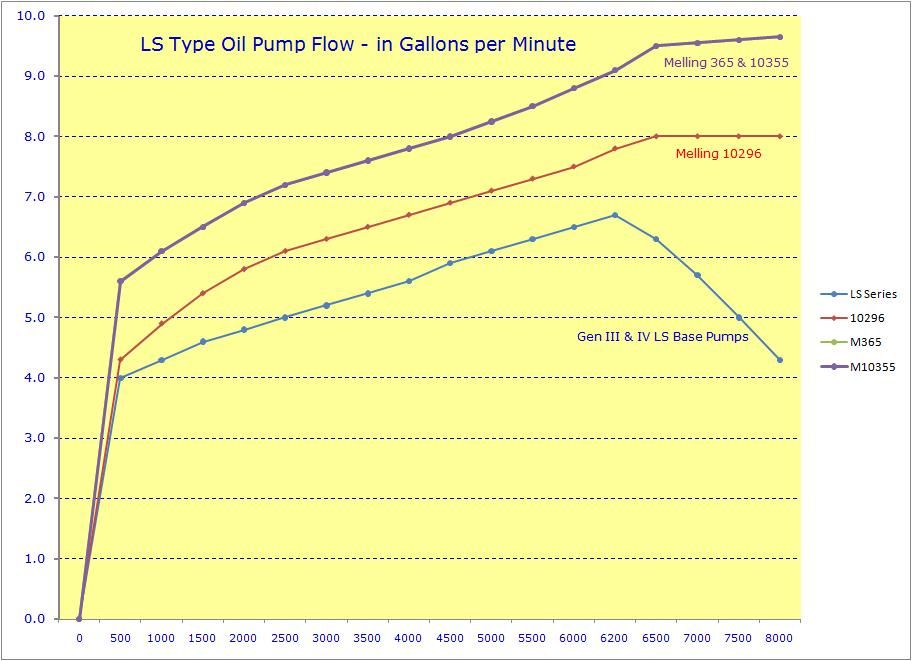
it should look like this
LSOilPumpSpecs-1.jpg


unless oil pump is too small or visc too high, then it looks like the other one. tho this is gpm not psi
 
Originally Posted By: mechtech2
According to that graph ^, an engine needs the same low pressure at 4,000 RPM as it does near idle.
I don't believe it at all.


Likewise.

Plus any discussion of oiling systems must include the many variations in pumps and designs. Not every engine has the same requirements.
 
The two graphs above show the same thing - a linear increase in pressure or flow with RPM until the pressure release valve opens. This phenomenon cannot be rationally disputed, granting minor variation.

As long as the pump is positive displacement and has a pressure relief valve, pump design is not relevant for the shape of the curve on these graphs.

The engine demand will vary, but shape of the curve will be similar. The lubrication points of the engine do need much pressure until a threshold RPM is reached. That phenomenon will remain true without regard to engine design. Individual designs will have different threshold.

However, oil serve other roles beyond lubrication, cooling for example. Designs that use oil spray to cool, may have vary different demands. In general though, the pump will exceed those needs at lower RPM. If it didn't, there would be failures.

I think that marting's comment is related to the degree of over-capacity that is in the design. It may not be intuitive that lubrication needs can be met with low pressure/flow at lower RPM. However, it would be rather silly to argue that the over-capacity does not exist when it is required for safety margin in the design.

 
So European OEMs specifying 5w40s are overheating their engines by use of a thicker engine oil grade due to the increased energy generated by the pumping needs?

Engine longevity before "thin was in" did and still does exist even using the thicker stuff.
 
virginoil wrote: "So European OEMs specifying 5w40s are overheating their engines"

Of course not, if European engines aren't overheating in mass, then this comment is fairly silly.

The higher viscosity oils give a larger margin for adequate lubrication at higher temperatures. That strategy can be useful. However, in exchange for that safety margin, the designer tolerates efficiency loss and useless generation of heat at operating temps under most loads.

Thicker oils are going to have advantages at higher temps and during shock loading. Most of the rest of the time, they have disadvantages. Design is a balancing act with compromises.
 
GMorg -
No, they don't show the same thing.

Graph #1:
Something is way wrong when the graph states that the engine demand remains the same [at only 15 lbs[ until 4,000 RPM.

Graph#2:
Seems OK.
 
I agree that volume is the only thing that matters. For lubrication, you really only need to replace the oil that is lost. Cooling on the other hand, requires more flow. Since flow is directly related to pressure, I conflated the two for simplicity.

The first graph shows that for lower RPMs, very little pressure (and therefore flow for the viscosity used for the graph) is required.

Keep in mind that in early engines the lubrication was provided by a single pass system using gravity flow (and the pumping action of some bearing surfaces). The oil was only used once, but it stayed in the bearing much longer than today.
 
The link below discusses pros and cons of different lubrication strategies and includes a standard equation for calculating recommended flow rates for oil film bearings.

Maybe the confusing part of the first graph is that the lower limit for flow has been set to the minimum output of the pump. In reality the curve would approach zero at low RPM.
 
”I agree that volume is the only thing that matters. For lubrication, you really only need to replace the oil that is lost.”

The only function of pressure is to move oil as needed. It serves no lubrication function by itself.

An increasing number of automotive oil pumps do not follow the “basic” RPM:Flow straight line displacement graph. They actually resemble, more, that graph that nobody thinks is possible. The idea of the advancement is that the oil pump consumes less energy from the engine. It only moves oil as needed to run hydraulic functions and keep bearings full of oil.

aehaas
 
Yes, increasingly the world is switching to variable displacement pumps to meet supply needs.

There ARE hydrostatic lubrication systems, but not many in automobiles.
 
Status
Not open for further replies.
Back
Top Bottom