Roadforce Numbers OK But Possible Bad Lateral Runout?

Thank you! And by "fixed" or "solved" what I really mean is "the vibration forces that I feel through the steering wheel has been reduced to a magnitude that is acceptable for me while driving my car. I enjoy my car now." For folks reading this in the future, its not really an binary "fixed / not fixed" thing .... eventually, rubber wears, bushings wear, stuff gets out of balance, etc.

To quantify this, I took compared accelerometer readings on the front left corner of the dash. At around 70-75mph, the magnitude of T1 - first order tire related vibration - has been reduced to about 1/3 of what they were.

5 - Vibrations Solved - 5.webp
 
Thank you and totally agree re lazy folks in this race-to-the-bottom industry. BTW that Hunter feature is called “Smartweight”. You are right NEVER use it - it is terrible! A sham of massive proportions which has condemned countless unknowing motorists to a lifetime of vibration filled agony while driving on the highway.

See this Audi TSB on wheel balancing that expressly tells its dealers to turn off “Smartweight” (snd use finger plates instead of cup clamps on the wheel face.)

View attachment 316622
thanks for correcting me I remembered it was "smart" something. So it's Smartweight, not that smart. I think it's a joke, if you read the Hunter marketing it is clearly trying to justify a way of saving a shop money by using less wheel weights.

Speaking of automakers, I remember Nissan had a service bulletin for the Z sports car that told the technician to remove ROCKS from the tire tread because that could affect balancing. I thought that was a joke, until I played along and took all the rocks out of my tire tread, it actually added up to TWO ounces! wow! So I don't think automakers are just trying to "cover their butts".

On my Scion (Toyota), Toyota actually says to get any residual imbalance down to under 8 grams! 7 grams IS 0.25 ounces (or 1/4 ounce for the fraction crowd). Why would I want to get just barely under what Toyota deems "acceptable" for balancing. Why not get to the lowest possible imbalance you can acheive?! It's like those techs that align the wheels and don't get it exactly on point but "within specs".. again, lazy. If you do something.. do the best you can, not the "good enough" junk that they want you to accept.

I've been down this road many times and gave up on what the "tire experts" in the tire industry have had to say. I've found if you do the following you'll get a great balance. Turn off the rounding balancing feature, use the correct mounting (mine works ok with the rubber cover, but yours needed the fingers) and unless the tire is defective, you'll acheive a nice balance. Oh and I do agree to make sure the tech uses plenty of mounting lube on the wheel lip and the tire, I have lower profile tires (many do today) and they have a stiff sidewall, if that is not mounted properly of course the balance will be off.
 
Glad you got it figured out. I went for a year with Discout tire trying to make my Pirelli tire vibration go away and they didn’t believe me when I kept telling them it’s the tires. They finally caved and put different tires on. Problem solved.
 
Just a note. My RF machine will measure "pull".

There are two vibration sensors (transducers) for balancing and a 3rd (appears to be small load cell) for measuring lateral load (pull). Earlier 9700's did not have this. You will know if the machine has it or not by the "Straight Trak" sticker on the front.

While not as good as measuring actual lateral runout, on rim mount surface (without tire), suspect it could indicate high, or varying lateral load, if rim is far enough out. Anyway, I spend enough time just messing around with RF, really haven't used Straight Trak much at all.........

20230815_132211.jpg


balancing transducers. (sorry for blurry pic)

20230815_132238.jpg


20230815_132247.jpg

And lateral load cell

20230815_132232.jpg


STRAIGHT%20TRAK.jpg
 
Just a note. My RF machine will measure "pull".

There are two vibration sensors (transducers) for balancing and a 3rd (appears to be small load cell) for measuring lateral load (pull). Earlier 9700's did not have this. You will know if the machine has it or not by the "Straight Trak" sticker on the front.

While not as good as measuring actual lateral runout, on rim mount surface (without tire), suspect it could indicate high, or varying lateral load, if rim is far enough out. Anyway, I spend enough time just messing around with RF, really haven't used Straight Trak much at all.........

20230815_132211.jpg


balancing transducers. (sorry for blurry pic)

20230815_132238.jpg


20230815_132247.jpg

And lateral load cell

20230815_132232.jpg


STRAIGHT%20TRAK.jpg

Oh thats fascinating - thank you. Yeah, lateral force of wheel/tire assembly is not the same as lateral runout of the wheel, but I digress. FWIW, one shop I uses apparently does not have Straight Trak


Screenshot 2025-12-26 at 11.39.16 AM.webp


and the other shop that I use *does* have Straight Trak.

Screenshot 2025-12-26 at 11.35.29 AM.webp
 
Yeah, lateral force of wheel/tire assembly is not the same as lateral runout of the wheel,

Understood, but figured if lateral wheel runout was that bad, might transfer over some, to a varying, lateral loading.
Obviously you still don't know for sure until you remove tire and mic rim (and, it could still be ALL tire related, I realize),
but another data point that might be useful (if/when) .

Anyway, I don't have any "normal" tolerances, on what would be acceptable lateral load/runout on the wheel/tire assembly,
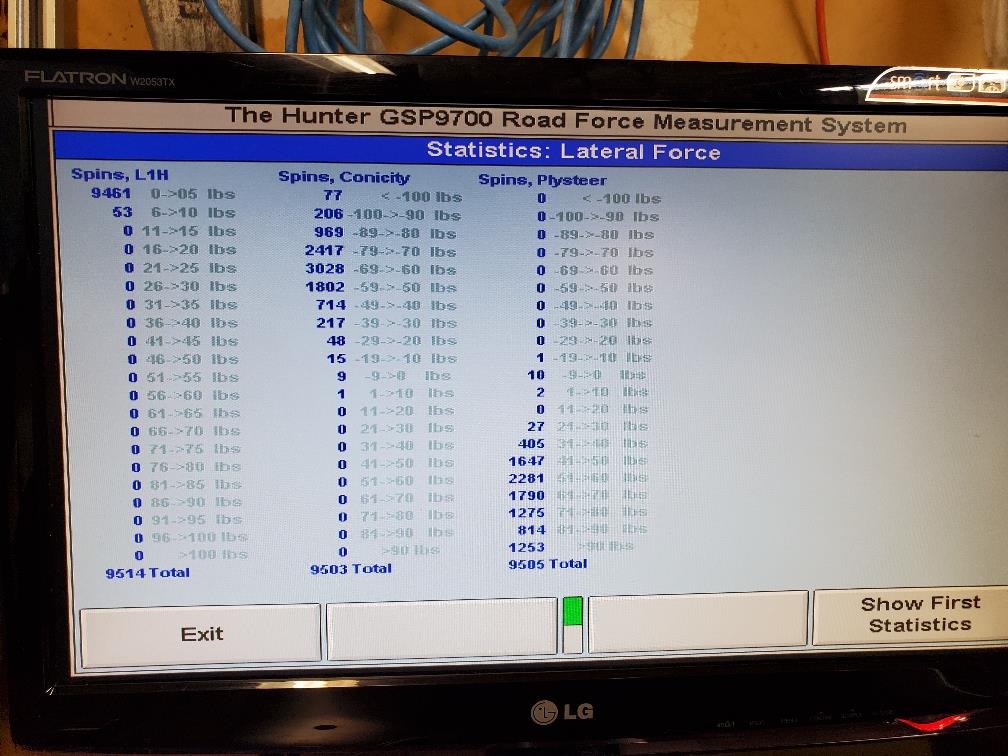
but the machine itself, does keep track of every balance/road force/"mic-ing". Pretty cool stats on conicity and plysteer.
(also makes me wonder if that part of machine has needed to be cal'd since day one, with all the forces in either one
direction or the other).

20230327_113907.jpg


Also, it is interesting that in the users manual for the RF Touch, which uses the lasers to supposedly measure runout on inside of rim,
they have this blurb about possibly having to remove tire for rim runout measurement.

With most of "today's" wheels, I don't personally see how you are measuring down to .020" (Hunter's and my personal limit), on a non machined rim surface. I guess it works many times, as I've seen vids of using the Touch/Elite and reducing RF #'s, without removing tire and mic-ing tire bead, mount surface.

INNER%20VS%20OUTER%20RUNOUT.jpg


This shop is the most professional tire/wheel shop I have used so far --- they insist (properly) on using the lug-centric finger-plate device to secure the wheel to the GSP9700 (not using the rubber press-the-wheel-face-to-the-machine that most shops use).

View attachment 316310

View attachment 316311
Eventually plan to get one of these setups. I typically like to stay with Hunter brand "add-ons', as
you never know on aftermarket stuff there manufacturing tolerance. Would be interested
on any info you can get from your "guy", on exact model, durability, usage (etc...)

But I'm not sure you can use this type setup on say my new F250. It is 100% hub-centric, not
even using conical lug nuts. I guess you can still do a back cone and then use lug centric
tool above to just hold down rim (although at that point, is it really needed/worth it over the normal cup hold down).

New truck vibrated like crazy right off the lot. RF#'s were in 50's and 60's. Ford claimed their limits were 45 rear, 35 front
(and did get the stock tires within those limits). Still vibrated pretty good, so I kept swapping things around
(and even bought two new tires myself). Eventually got numbers down to 8 and 13 front, 23 and 17 rear, '
which I thought was crazy good on an LT type tire.

It was very difficult to get rims like that, with large center hole that you cannot use just a single back-cone on,
mounted concentric. I did end up with the best results by coning from the front, but that is far from ideal
(not a machined surface).

BACK%20CONE%20LARGE%20ID.jpg


I have been meaning to get some quotes on an actual machined mount for just that wheel,
since I don't even plan on buying another truck. Hard to find anyone that will make a
part like that being concentric to a couple thousand and flatness (WMS to balancer
mounting surface) to about the same tolerances. I have two lathes and might try it out of alum,
but not sure i will ever get those tolerances.

 
Understood, but figured if lateral wheel runout was that bad, might transfer over some, to a varying, lateral loading.
Obviously you still don't know for sure until you remove tire and mic rim (and, it could still be ALL tire related, I realize),
but another data point that might be useful (if/when) .

Anyway, I don't have any "normal" tolerances, on what would be acceptable lateral load/runout on the wheel/tire assembly,
but the machine itself, does keep track of every balance/road force/"mic-ing". Pretty cool stats on conicity and plysteer.
(also makes me wonder if that part of machine has needed to be cal'd since day one, with all the forces in either one
direction or the other).

20230327_113907.jpg


Also, it is interesting that in the users manual for the RF Touch, which uses the lasers to supposedly measure runout on inside of rim,
they have this blurb about possibly having to remove tire for rim runout measurement.

With most of "today's" wheels, I don't personally see how you are measuring down to .020" (Hunter's and my personal limit), on a non machined rim surface. I guess it works many times, as I've seen vids of using the Touch/Elite and reducing RF #'s, without removing tire and mic-ing tire bead, mount surface.

INNER%20VS%20OUTER%20RUNOUT.jpg


Eventually plan to get one of these setups. I typically like to stay with Hunter brand "add-ons', as
you never know on aftermarket stuff there manufacturing tolerance. Would be interested
on any info you can get from your "guy", on exact model, durability, usage (etc...)

But I'm not sure you can use this type setup on say my new F250. It is 100% hub-centric, not
even using conical lug nuts. I guess you can still do a back cone and then use lug centric
tool above to just hold down rim (although at that point, is it really needed/worth it over the normal cup hold down).

New truck vibrated like crazy right off the lot. RF#'s were in 50's and 60's. Ford claimed their limits were 45 rear, 35 front
(and did get the stock tires within those limits). Still vibrated pretty good, so I kept swapping things around
(and even bought two new tires myself). Eventually got numbers down to 8 and 13 front, 23 and 17 rear, '
which I thought was crazy good on an LT type tire.

It was very difficult to get rims like that, with large center hole that you cannot use just a single back-cone on,
mounted concentric. I did end up with the best results by coning from the front, but that is far from ideal
(not a machined surface).

BACK%20CONE%20LARGE%20ID.jpg


I have been meaning to get some quotes on an actual machined mount for just that wheel,
since I don't even plan on buying another truck. Hard to find anyone that will make a
part like that being concentric to a couple thousand and flatness (WMS to balancer
mounting surface) to about the same tolerances. I have two lathes and might try it out of alum,
but not sure i will ever get those tolerances.

OX1,

Notice in the photo, the machine display shows L1H. That's the First Harmonic of Lateral Force Variation. That's the one you want. So the machine is measuring it, but you may have to dig to find out where it is displayed.

As far as hub centric. That's what the cones are supposed to do - center the wheel using the hole for the hub. In the discussion above, we've discussed how that might not work, but what I know about these things says that these discussions are minor points compared to the difference between lug-centric and hub-centric.
 
Jlaa,

I looked more closely at that table that I was referring to and it appears to be a list of L1H, Conicity, and Plysteer, divided into ranges.

And the L1H had 9,461 in the 0 to 5# range, 53 in the 5 to 10# range, and none larger than 10#. To my eye, that means that none of the assemblies measured was excessive.

The same can not be said about Conicity. Some of the numbers are HUGE!! (Which makes me think the machine gets different values than what I am used to seeing!)

I also note that the totals aren't the same, and I wonder why.
 
Jlaa,

I looked more closely at that table that I was referring to and it appears to be a list of L1H, Conicity, and Plysteer, divided into ranges.

And the L1H had 9,461 in the 0 to 5# range, 53 in the 5 to 10# range, and none larger than 10#. To my eye, that means that none of the assemblies measured was excessive.

The same can not be said about Conicity. Some of the numbers are HUGE!! (Which makes me think the machine gets different values than what I am used to seeing!)

I also note that the totals aren't the same, and I wonder why.

Yeah that is fascinating. I am not nor was I ever in the automobile tire industry so I ask - what is a good value for tire conicity? I notice from this: https://www.tiretechnologyinternational.com/opinion/prediction-of-ply-steer-and-conicity.html that the auto industry at one time would mount tires via the below approach to cancel out pull ---- but I've never (knock on wood), in the tire-replacement-market, ever had to deal with vehicle pull to one side that wasn't caused by vehicle alignment issues (usually toe).

To be transparent - I have only ever purchased radial tires (never bias ply) and have only ever purchased Michelin, Bridgestone, Continental, and Pirelli tires (and had my fair share of good tires and stinkers from all of those brands).

Anyways - perhaps a good topic to explore on Barry's Tire Tech, as well as conicity concerns (or lack thereof) in the tire-replacement-market. The vast difference between the seemingly strict regimen followed in the OEM market vs the cavalier attitude of technicians in the tire-replacement market is something that I didn't realize existed in such extreme until recently....

1766852526623.webp
 
  • Like
Reactions: OX1
Jlaa,

Your post opened Pandora's box. I could talk for hours. But let me answer your question.

so I ask - what is a good value for tire conicity?

It isn't the value, its the difference between the pair of tires on the front axle. So a huge value paired with another huge value is fine. But a huge value paired with a tiny value wouldn't be (depending on the vehicle.)

But the values shown in that photo are way, way larger than what I'm used to seeing, so I can't give you any guidance as to how much difference is acceptable.

Further, I notice that all the values are negative (except one). Conicity comes in positive and negative - pushing out and pushing in. That makes me think there's a problem with what is being displayed. I also notice that all the plysteer values are positive, (except for 11) and while that makes sense, the actual values don't.

So I don't know what is going on here.

And the rest of what you printed is mostly correct, there's some nuance that's getting lost.

BTW, I do have articles on my website that you could read - uniformity and drifts/pulls.
 
OX1,

Notice in the photo, the machine display shows L1H. That's the First Harmonic of Lateral Force Variation. That's the one you want. So the machine is measuring it, but you may have to dig to find out where it is displayed.

As far as hub centric. That's what the cones are supposed to do - center the wheel using the hole for the hub. In the discussion above, we've discussed how that might not work, but what I know about these things says that these discussions are minor points compared to the difference between lug-centric and hub-centric.

Capri (side note, my first new car was an 86 Capri, 5.0, which I still have :))

I mainly pointed it out, as there was some discussion that these balancers don't measure lateral load/runout.
But if those numbers are right, it's basically zero 99+% of the time. But that does match up with my experience.
Could have a basically square tire, RF/balance-wise, but I don't get really any new tires with a "pull".

Guessing you know this already, but for others, RF machines (maybe other newer balancers) have that centering check "thing" measuring runout vs wheel position, then re-mount with wheel in different position, and it checks it again (comparison).
I use it with a bare rim

CENTER%20CHECK%201.jpg


CENTER%20CHECK%202.jpg


CENTER%20CHECK%203.jpg


I could not get it to "repeat", using the extended ring, spacer, and larger back cone (in pic posted above),
that I had to use to get a back cone on my stock new F250 rims.

I did get it to easily center check on say an extra 14 mustang GT stock 18"
(that I had laying around at the time), so centering check "thingy" is/was working.
 
Further, I notice that all the values are negative (except one). Conicity comes in positive and negative - pushing out and pushing in. That makes me think there's a problem with what is being displayed. I also notice that all the plysteer values are positive, (except for 11) and while that makes sense, the actual values don't.

I noticed that also. There is a procedure for aligning forced roller to be perpendicular to WMS on balancer.
I wonder if it is out. Would have had to be out since new (guessing from data). And possible, since I don't think
many use the Straight Track feature/procedure.

ALIGN%20ROLLER%201.jpg

ALIGN%20ROLLER%202.jpg


ALIGN%20ROLLER%203.jpg
 
Back
Top Bottom