I have never fully understood which is more positive on the long term wear of an automobile. When I read "How to select a motor oil for you car and truck" the author seemed to lead toward filtration at the lower micron levels (around 10). However, I once saw that Bob on the site saying that filtration is second to flow rates. If this true, wouldn't an excellent filter light the Pure One possibly produce greater engine wear than a more moderate filter with better flow rates. By the way, the flow rates that I looked at came from www.oilfilterstudy.com

You are using an out of date browser. It may not display this or other websites correctly.
You should upgrade or use an alternative browser.
You should upgrade or use an alternative browser.
oil filter flow vs filtration
- Thread starter gulledge
- Start date
- Status
- Not open for further replies.
- Joined
- Sep 28, 2002
- Messages
- 39,793
James ..first off..

To give you the short answer ..flow isn't typically (note the qualification) effected by filter density. It may alter its effective life.
For my unconventional ..but mostly undisputed view .. read post #8 This may be of worth to you.

To give you the short answer ..flow isn't typically (note the qualification) effected by filter density. It may alter its effective life.
For my unconventional ..but mostly undisputed view .. read post #8 This may be of worth to you.
Gary,
How many of those welcome signs have you posted? I think you must be the king of welcome signs.
As far as the post topic. One of the key issues is that the oil pump is a positive displacement pump which behaves very differently to flow restriction than your typical centrifugal pump.
How many of those welcome signs have you posted? I think you must be the king of welcome signs.
As far as the post topic. One of the key issues is that the oil pump is a positive displacement pump which behaves very differently to flow restriction than your typical centrifugal pump.
gulledge
Thread starter
Gary, If in most cases flow isn't effected by filter density, then why are the flow rates in the www.oilfilterstudy.com so much lower on a densly packed filter like the pure one? Are you saying that filtration efficiency is the most important, and not to worry about the flow as much?
- Joined
- Sep 28, 2002
- Messages
- 39,793
The flow rates mentioned in the study were subjected to 10psi and (I believe) 20psi of pressure. In this type of test scenario ..the flow is a function of pressure x resistance. If the test would have been conducted with a 1 gpm flow for all filters, you would still see the various resistances ..but it would be more easily perceived the way it functions in your engine.quote:
Gary, If in most cases flow isn't effected by filter density, then why are the flow rates in the www.oilfilterstudy.com so much lower on a densly packed filter like the pure one? Are you saying that filtration efficiency is the most important, and not to worry about the flow as much?
The problem is one of perception. We have the hardest time looking at pressure as a result of something flowing through a resistance.
So what I'm saying is (qualified for observation of tested filters on tested engine applications) that filter density doesn't alter flow except in a very narrow set of circumstances.
HuH? LOL
- Joined
- Sep 28, 2002
- Messages
- 39,793
Do you have an alternative point of view to share with us?
The pressure drop on a new element is 1 PSI or less.
However, flow is always sufficient to lubricate the engine. So why would one worry about flow?
If you want a different thing to chew on, back in the 70's flow was about 2gpm, now engine manufacturers are in the neighborhood of 12-15 gpm for various reasons. And the filters today are more efficient than those in the 70's.
So what you really have is both..more flow and more efficiency.
However, flow is always sufficient to lubricate the engine. So why would one worry about flow?
If you want a different thing to chew on, back in the 70's flow was about 2gpm, now engine manufacturers are in the neighborhood of 12-15 gpm for various reasons. And the filters today are more efficient than those in the 70's.
So what you really have is both..more flow and more efficiency.
yes flow is affected by filters. not only did I changed filters on my filter test I dumped the oil in the filters. Mobil 1 filter, after running for 4k miles I put unside down for a month and still had a full can of oil in the filter. so it proves that it had a restiction in the filter. did the same with a fram and it was empty. so which had more restriction? If it has a restriction what does that do to the flow? is it ness to have oil to the bearings or have an oil clean that does not get to the bearings?
here is a pic of the inside of the oil pump and it shows that the oil verflow is constant. that it doesn't open that is always open, and that any oil that is over pressure will go back into the oil intake stream.
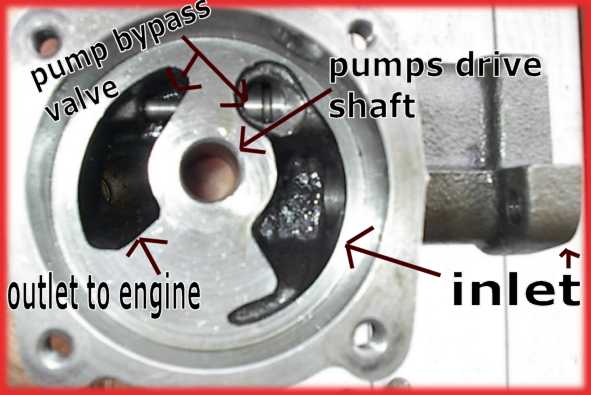
here is a pic of the inside of the oil pump and it shows that the oil verflow is constant. that it doesn't open that is always open, and that any oil that is over pressure will go back into the oil intake stream.
So, Filter Guy, if money is no object, why would I not want the most efficient filter? If fine filtration does in fact reduce engine wear, why would I not want an M1 e.g. as opposed to the bottom line made by Champion? I know many on bitog say that the filter is useless, but it seems to be a bitog theory only from all I have read.

- Joined
- Jan 6, 2005
- Messages
- 10,321
BOBISTHEOILGUY,quote:
Originally posted by BOBISTHEOILGUY:
yes flow is affected by filters. not only did I changed filters on my filter test I dumped the oil in the filters. Mobil 1 filter, after running for 4k miles I put unside down for a month and still had a full can of oil in the filter. so it proves that it had a restiction in the filter....
I'm sorry; I have to disagree with you on this one. The ADBV in the Mobil 1 filter is what kept the filter full of oil. It was not restricted.
I left an Mobil 1-205 filter sitting upside down for a week on my oil drain pan, trying to get the oil out before I cut it open. When I finally cut it open, it was full of oil. There was no blockage or restriction in the filter media; it was simply the ADBV doing it's job.
I think those circumstances are when the oil pump pressure relief valve is open.quote:
So what I'm saying is (qualified for observation of tested filters on tested engine applications) that filter density doesn't alter flow except in a very narrow set of circumstances.
I would use the mobil 1 if I was more interested in the best efficiency.
The Mobil 1 is packed with more media than say a standard filter of other brands. It is a denser media . The saturation of the media and denseness probably keeps the oil from draining out when turned upside down. That would be my guess as i've never tried it.
I would wager if you had an air hose and used it to send air into the filter, the oil would then drain out the center tube. ( less what remains saturated in the media).
Just as the flow of oil into the filter moves the oil remaining in the filter through the media when the filter is on the engine.
The Mobil 1 is packed with more media than say a standard filter of other brands. It is a denser media . The saturation of the media and denseness probably keeps the oil from draining out when turned upside down. That would be my guess as i've never tried it.
I would wager if you had an air hose and used it to send air into the filter, the oil would then drain out the center tube. ( less what remains saturated in the media).
Just as the flow of oil into the filter moves the oil remaining in the filter through the media when the filter is on the engine.
gulledge
Thread starter
The reason I brought up the concept of lower flow rates possibly producing greater engine wear was a scenerio that I had with my 2001 Civic that now has 205,000 miles on it. Some time ago, I noticed a ticking noise on startup (valve noise) until the engine became warm, then the noise went away. Tried everything to fix (had valves adjusted, tried a 0W oil), but nothing worked. Then I called Terry Dyson and asked him what he thought. He suggested trying a less restrictive filter such as an AC Delco. Tried the Mobil 1 filter, because I found it first, and the noise is now gone. What do you think?
gulledge
Thread starter
By the way, the filters I was using before were Denso. I have never seen the flow rates tested on these filters, but I had always heard good things about how well they were constructed. So it it safe to say that you have to have both excellent filtering as well as good flow to have the most efficient filter?
Oh wow, a new twist. "synthetic media vs. standard media" affecting startup lifter noise.
That is more likely the ADBV. I've had success with both M1 (synthetic) and Pure 1 (Standard) helping this. You have almost instant oil pressure as opposed to doing the static see what seeps through test. Fram may be less restrictive but tends to "rattle" is the adbv is important.quote:
Originally posted by Winston:
Oh wow, a new twist. "synthetic media vs. standard media" affecting startup lifter noise.
- Joined
- Jan 6, 2005
- Messages
- 10,321
BOBISTHEOILGUY,quote:
Originally posted by BOBISTHEOILGUY:
sorry wavinwane. the adbv has nothing to do with an upsidedownfilter. think about it. the left over oil is between the outside of the can and the inside filter media. if oil is able to seep out of frams media but not through the Mobil 1 filter what does that tell you about the Mobil 1 filter media, that it is one way or it is blocking the oil from passing by. since it can't be one way, then it is causing a restriction. that is why I no longer use a Mobil 1 filter, as it filters good, but I want oil in my bearings.
that also substanuatings my findings in my oil analsys with the different filters.
http://theoildrop.server101.com/ubb/ultimatebb.php?ubb=get_topic;f=3;t=000211;p=1
there is 5 pages on this topic and each on has different oil anlysis with different things done each time. you'll have to read the whole thing and see what effected what. I even ran the engine with out a filter just to show what the filter does to the oil.
This is going to be a long drawn out post, & I AM NOT trying to be controversial, so please bear with me. It has always been my understanding that the purpose of an oil filter's ADBV was to prevent (at least some) oil inside the filter from draining back into the engine. If that's not it's purpose, what the heck is it there for?
Since I am not an oil filter expert, & since you have done extensive filter testing, I will list all the data available to me & hopefully you & the rest of the BITOGers can help me more clearly understand why so much oil remains inside an Mobil 1-205 filter that has been turned upside down. I DON'T think it is totally due to excessively restrictive filter media.
My vehicle: '00 VW GTI 1.8T
current vehicle mileage: 55k
oils I use: Mobil 1 0w40 & GC
oil filter used: Mobil 1 Mobil 1-205 for the last two OCI's
driving conditions: 95% highway @70 mph - 80 miles round trip per day
I ran Mobil 1 0w40 & an Mobil 1-205 oil filter in this car from 46k to 51k miles, then drained & sent a sample to Blackstone for analysis. The wear levels were far below universal averages for my engine. Keep in mind, this is a VW TURBO. If that doesn't dispell the "Mobil 1 filters starve the engine of oil & lead to excessive wear" myth, I guess nothing will.
I somewhat agree with FilterGuy about why oil doesn't drain as quickly from an Mobil 1 filter, but I have an additional theory. The next time you guys are in an AutoZone, look into the end of an Mobil 1-205 oil filter. To my untrained eye, it looks as if the oil CAN NOT run out of the filter once it is removed from the vehicle. I can't give a detailed explanation; you'll just have to look at an Mobil 1-205 filter to see what I mean.
[ May 27, 2005, 02:55 PM: Message edited by: wavinwayne ]
gulledge
Thread starter
The ADBV on a denso filter is a silicon one. Are these suppose to be better than nitrile ones. Also, I would doubt that the ADBV on every one of the denso filters was defective. So back to my point, wouldn't a more restrictive flow, provided you have a good ADBV, have a possible negative effect?
- Status
- Not open for further replies.
Similar threads
- Replies
- 84
- Views
- 6K
- Replies
- 6
- Views
- 968

- Locked
- Replies
- 134
- Views
- 6K
