Why 5W40 and 0W40 Synthetic ?

Status
Not open for further replies.
Gokhan; Tell us what you ment in reference to your post #3890412; "Too tight bearing could result in mechanical pressure problems".
BTW, I loved your description "overexaggeration". Was that in reference to the 3000 ppm phosphorous in CF engine oils, or something else?
 
Last edited:
Originally Posted By: userfriendly
Gokhan; Tell us what you ment in reference to your post #3890412; "Too tight bearing could result in mechanical pressure problems".
BTW, I loved your description "overexaggeration". Was that in reference to the 3000 ppm phosphorous in CF engine oils, or something else?

Not sure why you are bringing this up here but what I meant by too tight was that if there is not enough freeplay, the bearing can be forced into metal-to-metal contact. Therefore, it needs to be within certain specs.

Again, not sure why you are bringing up the API SF discussion here. I believe I had used that expression in reference to too much Mg that can ruin some lead bearings.
 
Originally Posted By: Gokhan
Originally Posted By: camrydriver111
There is no guarantee 5W40 will have less VIs.

I think Castrol 5W40 has more VI than Mobil 1 0W40.

How can that be? You would end up with a 5W-50 or 5W-60, or the 0W-40 would end up to be a 0w30 or 0W-20. It's simple math. Unless the starting VI of the base oils are drastically different, it's mathematically impossible for one of them to be in the intended SAE grade. On top of that, thicker base oils have a higher VI to begin with. So, you are postulating a mathematical near impossibility, unless Castrol 5W-40 PCMO is made from a rather cheap, low-VI Group III.


I remember comparing the Harman index, and it was much lower for Castrol 5W40. Although Castrol PDS are sometimes problematic. It also has higher NOACK than Mobil 1 0W40. I don't think Castrol has any PAO unlike Mobil 1 0W40.
 
Originally Posted By: camrydriver111
I remember comparing the Harman index, and it was much lower for Castrol 5W40. Although Castrol PDS are sometimes problematic. It also has higher NOACK than Mobil 1 0W40. I don't think Castrol has any PAO unlike Mobil 1 0W40.

It sounds like a cheap Group III oil (not Group III+ or GTL) similar to the cheap Group III Rotella T6 but with an SM-only rather than a CJ-4/SM additive package. It would require somewhat more VII than a quality 5W-40 to make up for the low VI of the base oil.

Regarding estimating the HTHSV drop due to temporary shear of the VII (A_Harman index), Castrol doesn't publish actual HTHSV. Also, I don't know if there is a direct relation between temporary shear and permanent shear. It could depend on the VII type. Here is some info:

https://www.oronite.com/paratone/shearloss.aspx
 
Originally Posted By: Gokhan

You completely misread my post.


No, I read your post correctly. The problem appears to be that you didn't mean what you stated the way you stated it. Some effort put into being more clear would be quite helpful in the future.

Originally Posted By: Gokhan
I only gave it as a counterexample because OP made it sound like it's a general rule. Also, if you look at my signature line, I use 0W-40.


I know you do, which was why I thought that sort of statement coming from you was a bit odd.

Originally Posted By: Gokhan
0W-40 does use a lot of VII.


Using the chart you posted, Mobil's blending guide uses 11.6% VM for 0w-40 vs 8.7% for the 5w-40, and both are PAO based. When compared to a non-PAO based 5w-40, these percentages would of course be different.

Originally Posted By: Gokhan
Yes, 5W-50 and 10W-60 uses even more but hardly anyone uses those grades.


BMW uses 10w-60 quite extensively actually.

Originally Posted By: Gokhan
A lot of VII is not necessarily bad -- you do get higher VI.


Which means that there's simply less change between 40C and 100C. I'm not all that horned-up on VI like some around this place
wink.gif
 
Sounds good.
wink.gif


Group III+ (such as ExxonMobil's Visom) and GTL (exclusively by Shell currently and probably at least in the next decade) are HVI and XHVI base stocks, respectively, which have VI similar to and higher than of PAO (around 140 and higher). Cheap Group III has lower VI though.

Higher VI is a very good thing. Cold engines are always worrisome.
 
Originally Posted By: Gokhan
Let's give the facts so that there will be some actual useful information here. Here is the recommended ingredient list for synthetic oil by ExxonMobil. Formulas will vary a little but the following is rather typical:

exxonmobil_synthetic_PCMO.png


The difference between 0W-40 and 5W-40 is that 0W-40 starts from a much thinner base oil and uses more VII to increase KV100 to the SAE 40 level. That's the only real difference between the two grades.


Using the SPECIFIC example you've provided us with, the 0w-40 is 40% 6cSt PAO, 34.1% 4cSt PAO and 11.6% VI. This oil is significantly thinner based on MRV and HTHS than Mobil 1 0w-40 FWIW. It also has a higher NOACK. This would indicate that it (Mobil 1 0w-40) is blended using heavier bases than the product in this guide. In fact the HTHS on the actual product is the same as the 5w-40 in the chart
wink.gif


And of course this is just a blending guide.

Originally Posted By: Gokhan
The end result? 0W-40 benefits from lower CSS/MRV (thanks to thinner base oil) and higher VI (thanks to more VII content). However, 5W-40 benefits from lower NOACK (thanks to thicker base oil) and less oil shear (thanks to less VII content).


Also, FWIW, the old Pennzoil Platinum 5w-40 Euro had a NOACK higher than Mobil 1 0w-40 @ 11%. Pennzoil Ultra 5w-40 has a much lower NOACK @ 6.8%, and these are both Euro 5w-40's from the same manufacturer, LOL!

Originally Posted By: Gokhan
Regarding Group III vs. PAO, PCMO Group III has greater or equal VI than PAO these days, thanks to HVI Group III (Group III+) and XHVI Group III (GTL). Therefore, amount of VII content with high-quality Group III can be even less than with PAO. HDEO 5W-40 like Rotella tends to use cheaper Group III with lower VI.


It isn't just the VI, it is the amount of Pennzoil PlatinumD's needed for a Group III to meet the CCS/MRV requirements vs a PAO.

I'll borrow this picture Shannow posted before to illustrate this:
brookfield.jpg


Originally Posted By: Gokhan
Last but not least, shear-stable VIIs are common these days, resulting in very little degeneration of the overall VII content over time and therefore very little oil shear

*snip*
I have been using Mobil 1 0W-40 SN recently and my engine has never run smoother. I thought TGMO 0W-20 SN was great but the Group III+/PAO/ester base oil of Mobil 1 along with a higher-quality additive package seems to have resulted in a truly premium oil.


Yes, and the amount of VII's, even in the examples you gave (11.6 vs 8.7%) is hardly what I'd call significant.

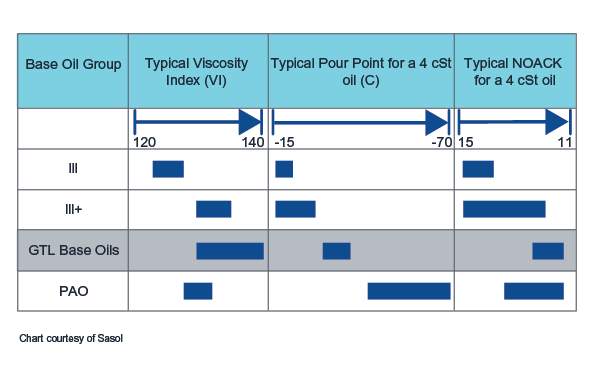
Also, you may find this graph interesting (as it specifically shows GTL):
Base-Table-1.png


From this Infineum presentation:
http://www.infineuminsight.com/insight/sep-2014/uncertainty-ahead-for-base-stocks

Which further demonstrates the above regarding the cold temp performance of PAO being significantly better than anything Group III/III+ regardless of the VI being the same or even lower.

This is why VI doesn't show the whole picture, because it doesn't cover true low temperature performance; it is not a replacement or even much of an indication of CCS/MRV, which is where PAO is significantly better and why a PAO-based 0w-xx can require less treat rate to meet the 0w-xx designation requirements than a Group III or III+ would to meet the 5w-xx one.

smile.gif
 
Thanks for all the input guys.

I was quite surprised when I heard that Castrol EDGE 0W40 had a HTHS of 3.6 while the Mobil 1 0W40 has a HTHS of 3.8. The Castrol EDGE 5W30 A3/B4 here has a HTHS of 3.6 as well.

I used the above examples because both these brands produce a 0W40 and a 5W40. In both cases the 0W40 is MB 229.3 / MB 229.5 while the 5W40 is only MB 229.3 (according to both the bottles and the local spec sheets). It may be different in another region.

I have no problem with Mobil 1 here, it's only around as a 0W40 and is MB 229.3 / 229.5 etc.
I also have no problem with the GTL Shell Helix Ultra here, it's only avaliable as a 5W40 and is both MB 229.3 / 229.5 etc.

One good 40 weight makes sense to me. Two 40 weights, less so.

I wish the 5W40 was made with heavier base stock, lower Noack, less VII, higher HTHS etc. That would make sense. But why are they cheaper and carry only MB229.3 ?

I suspect that the 0W40's are their premium product, with more group 4 base in it. I suspect the 5W40 is closer to a pure group 3 synthetic. A little cheaper to buy, but probably a better profit margin. I recall speaking to a Castrol tech over the phone years ago, he said only the Castrol EDGE 0W40 and Castrol EDGE 10W60 had group 4 base in them, all the rest of the Castrol EDGE line was pure group 3. This was years ago, and they never announce a formula change, and spec sheets are thin on info. So who knows now days.

I think market segment is the other reason. I know a guy with two Euro cars, I believe one requires 0W40 and the other 5W40, so he buys two separate oils rather than find one 40 weight that meets the specs of both cars. Around here there is no practical difference between 0W or 5W for cold starts as it never falls below 0 degC.
 
Originally Posted By: Gokhan
Most people, except those living in Canada etc., would be equally well off with 5W-40 but only Pennzoil seems to make a good one.

I think XOM would disagree with that, and they have plenty of justifiable pride in the lubricant that's in my G37's sump right now. Incidentally, where are all these fantastic products available?

Sorry to break it to you, but Pennzoil doesn't really market any Euro oils. Unless you go to a Pennzoil-Quaker State distributor, a dealer, or an independent European shop that carries the stuff, you won't find it. The only people here who have been able to get it are those getting it sent by the Pennzoil marketing team. That's not an effective way to distribute oil.

I can now get four A3/B4 Castrol varieties at my local automotive supplier. I can get zero A3/B4 Pennzoil varieties, unless I go to a dealer and pay their alarming prices.

I don't give Shell a free ride on this garbage at all. I've been a user of their products for a long time and am a huge fan (that's why they're not getting a pass on this), but them wasting a bunch of effort on marketing for products they have no intention of actually distributing is a complete waste of time. Frankly, unless a Shell product is an SN/GF-5 product (below the phantom PU tier) or an HDEO, it doesn't exist, since it's a phantom product.

Their logistics, particularly in this part of the country, are absolutely appalling.
 
Originally Posted By: OVERKILL
Also, FWIW, the old Pennzoil Platinum 5w-40 Euro had a NOACK higher than Mobil 1 0w-40 @ 11%. Pennzoil Ultra 5w-40 has a much lower NOACK @ 6.8%, and these are both Euro 5w-40's from the same manufacturer, LOL!

Why are you pointing out the obvious? Pennzoil Ultra was a mostly PAO oil and Pennzoil Platinum without PurePlus was mostly a low-grade Group III. Apples to oranges.

Visom base stocks have VI of 136 and 142 (link). Shell XHVI Group III can have VI of 150 and above (PDF link). GTL typically has VI of 140 and above. Modern Group III+ and GTL easily beat most PAOs' VI.

Where PAO really excels is its resistance to oxidation, which is probably the most important quality of a base oil. That's what makes PAO a premium base oil.

You can have a quality 0W-40 even with a Group II+/IV synthetic blend (semisynthetic):

exxonmobil_synthetic_blend_PCMO.png
 
Yep and Castrol Edge 5W30 is
API SL/CF, ACEA A3/B4, BMW LL-01, MB 229.3 / 229.5, VW 502/505

So between the Edge and the SynPower that's 6 good full synthetic A3/B4 oils. Eight if you count they heavy weights Edge 10W60 and SynPower 10W50. They also have C3 and A5/B5, but I'm not counting those.

I'm also only counting the two brands (Castrol and Valvoline) there is also Shell, Mobil, Penrite, etc.

But given they make a 5W30 and a 0W40 that are both MB229.5, why also make a 5W40 that is only MB 229.3 ?
 
Some Euros like Renault, Alfa Romeo and Fiat seem to prefer 5w40. RN700 and RN710 approved oils are 5w40. They can be C3 or A3/B4.

0w40 and 5w40 are both sold because there is a valid business case to do so. For non approved applications it also offers a similar product at a slight price difference.
 
supercity,

Originally Posted By: supercity

0w40 and 5w40 are both sold because there is a valid business case to do so.


Correct. I think people are still thinking that 0W-40 is too thin compared to 5W-40 and therefore the demand is lower (at least in Europe).

On my side I choose to use 5w30 and not 0w30 because I am afraid that when I will be selling the vehicle the potential buyer will ask me: "what is this 0W? I know only 5w30 and 5W-40 and this 0W-something makes me suspicious ..."
 
Originally Posted By: supercity
Some Euros like Renault, Alfa Romeo and Fiat seem to prefer 5w40. RN700 and RN710 approved oils are 5w40.

0w40 and 5w40 are both sold because there is a valid business case to do so.


SuperCity, I think you hit the nail on the head.

My mate has a Renault and he buys 5W40 for it, he also has a Mercedes and he buys a 0W40 for that. If the cars are new and expensive then, most people follow the owners manual, and job done. Yes, it makes good business sense to provide both oils.

I think I see a lot of this with Valvoline and their SynPower range. They have two mid-SAPS, C3, MB 229.51 oils. A 5W40 MST and a 5W30 XL-III. The XL-III also has VW 504/507, while the MST is also Dexos-2 and VW 502/505. They also have a 5W30 DX1 which is Dexos-1 and a 5W30 FE which is A5/B5 and Ford M2C-913-A/B/C. I see the two C3 oils and the two 5W30 (DX1 and FE) oils as being quite similar, but they all have their own customer base.

BTW Gokhan and OverKill, great posts above. Very interesting stuff, thanks.
 
Last edited:
Originally Posted By: supercity
Some Euros like Renault, Alfa Romeo and Fiat seem to prefer 5w40. RN700 and RN710 approved oils are 5w40. They can be C3 or A3/B4.

0w40 and 5w40 are both sold because there is a valid business case to do so. For non approved applications it also offers a similar product at a slight price difference.


Ferrari and Maser too, SHU 5w40 is approved oil, but not the 0w40.
 
Originally Posted By: Gokhan
Originally Posted By: OVERKILL
Also, FWIW, the old Pennzoil Platinum 5w-40 Euro had a NOACK higher than Mobil 1 0w-40 @ 11%. Pennzoil Ultra 5w-40 has a much lower NOACK @ 6.8%, and these are both Euro 5w-40's from the same manufacturer, LOL!

Why are you pointing out the obvious? Pennzoil Ultra was a mostly PAO oil and Pennzoil Platinum without PurePlus was mostly a low-grade Group III. Apples to oranges.

Visom base stocks have VI of 136 and 142 (link). Shell XHVI Group III can have VI of 150 and above (PDF link). GTL typically has VI of 140 and above. Modern Group III+ and GTL easily beat most PAOs' VI.

Where PAO really excels is its resistance to oxidation, which is probably the most important quality of a base oil. That's what makes PAO a premium base oil.

You can have a quality 0W-40 even with a Group II+/IV synthetic blend (semisynthetic):

exxonmobil_synthetic_blend_PCMO.png


Those two oils you put would not be able to meet ACEA A3/B3 or mfg. specifications.
 
Originally Posted By: Quattro Pete
Originally Posted By: chrisri
Valvoline Synpower 5w40 meets 229.5 and 229.3.

Not the one we have here available at retail level.

There is Synpower 0w-40 however, that does meet these specs.


Than you guys get different version, ours have 229.5 spec in 5w40 grade.
 
Status
Not open for further replies.
Back
Top Bottom