Toyota 90915-YZZF2 C&P

Status
Not open for further replies.
Gokhan - BTW, do you see an efficiency "cut-off" on this efficiency vs particle size graph. Note that the x-axis is a logarithmic scale, so it has no bearing on if the curve shows a cut-off knee or not. It won't show a cut-off if there is no cut-off. Goes for a non-logarithmic scale too.

 
Originally Posted By: kschachn
At this point the thread has become comical.

No kidding, it has got really silly to say the least. The other poster is unaware of analogies often made between electrical and mechanical systems, which I simply pointed out here. He somehow thinks I don't know the difference between a capacitor and an oil filter (and I hold several degrees in science and engineering). I give up at this point.
 
Originally Posted By: ZeeOSix
Note that the x-axis is a logarithmic scale, so it has no bearing on if the curve shows a cut-off knee or not. It won't show a cut-off if there is no cut-off. Goes for a non-logarithmic scale too.


The only problem is that the logarithmic scales never end in zero, which is the equivalent of minus infinity in a linear scale.

Apart from that mistake in that plot, the scale only covers a factor of about ten in particle size; so, it really doesn't matter if you plot it linearly or logarithmically.

To me all three curves there have sharp knees. This is really not different than a first-order electronic filter. The formula is 1/(1+x^2) for the first-order electronic filter. You can plot it here (just copy and paste the formula in) and see that it's really not that different in appearance.

https://www.desmos.com/calculator

We are going in circles here and this is really a moot discussion. I think we should agree to end this discussion.
wink.gif
 
Originally Posted By: Gokhan
Originally Posted By: kschachn
At this point the thread has become comical.

No kidding, it has got really silly to say the least. The other poster is unaware of analogies often made between electrical and mechanical systems, which I simply pointed out here. He somehow thinks I don't know the difference between a capacitor and an oil filter (and I hold several degrees in science and engineering). I give up at this point.


Pull the some links proving it. They are not analogous on how they capture particles.
 
Originally Posted By: Gokhan
Originally Posted By: ZeeOSix
Note that the x-axis is a logarithmic scale, so it has no bearing on if the curve shows a cut-off knee or not. It won't show a cut-off if there is no cut-off. Goes for a non-logarithmic scale too.


The only problem is that the logarithmic scales never end in zero, which is the equivalent of minus infinity in a linear scale.

Apart from that mistake in that plot, the scale only covers a factor of about ten in particle size; so, it really doesn't matter if you plot it linearly or logarithmically.

To me all three curves there have sharp knees. This is really not different than a first-order electronic filter. The formula is 1/(1+x^2) for the first-order electronic filter. You can plot it here (just copy and paste the formula in) and see that it's really not that different in appearance.

https://www.desmos.com/calculator

We are going in circles here and this is really a moot discussion. I think we should agree to end this discussion.
wink.gif


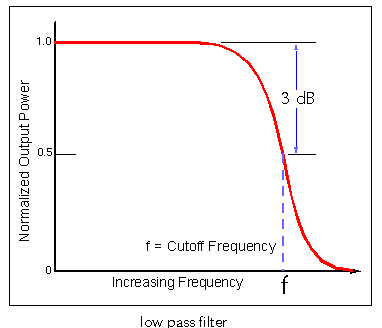
You must be seeing things. Those curves are not even close to the one you posted earlier and claimed oil filters follow the same kind of "cut-off" (shown below).

low_pass_filter%20freq%20response.gif


Originally Posted By: Gokhan
We are going in circles here and this is really a moot discussion. I think we should agree to end this discussion.
wink.gif


Back peddling ...
grin.gif
 
The premise that electronic filter response is analogous to oil filter efficiency vs particle size is false.

Electronic filter response is very consistent and easy to model.

The data presented on the oil filters shows them to be different from one make / model to another.

A model for these filters would be difficult to make and about as predictable as a hurricane making land fall.

The data shows some filters are much better than others with respect to filtration efficiency vs particle size.

The data does not address reliability or prove or disprove that high efficiency filters are better than low efficiency filters.

My uneducated 2 cents.

Regular programming may now resume.
 
I will add that the only type of oil filter that would have a very obvious efficiency "cut-off" would be the metal screen mesh type that have a fixed screen size. But oil filers composed of media with various sized fibers that creates a maze of many different sized pores (shown below) will have an efficiency vs particle size curve that doesn't show a defined efficiency cut-off because it's able to basically catch all sized particles, but of course less efficient as the particle size decreases as the various graphs posted have shown.


Some oil filters will filter down to 5 microns at an efficiency of 80% (ie, Fram Ultra & the old PureOne), so if there is any kind of efficiecny "cut-off" it's pretty much well below the 5 micron area - like in the 1~2 micron range. I'm betting a filter like the Ultra or old PureOne even catches a fair amount of 1~2 micron particles if it's still catching 80% of the 5 micron particles.
 
Originally Posted By: Gokhan
Originally Posted By: kschachn
At this point the thread has become comical.

No kidding, it has got really silly to say the least. The other poster is unaware of analogies often made between electrical and mechanical systems, which I simply pointed out here. He somehow thinks I don't know the difference between a capacitor and an oil filter (and I hold several degrees in science and engineering). I give up at this point.

Good, because you've dug quite a hole so far that you just keep digging deeper.
 
Originally Posted By: kschachn
Good, because you've dug quite a hole so far that you just keep digging deeper.

It's not that. The discussion started revolving around a very moot issue and became a waste of time.
 
Originally Posted By: Gokhan
Originally Posted By: kschachn
Good, because you've dug quite a hole so far that you just keep digging deeper.

It's not that. The discussion started revolving around a very moot issue and became a waste of time.


grin.gif
Well, then don't go down a cockamamie rabbit hole with a statement like:

Originally Posted By: Gokhan
Every filter has a sharp micron-cutoff rating (design spec) beyond it won't work. I meant if a filter isn't made to filter 20-micron particles, there is no point in testing it for that particle size. It could be that Toyota was designed for 25 microns or larger.

Basically all media type oil filters work at 20 microns (and smaller as the graphs have shown) ... some just work better than others based on the efficiency of the media. And that's why the test standard is to pretty much compare their efficiency at 20 microns.
 
Originally Posted By: ZeeOSix
Basically all media type oil filters work at 20 microns (and smaller as the graphs have shown) ... some just work better than others based on the efficiency of the media. And that's why the test standard is to pretty much compare their efficiency at 20 microns.

How about this? To me it looks like it has a really sharp fall starting at 20 microns.

R2C%20Oil%20Filter%20Multipass%20Testing%20Chart1.jpg


If Toyota filter has a similar curve but starts at 30 microns, it would explain its poor efficiency at 20 microns. I never disputed that it's not a good filter for smaller particles. All I was saying was that it could be by design so that it's not efficient at smaller particles, perhaps to increase the filter life. You have then turned it into a big deal.
 
Originally Posted By: Gokhan
Originally Posted By: ZeeOSix
Basically all media type oil filters work at 20 microns (and smaller as the graphs have shown) ... some just work better than others based on the efficiency of the media. And that's why the test standard is to pretty much compare their efficiency at 20 microns.

How about this? To me it looks like it has a really sharp fall starting at 20 microns.

R2C%20Oil%20Filter%20Multipass%20Testing%20Chart1.jpg


If Toyota filter has a similar curve but starts at 30 microns, it would explain its poor efficiency at 20 microns. I never disputed that it's not a good filter for smaller particles. All I was saying was that it could be by design so that it's not efficient at smaller particles, perhaps to increase the filter life. You have then turned it into a big deal.


That efficiency vs particle size curve looks basically like most that have been shown in this thread. Of course it looks like it has a sharp fall starting at 20 microns because that filter is 97% @ 20 microns and the efficiency naturally falls with smaller particles sizes as seen in every plot shown. But there is no huge "cut-off" where the curve falls off a cliff and the filter stops working below a certain micron size like you were claiming oil filters have. That's what got us going down this whole debate path. If media based oil filters have an efficiency "cut-off" it's going to be way down in the mud (1~3 microns range).

Here's another graph showing the typical shape for efficiency plots for media based filters. The curves will of course be somewhat different depending on exactly now the media is designed. Note that none of those filters are very efficient ... the best one being just under 70% @ 20 microns.

 
My 2009 Corolla has 210,625 miles (337,000km) on the odometer and still has no measurable oil consumption using the OEM oil filter. It still operates as it did the day I bought it. I would say the oil filter is performing as designed.

While the engine produces some particulates, the intake air filter is where the contaminants make their way from the external world into the engine.

I'll just stick with Denso OEM for both engine and air filters.
 
Last edited:
Originally Posted By: Smokescreen
My 2009 Corolla has 210,625 miles (337,000km) on the odometer and still has no measurable oil consumption using the OEM oil filter. It still operates as it did the day I bought it. I would say the oil filter is performing as designed.

While the engine produces some particulates, the intake air filter is where the contaminants make their way from the external world into the engine.

I'll just stick with Denso OEM for both engine and air filters.

That's because your car is brand-new. Mine is 32 years old and it still has virtually no oil consumption.
wink.gif
(Although, I replaced the valve-stem oil seals when it was 25 years old.)
 
Status
Not open for further replies.
Back
Top Bottom