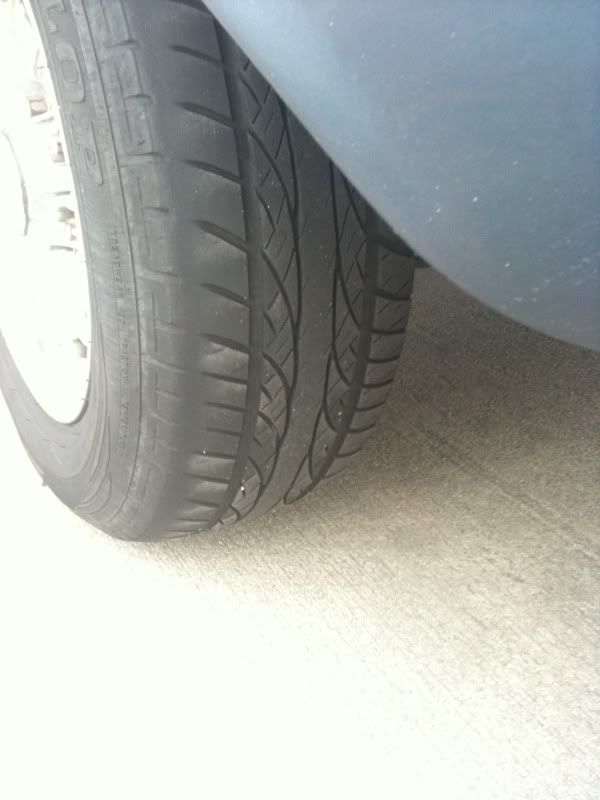
Tire feathering?

Status
Not open for further replies.
Joined
Nov 9, 2008
Messages
26,729
Location
NH
Why?

I missed a rotation, darn it. Now I have tire feathering. I'm not too far off from a tire rotation, so I'll at least try the tires up front, unless if the road noise is too bad (I had a previous set feather, and had to undo a rotation due to the noise). I think the tires will make it to the 50k mark (Nokian enTyre), but I'm curious, why did it feather?

I rotated these enTyre's at these milage points:
6,849
4,148
6,817
11,502
4,423

Right now I'm at 3,400 miles on this rotation, the rear tires are feathered, and as you can see, they were on the back for 11,502 miles prior. 37,139miles on the set; can't find my tire gauge so I'm not sure what tread is left. Tires are always rotated front to back, no criss-cross, as per manual.

I had it aligned 30kmiles/13months ago, due to a clutch job; but the rear suspension is pretty unadjustable I think, on the solid axle. The rear shocks are kinda old, 149kmiles/64months, but the front struts were replaced just last year. Car is 9.5 years old, with 282,400 miles on the clock.

For reference, the Nokian i3's I had prior were rotated at:
8,109
8,543
4,974
15,107
55 (stupid loud)
8,090
replaced tires after 44,878miles. I didn't write down (stupid me!) what tread it had left, but I'm pretty sure it wasn't much--and I was glad anyhow, as the i3's were scary even when new.
 
Originally Posted By: supton
I'm curious, why did it feather?


It's a symptom of an alignment condition. I've found that too much toe in tends to feather the outer edge of the tire and too much toe out tends to feather the inner edge of the tire. in other words, if one edge of the tire "leads" the other, that leading edge will become feathered over time. This heel-and-toe feathering is what cross rotations keep a handle on.
 
You know, there was one time, or maybe it was twice, that I bought tires at a discount place. They used only three jacks to lift the car. At the time I did not care for it--but I figured, they know what they are doing. That was long long ago, though. But I've always wondered about that. On a solid axle truck, lifting under the pumpkin shouldn't be a problem; but I'm not so sure about the solid axle on my Jetta. I recall seeing one or two alignment reports where it seemed like the rear numbers weren't stellar, but since they couldn't adjust it... Will have to dig that out.

I'll look at lunchtime, but I think it's just the outer edge of the tire that has feathering. When I noticed I didn't think to check the inside edge.
 
Agree it's an alignment issue. And Capri can weigh in but just because there isn't a vehicle adjustment doesn't mean it can't be adjusted with an aftermarket kit to correct specs.
 
Originally Posted By: supton
I'll look at lunchtime, but I think it's just the outer edge of the tire that has feathering.


I would expect that. Most cars are set up with some toe in for straight-line stability. Depending on the amount of toe, combined with other variables and geometries, some cars will constantly feather the outside edges. Our Chrysler minivan was one such animal. It had positive camber (tires leaned out) and toe in...it was REALLY prone to outer edge feathering. I had to replace the outer tie rod ends on it, and that's when I started playing with toe myself. I found that with too much toe out, the inner edges would feather; with too much toe in, the outer edges would feather. I found the balance I liked so that the feathering was minimized, yet it still had enough toe in to keep it from wandering. It took a lot of time for that process to unfold (especially waiting for the tires to start wearing how they were going to), but what can I say? I'm cheap and I like to learn.
 
I might not have been clear enough--it's the rear tires that feather, not the fronts. I'm not sure there is anything to adjust on a solid rear axle VW Mk4 chassis...?
 
There's probably nothing adjustable from the factory, but if it's out of whack, there are likely parts that can be changed to an adjustable version (or one with a specific correction built in) to get it back to spec.
 
When you said non adjustable my first thought was the rears. Like I said, even if there's no vehicle adjustment, I'm confident a kit is available if it is the alignment of the rear.

Worst feathering I had was the rear of a Plymouth Voyager.
 
For the final word on a shim kit for your application I'd like Capri to weigh in. I'd trust his judgement much more than the poster on that thread. Just me.

I've seen him post here more than once on using those kits to fix non vehicle adjustable parts. I had a shim installed on an 89 Geo Prizm rear, fixed the alignment and never had another issue.
 
Originally Posted By: supton
I might not have been clear enough--it's the rear tires that feather, not the fronts. I'm not sure there is anything to adjust on a solid rear axle VW Mk4 chassis...?


Same concept, front or rear. I'd say that it's likely that your rear wheels are toed in too much. You may even be able to see this visually. Rear toe is commonly used to add high speed straight-line stability. Neutral toe or toe out in the rear allows for more rear end rotation during a hard maneuver. Great if you're looking for it, bad if you're not expecting it.

I've done extensive "tuning" on our Honda to get the rear toe just where I want it. It's very easy to adjust it (I just back it up on ramps) and adjust with a straight edge. I hold it halfway up the tire, against the tire, and mostly horizontal to the ground; I look down the straight edge like the barrel of a shotgun. I "aim" it at a visual cue on the front of the car...usually at the rear of the front fender area where the front door hits the front fender. I set both sides the same, relative to the car, and adjust in equal measurements.

As I've said in prior threads, I have no idea what any of my alignment numbers are. I align to chassis feel first, then monitor for tire wear and make adjustments as I feel appropriate.

A non-adjustable suspension is best left to the pros, since you really can't adjust in small increments as you go. Shim kits are relatively easy, but you generally have to remove the rear hub to do it, so it's not really a trial-and-error kind of thing. They usually measure the rear alignment, get the baseline numbers, then clock the shim as appropriate to get the result they're looking for. Not really something you can do yourself...not easily anyway.
 
^ I set up the front alignment on the Jeep about the same way. Got some offset ball joints for extra camber, popped them in and then set up toe and caster until it felt good (and it just so happens that it wears the tires much more evenly than the stock alignment).
 
Have a pic?? Does it look like this:

82a2079e.jpg


I got this I think from a bad LCA bushing.
 
Originally Posted By: supton
Why?

I missed a rotation, darn it. Now I have tire feathering. I'm not too far off from a tire rotation, so I'll at least try the tires up front, unless if the road noise is too bad (I had a previous set feather, and had to undo a rotation due to the noise). I think the tires will make it to the 50k mark (Nokian enTyre), but I'm curious, why did it feather?

I rotated these enTyre's at these milage points:
6,849
4,148
6,817
11,502
4,423

Right now I'm at 3,400 miles on this rotation, the rear tires are feathered, and as you can see, they were on the back for 11,502 miles prior. 37,139miles on the set; can't find my tire gauge so I'm not sure what tread is left. Tires are always rotated front to back, no criss-cross, as per manual.

I had it aligned 30kmiles/13months ago, due to a clutch job; but the rear suspension is pretty unadjustable I think, on the solid axle. The rear shocks are kinda old, 149kmiles/64months, but the front struts were replaced just last year. Car is 9.5 years old, with 282,400 miles on the clock.

For reference, the Nokian i3's I had prior were rotated at:
8,109
8,543
4,974
15,107
55 (stupid loud)
8,090
replaced tires after 44,878miles. I didn't write down (stupid me!) what tread it had left, but I'm pretty sure it wasn't much--and I was glad anyhow, as the i3's were scary even when new.


Your car alignment or suspension geometry has something up. You mentioned prior post WR G2's were loud at 30k miles which my wife managed 55k out of set and they were still quiet. She rotated them every 7k-8k miles and her Subaru Legacy alignment first checked at 95k and recently at 140k still in spec.
 
Got a chance to look and take a photo.

My apologies: it's feathered on both inner and outer edges. Worse on outer I'd say.

main.php


zoom:
main.php


Oh: that is pictures of the passenger side.
 
Last edited:
Yeah, this car has always eaten tires. 40k and tires are usually done for. The i3's I see went the longest, at 45k. I had a set of Hakka 2's, and then a set of Nordman 2's, and they both did the same thing: flat spot on the tread. Not across the whole tread, just one spot. But only on the snows, never on all seasons. And on only one tire out of the set, not two; I rotated the snows also.

Great, now I'm going to think about trading out of this car (again).
 
Wifey found the last alignment printoff, and sent me a pic of it. I think it's of the post-alignment.

LF: -0.6 camber, 7.4 caster, -0.01 toe
RF: -0.1 camber, 7.5 caster, -0.01 toe
total toe front, -0.02
steer ahead (?) 0.00degree

LR: -1.6 camber, 0.22 toe
RR: -1.7 camber, 0.25 toe
total toe 0.47 (hmm, this one measurement was in red)
thrust angle -0.01

So, I do have a toe issue. How do you get a toe issue on a solid axle? Seems like it'd get a camber(?) issue from bending...?

Edit: Duh, just because the numbers were green... Camber and toe issues. Bent axle. Probably from the morons who put the jack in the center of the axle that one (two?) times.
 
Last edited:
The rear camber wouldn't worry me much, although the toe would. It might be able to be shimmed back to spec, or the axle could probably be pulled out and bent a little to fix it.
 
Status
Not open for further replies.
Back
Top Bottom