Thick oil, thin oil piston wear

Status
Not open for further replies.
Originally Posted By: Iketh
Originally Posted By: turtlevette
Originally Posted By: Shannow
Thicker oil provides greater separation between the piston, rings and liner...period...and reduces the length of the swept area that is undergoing boundary/mixed lubrication.


I really don't think that's true. With the thicker oils the ring tends to push the oil instead of riding on the oil. Or else how do you explain as the oil is more viscous you have less consumption? Thick oil does not creep and flow into very small crevices. Who uses heavy motor oil as a penetrate? Nobody because it doesn't work. You have to thin it down with acetone. What does a splash pattern of thick oil look like vs thin oil. The thin oil goes everywhere. The side clearance of these newer engines are specified with a 20wt in mind. What happens when you have a thicker oil. You have less oil discharge from the journal. Less oil on the piston.

I postulate that thinner oil can flow under the ring better than thick oil providing better hydrodynamic mode protection. Totally opposite to what you are saying.

So we are at odds again? But you are the man because you can out link me. I'm still wanting to read some of your original material. If you are as accomplished as you say where are your papers and tech articles?


Yes, oil burning (not via valve seals) is a good sign your rings aren't wearing against the cylinder walls LOL... this is for sure.

On a serious note, thinner oil protects rings better but only because there is no high lateral load on rings (rings pushing against the cylinder walls because of combustion).

However, ring protection is rarely an issue.

Thicker oil will better protect the pistons
against the cylinder walls. If the pistons deform the cylinder walls, your rings will no longer matter.

Furthermore, and most important, the real issue is ring overheating which causes them to lose their springiness.[/B] Rings overheat because of a combination of too much contact with the cylinder wall and high-load high RPMs. Too thin of oil will turn to water under said high-load high RPMs causing the friction and overheating. (It can happen without friction against walls but that's a moot point for this discussion.)


However, ring protection is rarely an issue. like I posted before.

Thicker oil will better protect the pistons against the cylinder walls. If the pistons deform the cylinder walls, your rings will no longer matter. Agree, as long as it is not overdone and creating needless drag, I think shannow mention that also.

Furthermore, and most important, the real issue is ring overheating which causes them to lose their springiness. And to think that low tension rings are all the rave now among manufacturers, while we try to avoid that, again horses for courses.
 
Originally Posted By: Brent_G
Originally Posted By: turtlevette
Originally Posted By: mene
the engine was noisy, vibrating more and wear rate increased more than 50% noted by the same pressure gauge, as soon as I went up to 40 weight (still lower than 50 may I add) oil the engine quieted down, vibrations were gone and rate of wear went back to where it was before. So, give me a logical explanation of "why" this happened,


You're not making much sense buddy. How are you determining wear rate? A single UOI cannot even determine wear rate. There is nothing that I know of other than an engine tear down to determine wear rate.

Originally Posted By: mene
By the way your claims and opinions are just that and have the same validity as anybody else's not more, perhaps in your own mind they do but not anywhere else.
Really. The same validity? Some of us have the technical background and experience tinkering with hotrods that probably gives us a tiny edge over a guy changing oil in his minivan. But of course this is just my opinion.


Then you should understand there isn't a one size fits all for oil. These "outdated" oils have a place in current engines and especially hotrods, so using blanket statements is a bit ridiculous IMO.

I have ran a few changes of Amsoil Dominator 5w20 in a 440 Mopar with good results - Average of a year per fill (about 1500 miles and 25-30 1/4 mile passes). Had the heads off for some work and walls look perfect. On the flip side of the coin the 528 Hemi will never see an oil thinner than a 50 besides the current fill due to fuel dilution. Different apps require different things.

Everybody has their own opinions and that is great, but getting offended when someone else doesn't see things as you do just results in tempers flaring on both side. There are many knowledgeable folks on this forum and tons of good information to absorb. We are all here to learn
11.gif


Where are your RB's sitting in? I'm not surprised, the way I see it is the wedge for street and the hemi for track.
 
Originally Posted By: Iketh
Originally Posted By: Shannow
Originally Posted By: mene
I have read the oil university, read a lot of threads regarding lower oil viscosity and understand everything and kind of agree with all the points and yet our van got to 475K. with a diet of Mobil 1 5W50 for 300K and the last 20K on 30 and the engine didn't like it, the unibody rusted out to the point of cracking but the engine ran perfectly I looked for a replacement body anywhere I could couldn't find one in decent shape; my point is even agreeing with the theory the facts don't support it at least in my personal experience and yes I have used thick oil all my life until this small test, I might try again but with a grain of salt.


Thicker oil provides greater separation between the piston, rings and liner...period...and reduces the length of the swept area that is undergoing boundary/mixed lubrication.

However, given that maximum piston speed is mid stroke, there can be excessive drag mid stroke...which wastes energy, but can't be any more "protective" than having a thinner oil at that point in the stroke.


NO, at mid stroke during combustion, the piston is being pushed against one half of the cylinder wall the hardest (mid stroke is when the rod is at its greatest angle.) A large portion of the power at the crankshaft is credited to the cylinder wall forcing the piston to move in a straight line. A thicker oil will protect better as long as the thickness does not prevent the oil from coating the entire surface.

Edit: I should also say thicker protects better as long as oil temp and engine load would cause the thinner oil to give way allowing metal-to-metal contact, i.e. thicker oil is NOT going to protect better than a thinner-prescribed oil at normal throttle and oil temp levels.


Agreed!, but some people can't wrap their heads around that!
 
Originally Posted By: turtlevette
Originally Posted By: Shannow
Only if it's factual (both the quals and the argument) and supportable by science and logic...which is demonstrable by the person making the statement.

Egos and supposition hold less sway...in my opinion


How are we going to know who is right until someone does studies to prove if thicker or thinner is better? Even then there will be arguments.

Ford seems rather adamant that thinner oils are the way to go. And there are millions of cars running 5W-20 with great results.

I think you should write a white paper on the subject...


And yet when it really matters, when the engine might blow up before the warranty expires they go with 5W50
 
Originally Posted By: mene
Originally Posted By: Brent_G
Originally Posted By: turtlevette
Originally Posted By: mene
the engine was noisy, vibrating more and wear rate increased more than 50% noted by the same pressure gauge, as soon as I went up to 40 weight (still lower than 50 may I add) oil the engine quieted down, vibrations were gone and rate of wear went back to where it was before. So, give me a logical explanation of "why" this happened,


You're not making much sense buddy. How are you determining wear rate? A single UOI cannot even determine wear rate. There is nothing that I know of other than an engine tear down to determine wear rate.

Originally Posted By: mene
By the way your claims and opinions are just that and have the same validity as anybody else's not more, perhaps in your own mind they do but not anywhere else.
Really. The same validity? Some of us have the technical background and experience tinkering with hotrods that probably gives us a tiny edge over a guy changing oil in his minivan. But of course this is just my opinion.


Then you should understand there isn't a one size fits all for oil. These "outdated" oils have a place in current engines and especially hotrods, so using blanket statements is a bit ridiculous IMO.

I have ran a few changes of Amsoil Dominator 5w20 in a 440 Mopar with good results - Average of a year per fill (about 1500 miles and 25-30 1/4 mile passes). Had the heads off for some work and walls look perfect. On the flip side of the coin the 528 Hemi will never see an oil thinner than a 50 besides the current fill due to fuel dilution. Different apps require different things.

Everybody has their own opinions and that is great, but getting offended when someone else doesn't see things as you do just results in tempers flaring on both side. There are many knowledgeable folks on this forum and tons of good information to absorb. We are all here to learn
11.gif


Where are your RB's sitting in? I'm not surprised, the way I see it is the wedge for street and the hemi for track.


The one that saw 5w20 was in a 1971 Superbee. Mainly a Walmart and DD in the summer when the weather permits but gets out to the track 3-5 times a year. Runs mid 10s on the bottle and 3800# street trim.
 
Last edited:
Cool, I thought you might have it in an A body, so the 20 weight is holding fine in it, good to know, at least is not a C body not that they are not cool too but in the too fat side of the camp.
 
Sent you a pm on the a body part.


With the heads off it looked perfect with the cross hatch and perfect compression across all 8. It's all about the usage and what engine imo. The Hemi turns the oil into ethanol within a few hours and with the power it has I don't feel comfortable with anything less than 50.
 
Last edited:
Originally Posted By: r2800
There are several articles on this website, and there are a multitude of posts saying the same thing, that lighter multigrade oils (0w20 0w30 etc) are better for car engines. These oils advertise efficiency as a selling point. I'm guessing they say the lower fluid friction will lower the internal resistance of the engine.

Even though the 0w20 oil has excellent starting viscosity My worry is that there could be a cooresponding increase in piston wear.

Each of us has our own opinions, and mine is that as far as piston wear, higher viscosity oils will do much better at the keeping the surfaces of the piston/rings and cylinder separated than low viscosity oil.

Comments, counterpoints?

Fuel-economy benefit of thinner oil is not due to less fluid friction -- it's due to less viscous drag in the bearings, which are hydrodynamically lubricated. Thinner oil has more surface friction than thicker oil in traction conditions (metal-to-metal contact), such as in the valvetrain.

While thicker oil usually has a thicker (stronger) oil film, thinner oil has an easier time getting into the upper piston rings, as it flows better. So, thinner oil could actually provide better lubrication than thicker oil in the upper piston rings. With thicker oil, it's possible to have a loss of lubrication in the upper rings because the oil may not fully reach the area in certain conditions and hence you can lose lubrication.

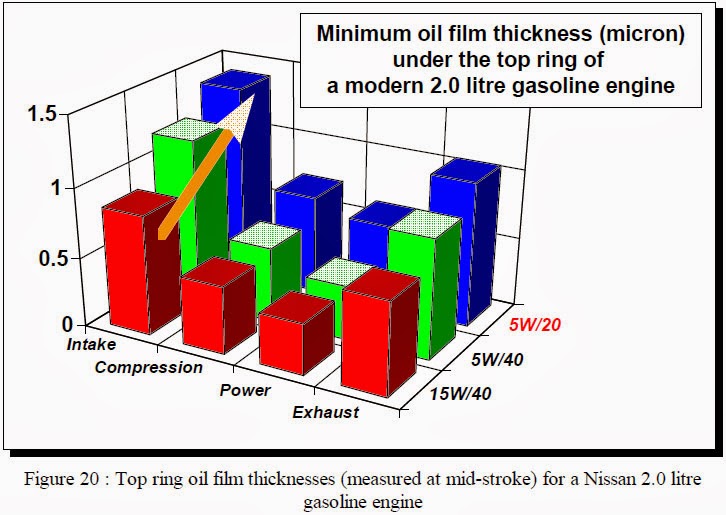
As you see in this figure, 5W-20 provides a thicker oil film than 5W-40, and 15w40 provides the thinnest oil film, as far as the top piston ring is concerned. In other words, thin oil lubricates the top ring best:

thin_oil_piston_ring.jpg


Read the full Shell review article here (PDF link).
 
Originally Posted By: Gokhan

Fuel-economy benefit of thinner oil is not due to less fluid friction -- it's due to less viscous drag in the bearings


I'm just a bit confused. Maybe you can help to explain the difference between 'fluid friction' and 'viscous drag'.
 
Originally Posted By: Gokhan

As you see in this figure, 5W-20 provides a thicker oil film than 5W-40, and 15w40 provides the thinnest oil film, as far as the top piston ring is concerned. In other words, thin oil lubricates the top ring best:

thin_oil_piston_ring.jpg


Read the full Shell review article here (PDF link).


If it is about wear protection, then why does the .pdf begin with CO2 emissions?
wink.gif


Quote:

So, thinner oil could actually provide better lubrication than thicker oil in the upper piston rings. With thicker oil, it's possible to have a loss of lubrication in the upper rings because the oil may not fully reach the area in certain conditions and hence you can lose lubrication.


That is quite the interpretation. It may lubricate better.

Quote:
In order to qualify a lubricant as a “fuel economy” oil, both the American Petroleum
Institute (API) and ACEA have developed engine tests that measure the fuel consumption
of candidate oils relative to reference oils, and the Effective Fuel Economy Increase (EFEI)
of the candidate oils has to be better than that of the reference oil by some pre-defined limit
in order to claim the oil is fuel efficient.


but wear protection doesn't seem to be the issue here.

Also, a measured deposited film thickness between the grades is one thing, but do all the grades tested perform equally for a given film thickness?
confused.gif


Another interpretation could be that the 5w20 is likely to slip more volume past the rings (be less controlled), enter the combustion chamber leading to consumption and emissions and coke around the ring pack.
wink.gif
Oil control rings are there to control a certain amount of oil deposited on the cylinder wall, too much is also a bad thing.
 
The linked PDF shows that the hydrodynamics of the piston assembly is at least similar (or more), than the bearing friction...stillit's hydrodynamics, and changes with HTHS, thus the drive for lower HTHS...for economy reasons.

Piston film thickness is still increased with thicker oils, diesel engine manufacturers trying to thin the film mid stroke, to reduce un-needed viscus drag (once it's separated, it doesn't need any more), while keeping the ends of the stroke adequately lubricated.

https://bobistheoilguy.com/forums/ubbthreads.php/topics/3256421/MIT_future_lubrication_directi

http://www.iaeng.org/publication/WCE2009/WCE2009_pp1452-1457.pdf

Ghokan's PDF suggesting that the thicker film for the rings is end gap leakage makes sense, as they do display higher oil consumption, and have a higher "refresh" rate, given that piston wall lubricant replacement is less than around 5% per cycle typically...

Table 2 showing way lower valvetrain friction for the 20W-50 was very interesting.
 
Also, don't want to forget to thank you Gokhan for posting that .pdf

There are some great insights regarding average opertating-cycles between the different markets, as well as FE or durability biased concerns.
thumbsup2.gif
 
Originally Posted By: Shannow

Piston film thickness is still increased with thicker oils, diesel engine manufacturers trying to thin the film mid stroke, to reduce un-needed viscus drag (once it's separated, it doesn't need any more), while keeping the ends of the stroke adequately lubricated.

https://bobistheoilguy.com/forums/ubbthreads.php/topics/3256421/MIT_future_lubrication_directi

http://www.iaeng.org/publication/WCE2009/WCE2009_pp1452-1457.pdf

Ghokan's PDF suggesting that the thicker film for the rings is end gap leakage makes sense, as they do display higher oil consumption, and have a higher "refresh" rate, given that piston wall lubricant replacement is less than around 5% per cycle typically...

Table 2 showing way lower valvetrain friction for the 20W-50 was very interesting.


Seen you mention this a couple of times, and am FINALLY loading it up for review. Interesting indeed, Thanks man
thumbsup2.gif
 
Originally Posted By: jrustles
Also, don't want to forget to thank you Gokhan for posting that .pdf

There are some great insights regarding average opertating-cycles between the different markets, as well as FE or durability biased concerns.
thumbsup2.gif


Yep, too true, I was looking for that PDF the other day for this thread...
 
Originally Posted By: jrustles
Originally Posted By: Gokhan
Fuel-economy benefit of thinner oil is not due to less fluid friction -- it's due to less viscous drag in the bearings

I'm just a bit confused. Maybe you can help to explain the difference between 'fluid friction' and 'viscous drag'.

I was referring to traction friction (surface friction) vs. viscous drag. The former happens in boundary lubrication (metal-to-metal contact) and the latter happens in hydrodynamic lubrication. The latter is also some type of internal fluid friction. Thinner oil results in more energy loss and more (traction) friction in boundary lubrication (valvetrain) but less energy loss and less (internal fluid) friction in hydrodynamic lubrication (bearings).

Rings work in both boundary and hydrodynamic lubrication and also in mixed lubrication. Therefore, thicker oil may help for rings as well.

The point of the review article I posted is that, for the top ring, thinner oil could actually provide better lubrication because it flows better and reaches this hard-to-reach area more easily.

For what it's worth, Blackstone also says that thicker oil could increase upper-end wear, upper end referring to rings and cylinders in addition to valvetrain:

http://www.blackstone-labs.com/oil-viscosity.php
 
Originally Posted By: Gokhan
For what it's worth, Blackstone also says that thicker oil could increase upper-end wear, upper end referring to rings and cylinders in addition to valvetrain:

http://www.blackstone-labs.com/oil-viscosity.php


These thick oil guys here at BITOG are much more interested in trying to prop up old outdated beliefs rather than get to the truth. It's an ego thing and I'm convinced they will take it to their grave. They conveniently ignore data that doesn't support their belief. They even try and twist the data to support their arguments. They ignore the fact that all the manufacturers have already done testing and been through all this discussion. And they are the true experts not stupid silly EE's like me, washed up turbine inspectors, and mini van oil changers.
 
Originally Posted By: jrustles
Another interpretation could be that the 5w20 is likely to slip more volume past the rings (be less controlled), enter the combustion chamber leading to consumption and emissions and coke around the ring pack.
wink.gif
Oil control rings are there to control a certain amount of oil deposited on the cylinder wall, too much is also a bad thing.


That's absolutely not what you and Shannow have been saying. You've been saying the thicker oil provides a thicker film for the ring to ride on. And that's a good thing because you are in hydrodynamic mode for more of the stroke.

Now that you've been proved wrong, it's all of a sudden a bad thing?

Why can't you guys be intellectually honest?
 
Originally Posted By: turtlevette
Originally Posted By: Gokhan
For what it's worth, Blackstone also says that thicker oil could increase upper-end wear, upper end referring to rings and cylinders in addition to valvetrain:

http://www.blackstone-labs.com/oil-viscosity.php


These thick oil guys here at BITOG are much more interested in trying to prop up old outdated beliefs rather than get to the truth. It's an ego thing and I'm convinced they will take it to their grave. They conveniently ignore data that doesn't support their belief. They even try and twist the data to support their arguments. They ignore the fact that all the manufacturers have already done testing and been through all this discussion. And they are the true experts not stupid silly EE's like me, washed up turbine inspectors, and mini van oil changers.


Nobody here is saying that running 0w20 in a car speced for it is going to cause complete failure, but there are many apps that it is not the best choice.

Instead of engaging in a mature debate and keeping an open mind you instantly scream wrong and resort to personal insults. There is a wealth of knowledge on this board if you try to learn and wade through the general blabber.

Since you like to base peoples' experience and knowledge on what they drive, and make blanket statements on every engine please answer this.

Do you feel a 0w20 would protect better than any other "outdated weight" in our 528 Hemi and why?
 
Originally Posted By: turtlevette
Originally Posted By: Gokhan
For what it's worth, Blackstone also says that thicker oil could increase upper-end wear, upper end referring to rings and cylinders in addition to valvetrain:

http://www.blackstone-labs.com/oil-viscosity.php


These thick oil guys here at BITOG are much more interested in trying to prop up old outdated beliefs rather than get to the truth. It's an ego thing and I'm convinced they will take it to their grave. They conveniently ignore data that doesn't support their belief. They even try and twist the data to support their arguments. They ignore the fact that all the manufacturers have already done testing and been through all this discussion. And they are the true experts not stupid silly EE's like me, washed up turbine inspectors, and mini van oil changers.


Let's scale the enthusiasm back a few notches here and take a look at what we do know:

1. Engines under high speed/high load continue to spec heavier oil than those that are not. A prime example of this are engines designed for Autobahn use

2. Viscosity directly relates to oil temperature. Auto manufacturers work to control oil temperature through sump size and the use of coolers.

3. In extremely demanding conditions, OEM's are not using thinner oils. Ford spec's 5w-50 for the Ford GT, GT500, BOSS 302 and the Track Pack version of the Mustang GT. The exact same engine in the non track pack version of the car spec's 5w-20. If Ford could have gotten away with spec'ing 5w-20 for the Track Pack car they most certainly would have.

4. Modern ECM's are able to leverage thermal castration mechanisms in order to control oil temps and scale engine power accordingly. This is
what Ford does with Coyote, they castrate the engine when the oil temperature gets too high. Nissan did the same thing with the GT-R, which spec's a 0w-40.

5. If upper ring wear with heavier lubricants was the issue that is being implied here transport truck engines wouldn't last as long as they do. Engine design is another component here that fits in with all of this. This is not a flat problem/solution situation. The lubrication demands in an engine are multi-faceted as are the engineering challenges in terms of optimizing durability, fuel economy, oil consumption, friction....etc. This is a complex problem and while it would be nice to pretend we can raise our fists in the air and scream VICTORY from the rooftops based on the data presented in a single presentation it really isn't that simple.

This can be a great and educational discussion if we let it. Calling people names and getting wound-up due to our beliefs/preconceived biases helps nobody and educates nobody. It is the choice of those involved as to the direction this thread goes.
 
Originally Posted By: OVERKILL

5. If upper ring wear with heavier lubricants was the issue that is being implied here transport truck engines wouldn't last as long as they do. Engine design is another component here that fits in with all of this. This is not a flat problem/solution situation.

This can be a great and educational discussion if we let it. Calling people names and getting wound-up due to our beliefs/preconceived biases helps nobody and educates nobody. It is the choice of those involved as to the direction this thread goes.


yes 5. is undeniable. I wonder if it's due to a different ring and piston design that you have in gas engines.

I'm sorry if I offended and didn't see it as being name calling. I thought it was funny. We all take ourselves very seriously here. Got it.
 
Status
Not open for further replies.
Back
Top Bottom