Originally Posted By: Iketh
Originally Posted By: turtlevette
Originally Posted By: Shannow
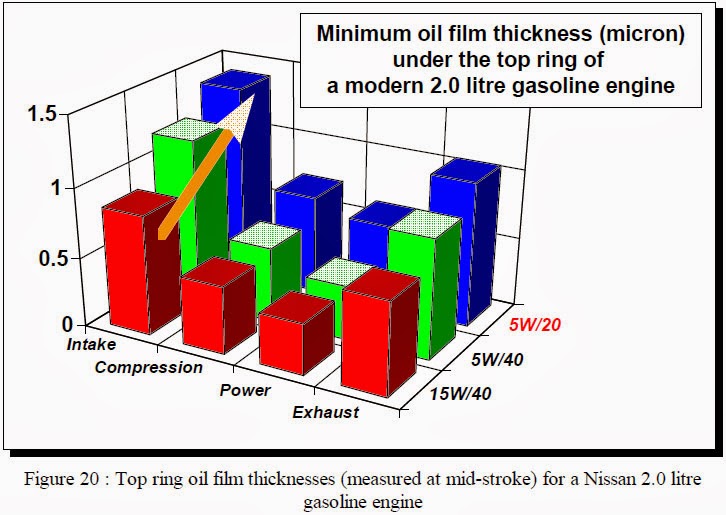
Thicker oil provides greater separation between the piston, rings and liner...period...and reduces the length of the swept area that is undergoing boundary/mixed lubrication.
I really don't think that's true. With the thicker oils the ring tends to push the oil instead of riding on the oil. Or else how do you explain as the oil is more viscous you have less consumption? Thick oil does not creep and flow into very small crevices. Who uses heavy motor oil as a penetrate? Nobody because it doesn't work. You have to thin it down with acetone. What does a splash pattern of thick oil look like vs thin oil. The thin oil goes everywhere. The side clearance of these newer engines are specified with a 20wt in mind. What happens when you have a thicker oil. You have less oil discharge from the journal. Less oil on the piston.
I postulate that thinner oil can flow under the ring better than thick oil providing better hydrodynamic mode protection. Totally opposite to what you are saying.
So we are at odds again? But you are the man because you can out link me. I'm still wanting to read some of your original material. If you are as accomplished as you say where are your papers and tech articles?
Yes, oil burning (not via valve seals) is a good sign your rings aren't wearing against the cylinder walls LOL... this is for sure.
On a serious note, thinner oil protects rings better but only because there is no high lateral load on rings (rings pushing against the cylinder walls because of combustion).
However, ring protection is rarely an issue.
Thicker oil will better protect the pistons against the cylinder walls. If the pistons deform the cylinder walls, your rings will no longer matter.
Furthermore, and most important, the real issue is ring overheating which causes them to lose their springiness.[/B] Rings overheat because of a combination of too much contact with the cylinder wall and high-load high RPMs. Too thin of oil will turn to water under said high-load high RPMs causing the friction and overheating. (It can happen without friction against walls but that's a moot point for this discussion.)
However, ring protection is rarely an issue. like I posted before.
Thicker oil will better protect the pistons against the cylinder walls. If the pistons deform the cylinder walls, your rings will no longer matter. Agree, as long as it is not overdone and creating needless drag, I think shannow mention that also.
Furthermore, and most important, the real issue is ring overheating which causes them to lose their springiness. And to think that low tension rings are all the rave now among manufacturers, while we try to avoid that, again horses for courses.
Originally Posted By: turtlevette
Originally Posted By: Shannow
Thicker oil provides greater separation between the piston, rings and liner...period...and reduces the length of the swept area that is undergoing boundary/mixed lubrication.
I really don't think that's true. With the thicker oils the ring tends to push the oil instead of riding on the oil. Or else how do you explain as the oil is more viscous you have less consumption? Thick oil does not creep and flow into very small crevices. Who uses heavy motor oil as a penetrate? Nobody because it doesn't work. You have to thin it down with acetone. What does a splash pattern of thick oil look like vs thin oil. The thin oil goes everywhere. The side clearance of these newer engines are specified with a 20wt in mind. What happens when you have a thicker oil. You have less oil discharge from the journal. Less oil on the piston.
I postulate that thinner oil can flow under the ring better than thick oil providing better hydrodynamic mode protection. Totally opposite to what you are saying.
So we are at odds again? But you are the man because you can out link me. I'm still wanting to read some of your original material. If you are as accomplished as you say where are your papers and tech articles?
Yes, oil burning (not via valve seals) is a good sign your rings aren't wearing against the cylinder walls LOL... this is for sure.
On a serious note, thinner oil protects rings better but only because there is no high lateral load on rings (rings pushing against the cylinder walls because of combustion).
However, ring protection is rarely an issue.
Thicker oil will better protect the pistons against the cylinder walls. If the pistons deform the cylinder walls, your rings will no longer matter.
Furthermore, and most important, the real issue is ring overheating which causes them to lose their springiness.[/B] Rings overheat because of a combination of too much contact with the cylinder wall and high-load high RPMs. Too thin of oil will turn to water under said high-load high RPMs causing the friction and overheating. (It can happen without friction against walls but that's a moot point for this discussion.)
However, ring protection is rarely an issue. like I posted before.
Thicker oil will better protect the pistons against the cylinder walls. If the pistons deform the cylinder walls, your rings will no longer matter. Agree, as long as it is not overdone and creating needless drag, I think shannow mention that also.
Furthermore, and most important, the real issue is ring overheating which causes them to lose their springiness. And to think that low tension rings are all the rave now among manufacturers, while we try to avoid that, again horses for courses.