TGMO 0W-20 SN for 2002 Toyota Echo?

Status
Not open for further replies.
Originally Posted By: kr_bitog
It struck me the 0w-20 will reduce the noise when the ambient is very hot but the car will just lost torque, which does not happen with 30 weight oil.

Chances are more than likely that there was another problem -- unrelated to the oil -- with the engine.
 
My Avalon is specd for 30 weight and was not back specd for 20 weight. But I am to believe from your experience with your '85 Corolla that I should ignore Toyota's specs? This thread is another example of why you should not believe all the [censored] you read on the internet.
 
Originally Posted By: Tones
My Avalon is specd for 30 weight and was not back specd for 20 weight. But I am to believe from your experience with your '85 Corolla that I should ignore Toyota's specs? This thread is another example of why you should not believe all the [censored] you read on the internet.

My 85 Corolla doesn't even spec 5w30 but 10w30. So, what's your point? We all know what Toyota specs for what car. If you only care about what Toyota recommends, why do you even read this blog?
 
Originally Posted By: Gokhan

My 85 Corolla doesn't even spec 5w30 but 10w30. So, what's your point? We all know what Toyota specs for what car. If you only care about what Toyota recommends, why do you even read this blog?


I'm curious. How much does your old Corolla consume.

I just started running 0W-20 and 5W-20 in my vette and old burban both with old SB1 small block engines. I haven't driven enough to get a feel for consumption.
 
Originally Posted By: turtlevette
Originally Posted By: Gokhan

My 85 Corolla doesn't even spec 5w30 but 10w30. So, what's your point? We all know what Toyota specs for what car. If you only care about what Toyota recommends, why do you even read this blog?

I'm curious. How much does your old Corolla consume.

I just started running 0W-20 and 5W-20 in my vette and old burban both with old SB1 small block engines. I haven't driven enough to get a feel for consumption.

My 85 Corolla consumes almost no oil with 0W-20 because I changed my valve-stem oil seals a few years ago. Before that, the consumption was very large -- 2.5 qt per 1k miles with 5w30 and 1.0 qt per 1k miles with 15w40.

I actually do lose about 0.3 - 0.4 qt of 0W-20 over 5000 miles but I think that's mostly due to a small visible leak I have at the oil-pan seal that results in some oil on the floor when the car is parked.
 
Originally Posted By: Gokhan
Originally Posted By: kr_bitog
It struck me the 0w-20 will reduce the noise when the ambient is very hot but the car will just lost torque, which does not happen with 30 weight oil.

Chances are more than likely that there was another problem -- unrelated to the oil -- with the engine.


the symptom is repeatable in very hot day and most of the people credit the issue to the VVTi that depends on oil pressure to governs the timing. so on the old engine without VVTi, this issue may not exist but with modern car where all use VVTi, this may likely an issue if the oil does not meet certain spec. I think Echo is backspeced but only allow 5w-20 and not 0w-20, but not sure how different is viscosity for toyota 5w-20 and 0w-20 oil
 
Originally Posted By: Gokhan

So, what's your point?

My 2011 Avalon was specified for 30 weight 5 years after the 0w-20 was introduced. So apparently not all Toyotas 1980 and newer (and perhaps older) should be using the 0W-20, and that people are far better off referring to TSBs and their owner's manuals than an internet board.
 
Last edited:
Despite the endless discussion in this thread, OP's 2002 ECHO will run just fine on 0W-20 in summer, winter and everything in between. I do it every day and I have no excessive consumption nor any other issues.
 
Originally Posted By: Tones
Originally Posted By: Gokhan

So, what's your point?

My 2011 Avalon was specified for 30 weight 5 years after the 0w-20 was introduced. So apparently not all Toyotas 1980 and newer (and perhaps older) should be using the 0W-20, and that people are far better off referring to TSBs and their owner's manuals than an internet board.


Forget logic and reason. This argument seems to be one sided. When Toyota recommends or back specks to 0w20, then this fact is used as a living proof that 0w20 oils are fantastic and that Toyota knows what they're doing. When Toyota doesn't recommend 0w20 oil, or doesn't back speck to it, then all of the sudden that should be ignored and instead asinine arguments are brought up, such as viscosity doesn't matter and that additives will take care of everything.

Then when a poster claims that if the engine seems to run better on 0w20, it was all because of the oil, but when another poster claims his engine seems to run better with a thicker oil, it is suggested that there is something wrong with the engine (the implication is that the thicker oil could not possible be better than the beloved 0w20), it's an indication of a heavy bias that is based purely on feel good "facts".
 
Originally Posted By: kr_bitog
Originally Posted By: Gokhan
Originally Posted By: kr_bitog
It struck me the 0w-20 will reduce the noise when the ambient is very hot but the car will just lost torque, which does not happen with 30 weight oil.

Chances are more than likely that there was another problem -- unrelated to the oil -- with the engine.


the symptom is repeatable in very hot day and most of the people credit the issue to the VVTi that depends on oil pressure to governs the timing. so on the old engine without VVTi, this issue may not exist but with modern car where all use VVTi, this may likely an issue if the oil does not meet certain spec. I think Echo is backspeced but only allow 5w-20 and not 0w-20, but not sure how different is viscosity for toyota 5w-20 and 0w-20 oil

0W-20 and 5W-20 have exactly the same viscosity for most purposes -- only the extremely cold starting performance is different. So, if 5W-20 is specified, 0W-20 will work even better because it's synthetic.

Thinner the oil is, better the VVTi will work with it, as thinner oil flows faster. So, that's not what's happening in your case. There is probably some problem in the fuel system or engine-control system that triggers with a very hot engine. Perhaps there is some engine knock and the engine-control system cuts the power down.

What Toyota means by 5W-20 but not 0W-20 for your car on their TSB is that you cannot do 10,000-mile OCI with 0W-20 (according to their recommendation). They don't mean that you can't use 0W-20 instead of 5W-20. Otherwise, 0W-20 and 5W-20 are the same oil (as far as viscosity is concerned), except that 0W-20 allows longer OCIs. All Toyota is saying is that you can do longer OCIs with 0W-20 but not quite 10,000 miles.

PS: Of course, TGMO 0W-20 SN has a higher VI than most other oils and it's thinner in cold engine -- but that's a desirable thing.
 
Originally Posted By: Tones
Originally Posted By: Gokhan

So, what's your point?

My 2011 Avalon was specified for 30 weight 5 years after the 0w-20 was introduced. So apparently not all Toyotas 1980 and newer (and perhaps older) should be using the 0W-20, and that people are far better off referring to TSBs and their owner's manuals than an internet board.

I know that TSB. If my car was included there, they wouldn't recommend xW-20 either. However, as I said, TGMO 0W-20 SN works perfectly in my car, and we're coming back to the same point -- car makers' recommendation vs. real-world performance.

One problem with running thinner oil is that it will increase the oil consumption. I don't have oil consumption because I have new valve-stem oil seals -- so, this is not a problem for me but if you do have oil consumption, running thinner oil is not a good idea. In fact running 10W-40 might be a better idea if the consumption is too large. That's one reason why Toyota doesn't recommend xW-20 for older cars because their valve-stem oil seals are worn.
 
Originally Posted By: Gokhan

0W-20 and 5W-20 have exactly the same viscosity for most purposes -- only the extremely cold starting performance is different. So, if 5W-20 is specified, 0W-20 will work even better because it's synthetic.


Both of the Toyota oil's have the same KV100, same HTHS and both exhibit the same shear or lack thereof? I'd be surprised if long drain performance is the only reason for this recommendation.

Quote:
Thinner the oil is, better the VVTi will work with it, as thinner oil flows faster. So, that's not what's happening in your case. There is probably some problem in the fuel system or engine-control system that triggers with a very hot engine. Perhaps there is some engine knock and the engine-control system cuts the power down.


Probably depends on the system. If you have a valve-type system that leverages engine oil pressure to operate, with enough leakage in the bearings and other areas that potentially reduces engine oil pressure I'm sure one could observe the system behaving in a less than desirable manner with a thinner lubricant.

Ultimately, given my experience with BMW's system (which leverages pumps as parts of the units themselves), they don't seem to be affected by viscosity one way or the other. They don't operate better with thinner or thicker lubes. That's probably the case for most systems out there even if they don't share a similar design.

Quote:
What Toyota means by 5W-20 but not 0W-20 for your car on their TSB is that you cannot do 10,000-mile OCI with 0W-20 (according to their recommendation). They don't mean that you can't use 0W-20 instead of 5W-20. Otherwise, 0W-20 and 5W-20 are the same oil (as far as viscosity is concerned), except that 0W-20 allows longer OCIs. All Toyota is saying is that you can do longer OCIs with 0W-20 but not quite 10,000 miles.


This is the first time I've heard of this and would like to know more about it if you have some supporting documentation on it. What aspects of the 0w-20 make it a poorer choice for extended drains than its 5w-20 sibling?
 
Originally Posted By: OVERKILL
Gokhan said:
Quote:
What Toyota means by 5W-20 but not 0W-20 for your car on their TSB is that you cannot do 10,000-mile OCI with 0W-20 (according to their recommendation). They don't mean that you can't use 0W-20 instead of 5W-20. Otherwise, 0W-20 and 5W-20 are the same oil (as far as viscosity is concerned), except that 0W-20 allows longer OCIs. All Toyota is saying is that you can do longer OCIs with 0W-20 but not quite 10,000 miles.

This is the first time I've heard of this and would like to know more about it if you have some supporting documentation on it. What aspects of the 0w-20 make it a poorer choice for extended drains than its 5w-20 sibling?

Actually it's very simple. TGMO 0W-20 SN is synthetic but TGMO 5W-20 SN is conventional.
 
Originally Posted By: Gokhan
Originally Posted By: OVERKILL
Gokhan said:
Quote:
What Toyota means by 5W-20 but not 0W-20 for your car on their TSB is that you cannot do 10,000-mile OCI with 0W-20 (according to their recommendation). They don't mean that you can't use 0W-20 instead of 5W-20. Otherwise, 0W-20 and 5W-20 are the same oil (as far as viscosity is concerned), except that 0W-20 allows longer OCIs. All Toyota is saying is that you can do longer OCIs with 0W-20 but not quite 10,000 miles.

This is the first time I've heard of this and would like to know more about it if you have some supporting documentation on it. What aspects of the 0w-20 make it a poorer choice for extended drains than its 5w-20 sibling?

Actually it's very simple. TGMO 0W-20 SN is synthetic but TGMO 5W-20 SN is conventional.


That's not simple at all, in fact it is counter-intuitive, LOL! I don't know of a single Euro-spec extended drain oil that is conventional, they are all synthetic
21.gif


Mobil 1 Extended Performance 0w20 is also synthetic as are all the AMSOIL extended drain products. I can't think of an extended drain conventional.
 
Regarding Toyota recommendations, they are all over the place sometimes.

I used to have a 2009 Corolla and it recommended 0W-20 or 5W-20 but 5k OCIs on both. So, I just kept changing the oil with Mobil 1 0W-20 SM every 5k.

Then, when 2010 Corolla came, guess what, they recommended 10k OCI with synthetic (0W-20) but the TSB said 2009 Corolla should still do 5k OCI with synthetic (0W-20). Go figure, as the 2009 and 2010 Corollas have exactly the same engine!

So, the moral of the story is that don't take the car makers' recommendations and TSBs as absolute.
 
Originally Posted By: OVERKILL
Originally Posted By: Gokhan
Originally Posted By: OVERKILL
Gokhan said:
Quote:
What Toyota means by 5W-20 but not 0W-20 for your car on their TSB is that you cannot do 10,000-mile OCI with 0W-20 (according to their recommendation). They don't mean that you can't use 0W-20 instead of 5W-20. Otherwise, 0W-20 and 5W-20 are the same oil (as far as viscosity is concerned), except that 0W-20 allows longer OCIs. All Toyota is saying is that you can do longer OCIs with 0W-20 but not quite 10,000 miles.

This is the first time I've heard of this and would like to know more about it if you have some supporting documentation on it. What aspects of the 0w-20 make it a poorer choice for extended drains than its 5w-20 sibling?

Actually it's very simple. TGMO 0W-20 SN is synthetic but TGMO 5W-20 SN is conventional.

That's not simple at all, in fact it is counter-intuitive, LOL! I don't know of a single Euro-spec extended drain oil that is conventional, they are all synthetic
21.gif


Mobil 1 Extended Performance 0w20 is also synthetic as are all the AMSOIL extended drain products. I can't think of an extended drain conventional.

I think we're misunderstanding each other. I'm saying exactly what you're saying. With 5W-20 conventional, the OCI is 5k and with 0W-20 synthetic, the OCI is 10k, but Toyota allows 10k OCIs only on certain engines, even with synthetic.

 
OK yes, when you replied to my "What aspects of the 0w-20 make it a poorer choice for extended drains than its 5w-20 sibling?" with what you did, I had the WTH??? look on my face up here, LOL!!! But I think that's because I misinterpreted part of what you were saying in what I quoted originally so I can see how that went sideways.

So to get back on track here:

Just because the OCI recommendation differs between the two, why should that stop them from recommending the (superior) lubricant for those applications with perhaps an amendment for OCI length or to only use it at the original spec OCI?

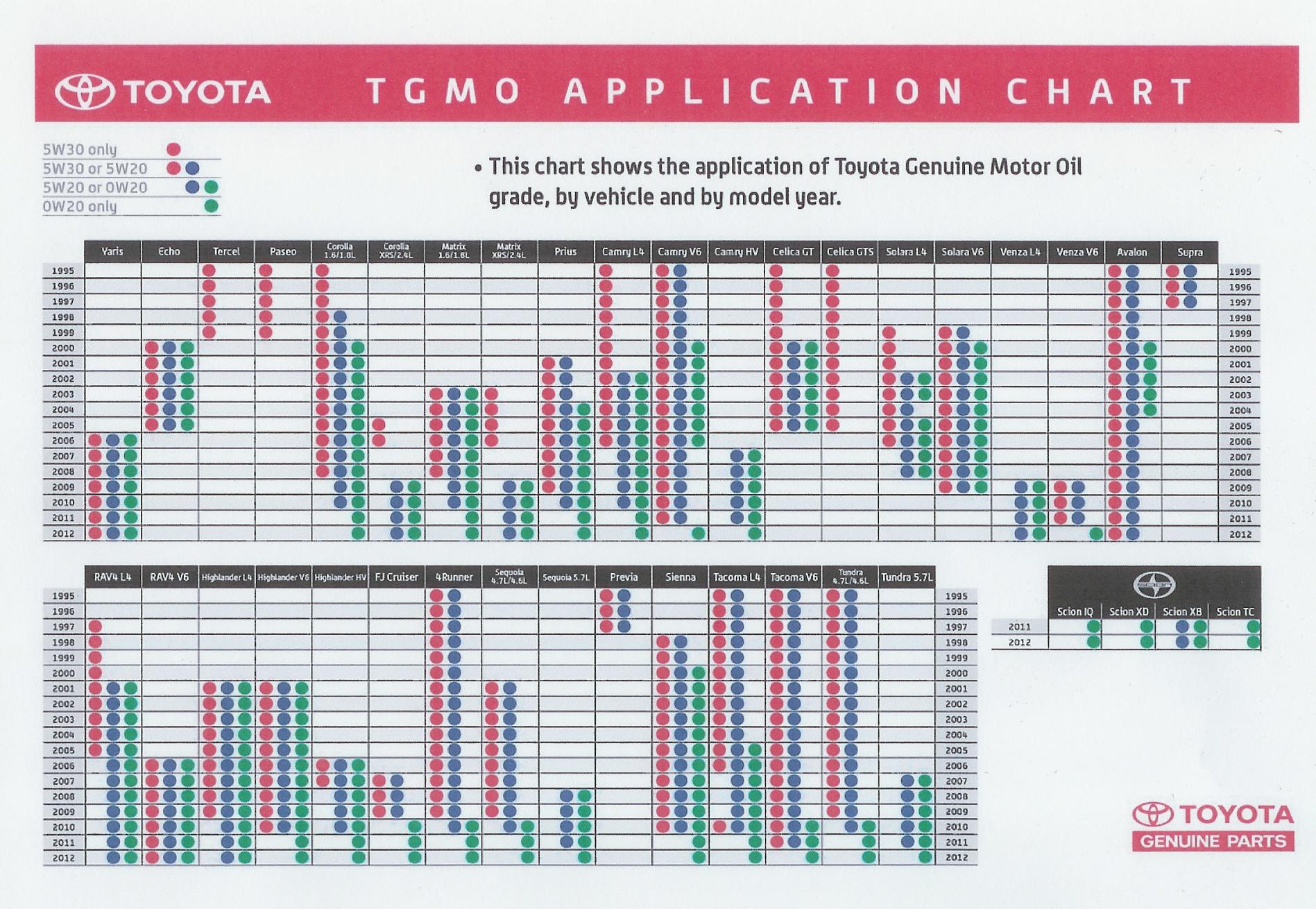
I'm thinking of this chart:

Toyota%20Oil%20Chart.JPG


Where it makes no reference to OCI length but certainly does note that 0w-20 is not to be used in some engines that spec 5w-20, which seems a bit "off" unless there are differences between the two lubricants that we are unaware of
21.gif
 
Note that this is more of a part-department chart. I don't think there is any valid reason why synthetic 0W-20 wouldn't be recommended for an application that recommends conventional 5W-20. It's plain silly for Toyota to publish such a chart.

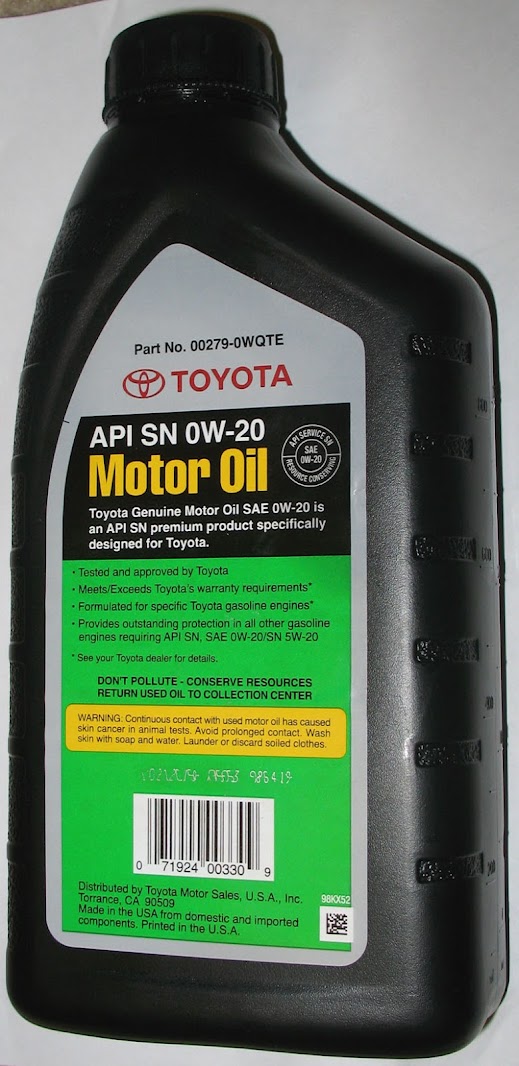
Here is the back of the TGMO 0W-20 SN bottle, saying that it can be used for any 5W-20 SN application for any car make, which is contradicting the chart above:

IMG_3608_cropped_800.jpg
 
Originally Posted By: OVERKILL
Yup, that is a bit contradictory eh? LOL

I wonder if we asked Toyota what they would say?


Probably something along the lines of:-

"Be extremely subtle, even to the point of formlessness. Be extremely mysterious, even to the point of soundlessness. Thereby you can be the director of the opponent's fate."

You don't go to Asia looking for straight answers.
 
Status
Not open for further replies.
Back
Top Bottom