Oil temps?

Status
Not open for further replies.
Originally Posted By: Zach72
Once the car is running it should be at a constant temp i.e. what it was engineered to run at no matter the ambient temp unless its got some issues with the radiator etc. Not sure if extreme cold would affect it

Winter temps do affect it. People (including myself) have reported somewhat lower running oil temps on their cars in very low ambient temps.
 
When Hyundai upped the HP in the 2013 2L turbo models they also upped the oil temp parameter for full boost. Previously it was 150F but they changed that to 180F. Some peoples cars were not ever going into full boost so they had a TSB to lower the temp threshold to 160F.

They did add a coolant oil heat exchanger at the oil filter.

I have two oil temp sensors, the one at the oil filter will almost always read lower. Only when the oil is cold and under 145F. After 145F then the oil temp sender at the cams will read higher.

The engine surfaces shed quite a bit of heat in the winter, timing chain cover and oil pan.
 
Originally Posted By: Zach72
the outside temp only matters at startup. Once the car is running it should be at a constant temp i.e. what it was engineered to run at no matter the ambient temp unless its got some issues with the radiator etc. Not sure if extreme cold would affect it but again once it warms up it should be at a steady temp. per one of the motor oil university articles here on BITOG:

One thing that is no longer important is the ambient temperature. Older automotive owner manuals often recommended one oil for the summer and another for the winter. This is still necessary for air cooled engines but is no longer a consideration in pressurized water cooled engines. These engine blocks are kept at around 212°F all year round. The oil is around the same temperature as well. This allows for a single grade oil all year round. Again, this is not the same as on the track where the coolant temperature is slightly higher and the oil temperature is much higher.


Except that this is patently incorrect in practice as both observed by myself and by Shannow using two methods of measuring oil temperature. Ambient has a massive effect on oil temperature and rate of oil temperature change on my car and that is even WITH a thermostatically controlled oil cooler. Shannow saw more dramatic changes just by changing engine RPM.
 
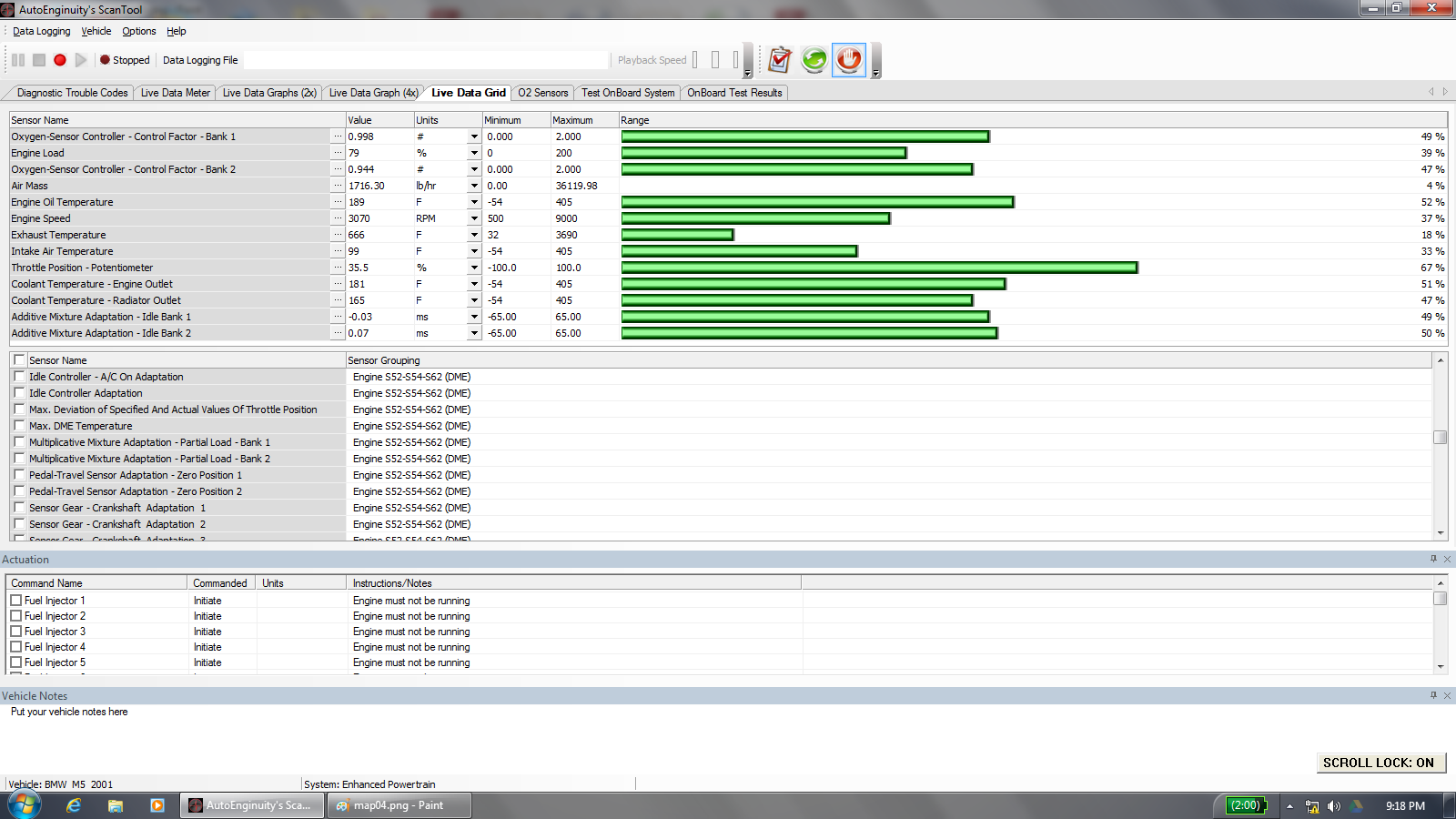
Just as an example, here's one datalog from my M5:

map05.png


Oil temperature is at 189F, air charge temperature is 99F and coolant is at somewhere between 165 and 181 depending on which reference point you are looking at. This is under 79% load at a relatively sedate RPM.

If I go on the highway, I can drop the oil temp 20 degrees. If I beat on it, I can drive it up. And again, this car has a large thermostatically controlled oil cooler that uses the coolant. On a car without this, the differences are far more dramatic under the same conditions.
 
I run 0w40 Mobil 1 right now I'm my Audi and I see temps of 225 when on the highway and about 200-215 normal driving around town. And I'll see 225 again when heading home as I live up a huge hill
 
Originally Posted By: SHOZ
And just how accurate are OEM oil temp gauges?


Digital models are usually quite accurate with the location of the temp sensor an issue to be considered.

it's gauges that are suspect in some vehicles...
 
Originally Posted By: Jetronic
unless the digital or analog gauges are programmed not to show fluctuations, much like coolant temp gauges.


You are implying that digital gauges can be "dummied" like analog?


Please provide an example, as the tech to falsify an analog reading is quite simple.
 
Originally Posted By: SteveSRT8
it's gauges that are suspect in some vehicles...

In some cases, such as my old Audi, you could even check the accuracy of the reading with Audi's special tool, or, alternatively, some resistors.
 
If the factory oil temp gauge in my '09 Nissan 370Z is to be believed, the oil regularly hits 220 F and gets up to 240 with the slightest provocation. Spirited driving as in going up curvy mountain roads at a good clip easily will reach 260 degrees. At 285 I believe, the engine goes into "limp mode" and electronically limits the RPM's to 3000 until the temp drops. I have never reached that point but people who track their cars add oil coolers.
I use a robust oil like Redline or the discontinued Pennzoil Ultra to be on the safe side.
 
Dwight, as I mentioned about the "feel of the hands" business on my G37's oil filter after even a short drive in the cold, I'd believe your oil temperature gauge without much question.
 
Originally Posted By: SteveSRT8
Originally Posted By: Jetronic
unless the digital or analog gauges are programmed not to show fluctuations, much like coolant temp gauges.


You are implying that digital gauges can be "dummied" like analog?


Please provide an example, as the tech to falsify an analog reading is quite simple.


They certainly can, as easy or easier than analog. All it takes is a single line of code that says:
For sensor input values X to Y display Z.

There you go, a dummy digital gauge that, for example, reads coolant temperature at 195 for values between 160 and 230.

Ed
 
The speedo on my Hyundai is a digital signal and it is programmed to read slow. And the coolant gauge which is a digital signal is as worthless as can be. It tells you it's cold, OK and it's too late.
 
Originally Posted By: SHOZ
The speedo on my Hyundai is a digital signal and it is programmed to read slow.

That's odd. Normally speedos are programmed to read high.
 
Originally Posted By: SHOZ
The speedo on my Hyundai is a digital signal and it is programmed to read slow. And the coolant gauge which is a digital signal is as worthless as can be. It tells you it's cold, OK and it's too late.

If it was truly a digital signal it would read either hot or not hot like the old idiot light. Most sensors are analog signals that are sampled by a processor and digitized. From there the software decides what to do with it. There is always going to be some amount of filtering of the signal and the filtering time will depend on what is being sampled.
 
Originally Posted By: Quattro Pete
Originally Posted By: SHOZ
The speedo on my Hyundai is a digital signal and it is programmed to read slow.

That's odd. Normally speedos are programmed to read high.


Yes I meant to write fast.

But it is sampled form the wheel sensor and the digitized. Sent to the speedo over the CAN bus.

On the hewer Gen Coupes the oil, coolant and boost are all the same. The boost is obviously modified as it hangs and is not really responsive. With the dials and needles with no numbers it is near impossible to tell the accuracy.
 
Originally Posted By: yst
Oil temperature never goes outside 188-194F range year around in my 12 Honda CRV.


I'm surprised the CRV gives you oil temperature. How are you tracking it?
 
Love that you guys did a real world test and data collection to establish fact from theory.

I would have to believe however every car and engine would vary somewhat too due to how its designed engine compartment radiator design etc. I live in Minnesota and have seen a small difference between summer and winter in a mildly souped up Chevy small block with generic coolant oil temp gauges.
Thanks OverKill!
 
Last edited:
Status
Not open for further replies.
Back
Top Bottom