MDX and melted spark plugs.

Status
Not open for further replies.
Joined
Apr 15, 2010
Messages
15,353
Location
Atlanta,GA
What can cause this condition other than a lean burn? I have family who was told that they need a new head because all the plugs were 'melted'. Car has over 100k miles and I haven't been able to confirm if they had the plugs recently changed.


Thanks!
 
How hot do you have to get the engine to melt plugs?

I've severely overheated my old Taurus to the point it wouldn't run. The spark plugs were white from the heat - but they did not melt.

There is something else going on. What was the engine doing that prompted them to bring it in? Wonder if the VCM cooked the front cams or something and the shop doesn't know what is wrong so they are making something up and replacing the head.
 
Last edited:
Overheating in the normal sense might be 250F or 300F. But the temp inside the cylinder that the plugs routinely withstand is significantly higher.

More info needed.
 
From what I understand, some of these engines (Honda 3.5L V-6s) suffer from a problem of "loose" spark plugs. If you Google "honda v-6 loose spark plugs", you get a number of hits on it. I changed the plugs in our MDX at about 90k miles, mostly to inspect the condition of the plugs. My fears were unfounded, and the plugs were fine and it continues to run well with new plugs. But I understand that this is not unheared of.
 
Originally Posted By: Miller88
Wonder if the VCM cooked the front cams or something and the shop doesn't know what is wrong so they are making something up and replacing the head.


As an aside, the MDX has never had a VCM-equipped engine. Similar to the Ridgeline, which also never received a VCM-equipped engine.
 
Originally Posted By: Donald
Overheating in the normal sense might be 250F or 300F. But the temp inside the cylinder that the plugs routinely withstand is significantly higher.

More info needed.


Engine knocking, car was filled with high octane gas, knock went away and came back a day later.

No complaints about poor running prior to. This is all second hand information.
 
Define "melted"?

Unless severe detonation (which typically would also punch holes through piston heads, etc.), otherwise: don't forget that modern IC engines are also water cooled, meaning that the cylinder head has water passage to keep the internal temperature well under control.

*I have yet to see a spark plug "melting" in all these years of servicing....

Pics needed for viewing in this case.

Q.
 
Originally Posted By: Miller88
...

There is something else going on. What was the engine doing that prompted them to bring it in? Wonder if the VCM cooked the front cams or something and the shop doesn't know what is wrong so they are making something up and replacing the head.

There is no VCM. Only the new '14 MDX has it and it's a new iteration of the system.
 
Originally Posted By: Hokiefyd
From what I understand, some of these engines (Honda 3.5L V-6s) suffer from a problem of "loose" spark plugs. If you Google "honda v-6 loose spark plugs", you get a number of hits on it. I changed the plugs in our MDX at about 90k miles, mostly to inspect the condition of the plugs. My fears were unfounded, and the plugs were fine and it continues to run well with new plugs. But I understand that this is not unheared of.

I know some people use anti-seize on their plugs, but I understand that neither NGK nor Denso recommend it with any of their plugs. They're designed to be properly torqued with dry threads, and lubricating them may throw it off. They use a zinc-chromate dry plating that resists seizing. They've gotten reports that people have snapped off their plugs at the thread base.

http://www.ngksparkplugs.com/pdf/tb-0630111antisieze.pdf

Why does anyone still use those black coated threads?
 
Originally Posted By: Quest
Define "melted"?

Unless severe detonation (which typically would also punch holes through piston heads, etc.), otherwise: don't forget that modern IC engines are also water cooled, meaning that the cylinder head has water passage to keep the internal temperature well under control.

*I have yet to see a spark plug "melting" in all these years of servicing....

Pics needed for viewing in this case.

Q.


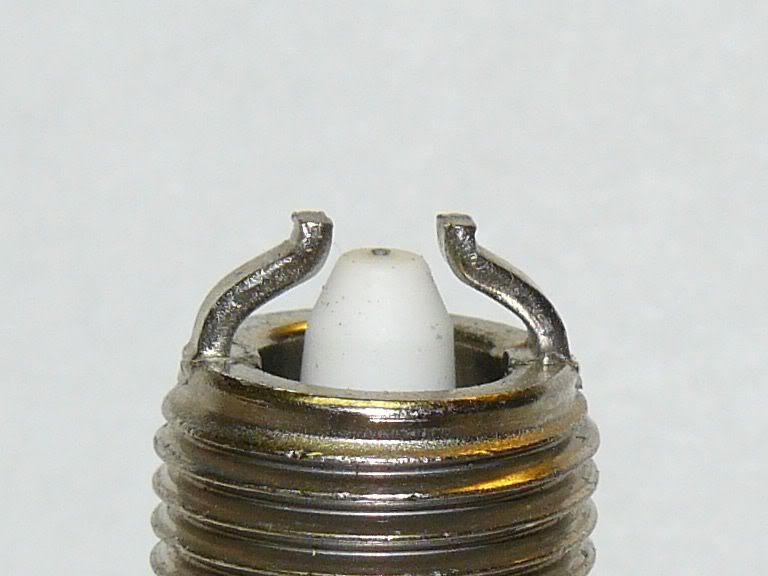
Good question as I wondered that myself . I'm assuming the dealer means that the ceramic tip has broken/melted off. This is why I said "melted".
 
Originally Posted By: BMWTurboDzl
Originally Posted By: Hokiefyd
What model year is the vehicle?


2008 +/- if I remember.


If it's a 2nd generation MDX (2007-2013), it will have the J37, or a 3.7L variant of Honda's J-series engine. I haven't seen many/any reports of spark plug problems with these engines. The spark plugs, like the timing belt, are due to be changed at 105k miles on these. If this service has already been done, and not personally by the owner, it could be that a plug was cross-threaded into one of the cylinder heads, which could in theory compromise the cooling of that spark plug (kind of how an exhaust valve can burn if it doesn't close fully).

I'm just grasping at straws here, though.
 
I have seen the ceramic literally melt on some Bosch +4 plugs. the spark was jumping to one prong only and the ceramic portion near the tip looked like it melted.
 
Originally Posted By: Kool1
I have seen the ceramic literally melt on some Bosch +4 plugs. the spark was jumping to one prong only and the ceramic portion near the tip looked like it melted.


Maybe I missed it but that begs the question on whether the plugs have been replaced. I remember the service manager at Honda telling me not to use Bosch plugs since it can cause some engine issues. Just use Denso or NGK he stated.
 
aluminium oxide (typically used in making spark plug's ceramic part): melting point is 2,072C

platinum melting temp: 1,768C

aluminium alloy (cylinder head): between 463C and 671C

Cupric Nickel alloy: 1,170C - 1,240C

typical spark plug nickel alloy: 1,200C to 1,300C


Sorry, the facts listed here tells me that the aluminium alloy (used to make cylinder head) should melt long before the nickel-alloy electrode on tyical copper plugs would, or even platinum tip (spark plug electrodes) long before ceramic would melt.

Q.
 
Originally Posted By: satinsilver
Originally Posted By: Kool1
I have seen the ceramic literally melt on some Bosch +4 plugs. the spark was jumping to one prong only and the ceramic portion near the tip looked like it melted.


Maybe I missed it but that begs the question on whether the plugs have been replaced. I remember the service manager at Honda telling me not to use Bosch plugs since it can cause some engine issues. Just use Denso or NGK he stated.

I previously took my car to a nearby Japanese car specialist. I would take my car there again, but they're not near where I work now. I was asking about plugs, and they said they used to use Bosch platinums but only had the worst performance with them. The issue is that they use a thin wire of platinum buried flush in the insulator. They claim it will resist erosion, but a lot of evidence is that they melt away.

My wife's car specs a Denso PKJ20CR-M11. I can't find any place that sells it other than dealers, and Denso says to use a PKJ20CR-L11. Supposedly the difference is a slightly larger ground electrode. Here's what it looks like:

41%2BOWDMV2eL._SY300_.jpg


And the NGK equivalent is the PZFR6F-11. I got this one and a US assembled set was installed at the factory in my wife's Civic.

NGK7968-2.jpg


Now, Bosch now seems to have original equipment style platinum plugs with a platinum tip fused to some alloy. The fine wire buried flush in the insulator was the way they used to do their single platinums as well as their +2 and +4 platinums:

P1000369.jpg
 
Status
Not open for further replies.
Back
Top Bottom