
You are using an out of date browser. It may not display this or other websites correctly.
You should upgrade or use an alternative browser.
You should upgrade or use an alternative browser.
GTL base stocks better than PAO/POE?
- Thread starter BerndV
- Start date

- Status
- Not open for further replies.

Quote:
An oil could have a stratospheric VI but horrific deposit control characteristics that could lead to ring coking for example. A properly formulated lubricant's value rests on the sum of its components, not some individual trait that somebody singles out for whatever reason, be it PAO or POE content, how much ZDDP it has, whether it has moly or not, or whether it has a super high VI. It is the overall PERFORMANCE of the product, which can, I would argue, be measured through how many hard to obtain certs/approval an oil has that truly speaks to its spot on the totem pole.
Exactly. Amazing some people can't grasp that simple concept.
An oil could have a stratospheric VI but horrific deposit control characteristics that could lead to ring coking for example. A properly formulated lubricant's value rests on the sum of its components, not some individual trait that somebody singles out for whatever reason, be it PAO or POE content, how much ZDDP it has, whether it has moly or not, or whether it has a super high VI. It is the overall PERFORMANCE of the product, which can, I would argue, be measured through how many hard to obtain certs/approval an oil has that truly speaks to its spot on the totem pole.
Exactly. Amazing some people can't grasp that simple concept.
Originally Posted By: OVERKILL
There are many sides to this debate, all of them having good points. I'm of the opinion that there is no single characteristic that makes a lubricant exceptional. It is the combination of traits that results in a lubricant standing above its peers. An oil could have a stratospheric VI but horrific deposit control characteristics that could lead to ring coking for example.
As long as the oil meets basic API/ILSAC standards, I don't believe it could have "horrible deposit control", as there are reasonable standards the oil has to meet. This seems like a bit of a boogieman proposition to me, which often gets repeated--but doesn't have much validity IMO.
There are many sides to this debate, all of them having good points. I'm of the opinion that there is no single characteristic that makes a lubricant exceptional. It is the combination of traits that results in a lubricant standing above its peers. An oil could have a stratospheric VI but horrific deposit control characteristics that could lead to ring coking for example.
As long as the oil meets basic API/ILSAC standards, I don't believe it could have "horrible deposit control", as there are reasonable standards the oil has to meet. This seems like a bit of a boogieman proposition to me, which often gets repeated--but doesn't have much validity IMO.

OVERKILL
$100 Site Donor 2021
Originally Posted By: JOD
Originally Posted By: OVERKILL
There are many sides to this debate, all of them having good points. I'm of the opinion that there is no single characteristic that makes a lubricant exceptional. It is the combination of traits that results in a lubricant standing above its peers. An oil could have a stratospheric VI but horrific deposit control characteristics that could lead to ring coking for example.
As long as the oil meets basic API/ILSAC standards, I don't believe it could have "horrible deposit control", as there are reasonable standards the oil has to meet. This seems like a bit of a boogieman proposition to me, which often gets repeated--but doesn't have much validity IMO.
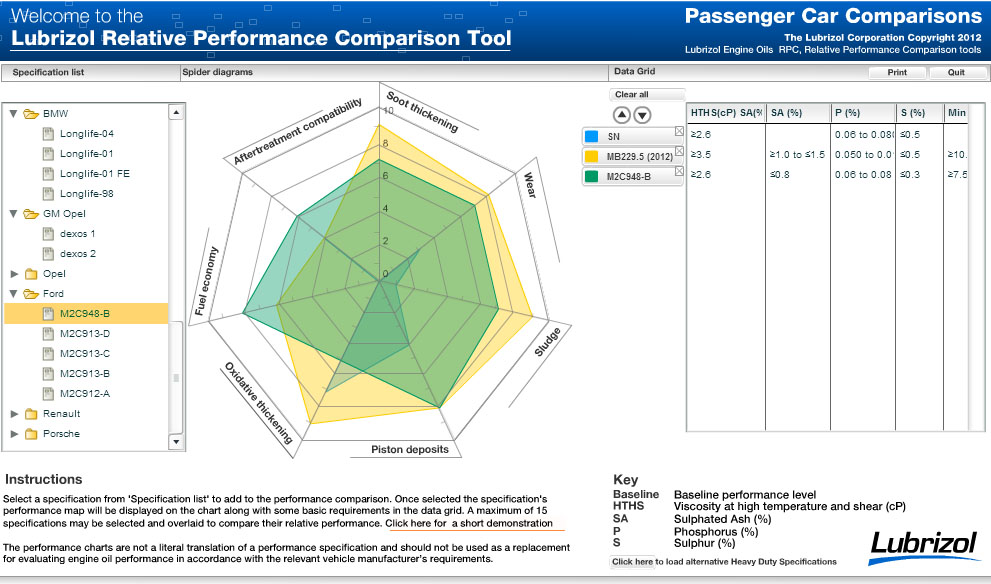
Please take a look at the Lubrizol graph and compare some of the OEM approvals to the API ones. The OEM ones are FAR more stringent.
For example:
API SN vs Ford and MB spec's:
Originally Posted By: OVERKILL
There are many sides to this debate, all of them having good points. I'm of the opinion that there is no single characteristic that makes a lubricant exceptional. It is the combination of traits that results in a lubricant standing above its peers. An oil could have a stratospheric VI but horrific deposit control characteristics that could lead to ring coking for example.
As long as the oil meets basic API/ILSAC standards, I don't believe it could have "horrible deposit control", as there are reasonable standards the oil has to meet. This seems like a bit of a boogieman proposition to me, which often gets repeated--but doesn't have much validity IMO.
Please take a look at the Lubrizol graph and compare some of the OEM approvals to the API ones. The OEM ones are FAR more stringent.
For example:
API SN vs Ford and MB spec's:
Originally Posted By: OVERKILL
Originally Posted By: JOD
Originally Posted By: OVERKILL
There are many sides to this debate, all of them having good points. I'm of the opinion that there is no single characteristic that makes a lubricant exceptional. It is the combination of traits that results in a lubricant standing above its peers. An oil could have a stratospheric VI but horrific deposit control characteristics that could lead to ring coking for example.
As long as the oil meets basic API/ILSAC standards, I don't believe it could have "horrible deposit control", as there are reasonable standards the oil has to meet. This seems like a bit of a boogieman proposition to me, which often gets repeated--but doesn't have much validity IMO.
Please take a look at the Lubrizol graph and compare some of the OEM approvals to the API ones. The OEM ones are FAR more stringent.
Exactly, "horrible deposit control" might have mean an issue with conventional oils that used a lot of cheap polymer VIs back in the day but it's a non-issue among today's modern ultra high VI oils. Many are OEM oils and by definition they are all synthetic so cleanliness is not a problem.
And with the highest VI oil made, Sustina 0W-20 (229 VI) the emphasis is on "Cleanliness and Fuel Efficient":
http://www.sustina.us/
Originally Posted By: JOD
Originally Posted By: OVERKILL
There are many sides to this debate, all of them having good points. I'm of the opinion that there is no single characteristic that makes a lubricant exceptional. It is the combination of traits that results in a lubricant standing above its peers. An oil could have a stratospheric VI but horrific deposit control characteristics that could lead to ring coking for example.
As long as the oil meets basic API/ILSAC standards, I don't believe it could have "horrible deposit control", as there are reasonable standards the oil has to meet. This seems like a bit of a boogieman proposition to me, which often gets repeated--but doesn't have much validity IMO.
Please take a look at the Lubrizol graph and compare some of the OEM approvals to the API ones. The OEM ones are FAR more stringent.
Exactly, "horrible deposit control" might have mean an issue with conventional oils that used a lot of cheap polymer VIs back in the day but it's a non-issue among today's modern ultra high VI oils. Many are OEM oils and by definition they are all synthetic so cleanliness is not a problem.
And with the highest VI oil made, Sustina 0W-20 (229 VI) the emphasis is on "Cleanliness and Fuel Efficient":
http://www.sustina.us/
I've seen it. Sure, some standards are tougher than others, and if have a particular engine with deposit issues (or an OEM that specs very long OCI's) then you could potentially look for an oil that meets a tougher standard; but "horrible deposit control" is nothing more than hyperbole in my opinion.
Originally Posted By: buster
I think high viscosity index is anything over 150. Ultra high is over 200. I'm sure there are trade-offs between high and ultra high VI and it's reflected in the fact that the majority of the top tier oils are in the 150-190 range.
As if you would know.
A 170 VI is the norm for a typical 5w30 syn oil.
A 185 VI is the norm for a 0W-40 largely because M1 has set the bar on that grade.
You can have a 150 VI dino with more "trade-offs" than a 229 VI high tech' GP III+ synthetic using the absolute latest in very high VI polymer VI improvers. So what is the trade-off? Well there is one COST. Not surprisingly it is the OEM oils that have many of the ultra high VIs oils and they absorb the cost in one way or another, there is no advertising for one.
The main beef against high and ultra high VI oils simply has to do with brand loyalty. If your fav' brand doesn't have one in their product line then loyal supporters will rationalize that it's obviously wasn't an important attribute in the first place.
But it works the other way as well. Mobil 1 0W-40 fans will take exception to a boutique formulator that's made a competing lower VI 40wt oil (at 2-3 times the price) made without VIIs that virtually shear proof under the most extreme conditions imaginable. So who has made the trade-offs? M1 that's considerably lighter on start-up and is still reasonably shear stable in most applications or the expensive boutique oil (with few cert's) that's main claim to fame is rock solid shear stability and a lower NOACK?
The answer for most is to follow OEM guidelines and what they recommend.
I think high viscosity index is anything over 150. Ultra high is over 200. I'm sure there are trade-offs between high and ultra high VI and it's reflected in the fact that the majority of the top tier oils are in the 150-190 range.
As if you would know.
A 170 VI is the norm for a typical 5w30 syn oil.
A 185 VI is the norm for a 0W-40 largely because M1 has set the bar on that grade.
You can have a 150 VI dino with more "trade-offs" than a 229 VI high tech' GP III+ synthetic using the absolute latest in very high VI polymer VI improvers. So what is the trade-off? Well there is one COST. Not surprisingly it is the OEM oils that have many of the ultra high VIs oils and they absorb the cost in one way or another, there is no advertising for one.
The main beef against high and ultra high VI oils simply has to do with brand loyalty. If your fav' brand doesn't have one in their product line then loyal supporters will rationalize that it's obviously wasn't an important attribute in the first place.
But it works the other way as well. Mobil 1 0W-40 fans will take exception to a boutique formulator that's made a competing lower VI 40wt oil (at 2-3 times the price) made without VIIs that virtually shear proof under the most extreme conditions imaginable. So who has made the trade-offs? M1 that's considerably lighter on start-up and is still reasonably shear stable in most applications or the expensive boutique oil (with few cert's) that's main claim to fame is rock solid shear stability and a lower NOACK?
The answer for most is to follow OEM guidelines and what they recommend.

Caterham....please, grab any engineering text, and demonstrate that the parameter that is the dimensionless "viscosity index" is referenced in any way.
Design is ALWAYS at the operating point, and VI makes off design "better than it could be".
VI is never a design point, as it isn't a data point, it is by definition a slope, and needs at least one actual measure to give it any meaning whatsoever.
Brand Loyalty, third world aside...it's laws of physics.
Design is ALWAYS at the operating point, and VI makes off design "better than it could be".
VI is never a design point, as it isn't a data point, it is by definition a slope, and needs at least one actual measure to give it any meaning whatsoever.
Brand Loyalty, third world aside...it's laws of physics.
Originally Posted By: Shannow
Caterham....please, grab any engineering text, and demonstrate that the parameter that is the dimensionless "viscosity index" is referenced in any way.
Design is ALWAYS at the operating point, and VI makes off design "better than it could be".
VI is never a design point, as it isn't a data point, it is by definition a slope, and needs at least one actual measure to give it any meaning whatsoever.
Shannow you're being silly.
Of course VI is a design aspect of an oil.
Mobil calls their 0W-40 a high VI oil.
Sustina claims there oils have high VIs.
Or would you rather I say, a 220 VI oil with a KV100 of 10cSt will be 35% lighter at 40C, 65% lighter at 0C and 15% heavier at 150C than a 150 VI oil with the same KV100?
We both know or you should know the full viscosity ramifications of VI differences between oils.
Caterham....please, grab any engineering text, and demonstrate that the parameter that is the dimensionless "viscosity index" is referenced in any way.
Design is ALWAYS at the operating point, and VI makes off design "better than it could be".
VI is never a design point, as it isn't a data point, it is by definition a slope, and needs at least one actual measure to give it any meaning whatsoever.
Shannow you're being silly.
Of course VI is a design aspect of an oil.
Mobil calls their 0W-40 a high VI oil.
Sustina claims there oils have high VIs.
Or would you rather I say, a 220 VI oil with a KV100 of 10cSt will be 35% lighter at 40C, 65% lighter at 0C and 15% heavier at 150C than a 150 VI oil with the same KV100?
We both know or you should know the full viscosity ramifications of VI differences between oils.
Shannow, I'm trying to shed light on a subject not obfuscate the issue.
Check out the following article in Machinery Lubrication, titled "Don't ignore Viscosity Index when selecting a Lubricant":
http://www.machinerylubrication.com/Read/28956/lubricant-viscosity-index
VI is also not represented in the very much flawed SAE grading system, but it probably should be now that OEM's are specifying 200+ VI oils.
When an OEM specifies that only a 0W-20 oil grade should be used what are they really saying? Technically, the only difference vs a 5W-20 is that the 0W oil will pump at -40 degrees and the 5W oil will not. Is that why the 0W is spec'd? Of course not. The real reason is that the 0W-20 oil is very much lighter at normal start-up temp's and that is solely due to the inherently higher VI of the 0W-20 grade.
There should be some mechanism in the SAE grading system that accounts for that but there isn't. Hence a lot of consumer confusion.
Check out the following article in Machinery Lubrication, titled "Don't ignore Viscosity Index when selecting a Lubricant":
http://www.machinerylubrication.com/Read/28956/lubricant-viscosity-index
VI is also not represented in the very much flawed SAE grading system, but it probably should be now that OEM's are specifying 200+ VI oils.
When an OEM specifies that only a 0W-20 oil grade should be used what are they really saying? Technically, the only difference vs a 5W-20 is that the 0W oil will pump at -40 degrees and the 5W oil will not. Is that why the 0W is spec'd? Of course not. The real reason is that the 0W-20 oil is very much lighter at normal start-up temp's and that is solely due to the inherently higher VI of the 0W-20 grade.
There should be some mechanism in the SAE grading system that accounts for that but there isn't. Hence a lot of consumer confusion.
Originally Posted By: CATERHAM
Technically, the only difference vs a 5W-20 is that the 0W oil will pump at -40 degrees and the 5W oil will not. Is that why the 0W is spec'd? Of course not. The real reason is that the 0W-20 oil is very much lighter at normal start-up temp's and that is solely due to the inherently higher VI of the 0W-20 grade.
Yes, the 0w20 is lighter at -40. Why does this matter? Do manufacturers care about wear protection for Siberians? Do they only care about the start-up flow for their 'high-efficiency' vehicles?
No, it's all about fuel economy, NOT ENGINE WEAR. For the one -off consumer, they will be hard pressed to notice ANY difference in FE in normal condition between a 5w20 and 0w20. But as an automaker, when you multiply the increase of 0.04MPG FE as observed in tests, across your entire lineup, you have a nice contribution to your CAFE. This is why 0w20s are so slow to catch on interationally, because there is no incentive! If someone told me that automakers do this for start up flow, and cold engine protection I would say how nice of them to only consider their North American-bound cars. Yes, 0w20s are starting to pick up off-shore, but again it's only driven by fuel economy.
Besides CAT, VI alone can be misleading if trying to determine the robustness or quality of an oil. High VIs are achieved in many different ways. I would always choose, all else equal, a non-VM "inherently high VI" base oil formula say around 140, over a heavily VM'ed blend of 2&5cSt bases with a VI of 200+ if WEAR and DEPOSIT PROTECTION was priority. I would never choose based on VI exclusively, unless my operating conditions matched- ie. never reaching NOT, super-short trips and/or extreme cold. Otherwise, in normal conditions, engines spend very little time 'cold', and even less time cold-enough to benefit from the higher VI oil's lower-drag- at 70F, 0w20 isn't pumping any better than 5w20 to affect flow. The brand of oil filter would probably make a bigger difference in that case.
Originally Posted By: Shannow
Engineering textbook...reference to Viscosity Index as a design parameter for a bearing.
Simple question, simple answer.
It's been touched on before regarding industry-wide viscosity changes and bearing design. I too notice bearing journals decreasing in width, and increasing in circumference as engine generations evolve. Someone correct me if I'm wrong, but thinner oils need higher bearing speeds to maintain an equal hydrodynamic wedge. Increasing the circumference of the crankpin accomplishes this. Thinning the journal allows a greater flow of oil out of the journal, increasing the 'refresh rate', which is good for a thinner oil under pressure.
So, with what seems like an anti-thin, anti-VI diatribe, I will close with this: I prefer lighter oils like light 20s in my Mazda V6- because I know the bearing dimensions, and they are very suitable for thin oils despite being made in 1993 and speccd for 5w30. The oil pump has good capacity, the bearings are std three-layer, the main and rod journals have been rolled, nitride hardened and micropolished, so I KNOW a light viscosity would perform well in my engine's bearings that see a high redline and higher-speed bearings (large circumference). In fact, I prefer low viscosity because I can't imagine the local heat that would be generated strictly from molecular shear if using a 50grade! "Bearing" in mind that bearing design is only one part of engine building.

Most new engines though have these design changes and treatments applied now-days, so engineers don't lose sleep about the engines that get shipped to our shores with FE obsessed bean counters hiding in EPA offices somewhere.
Put short, not all low-vis oils have super-crazy VIs yet may protect better than the high VI oil, and that not all super-high VI oils are suitable for all conditions and most importantly, not all VIs are achieved the same way- so unless you only care about the VI, without considering what it affects, if anything, then VI as a standalone parameter is truly dimensionless.
Technically, the only difference vs a 5W-20 is that the 0W oil will pump at -40 degrees and the 5W oil will not. Is that why the 0W is spec'd? Of course not. The real reason is that the 0W-20 oil is very much lighter at normal start-up temp's and that is solely due to the inherently higher VI of the 0W-20 grade.
Yes, the 0w20 is lighter at -40. Why does this matter? Do manufacturers care about wear protection for Siberians? Do they only care about the start-up flow for their 'high-efficiency' vehicles?
No, it's all about fuel economy, NOT ENGINE WEAR. For the one -off consumer, they will be hard pressed to notice ANY difference in FE in normal condition between a 5w20 and 0w20. But as an automaker, when you multiply the increase of 0.04MPG FE as observed in tests, across your entire lineup, you have a nice contribution to your CAFE. This is why 0w20s are so slow to catch on interationally, because there is no incentive! If someone told me that automakers do this for start up flow, and cold engine protection I would say how nice of them to only consider their North American-bound cars. Yes, 0w20s are starting to pick up off-shore, but again it's only driven by fuel economy.
Besides CAT, VI alone can be misleading if trying to determine the robustness or quality of an oil. High VIs are achieved in many different ways. I would always choose, all else equal, a non-VM "inherently high VI" base oil formula say around 140, over a heavily VM'ed blend of 2&5cSt bases with a VI of 200+ if WEAR and DEPOSIT PROTECTION was priority. I would never choose based on VI exclusively, unless my operating conditions matched- ie. never reaching NOT, super-short trips and/or extreme cold. Otherwise, in normal conditions, engines spend very little time 'cold', and even less time cold-enough to benefit from the higher VI oil's lower-drag- at 70F, 0w20 isn't pumping any better than 5w20 to affect flow. The brand of oil filter would probably make a bigger difference in that case.
Originally Posted By: Shannow
Engineering textbook...reference to Viscosity Index as a design parameter for a bearing.
Simple question, simple answer.
It's been touched on before regarding industry-wide viscosity changes and bearing design. I too notice bearing journals decreasing in width, and increasing in circumference as engine generations evolve. Someone correct me if I'm wrong, but thinner oils need higher bearing speeds to maintain an equal hydrodynamic wedge. Increasing the circumference of the crankpin accomplishes this. Thinning the journal allows a greater flow of oil out of the journal, increasing the 'refresh rate', which is good for a thinner oil under pressure.
So, with what seems like an anti-thin, anti-VI diatribe, I will close with this: I prefer lighter oils like light 20s in my Mazda V6- because I know the bearing dimensions, and they are very suitable for thin oils despite being made in 1993 and speccd for 5w30. The oil pump has good capacity, the bearings are std three-layer, the main and rod journals have been rolled, nitride hardened and micropolished, so I KNOW a light viscosity would perform well in my engine's bearings that see a high redline and higher-speed bearings (large circumference). In fact, I prefer low viscosity because I can't imagine the local heat that would be generated strictly from molecular shear if using a 50grade! "Bearing" in mind that bearing design is only one part of engine building.
Most new engines though have these design changes and treatments applied now-days, so engineers don't lose sleep about the engines that get shipped to our shores with FE obsessed bean counters hiding in EPA offices somewhere.
Put short, not all low-vis oils have super-crazy VIs yet may protect better than the high VI oil, and that not all super-high VI oils are suitable for all conditions and most importantly, not all VIs are achieved the same way- so unless you only care about the VI, without considering what it affects, if anything, then VI as a standalone parameter is truly dimensionless.
OVERKILL
$100 Site Donor 2021
Originally Posted By: JOD
I've seen it. Sure, some standards are tougher than others, and if have a particular engine with deposit issues (or an OEM that specs very long OCI's) then you could potentially look for an oil that meets a tougher standard; but "horrible deposit control" is nothing more than hyperbole in my opinion.
Of course it was hyperbole for the sake of making the statement itself more attention-grabbing (and it worked now didn't it, given that we are having this discussion, right?
 ) but the point, even if we scale the magnitude back a bit, is still relevant.
When a company like XOM or SOPUS blends an oil they are doing so to meet the deposit control (and of course numerous other characteristics.... also made visible using the Lubrizol tool) requirements of whatever certs/approvals are relevant to the grade and they are willing to pay for/submit to. If the use of more polymer to enhance VI has a negative effect here, then of course we are going to see less of it. And this takes me back to my earlier point about VI being but one characteristic of a properly blended lubricant. I'm far more interested in what OEM testing a lubricant has passed then whether it's VI is 172 or 185. Because the OEM testing is a verified indication of the lubricant's performance, VI is not. It tells us that the oil thickens less as temperatures cool and potentially thins less as temperatures rise. And while this characteristic may indeed be touted as a performance metric, it really doesn't tell us anything other than that now does it? IE, the high VI by itself does not mean the oil is going to excel at anything other than this trait. It is the MEASURED performance of the lubricant that we should be interested in. After all, is that not what the OEM's are interested in?
I've seen it. Sure, some standards are tougher than others, and if have a particular engine with deposit issues (or an OEM that specs very long OCI's) then you could potentially look for an oil that meets a tougher standard; but "horrible deposit control" is nothing more than hyperbole in my opinion.
Of course it was hyperbole for the sake of making the statement itself more attention-grabbing (and it worked now didn't it, given that we are having this discussion, right?
When a company like XOM or SOPUS blends an oil they are doing so to meet the deposit control (and of course numerous other characteristics.... also made visible using the Lubrizol tool) requirements of whatever certs/approvals are relevant to the grade and they are willing to pay for/submit to. If the use of more polymer to enhance VI has a negative effect here, then of course we are going to see less of it. And this takes me back to my earlier point about VI being but one characteristic of a properly blended lubricant. I'm far more interested in what OEM testing a lubricant has passed then whether it's VI is 172 or 185. Because the OEM testing is a verified indication of the lubricant's performance, VI is not. It tells us that the oil thickens less as temperatures cool and potentially thins less as temperatures rise. And while this characteristic may indeed be touted as a performance metric, it really doesn't tell us anything other than that now does it? IE, the high VI by itself does not mean the oil is going to excel at anything other than this trait. It is the MEASURED performance of the lubricant that we should be interested in. After all, is that not what the OEM's are interested in?
BerndV
Thread starter
Originally Posted By: OVERKILL
It tells us that the oil thickens less as temperatures cool and potentially thins less as temperatures rise. And while this characteristic may indeed be touted as a performance metric, it really doesn't tell us anything other than that now does it? IE, the high VI by itself does not mean the oil is going to excel at anything other than this trait. It is the MEASURED performance of the lubricant that we should be interested in.
Very well stated OVERKILL.
It tells us that the oil thickens less as temperatures cool and potentially thins less as temperatures rise. And while this characteristic may indeed be touted as a performance metric, it really doesn't tell us anything other than that now does it? IE, the high VI by itself does not mean the oil is going to excel at anything other than this trait. It is the MEASURED performance of the lubricant that we should be interested in.
Very well stated OVERKILL.
OVERKILL
$100 Site Donor 2021
Originally Posted By: CATERHAM
Or would you rather I say, a 220 VI oil with a KV100 of 10cSt will be 35% lighter at 40C, 65% lighter at 0C and 15% heavier at 150C than a 150 VI oil with the same KV100?
This appears to assume a completely linear relationship, which we know, using oils like Mobil 1 0w-20 for example, isn't the case:
ENEOS 0w-20: :
CCS @-35C 3550cP
MRV @ -40C 9630cP
KV40 32.69cSt
KV100 7.94cSt
HTHS ~2.6cSt (based on our discussions on this oil)
VI 229
NOACK 13%
MOBIL 1 0w-20: :
CCS @ -35C N/A
MRV @ -40C 9200cP
KV40 44.8cSt
KV100 8.7cSt
HTHS 2.7
VI 172
NOACK N/A
So at some point below 0, Mobil 1 0w-20 passes VI-ZILLA in terms of thinness. And although their 100C visc's are not the same, the higher HTHS of Mobil 1 0w-20 indicates that VI-ZILLA @ 150C is still thinner too...... North of 150C?
 how well do the VII's used to obtain this 229VI handle heat?
Or would you rather I say, a 220 VI oil with a KV100 of 10cSt will be 35% lighter at 40C, 65% lighter at 0C and 15% heavier at 150C than a 150 VI oil with the same KV100?
This appears to assume a completely linear relationship, which we know, using oils like Mobil 1 0w-20 for example, isn't the case:
ENEOS 0w-20: :
CCS @-35C 3550cP
MRV @ -40C 9630cP
KV40 32.69cSt
KV100 7.94cSt
HTHS ~2.6cSt (based on our discussions on this oil)
VI 229
NOACK 13%
MOBIL 1 0w-20: :
CCS @ -35C N/A
MRV @ -40C 9200cP
KV40 44.8cSt
KV100 8.7cSt
HTHS 2.7
VI 172
NOACK N/A
So at some point below 0, Mobil 1 0w-20 passes VI-ZILLA in terms of thinness. And although their 100C visc's are not the same, the higher HTHS of Mobil 1 0w-20 indicates that VI-ZILLA @ 150C is still thinner too...... North of 150C?
BerndV
Thread starter
VI-ZILLA, lol!
Originally Posted By: OVERKILL
Of course it was hyperbole for the sake of making the statement itself more attention-grabbing (and it worked now didn't it, given that we are having this discussion, right?
) but the point, even if we scale the magnitude back a bit, is still relevant.
I agree that it's worth discussing--but the tacit implication is that the high VI oils offer poor deposit control, and the characterization of "horrible deposit control" just contributes to what seems to be internet legend. I haven't seen any evidence of poor deposit control, and I've been using them for 60K miles (granted, not a lot of miles). Still I haven't seen any evidence of these oils offering poor deposit control, and they've been in use for a while now.
Most of this seems to stem from the fact that 0W20 oils are exempt from TEOST-33, which is a turbo spec. While some view an oil that passes that spec as "better", it's more a matter of suitability more than performance. Just because an oil is better at deposit formation when some engine parts reach 480C, doesn't mean it will be better at controlling deposits under normal conditions.
Originally Posted By: OVERKILL
When a company like XOM or SOPUS blends an oil they are doing so to meet the deposit control (and of course numerous other characteristics.... also made visible using the Lubrizol tool) requirements of whatever certs/approvals are relevant to the grade and they are willing to pay for/submit to. If the use of more polymer to enhance VI has a negative effect here, then of course we are going to see less of it. And this takes me back to my earlier point about VI being but one characteristic of a properly blended lubricant. I'm far more interested in what OEM testing a lubricant has passed then whether it's VI is 172 or 185. Because the OEM testing is a verified indication of the lubricant's performance, VI is not. It tells us that the oil thickens less as temperatures cool and potentially thins less as temperatures rise. And while this characteristic may indeed be touted as a performance metric, it really doesn't tell us anything other than that now does it? IE, the high VI by itself does not mean the oil is going to excel at anything other than this trait. It is the MEASURED performance of the lubricant that we should be interested in. After all, is that not what the OEM's are interested in?
Companines like XOM and Shell have lots of considerations when blending oils, cost being one of them. I have no idea why they don't have an extremely high VI oil available (and neither do you), but it wouldn't surprise me if cost/benefit is one factor. As far as VI being a "performance metric", I get your point. However, indirectly at least it is a performance metric. Engines generally have less wear when oil is within a certain viscosity range (even fully warmed engines). There's a reason that engines aren't spec's with 100W oils, after all. So, having a lubricant that spends more of its time closer to the ideal viscosity is certainly going to impact performance, particularly when you consider that the average car spends most of its time under ideal operating temperature (given average trip length). How much benefit will a high VI oil provide? I don't know...but the upsides seem worth it to me, and I still fail to see the downsides, "horrible deposit control boogiemen" and all. The measured performances of the API/ILSAC specs are good enough for me, and about that I'll go with my own logical inferences.
Of course it was hyperbole for the sake of making the statement itself more attention-grabbing (and it worked now didn't it, given that we are having this discussion, right?
I agree that it's worth discussing--but the tacit implication is that the high VI oils offer poor deposit control, and the characterization of "horrible deposit control" just contributes to what seems to be internet legend. I haven't seen any evidence of poor deposit control, and I've been using them for 60K miles (granted, not a lot of miles). Still I haven't seen any evidence of these oils offering poor deposit control, and they've been in use for a while now.
Most of this seems to stem from the fact that 0W20 oils are exempt from TEOST-33, which is a turbo spec. While some view an oil that passes that spec as "better", it's more a matter of suitability more than performance. Just because an oil is better at deposit formation when some engine parts reach 480C, doesn't mean it will be better at controlling deposits under normal conditions.
Originally Posted By: OVERKILL
When a company like XOM or SOPUS blends an oil they are doing so to meet the deposit control (and of course numerous other characteristics.... also made visible using the Lubrizol tool) requirements of whatever certs/approvals are relevant to the grade and they are willing to pay for/submit to. If the use of more polymer to enhance VI has a negative effect here, then of course we are going to see less of it. And this takes me back to my earlier point about VI being but one characteristic of a properly blended lubricant. I'm far more interested in what OEM testing a lubricant has passed then whether it's VI is 172 or 185. Because the OEM testing is a verified indication of the lubricant's performance, VI is not. It tells us that the oil thickens less as temperatures cool and potentially thins less as temperatures rise. And while this characteristic may indeed be touted as a performance metric, it really doesn't tell us anything other than that now does it? IE, the high VI by itself does not mean the oil is going to excel at anything other than this trait. It is the MEASURED performance of the lubricant that we should be interested in. After all, is that not what the OEM's are interested in?
Companines like XOM and Shell have lots of considerations when blending oils, cost being one of them. I have no idea why they don't have an extremely high VI oil available (and neither do you), but it wouldn't surprise me if cost/benefit is one factor. As far as VI being a "performance metric", I get your point. However, indirectly at least it is a performance metric. Engines generally have less wear when oil is within a certain viscosity range (even fully warmed engines). There's a reason that engines aren't spec's with 100W oils, after all. So, having a lubricant that spends more of its time closer to the ideal viscosity is certainly going to impact performance, particularly when you consider that the average car spends most of its time under ideal operating temperature (given average trip length). How much benefit will a high VI oil provide? I don't know...but the upsides seem worth it to me, and I still fail to see the downsides, "horrible deposit control boogiemen" and all. The measured performances of the API/ILSAC specs are good enough for me, and about that I'll go with my own logical inferences.
Originally Posted By: OVERKILL
Originally Posted By: CATERHAM
Or would you rather I say, a 220 VI oil with a KV100 of 10cSt will be 35% lighter at 40C, 65% lighter at 0C and 15% heavier at 150C than a 150 VI oil with the same KV100?
This appears to assume a completely linear relationship, which we know, using oils like Mobil 1 0w-20 for example, isn't the case:
ENEOS 0w-20: :
CCS @-35C 3550cP
MRV @ -40C 9630cP
KV40 32.69cSt
KV100 7.94cSt
HTHS ~2.6cSt (based on our discussions on this oil)
VI 229
NOACK 13%
MOBIL 1 0w-20: :
CCS @ -35C N/A
MRV @ -40C 9200cP
KV40 44.8cSt
KV100 8.7cSt
HTHS 2.7
VI 172
NOACK N/A
So at some point below 0, Mobil 1 0w-20 passes VI-ZILLA in terms of thinness. And although their 100C visc's are not the same, the higher HTHS of Mobil 1 0w-20 indicates that VI-ZILLA @ 150C is still thinner too...... North of 150C?
how well do the VII's used to obtain this 229VI handle heat?
These are the spec's for the Cdn version of Mobil 1 Advanced Fuel Economy 0W-20:
MRV 10,400cP
VI 170
HTHSV 2.6cP
Does this oil appear to be different than the US version? Yes.
Is there any difference in the two formulations according to Mobil? No, it is just normal batch variation.
The only reason I point this out is the MRV difference between the two Mobil 1 versions is a 1,200cP which may appear significant but is actually an insignificant at that temperature. In fact a temperature variation of a fraction of a degree can affect the viscosity of an oil that much at those extremely cold temp's.
So based on the MRV spec's alone, Sustina is 730cP lighter than Cdn Mobil 1 and 430cP heavier than US Mobil 1 or lighter than an average of the two Mobil 1 oils. But for the sake of argument let just say Mobil 1 ans Sustina have the same MRV performance.
As for your conclusion that "at some point below 0 Mobil 1 passes VI-ZILLA in terms of thinness" you're wrong. At 0C Sustina is 34% lighter than Mobil 1 0W-20 and will remain lighter all the way down to -40 degrees at which point there virtually no difference.
As for their HTHS viscosity spec's you're referencing the US Mobil 1 0W-20 (HTHSV 2.7cP), so I guess purchasers of the Cdn Mobil 1 0W-20 (HTHSV 2.6cP) don't have the same protection?
The reality according to Mobil is that there is no difference between the two oils.
Originally Posted By: CATERHAM
Or would you rather I say, a 220 VI oil with a KV100 of 10cSt will be 35% lighter at 40C, 65% lighter at 0C and 15% heavier at 150C than a 150 VI oil with the same KV100?
This appears to assume a completely linear relationship, which we know, using oils like Mobil 1 0w-20 for example, isn't the case:
ENEOS 0w-20: :
CCS @-35C 3550cP
MRV @ -40C 9630cP
KV40 32.69cSt
KV100 7.94cSt
HTHS ~2.6cSt (based on our discussions on this oil)
VI 229
NOACK 13%
MOBIL 1 0w-20: :
CCS @ -35C N/A
MRV @ -40C 9200cP
KV40 44.8cSt
KV100 8.7cSt
HTHS 2.7
VI 172
NOACK N/A
So at some point below 0, Mobil 1 0w-20 passes VI-ZILLA in terms of thinness. And although their 100C visc's are not the same, the higher HTHS of Mobil 1 0w-20 indicates that VI-ZILLA @ 150C is still thinner too...... North of 150C?
These are the spec's for the Cdn version of Mobil 1 Advanced Fuel Economy 0W-20:
MRV 10,400cP
VI 170
HTHSV 2.6cP
Does this oil appear to be different than the US version? Yes.
Is there any difference in the two formulations according to Mobil? No, it is just normal batch variation.
The only reason I point this out is the MRV difference between the two Mobil 1 versions is a 1,200cP which may appear significant but is actually an insignificant at that temperature. In fact a temperature variation of a fraction of a degree can affect the viscosity of an oil that much at those extremely cold temp's.
So based on the MRV spec's alone, Sustina is 730cP lighter than Cdn Mobil 1 and 430cP heavier than US Mobil 1 or lighter than an average of the two Mobil 1 oils. But for the sake of argument let just say Mobil 1 ans Sustina have the same MRV performance.
As for your conclusion that "at some point below 0 Mobil 1 passes VI-ZILLA in terms of thinness" you're wrong. At 0C Sustina is 34% lighter than Mobil 1 0W-20 and will remain lighter all the way down to -40 degrees at which point there virtually no difference.
As for their HTHS viscosity spec's you're referencing the US Mobil 1 0W-20 (HTHSV 2.7cP), so I guess purchasers of the Cdn Mobil 1 0W-20 (HTHSV 2.6cP) don't have the same protection?
The reality according to Mobil is that there is no difference between the two oils.
BerndV
Thread starter
C'mon everyone, we all now have to realize that Mobil 1, Pennzoil Platinum, Pennzoil Ultra Platinum, Amsoil, etc. are inferior products and the chemists developing these formulas are clearly clueless about the importance of VI. There is really nothing else to say. Perhaps EM or Shell will hire ole Caterham the Great so that he can school their chemists about how to design a first rate motor oil. Frankly, this VI mania is unbelievably tiresome and boring. Every thread I've tried to start has been hijacked by this tedious looped recording.
- Status
- Not open for further replies.
Similar threads
- Locked
- Replies
- 7
- Views
- 1K
- Replies
- 84
- Views
- 4K
- Replies
- 19
- Views
- 1K
- Replies
- 17
- Views
- 5K