Genesis 0W-30 Vs 5w-30

I know there is this belief of "more is better" understanding in some, but a thicker oil, or thicker film does not necessarily mean better protection. If one provides adequate strength of film, how does a thicker film provide a better protection?
It is not just HTHS.
ESP has more robust additive package. And there is more to it. Just because two oils have same amount of Zinc, doesn’t mean it is same. Viscosity improvers are different etc.
 
Or actually lets put it this way, from your expectation, at what milage would this engine running purely on AFE would cause an oil related problem that could have prevented if the owner instead used ESP?

Will the owner keep the car hallf that milage?
How much would he saved if he used AFE instead untill then?
Let’s put it this way: why would you run inferior oil for the same price of superior oil?
 
Back then there

I know this conversation will not really lead anywhere, but from that stand point, why would not you get a one great higher AFE rather than 1 grade lower ESP? And at that point, why would not you get the ESP version of that higher grade as it will provide "greater protection."
And once you are there, why not to get AFE of a grade higher?
so on and so fort.

All I am saying is, we cannot say "thicker oil provide better protection" as that logic leads to an unbounded outcome
OP’s car calls for a 30-grade oil, and Mobil simply doesn’t make a 40-grade AFE. Simple enough? And it doesn’t have anything to do with “thicker oils” as both oils that would satisfy OP’s manufacturer recommendations were already 30-grade. The fact that one doesn’t stay in its advertised grade should be an automatic disqualifier, at least in my book.
 
I know very well that saying anything in favor of Rotella, or anything against HPL/ESP is a big taboo around here.

But this falling out of grade thing is a common misunderstanding, or manufacturers really have no idea what they are doing and still approve oils they fall out of grade over an OCI they recommend. Or perhaps what they are suggesting is the virgin grade, and not the used grade?
 
It is not just HTHS.
ESP has more robust additive package. And there is more to it. Just because two oils have same amount of Zinc, doesn’t mean it is same. Viscosity improvers are different etc.
Oh I completely agree. Even the base stock is superior, I am not arguing against that.
(or at least for the 0w30 variant. I think 5w30 base stock is not that much better? I am not sure)
 
Oh I completely agree. Even the base stock is superior, I am not arguing against that.
(or at least for the 0w30 variant. I think 5w30 base stock is not that much better? I am not sure)
Mobil 1 ESP 0W30 is PAO/GTl/Ester/GRIII
Mobil 1 ESP 5W30 is GTL/GrIII
Mobil 1 Advanced Fuel Economy 0w30 is GrIII.

AFE was never robust oil. It was always shear prone.

ESP 0W30 from oil.ru:
The oil is declared as: ACEA C3; VW 504 00 / 507 00; MB-Approval 229.52; MB-Approval 229.51; MB-Approval 229.31; Porsche C30.
1) A pour point of -57°C is extremely low! This means you can safely use this oil not only in Siberia but also in the Far North. It's almost impossible for this oil to freeze in the crankcase. If you've got it in your engine and you notice the starter turning very slowly when cranking, it's more likely that your battery is frozen than the oil itself.
2) The base number is 8.7 mgKOH. Slightly higher than usual. Mobil clearly uses an ashless additive, which slightly increases the base number. It's supposed to be a medium-ash oil, but it has detergent and neutralizing properties, almost like a full-ash oil. Of course, our harsh operating conditions will still negate all of this. I'd say you can extend the drain interval with it; thanks to its synthetic base, this oil will forgive you a lot. But it's still better not to tempt fate and change it after 7,500 kilometers in a gasoline engine or after 10,000 kilometers in a diesel engine.
3) The viscosity characteristics are quite strong. The viscosity at 40 degrees Celsius is high. At 100 degrees Celsius, it's 12.21. By all indications, this is a thick, strong 0W-30. If you're afraid to use this oil and think that low viscosity can cause wear, let me reassure you: this is practically the thickest 0W-30 oil. Use it with confidence, whether in winter or summer!
4) Flash point = 243C. Extremely high. 0W-30 usually has worse flash points. The culprit of such good thermal stability is the synthetic GTL and PAO base oils. 5) NOACK
mass evaporation = 9.1%. This is evaporation at a temperature of 250C within one hour. A decent value for a zero grade. The oil shouldn't burn off much, if that's what it's used for. 6) The sulfur content is 0.197% - low. The oil contains a modern additive package and is generally sulfur-free. However, the sulfated ash content is slightly higher. According to the ACEA C3 standard, it should be < 0.8%. For some reason, I think there's an inaccuracy here (I'll ask the lab). In any case, there's nothing to worry about. The excess is not significant. 8) The Infineum additive package. It contains organic molybdenum to reduce friction. Boron as an ashless dispersant. It improves the interaction of the additives with the friction surfaces and carries away contaminants when draining the oil. It keeps them in suspension. Calcium as a detergent and neutralizing additive. And phosphorus plus zinc as an anti-wear additive (ZDDP ).


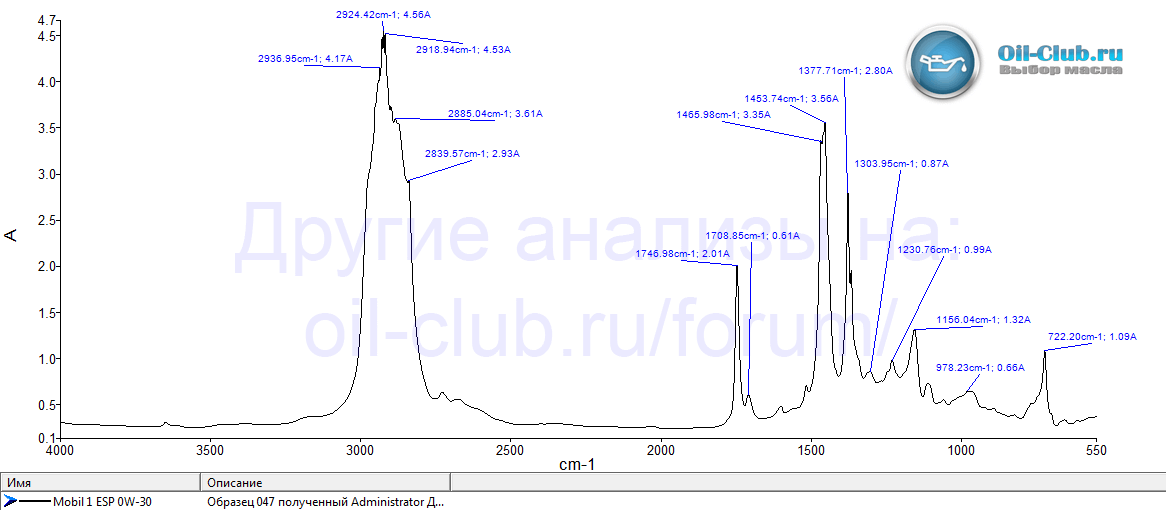
The IR spectrum (using MSDS ) indicates that the oil consists of GTL + PAO + esters + hydrocracking.
Mobil 1 ESP 0W-30 copy.gif

Conclusion: The parameters are all normal. Don't worry about the slightly elevated ash levels. They're minor. It doesn't affect speed. The oil's advantages are as follows. It consists mainly of PAO synthetics , esters, and GTL . That's why it has such a low pour point of -57°C. It has good thermal stability at high temperatures—low evaporation. It has a strong viscosity for a 0W-30 oil. The oil's only drawback is the price: 3,200 rubles for 4 liters. It's not cheap.

 
Or actually lets put it this way, from your expectation, at what milage would this engine running purely on AFE would cause an oil related problem that could have prevented if the owner instead used ESP?

Will the owner keep the car hallf that milage?
How much would he saved if he used AFE instead untill then?

Absolutely no plans on trading it in anytime in the foreseeable future. It all depends upon how it holds up to multiple cross country trips

Engine protection is more important than any fuel savings
 
The most important thing to remember is that people who use Rotella, never have any oil related issues. It's always something else, but not oil related. So, it must be very robust oil. :ROFLMAO:

I swore by rotella in my 97 Powerstroke diesel that had over 200k miles and months of idle time on it
 
Last edited:
Mobil 1 ESP 0W30 is PAO/GTl/Ester/GRIII
Mobil 1 ESP 5W30 is GTL/GrIII
Mobil 1 Advanced Fuel Economy 0w30 is GrIII.

AFE was never robust oil. It was always shear prone.

ESP 0W30 from oil.ru:
The oil is declared as: ACEA C3; VW 504 00 / 507 00; MB-Approval 229.52; MB-Approval 229.51; MB-Approval 229.31; Porsche C30.
1) A pour point of -57°C is extremely low! This means you can safely use this oil not only in Siberia but also in the Far North. It's almost impossible for this oil to freeze in the crankcase. If you've got it in your engine and you notice the starter turning very slowly when cranking, it's more likely that your battery is frozen than the oil itself.
2) The base number is 8.7 mgKOH. Slightly higher than usual. Mobil clearly uses an ashless additive, which slightly increases the base number. It's supposed to be a medium-ash oil, but it has detergent and neutralizing properties, almost like a full-ash oil. Of course, our harsh operating conditions will still negate all of this. I'd say you can extend the drain interval with it; thanks to its synthetic base, this oil will forgive you a lot. But it's still better not to tempt fate and change it after 7,500 kilometers in a gasoline engine or after 10,000 kilometers in a diesel engine.
3) The viscosity characteristics are quite strong. The viscosity at 40 degrees Celsius is high. At 100 degrees Celsius, it's 12.21. By all indications, this is a thick, strong 0W-30. If you're afraid to use this oil and think that low viscosity can cause wear, let me reassure you: this is practically the thickest 0W-30 oil. Use it with confidence, whether in winter or summer!
4) Flash point = 243C. Extremely high. 0W-30 usually has worse flash points. The culprit of such good thermal stability is the synthetic GTL and PAO base oils. 5) NOACK
mass evaporation = 9.1%. This is evaporation at a temperature of 250C within one hour. A decent value for a zero grade. The oil shouldn't burn off much, if that's what it's used for. 6) The sulfur content is 0.197% - low. The oil contains a modern additive package and is generally sulfur-free. However, the sulfated ash content is slightly higher. According to the ACEA C3 standard, it should be < 0.8%. For some reason, I think there's an inaccuracy here (I'll ask the lab). In any case, there's nothing to worry about. The excess is not significant. 8) The Infineum additive package. It contains organic molybdenum to reduce friction. Boron as an ashless dispersant. It improves the interaction of the additives with the friction surfaces and carries away contaminants when draining the oil. It keeps them in suspension. Calcium as a detergent and neutralizing additive. And phosphorus plus zinc as an anti-wear additive (ZDDP ).


The IR spectrum (using MSDS ) indicates that the oil consists of GTL + PAO + esters + hydrocracking.
Mobil 1 ESP 0W-30 copy.gif

Conclusion: The parameters are all normal. Don't worry about the slightly elevated ash levels. They're minor. It doesn't affect speed. The oil's advantages are as follows. It consists mainly of PAO synthetics , esters, and GTL . That's why it has such a low pour point of -57°C. It has good thermal stability at high temperatures—low evaporation. It has a strong viscosity for a 0W-30 oil. The oil's only drawback is the price: 3,200 rubles for 4 liters. It's not cheap.


Thanks for the education, been watching YouTube videos on oils and my Neanderthal brain is struggling with all the differences in oil

Think I’ll keep it simple and go with the 0W-30 ESP & Wix filter. Coldest one seen was -65F ground temp with -100F wind chill in a North Dakota blizzard & that was a cold one 🥶🥶🥶🥶

After this thread I ended up going with 5W-30 Extended Performance oil and a Wix XP filter


Now to figure out what oil for the daughters 22 Bronco Sport with the 1.5L, will have to start a new thread for that one 🤣🤣
 
Thanks for the education, been watching YouTube videos on oils and my Neanderthal brain is struggling with all the differences in oil

Think I’ll keep it simple and go with the 0W-30 ESP & Wix filter. Coldest one seen was -65F ground temp with -100F wind chill in a North Dakota blizzard & that was a cold one 🥶🥶🥶🥶

After this thread I ended up going with 5W-30 Extended Performance oil and a Wix XP filter


Now to figure out what oil for the daughters 22 Bronco Sport with the 1.5L, will have to start a new thread for that one 🤣🤣
Same.
 
I swore by rotella in my 97 Powerstroke diesel that had over 200k miles and months of idle time on it
Nothing is wrong with Rotella if you use it for what it's meant for and not magic potion for everything from lawn mowers to Harleys to F1 race cars.

It comes down to that people use Rotella mostly because it's cheaper than any other oil per gallon. So when day get a couple/few gallons they have oil for motorcycles, lawnmowers, chain saws, generators etc.
Then to rationalize their choice, they say it's very a robust oil with all the approvals they need.
 
Mobil 1 ESP 0W30 is PAO/GTl/Ester/GRIII
Mobil 1 ESP 5W30 is GTL/GrIII
Mobil 1 Advanced Fuel Economy 0w30 is GrIII.

AFE was never robust oil. It was always shear prone.

ESP 0W30 from oil.ru:
The oil is declared as: ACEA C3; VW 504 00 / 507 00; MB-Approval 229.52; MB-Approval 229.51; MB-Approval 229.31; Porsche C30.
1) A pour point of -57°C is extremely low! This means you can safely use this oil not only in Siberia but also in the Far North. It's almost impossible for this oil to freeze in the crankcase. If you've got it in your engine and you notice the starter turning very slowly when cranking, it's more likely that your battery is frozen than the oil itself.
2) The base number is 8.7 mgKOH. Slightly higher than usual. Mobil clearly uses an ashless additive, which slightly increases the base number. It's supposed to be a medium-ash oil, but it has detergent and neutralizing properties, almost like a full-ash oil. Of course, our harsh operating conditions will still negate all of this. I'd say you can extend the drain interval with it; thanks to its synthetic base, this oil will forgive you a lot. But it's still better not to tempt fate and change it after 7,500 kilometers in a gasoline engine or after 10,000 kilometers in a diesel engine.
3) The viscosity characteristics are quite strong. The viscosity at 40 degrees Celsius is high. At 100 degrees Celsius, it's 12.21. By all indications, this is a thick, strong 0W-30. If you're afraid to use this oil and think that low viscosity can cause wear, let me reassure you: this is practically the thickest 0W-30 oil. Use it with confidence, whether in winter or summer!
4) Flash point = 243C. Extremely high. 0W-30 usually has worse flash points. The culprit of such good thermal stability is the synthetic GTL and PAO base oils. 5) NOACK
mass evaporation = 9.1%. This is evaporation at a temperature of 250C within one hour. A decent value for a zero grade. The oil shouldn't burn off much, if that's what it's used for. 6) The sulfur content is 0.197% - low. The oil contains a modern additive package and is generally sulfur-free. However, the sulfated ash content is slightly higher. According to the ACEA C3 standard, it should be < 0.8%. For some reason, I think there's an inaccuracy here (I'll ask the lab). In any case, there's nothing to worry about. The excess is not significant. 8) The Infineum additive package. It contains organic molybdenum to reduce friction. Boron as an ashless dispersant. It improves the interaction of the additives with the friction surfaces and carries away contaminants when draining the oil. It keeps them in suspension. Calcium as a detergent and neutralizing additive. And phosphorus plus zinc as an anti-wear additive (ZDDP ).


The IR spectrum (using MSDS ) indicates that the oil consists of GTL + PAO + esters + hydrocracking.
Mobil 1 ESP 0W-30 copy.gif

Conclusion: The parameters are all normal. Don't worry about the slightly elevated ash levels. They're minor. It doesn't affect speed. The oil's advantages are as follows. It consists mainly of PAO synthetics , esters, and GTL . That's why it has such a low pour point of -57°C. It has good thermal stability at high temperatures—low evaporation. It has a strong viscosity for a 0W-30 oil. The oil's only drawback is the price: 3,200 rubles for 4 liters. It's not cheap.

Disregard, can’t delete this & will start new thread


Took a quick look at what oil Mobil 1 recommends for a 22 Bronco Sport 1.5l and am confused as they recommend the 5W-20 Extended Performance 5W-20 instead of a ESP since they don’t have a 5W-20 ESP

Will have 33k on it next oil change, would not a ESP be a better oil due to it being a hard working ecoboost 3 cylinder turbo??
 
Last edited:
Back
Top Bottom