Engine Design Features That Permit 5w20

Status
Not open for further replies.
Originally Posted By: edwardh1
Originally Posted By: MolaKule
I would add that in addition to improved parts finishing, part of it is found in the coatings (Titanium and Diamond Like Coatings or DLC), tighter temperature control, and more accurate fuel delivery and timing.


how would tighter temperature control be achieved, or how is it being achieved?


A lot is in the materials. Most aluminum blocks and heads, heat up much much faster than the iron blocks of the 70's late 80's. that moves you out of the boundry/ mixed lubrication region faster.
 
Originally Posted By: JHZR2
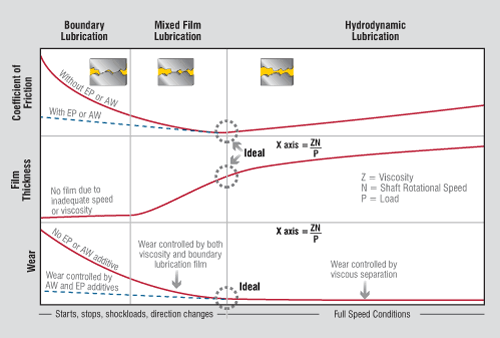
Go back and learn hydrodynamics, the nature of the wedge, and the influence of boundary lubrication. There is a reason why we have EP and AW adds, and why we see a minima in wear on the Stribeck curve when we hit the point between mixed film and hydrodynamic lubrication. Within the engine the fluid velocity transitions into steady flow, any shear-induced thinning occurs, there is local heating, viscosity decreases, etc. Given the bearing size, clearances, pump flow and pressure, and so on, it seems to not be a practical issue for all intents and purposes.

It's valid to consider that oil is dynamic, especially over the OCI and conditions incurred. That's for sure. But IMO that has also been part of the consideration set in engineering and specifying a lubricant to do a job. One of the comments when people were transitioning from 5w30 to 5w-20 oils was that the 30wt oils often sheared down into a heavy 20, so people HAVE been running lighter oils for a long time and not known it. The intent of that comment was to show that if the 5w-20 oils coming on market are shear-stable, then it is no different than what ran in most sumps for the last 1500+ miles anyway for years and years past.

UOA is no newfangled technique. Engine manufacturers and lubrication engineers know what an oil will look like after a relevant amount of shearing, heating, oxidation, etc. These are all knobs which can be turned (look at older versions of Mobil 1 0w-40 which competed shearing with oxidation to maintain a 40wt A3 oil) as part of the lube design. The engine builders know what they need to know - Viscosity, rotational speed and load. From Noria:

Exponent_37.gif


This stuff is easily calculated for designs and across the lifecycle of the engine and lubricant. There is sufficient variability in lube options that the "right one" can be specified or a specification can be written to make it work.

Example: is 10w-60 REALLY necessary for an M engine? Maybe really a 50wt is necessary, but given the characteristics of service interval and available lubricants, the 10w-60 was selected to provide the maximum "time at rated condition" (which is what engineering stuff is really about) to provide "design life at rated condition". That is the end game and goal. To do that, as cheaply as possible, with just enough overdesign to ensure optimal MTBF/MTBO and customer satisfaction without costing too much in NRE, parts, labor, etc.

But again, go back and check your knowledge of the Stribeck Curve. At startup and until that pressure wedge occurs in a journal bearing, you are purely talking boundary lubrication. Once you get bast the boundary phase and the flowing lube can inherently create its own wedge and lift off, youre pretty set with hydrodynamic lubrication. Better manufacturing yields better surface finishes which minimize the need for as much film thickness due to less surface roughness, and then a proper boundary lubricant is necessary prior to liftoff to ensure that the surfaces are protected.

IMO better base stocks with better overall film strength, coupled with the purpose-specific additive on the surface providing the boundary lubrication, allows for a wider range of safe operation versus relying upon the component that inherently makes up the hydrodynamic wedge once lifted off.

I think that for the most part, statistically significant information has suitably indicated a non-issue using the specified lube for the specified interval in ones' engine. That does not mean to pack up shop and go home, but it does generally mean that using the recommendation is a fair approach that has been successful, and optimization, if any, is generally done more for sport/hobby than to see practical longevity improvements.


Wow, great information. Thanks for taking the time to write that out for us.

 
Originally Posted By: m6pwr
I'm getting a 2015 Mustang GT with the port injected naturally aspirated V8 (435 hp, 400 lb ft torque). Ford spec's 5w20 synthetic for this motor. Coming from BMWs, I'm used to thicker oils (10w60 for na M cars, and 5w30/5w40 for the latest turbo motors). What design features in a high rpm performance engine would allow the use of such a relatively thin viscosity oil as a 5w20?


You got a bunch of very interesting information that is interesting but it doesn't answer your question.

There are two reasons Ford can spec 5w-20: first, they've been using 5w-20 for a decade in production engines, so their engineers know intimately the strengths and weaknesses of the engine-and-lubricant regime. The second reason is that your 435HP Coyote is making 0.84 HP/liter at around 6000RPM, while a BMW S65 makes 1.04 HP/litre at around 8000RPM. The stresses and loads in the Ford engine are much lower and that's why they can use an oil that's more commonly used in grocery getters.

Ford does spec 5W-50 for the Boss 302 and the GT500, and those engines produced more power, either by spinning faster (the Roadrunner) or with forced induction (Trinity).
 
Originally Posted By: jaj
. The second reason is that your 435HP Coyote is making 0.84 HP/liter at around 6000RPM, while a BMW S65 makes 1.04 HP/litre at around 8000RPM. The stresses and loads in the Ford engine are much lower and that's why they can use an oil that's more commonly used in grocery getters..


In the higher specific output engines, all a designer would need to do is design the bearings in the crank pin, rod bearings, and crank bearings with more surface area. Its not the load force, its the load pressure on the bearings. Until you know load pressure, you don't know what viscosity can safely be used without excessive wear.
 
Originally Posted By: fredfactory
Originally Posted By: jaj
. The second reason is that your 435HP Coyote is making 0.84 HP/liter at around 6000RPM, while a BMW S65 makes 1.04 HP/litre at around 8000RPM. The stresses and loads in the Ford engine are much lower and that's why they can use an oil that's more commonly used in grocery getters..


In the higher specific output engines, all a designer would need to do is design the bearings in the crank pin, rod bearings, and crank bearings with more surface area. Its not the load force, its the load pressure on the bearings. Until you know load pressure, you don't know what viscosity can safely be used without excessive wear.


That's one factor, for sure. Otherwise, there was a press piece on the development of the Boss 302 Roadrunner engine that said that Ford had problems with the crankshaft aerating the oil at the increased redline of that engine, so they'd switched to a full synthetic 5w-50.
 
If you look carefully at the intended use of the car the specs reveal their true source.

Application is the critical detail. Identical engines can need drastically different viscosities at higher temps and loads encountered in road racing for example...
 
Last edited:
Originally Posted By: SteveSRT8


Application is the critical detail. Identical engines can need drastically different viscosities at higher temps and loads encountered in road racing for example...


Exactly, which is why one size fits all intended uses, in all climates, might not be such a good idea. But we've been down this road before...............
 
The Best answer I heard was these engines will run on a multitude of oils. I just can not wrap my brain around the use of thinner oils such as 5w20 has any advantage but fuel mileage. Too many people, some how think American engineers have some secret super idea of knowledge and if they told you to spit in the oil filter before installing it, 80% of people would do it because they told you to in the manual, 10% would be too lazy and 10% would say that's as rediculas as using 5w20 for added benefits of lubrication. They would and claim the increased hydrogen in your saliva cleans the valves. If you want better wear and longer life, go with a thicker oil. I have found in "Real Life" of using 5w20 v.s 10w30, the fuel mileage wasnt anything significant.
 
Originally Posted By: JHZR2

IMO better base stocks with better overall film strength,


Thank you,

I've been in an argument with Shannow on this for a long time.

There was a really good post years ago explaining why longer synthetic molecules produce a higher film strength for its viscosity. It must have been from a PhD at an oil company.

It has to do with the molecules lining up in a reptilian fashion to produce an effectively super high film strength/viscosity right before boundary space. I believe it.

I don't think any manufacturer wants to see failed engines to save gas. They really don't care about environmental issues. They want to produce a better engine than the competition.

And they don't design engines for light oils. They design engines to be as small, light and powerful as possible. That's why you see GM still using pushrods, providing the smallest footprint to get in a small low slung car like the vette. That front of that thing is so low its hard to believe a massive 6.2 to 7 liter engine is in there.
 
Originally Posted By: edwardh1
Originally Posted By: MolaKule
I would add that in addition to improved parts finishing, part of it is found in the coatings (Titanium and Diamond Like Coatings or DLC), tighter temperature control, and more accurate fuel delivery and timing.


how would tighter temperature control be achieved, or how is it being achieved?


Better quality thermostats, electronic control of thermostats, more accurate timing and fuel control.

Keeping the water temperature from spiking moderates oil temperature, keeping the oil film from thinning.
 
Originally Posted By: MolaKule


Keeping the water temperature from spiking moderates oil temperature, keeping the oil film from thinning.


I'm going to disagree with that. There is not a hard correlation between water and oil temps. The water temp is based on heat sinking from the block. The oil temp is based on heat sinking oil from bearings, rings, and the bottom of the piston which rivals the hottest temperature anywhere in the engine.

I witnessed my 455 olds jet boat running 300deg oil temps at 6000 rpm when the block was dead cold to the touch. I simply turned up the cooling water from the jet till the block was ice cold thinking that would keep the oil cool. It didn't.
 
Originally Posted By: Shannow
It doesn't lead to a "pile of failed engines" as some people seek, just engines that don't outlive their chassis by as much as they could, and use a few hundred gallons less fuel doing it.


If the engine will last "long enough", then seeing how outside the US both fuel is more expensive and people are more concerned about the environment, why haven't these other countries moved to thinner oil, especially on "world engines"?
 
When you consider that GM listed 20W-20 among the recommended grades at ambients above 20F with no upper limit fifty years ago, I'd say that no particular engine design changes were needed.
For those who think that I'm just pulling this out of my hat, I've got an OM for the 1974 Cutlass in front of me, a car available with either a 350 or 455 CID engine.
These weren't Chevy engines back in 1974, either.
If a twenty grade oil worked way back when, why wouldn't a 5W-20 with vastly better performance work now?
It's not as though the Mustang will be spending all that much time at full chat, unless you track it and anyone tracking the car would already be using Mobil 1 0W-40 in any event.
If you're going to void the warranty by tracking the car, you might as well use an appropriate oil for the conditions.
 
Originally Posted By: fdcg27
When you consider that GM listed 20W-20 among the recommended grades at ambients above 20F with no upper limit fifty years ago, I'd say that no particular engine design changes were needed.


As I've pointed out a number of times, a straight "20" would be classed by the thin oil proponents on the board as "really a 30" (for examples see the discussions from prominant thin advocates on Redline's 20s and 30s).

a 20W20 would have an HTHS of 2.9, over 10% thicker than a modern economy xW20 with a minimum 2.6 HTHS.

So I'm happy to say that a 57Chev would be comfortable on an XW30 ILSAC, 2.9 min HTHS, but not necessarily a modern 20.
 
Wouldn't this help compensate for that 10%?

Originally Posted By: JHZR2
IMO better base stocks with better overall film strength, coupled with the purpose-specific additive on the surface providing the boundary lubrication, allows for a wider range of safe operation versus relying upon the component that inherently makes up the hydrodynamic wedge once lifted off
 
Pertinent to the discussion

http://dwolsten.tripod.com/articles/sep93a.html

Quote:
Two and a half years ago, when the engine team began developing the new 1.8-L VTEC engine, it had to limit its highest sustainable speed to 7500 rpm and maximum power output to 125 kW. "Our initial reaction was, 'The senior Prelude's 2.0-L VTEC's limit is 7400. So it should be high enough,'" says the senior engineer. Obstacles were known to us. "Stroking of the 1.6-L engine by 19% to obtain 1.8-L would have been accompanied by a 20% increase in load of such vital components as the crankshaft. Our data on the 1.6-L's crankshaft indicated that it would not stand up to that kind of load. Nor would the connecting-rod bearing metal." Widening the bearing metal would have made it withstand the load, but that would have further reduced the crankshaft's strength, which had to accommodate the wider bearings within a set length. Attainable and allowable piston speed is really determined by the fine balance between the crankshaft and connecting-rod bearing performances.

At about the same time, at another corner of Honda's Wako R&D Center, a group of advanced engine designers and engineers were striving to get another engine to combine high-rpm power and reliability under very demanding operating conditions–Formula One racing. Lack of reliability had for some time been plaguing the naturally aspirated, 3.5-L, V12 engine.

To remedy the problem, a team of Honda metallurgists/engineers created a highly seizure-resistant overlay on the bearing's sliding surface using a unique electrodepositing of tetra-methyl lead, Pb (h00). The highly oriented Pb surface has a composition of myriad minuscule pyramids, which possesses outstanding "wettability" or lubricant-retaining properties. Honda claims it has given a 30% or higher increase in the anti-seizure parameter, PV, than a surface with conventional deposits.

In August 1991, Soichiro Honda passed away. The Wako engineers' way of expressing homage to the late founder was to win the next Formula One race–the Hungarian Grand Prix of that year. The new highly oriented crystal bearings were used in the Honda V12 which propelled a McLaren racer to its long overdue victory.

The beauty of this bearing was that it was cost-competetive. It was subsequently adopted in the Legend's new longitudinal V6 engine. In the B18C, it enabled the engine designers to reduce the connecting-rod bearing width from the B16A's 19.5 to 17.5 mm. Two millimeters shaved off each connecting rod journal is added to the crankshaft webs flanking it, giving the crankshaft the extra strength it needed.

Furthermore, with the new bearing material, Honda was able to revert to a low-vicosity, low-friction lubricant (the smaller B16A VTEC is specified with a higher-viscosity one), that contributes to improved fuel economy.
 
Quote:
.

" Widening the bearing metal would have made it withstand the load, but that would have further reduced the crankshaft's strength, which had to accommodate the wider bearings within a set length.


I keep hearing people here say just widen the bearing for thinner oil. And as I've explained they don't have that luxury. It makes the engine longer and heavier.

How many times have I said that?

Thanks for the info Shannow
 
Originally Posted By: Evanson
Wouldn't this help compensate for that 10%?

Originally Posted By: JHZR2
IMO better base stocks with better overall film strength, coupled with the purpose-specific additive on the surface providing the boundary lubrication, allows for a wider range of safe operation versus relying upon the component that inherently makes up the hydrodynamic wedge once lifted off


Yea
 
Originally Posted By: SteveSRT8
If you look carefully at the intended use of the car the specs reveal their true source.

Application is the critical detail. Identical engines can need drastically different viscosities at higher temps and loads encountered in road racing for example...


This is an important point not just for the performance/racing discussion, but also for the world use discussion.

Roads in the USA are set up one way, with traffic patterns, use profiles, load characteristics, etc a certain way. Plus an ambient temperature range which is pretty wide.

Other places in the world have other speed limits, use profiles, etc.

Not to mention that in other places in the world, fuel quality, lube oil quality, OCIs, etc may all differ.

Further, we love to blame CAFE, but if in the rest of the world the consumer bares more of the injury of low efficiency and lower MPGs, then the vendors may not necessarily care and stay with a status quo.
 
Status
Not open for further replies.
Back
Top Bottom