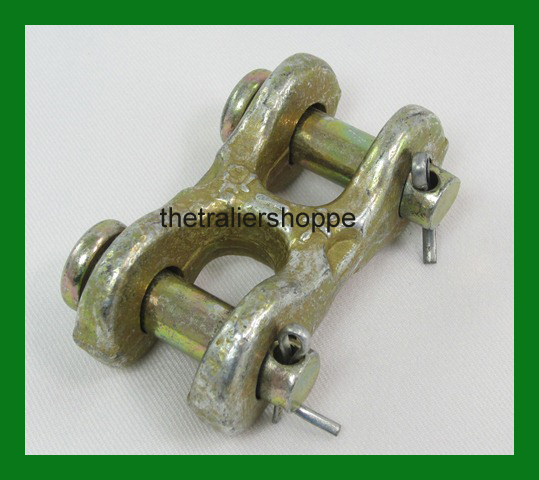
Correct hardware to loop a chain on itself

Status
Not open for further replies.

JHZR2

Staff member
Joined
Dec 14, 2002
Messages
56,028
Location
New Jersey
Not sure of the exact lingo, essentially I want to wrap a 3/8” chain around a post and have it connect back on itself. I can imagine that after making the chain loop, thentwo connecting links could have a bolt put through them, and tightened down with washers on both sides. That said I assume there’s a correct way with the right hardware. What is it?

Thanks!
 
Are you pulling the post or attaching the chain permanently? If you just want to use it to fasten a chain around stuff to pull with, what you're looking for is called a "grab hook". It has a long thin slot as opposed to a round hook and needs to match the size of your chain.
 
Are you talking about a chain repair link?
1637325175676.jpeg
488Y73_AS02
020418192593.jpg
THH17-1.jpg
8d0d3ca947a59cc405cc6deea158f9846b8b4ed2_307_1013094_L.jpg
 
John - it would be of great benefit to you if you told us exactly what you intend to secure, why, and what grade of chain you actually have. Then we can advise you better.

A typical 3/8" chain is a pretty hefty thing ... depending upon grade it can be anywhere from 2600 to 8800 lb rated for load. I'm sure there are some variations in these ratings, but overall you get the idea:
https://blog.uscargocontrol.com/working-load-limits-chain/

Assuming you're wanting a quasi-permanent connection (you said "bolts" which don't remove quickly), you need a quality of connector that matches or exceeds the working load rating of the chain itself.

In the post above by doitmyself, there's an image with a pin-link connector (seen in the green highlight box). That is by far the safest of the choices above, if you'd be anywhere near the WLL of the chain you have. Don't "bolt" chains together (don't put a bolt through the inside of the links with washers to join them; not a safe method if any real loading is occuring!).
 
John - it would be of great benefit to you if you told us exactly what you intend to secure, why, and what grade of chain you actually have. Then we can advise you better.

A typical 3/8" chain is a pretty hefty thing ... depending upon grade it can be anywhere from 2600 to 8800 lb rated for load. I'm sure there are some variations in these ratings, but overall you get the idea:
https://blog.uscargocontrol.com/working-load-limits-chain/

Assuming you're wanting a quasi-permanent connection (you said "bolts" which don't remove quickly), you need a quality of connector that matches or exceeds the working load rating of the chain itself.

In the post above by doitmyself, there's an image with a pin-link connector (seen in the green highlight box). That is by far the safest of the choices above, if you'd be anywhere near the WLL of the chain you have. Don't "bolt" chains together (don't put a bolt through the inside of the links with washers to join them; not a safe method if any real loading is occuring!).

Sure. I need to do some renewal of roof rafters and rafter ties/collar ties on an old building I own. I want to (very slowly) bring a bit of inward pressure on the top of the studs (balloon frame building, unfinished) and top plate. Thus the intention is a 4x4 on the exterior of the building on both sides, chains wrapped around the 4x4, turnbuckles in the middle.

Had originally thought about multiple straps, 3000lb rated type with ratchet, but they have more flex, and the release is always more of a “pop” then the gentle unloading you get from turning a turnbuckle.

So I want to be able to loop the chain around the 4x4, and then have it cooled back on itself, like there’s a loop in the chain that goes around the 4x4. The issue is thst most caribiners and other type links don’t have the weight rating of the turnbuckles (3/4”) or chain (3/8“ 43 or better, rated for >4000 lb) that I intend to use for safety.

I anticipate pulling the studs inward a bit, as there is some bow. This will help raise the ridge slightly so I can put in a new rafter where one is missing, and one is warped.

So that’s the plan, amd I want to ensure that I loop the chains with something of sufficient strength that it isn’t the weak point…
 
You might consider using heavy nylon straps (which can easily support 4000# static loads) as they will be less likely to mar your lumber.
Straps were an initial thought, but the issue is that ratcheting them, or more specifically, untensioning them, can result in shock or pop loads when the unit comes loose. If they’re under a lot of tension it can become hard to get them to loosen in a smooth manner. The ratcheting can also require more pull than is desired at any one time, and the straps stretch. Chains with turnbuckles can be tightened very gradually, the chains don’t stretch, and if one fails, it will fall, not whip.

That said, if I can find a way to do straps, I would entertain it. Even better if I could pull the walls in from the inside. Not sure I can, the only way would be a ledger board screwed in, and it could pull out with bad consequences. Thus why I want to pull against solid lumber from the outside of the building.
 
That’s just a temporary rigging to apply tension until braced ?
If you have enough chain - a double half hitch will hold … (used them many times) …
 
That’s just a temporary rigging to apply tension until braced ?
If you have enough chain - a double half hitch will hold … (used them many times) …
More or less. Temporary is relative. I think it’s going to be 1/8” per day…. Maybe less. It took years for the old balloon frame to take a set, so I want to go slow. Then I’m going to redo the roof, as there’s at least two layers on… remove the weight. Replace a bowed rafter, life the ridge slightly, reset rafter ties and install collar ties that aren’t there. So lots of work over a few months I’d guess.
 
I still don't quite understand your process of pulling the walls in from the outside. The weight-rated grab hooks ripcord first mentioned is the proper way to connect chains. Sometimes I have wrapped the hooked chain with duct tape or baling wire to keep them together when under slack (need to always confirm they are properly engaged every time you retighten).

You could have very short chains looped around the 4 x 4 and then connect longer chains/cables to the loops.

Very long chains will be heavy, sag a lot, and be more difficult to remove the initial sag/slack.

Would ratcheting chain binders work:
38-transport-chain-and-binders-grade-70-20-foot.01_420x.jpg


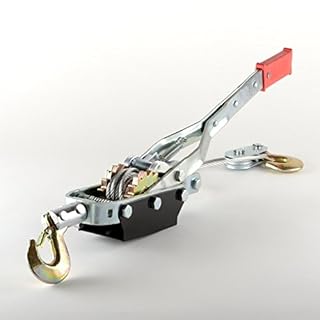
What about heavy duty come-along:
41CTB%2BI3-JL._UL320_.jpg


Youtube using chain and binders:
 
Last edited:
I am sure this is a "NO NO" BUT my Dad just ran a pair of BOLTS thru the chain eye to secure them when no hook was available. Grade 5 bolt with washers and two nuts that bind each other on the thread to wrap it around a tree, etc.

Keep in mind we are pulling no where near half the capacity of the chain.
 
I still don't quite understand your process of pulling the walls in from the outside. The weight-rated grab hooks ripcord first mentioned is the proper way to connect chains. Sometimes I have wrapped the hooked chain with duct tape or baling wire to keep them together when under slack (need to always confirm they are properly engaged every time you retighten).

You could have very short chains looped around the 4 x 4 and then connect longer chains/cables to the loops.

Very long chains will be heavy, sag a lot, and be more difficult to remove the initial sag/slack.

Would ratcheting chain binders work:
38-transport-chain-and-binders-grade-70-20-foot.01_420x.jpg


What about heavy duty come-along:
41CTB%2BI3-JL._UL320_.jpg


Youtube using chain and binders:

Essentially this:

4BDF2F03-F792-4BEF-875A-3E4FDCAE2E8E.jpeg


Something along those lines.

While it would be worlds easier to screw a ledger onto the top plate and studs from the inside, and pull the top together, then I’m limited to the pullout strength of the bolts and wood. Pulling in from the outside means wood on wood crossing many studs.

The issue with come along sand ratchet straps is a few:
1) one ratchet click may be too much pulling in at a time.
2) once tensioned, release of ratchet devices usually involves a rapid release, and a pop. Not good for the structure I’m trying to pull in very slowly and carefully
3) straps stretch
4) straps and wire rope whips when it fails
5) pulling from the inside means I’m limited to the pullout strength of the lag bolts or other fasteners

That’s my logic. Open to other opinions though.
 
Excellent diagram. That makes things a lot clearer. I assume you are going to add joists between the cripple walls to keep them from pushing back out?
 
So the ratcheting action of a come-along is too much at once?

Amazon has a 1/2" galv turnbuckle for $25. Then chain or tow straps out to the 4x4 wood. Shackles as needed.

You could use a 1/2" eyebolt with the nut, washer and 4x4 on outside. Not one threaded like a lagbolt. Rather than wrapping chain or a strap around the 4x4.
 
So the ratcheting action of a come-along is too much at once?

Amazon has a 1/2" galv turnbuckle for $25. Then chain or tow straps out to the 4x4 wood. Shackles as needed.

You could use a 1/2" eyebolt with the nut, washer and 4x4 on outside. Not one threaded like a lagbolt. Rather than wrapping chain or a strap around the 4x4.
Eye bolt weight ratings always seem very low compared to the chains and other parts.
 
Would a small chain winch work?
I still need all the connecting points to be rated correctly. I think I’ve found large lifting eyes that I’d put though the 4x4, then connect via shackles.

Right now the issue is finding all the right size parts that meet the loading requirements. The shackle posts and parts need to fit the ID of the chain.
 
A logging chain with a hook won’t work? I’d just loop it back to itself but never looked at the actual ratings of doing that.
 
Status
Not open for further replies.
Back
Top Bottom