Any harm from Motul 300v?

Status
Not open for further replies.
I also had similar interrogations regarding Mobil 1 vs 300V ; completely different engine and car (although it can take a bit more than 7000rpm), but I am currently using Mobil 1 0W40 in my Barchetta, and the engine is running smoothly at medium range rpm, but a bit more noisy above 5000rpm than with previous Total 5W40 oil. I ran Mobil 1 because I found some very cheap, and to clean things a bit after years of abuse, over 300V.

I am going to try 300V oil next time, just because it is not much more expensive than Mobil 1 for me, and because I am curious. My car also sits for days/weeks, and cold start are sometimes a bit rough and noisy, at least with Mobil 1. Will see how 300V does!

300V 0W40 is actually thinner than Mobil 1, but 300V 5W40 (or 10W40) sounds perfect with high HTHS for your car.

I am also currently using Motul 300V 0W40 in my Colt with great success, the engine is smoother than with previous fill (Shell HU 5W40 and Petronas 5W40), cold start are easier (normal considering 0W vs 5W), but once again completely different car and engine, and one which doesn't like to rev high! All in all I am very satisfied with 300V in the Colt, but haven't done any UOA yet. Still I probably won't went back to other oils in this car.
 
Originally Posted By: bobbydavro
Esters may cling, but they wont maintain oil pressure which is what bearings need. Certainly moving to a thinner oil will help bearings get pressure sooner but dont forget the 10W-60 is almost a 5W already.

'I will simply say that, in my opinion and in the opinion of many people whom I respect, the rod bearing clearances on this car are extremely tight and I agree with the many people who have moved to a thinner oil as a remedy for this issue. '

What is the issue with this? sorry I've not really read much about this engine / oil on the forums.


doodf00d nailed it. Basically, BMW took the recommended clearances from their supplier, Clevite, and cut them in half. (Actually, less than half.) Lots of engines are having rod knock or ticking from the bearings at very low mileages. A smaller number are actually popping. Virtually every set of bearings that have been pulled from these cars range from pretty bad to extremely bad. And these are cars with 20,000 to 60,000 miles. I pulled mine at 36k and they looked very bad. And I am someone who religiously waits for the oil to get up to 210 F before exceeding 3k RPM and changes his oil often. It's nuts.

I'm curious why you say ester-based oils won't maintain oil pressure? Wouldn't oil pressure be a function of the oil weight and its viscosity, not the base stock? Please elaborate if you can. Thanks!
 
Originally Posted By: Hujan


I'm curious why you say ester-based oils won't maintain oil pressure? Wouldn't oil pressure be a function of the oil weight and its viscosity, not the base stock? Please elaborate if you can. Thanks!


That's exactly what he's saying.... base oil doesn't matter if the viscosity is wrong
 
Originally Posted By: Jetronic
Originally Posted By: Hujan


I'm curious why you say ester-based oils won't maintain oil pressure? Wouldn't oil pressure be a function of the oil weight and its viscosity, not the base stock? Please elaborate if you can. Thanks!


That's exactly what he's saying.... base oil doesn't matter if the viscosity is wrong


I'm not sure that's what he said. He said, "Esters may cling, but they wont maintain oil pressure which is what bearings need."

His comment regarding oil pressure (like cling ability) was thus a reference to esters generally, regardless of weight.
 
I think the reference is to a cold engine start. I think he is saying a bearing needs oil pressure for lubrication, which only happens once the engine is going.

Other things like tappets maybe different, in which case, the clinging esters may help with start-up. I think the comment was that esters help with some things, but not everything, on start-up.

Happy to be corrected.
 
I think the esters are a bit of a distraction here - are not going to give some magically benefit and they are likely to be relatively low treat. Often Di-esters are used to improve solubility of a formulation, they tend to be a little too attracted to metal surfaces and can displace other chemistry fighting for the surface

A bearing needs oil for it create its own hydrodynamic 'wedge' this creates high pressure in the bearing itself to allow it to support the forces from combustion.

and with a bigger bearing clearance you allow a larger angle in the converging wedge within the bearing and the higher the load the bearing can take. However big clearances cause increased internal friction, work the oil pump harder and benefit from thicker oils. Too thin and you get low oil pressure (gallery). Why BMW seem to have the clearances so tight I dont know. But I cant imagine thicker oil causes any issues. Fuel dilution is the number one enemy for viscosity drop and hard driven cars can get very high dilution, this seems to get ignored and actually driving on a motorway after say a track day will boil off a lot of this fuel.

For cold starts after a long time - Whether there is ester or not, it wont offer protection until the bearing has sufficient flow to allow it to create its own pressure via the wedge, the esters used in most formulations are no better for protecting surfaces than dedicated chemistry.

Antiwear chemistrys don't tend to work too well, friction modifiers offer a bit of help but its basically a water skier not moving until the oil arrives. VM can help as it likes to hang around

I read a bit of that link, and note comments about needing a low viscosity oil for startup. This is where he mentions potentially a 5W, however the 10W-60 is pretty good in cold flow more (like a 7.5W if one existed) and HTHS is around 5.1cP.

Its very difficult to know whats thinner in the context of bearings. HTHS is relatively low shear compared to a 6000rpm + engine bearing. Different VMs (VIIs) work differently in the bearing environment and ou can often end up relying more on the base oil viscosity rather than the 'VM boosts' viscosity. This is why I would be a bit cautious to move to a 0W grade.
 
Last edited:
Following on from bobbydavro...

Big ends get their lubrication passing through the mains. I'd be disinclined to choose an oil that provides lower oil pressure at high revs, as there will be less available to overcome some of the forces that reduce flow to big ends...but I doubt any of the selections that you have will markedly change that.

When supply is adequate, the supply to the bearings doesn't force oil into them, it's just a supply. The bearings leak oil out the side clearances, and the bearing draws sufficient oil to replace it.

At revs, the higher HTHS oil will have less side leakage, and thus less make-up draw from the galleries (which is how oil pressure is formed, it's an artifact of the bearings needing less than the supply volume). However, this means that more of the oil spends more time in the bearings and runs a little hotter...meaning it thins some.

There is some self compensation but the higher HTHS oil will nearly always have higher minimum oil film thicknesses, even though it's operating a little hotter.

I've put a lot of thought into the BMW issue, and I think that was BMWs intent in speccing the 10W60, to get that little margin when their design glitch causes things to fail...I don't beleive that the 40s will help in providing "better flow", as that's not how the things work.

I'd make the pick based on HTHS, and picking one at the upper end for this engine.

You could go nuts with Mobil 1 V-Twin, which is in the 6 range, nearly all base oil effect and little action from the VIIs...not my recommendation, but a possibility...buckets of additive in that one too...

Mobil's 15W50 is advertised at 4.5cP, sort of where I'd consider starting personally.

Originally Posted By: bobbydavro

Its very difficult to know whats thinner in the context of bearings. HTHS is relatively low shear compared to a 6000rpm + engine bearing. Different VMs (VIIs) work differently in the bearing environment and ou can often end up relying more on the base oil viscosity rather than the 'VM boosts' viscosity. This is why I would be a bit cautious to move to a 0W grade.


Agree wholeheartedly.
 
Thanks, bobbydavro and Shannow, for your legitimately knowledgeable and high-level posts. What a breath of fresh air on this forum!
 
Originally Posted By: SR5
I think the reference is to a cold engine start. I think he is saying a bearing needs oil pressure for lubrication, which only happens once the engine is going.

Other things like tappets maybe different, in which case, the clinging esters may help with start-up. I think the comment was that esters help with some things, but not everything, on start-up.

Happy to be corrected.


Thank you for that. That makes more sense.
 
Originally Posted By: Shannow
Following on from bobbydavro...

Big ends get their lubrication passing through the mains. I'd be disinclined to choose an oil that provides lower oil pressure at high revs, as there will be less available to overcome some of the forces that reduce flow to big ends...but I doubt any of the selections that you have will markedly change that.

When supply is adequate, the supply to the bearings doesn't force oil into them, it's just a supply. The bearings leak oil out the side clearances, and the bearing draws sufficient oil to replace it.

At revs, the higher HTHS oil will have less side leakage, and thus less make-up draw from the galleries (which is how oil pressure is formed, it's an artifact of the bearings needing less than the supply volume). However, this means that more of the oil spends more time in the bearings and runs a little hotter...meaning it thins some.

There is some self compensation but the higher HTHS oil will nearly always have higher minimum oil film thicknesses, even though it's operating a little hotter.

I've put a lot of thought into the BMW issue, and I think that was BMWs intent in speccing the 10W60, to get that little margin when their design glitch causes things to fail...I don't beleive that the 40s will help in providing "better flow", as that's not how the things work.

I'd make the pick based on HTHS, and picking one at the upper end for this engine.

You could go nuts with Mobil 1 V-Twin, which is in the 6 range, nearly all base oil effect and little action from the VIIs...not my recommendation, but a possibility...buckets of additive in that one too...

Mobil's 15W50 is advertised at 4.5cP, sort of where I'd consider starting personally.

Originally Posted By: bobbydavro

Its very difficult to know whats thinner in the context of bearings. HTHS is relatively low shear compared to a 6000rpm + engine bearing. Different VMs (VIIs) work differently in the bearing environment and ou can often end up relying more on the base oil viscosity rather than the 'VM boosts' viscosity. This is why I would be a bit cautious to move to a 0W grade.


Agree wholeheartedly.


Thank you, Shannow and bobbydavro for your posts. You are clearly very knowledgeable on this subject. It sounds like both of you actually like the Castrol TWS in this car. If so, I'm curious what you think might be behind the widespread premature bearing wear in these engines (taking as true that it exists).
 
Originally Posted By: bobbydavro
Auto stop technology could be a potential reason. Many OEMs have moved to polymer bearings.


I'm not so sure that explains these results. The auto start/stop feature didn't show up until sometime in MY 2010 and it is disabled by default. I don't know anyone who activated it. I'm sure there's some but it can't explain the breadth of the bearing wear we're seeing with these cars and across all model years.
 
Here's a question: is there any engine with comparable piston speeds and internal stresses that DOESN'T eat bottom end bearings at a higher-than-average rate?
 
Originally Posted By: d00df00d
Here's a question: is there any engine with comparable piston speeds and internal stresses that DOESN'T eat bottom end bearings at a higher-than-average rate?


GT3/GT3RS?
 
I mean, if we have to go to Porsche's best engines to find examples, I feel like that kind of proves the point.

...But don't those engines have relatively short rebuild intervals, too?

I was thinking S2000. Not sure how well those engines hold up.
 
Originally Posted By: d00df00d

I was thinking S2000. Not sure how well those engines hold up.


They are amazing. Last forever. I've got 183K on mine, still smooth and powerful. Lots of similar stories. Honda doesn't recommend anything exotic in them, just API SJ conventional 10w30 oil in my 2001.

robert
 
Originally Posted By: d00df00d
I mean, if we have to go to Porsche's best engines to find examples, I feel like that kind of proves the point.

...But don't those engines have relatively short rebuild intervals, too?

I was thinking S2000. Not sure how well those engines hold up.


There have been bottom-end issues with them, but no where near as prevalent as the issue with the M3.
 
Originally Posted By: Hujan
It sounds like both of you actually like the Castrol TWS in this car. If so, I'm curious what you think might be behind the widespread premature bearing wear in these engines (taking as true that it exists).


I've got no dog in the fight really, I just think that BMW specified it to mask an inherent problem. Thus I wouldn't really want to stray too far from what they recommend as a bandaid.

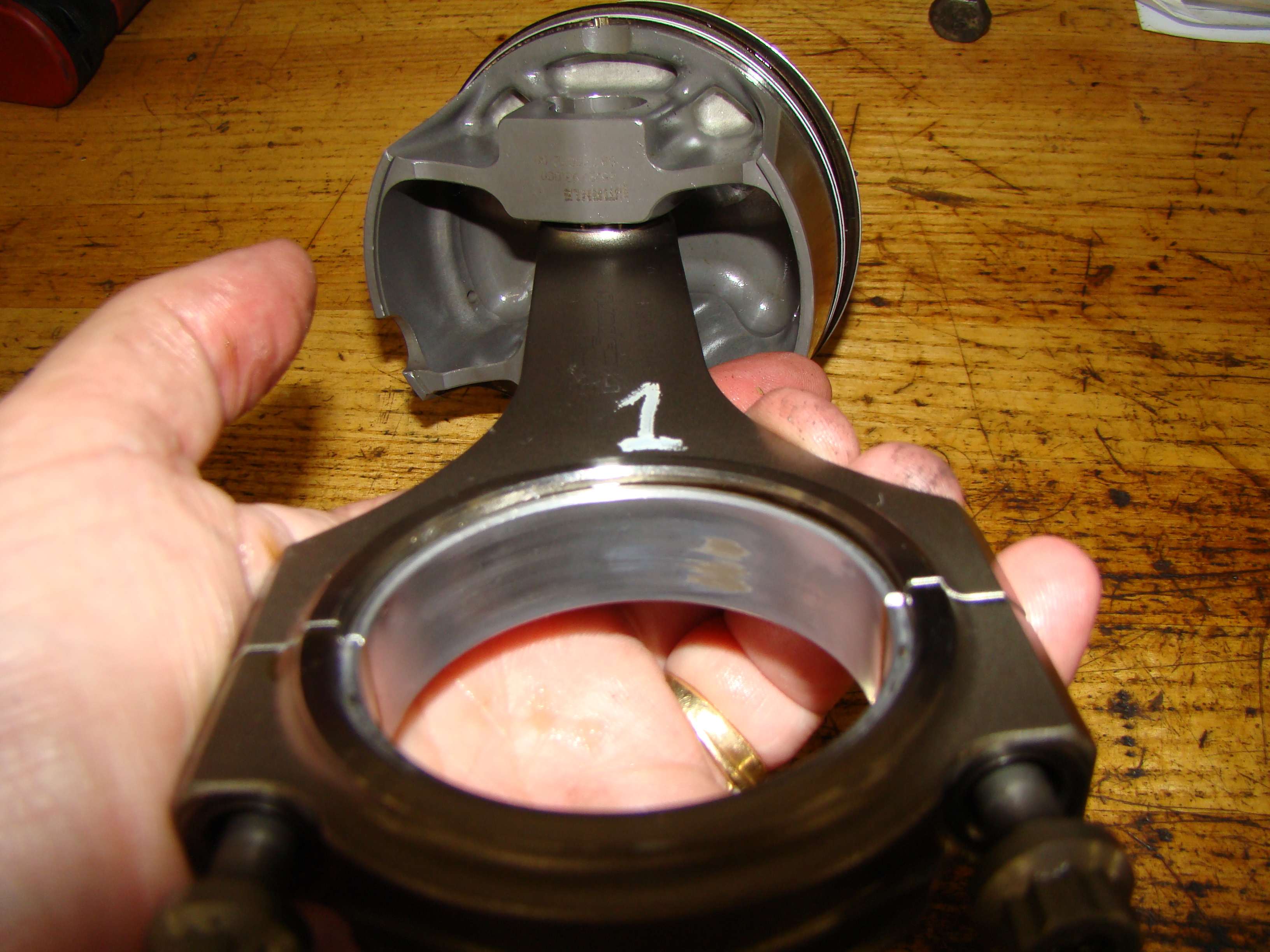
Checked the link that doodfood provided, and didn't like the shiny "bearing surfaces" on the sides of the big end. Clearly there is touching when running...and that's a no-no.

DSC04273.JPG


The oil has to escape this area and not be trapped. By trapping it, the oil that's escaping the high pressure areas (the areas of that are wiped) will be more likely to be recirculated back to the unloaded side where the fresh oil comes in.

End result is that the bearing thinks it's getting a higher supply oil temperature.

Here's what supply temperature and RPM do in a big end...popular misconception is that the oil "carries away heat", but it's actually largely generated within the bearing through viscous drag.

big%20end%20temperature.jpg


The number on the right axis is the big end oil supply temperature, the number on the left is bearing temperature...the oil exit temperature is higher. If the bearing was rained properly (adequate side clearance, the bearing temperature is the average of the supply and exit temperatures.

The "150C supply" temperature is missing the "full load" piece at the top end because it failed, and failed repeatedly in the paper (title at the top of the pic)...They survived at light/medium loads, even at high RPM...couldn't cut it when the full load was applied.

I think that the failures are a perfect storm of radial clearance, side clearance, and piston/bore alignment, causing overheating and failure of the oil film...

The oil with high HTHS is there to bandaid that if possible, but depending on the car, the day, and maybe a transition from light load high revs (I can see 135 oil temperatures just holding 100km/hr at 4,000RPM in my 3.8L V-6), and sudden application of power, the stars line up and bearings fail.

The pics aren't sudden failure, they are repeated minor rubs causing wear.

 
Status
Not open for further replies.
Back
Top Bottom