5 year maint

Status
Not open for further replies.
Joined
Jan 8, 2006
Messages
2,813
Location
Michigan
Greeting Boyz et Girlz,

My harem of vehicles all have reached 5 years or more,
Do I need to do these, pls chime in:

1. Radiator fluid drain/fill?
2. Brake/steering flush for chevy hydroboost? (diesel duramax)
3. PowerSteering drain/fill?
4. Tires have dry rot, both ridgeline and silverado needs tires (ouch)

Transmission, diffy, oil - all have been changed by the book.
 
1. Yes, 5 year coolant should be replaced in the 4th year, IMO
2. Yes, those fluids tend to dirty up quickly in Chevy/GMC trucks, and most aftermarket replacement fluids are better.
3. Yes, see #2
4. That is unfortunate.
 
1 - Yep
2 - Up to you. I would do them
3 - Up to you. I would do them
4 - It won't hurt for long. Beadlocks and tires for my buggy are going to run $3,200.00. The MT Claws on my trail Jeep were $420 ea.
 
When you pull any hoses, check for their condition...make sure their ends are supple/soft and not hard and brittle...
 
Last edited:
Yes do them all. Preventative maintenance!!!! Fluids are cheap......repairs aren't. I'd service ALL fluids about every 50k including trans
 
Last edited:
Honda and chevy both advertises 100k rad fluids,
I am not even 10k for Chevy and 2xk for honda, so do I do the rad still?

What fluid is in the chevy hydroboost? is it hygroscopic ?

Yeah the tires are a real loss, it pains me to shell out 1000 plus for tires with 10k miles on them. arrrrrrgh.
 
I've been treating my tyres (and radiator hoses as a one-off) with sunflower oil/canola oil for about 3-4 years now, after noticing some sidewall cracking. I don't do many miles and the strong sunlight here in Taiwan probably accelerates ageing.

This is NOT a recommendation. It could kill you and/or your tyres. But so far, so good.

I think there's a Aerospace 303 protectant? (can't remember the name exactly) available in the US that's supposed to protect rubber.
 
Last edited:
Originally Posted By: stockrex
Honda and chevy both advertises 100k rad fluids,
I am not even 10k for Chevy and 2xk for honda, so do I do the rad still?

What fluid is in the chevy hydroboost? is it hygroscopic ?

Yeah the tires are a real loss, it pains me to shell out 1000 plus for tires with 10k miles on them. arrrrrrgh.


For the Honda, you can wait on changing the coolant until you do the timing belt job or any other repair that opens the cooling system. I'd say the same for the Chevy, only ignore the part about the timing belt as it doesn't have one.

Yes, pictures of the condition of the tires on both vehicles would be helpful in determining if they need to be replaced. I drove 3 years on BFG tires on an SUV that had sidewall and tread cracking with no issues. The cracks in the tread were in the voids and not the tread blocks, and that is what made it OK to drive on.
 
My rationale is that it will form a physical barrier to ozone, and also react sacrificially with it. It seems to work, but it did seem to be absorbed by the rubber to some extent. Since I can't really predict the effect of an unstable oil inside the tyre structure, I'm trying canola oil (which is more stable) on the rear tyres, though I'll be surprised if I can tell the difference.

The cracks have....er....gone.

(well almost)

OK obviously they can't have gone. They must just have been hidden/closed up, either because there's been some swelling of the surrounding rubber, and/or because the cracks have filled up with a sticky mixture of veg oil and degraded rubber/carbon black.

Maybe if I'd been driving more they'd have stayed open.

I didn't really expect cosmetic improvement and have to regard it as a bad thing, since it could hide a problem.

OTOH, if the cracks are filled/closed up, it seems reasonable to suppose they are to some extent protected from further ozone attack.

I've seen a US Army ref to SFO as a rubber protectant, and an (unreferenced) recommendation of castor oil as a tyre treatment. Latter is a lot more stable, but expensive.

I've posted this in the tyre section here and was told (politely and quite reasonably) to stop it.

I also posted it (along with some speculation on N fill) on the UK Honest John website (where be pompous arseholes) and it got quite nasty, but I realise that being criticised by pompous arseholes doesn't make you right.

This procedure is speculative, experimental and not necessarily safe.

After I did this I read that one of the big tyre producers was using SO to enhance grip, but I think that's irrelevant either way, since they'll incorporate it into the compound.

Front OS untreated

http://www.flickr.com/photos/31043052@N06/6900646920/


IMG_0113 by ed_lithgow, on Flickr

Front OS untreated detail

http://www.flickr.com/photos/31043052@N06/7046744391/


IMG_0114 by ed_lithgow, on Flickr

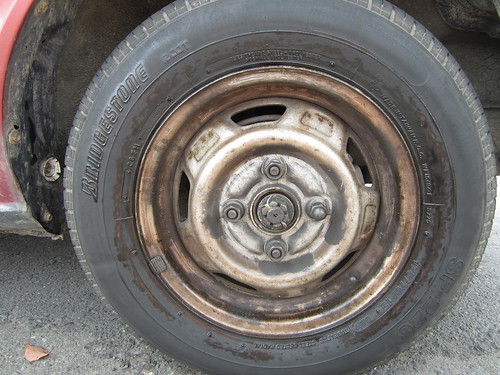
Front NS tyrewall 10 mins after the sixth daily treatment with sunflower oil
http://www.flickr.com/photos/31043052@N06/6900651372/

IMG_0115 by ed_lithgow, on Flickr

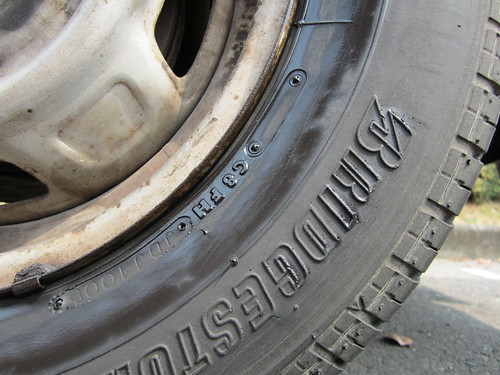
Front Nearside treated detail
http://www.flickr.com/photos/31043052@N06/6900653460/

IMG_0110 by ed_lithgow, on Flickr

These pictures are from a couple of years ago (thought it was longer). After the initial week of treatment I went to a top up every 2-3 months. They look better now.

 
Last edited:
Originally Posted By: threeputtpar
The cracks in the tread were in the voids and not the tread blocks, and that is what made it OK to drive on.


Don't get that. I'd like it to be true, since one of mine is the same, but I'd have thought the tyre thickness is less between the tread blocks so a crack of a given depth is proportionally more weakening in that location.
 
Forgot to mention, my top radiator hose had gone "crunchy" (When squeezed, it had a crunchy feel to it, as if it had hardened internally)

Liberally applied Sunflower Oil to the exterior, thinking it might buy a little time, and they went soft again.

(!)

Good and bad. It suggests that SFO softens rubber, and can "reverse some of the effects of ageing." (Am I sounding snake-oil enough for ya? I'm sounding far too snake-oil for me).

This doesn't seem to make sense, since SFO on its own sets hard over time.

It also suggests that if I put more on they might soften enough to blow, so I havn't. This might also apply to the tyres, of course, which is a bit worrying.

But so far, so good.
 
Last edited:
Status
Not open for further replies.
Back
Top Bottom