2019 RS5 calls for 504, but...

Joined
Dec 2, 2025
Messages
6
... tell me why I shouldn't buy Mobil 1 ESP x4 0W-40 ($6/qt) for my next oil change?

Long time listener, first time caller. Recently purchased a 2019 RS5 and found myself in that awesome part of the internet that is oil forums. Coming up on 40K miles. Previous owner let the dealer do oil changes (unknown oil but every 5K at least). I'll continue the 4-5K OCI. Car is my daily aggressive driver, but commutes are short. Northeastern US weather. No tune or modifications 2.9TT DI.

Calls for 504 but when this engine was released it called for 502. Local Audi dealer recommended against 504 and suggested 0W-40 and a reputable VAG tuner suggested 5W-40. Also looked at Pennzoil Platinum Euro x-40 and Mobil 1 FS Euro. Maybe Amsoil but I'd need to be sold on that for my application given so many good oils on the shelf. Anything wrong with my choice? I know I'm splitting hairs here but it feels like a moving target. If you were in my shoes, what's your next pour?
 
... tell me why I shouldn't buy Mobil 1 ESP x4 0W-40 ($6/qt) for my next oil change?

Long time listener, first time caller. Recently purchased a 2019 RS5 and found myself in that awesome part of the internet that is oil forums. Coming up on 40K miles. Previous owner let the dealer do oil changes (unknown oil but every 5K at least). I'll continue the 4-5K OCI. Car is my daily aggressive driver, but commutes are short. Northeastern US weather. No tune or modifications 2.9TT DI.

Calls for 504 but when this engine was released it called for 502. Local Audi dealer recommended against 504 and suggested 0W-40 and a reputable VAG tuner suggested 5W-40. Also looked at Pennzoil Platinum Euro x-40 and Mobil 1 FS Euro. Maybe Amsoil but I'd need to be sold on that for my application given so many good oils on the shelf. Anything wrong with my choice? I know I'm splitting hairs here but it feels like a moving target. If you were in my shoes, what's your next pour?
You should.
 
... tell me why I shouldn't buy Mobil 1 ESP x4 0W-40 ($6/qt) for my next oil change?

Long time listener, first time caller. Recently purchased a 2019 RS5 and found myself in that awesome part of the internet that is oil forums. Coming up on 40K miles. Previous owner let the dealer do oil changes (unknown oil but every 5K at least). I'll continue the 4-5K OCI. Car is my daily aggressive driver, but commutes are short. Northeastern US weather. No tune or modifications 2.9TT DI.

Calls for 504 but when this engine was released it called for 502. Local Audi dealer recommended against 504 and suggested 0W-40 and a reputable VAG tuner suggested 5W-40. Also looked at Pennzoil Platinum Euro x-40 and Mobil 1 FS Euro. Maybe Amsoil but I'd need to be sold on that for my application given so many good oils on the shelf. Anything wrong with my choice? I know I'm splitting hairs here but it feels like a moving target. If you were in my shoes, what's your next pour?
What target is moving? I don't know what you mean by that.

Nevertheless, here are some previous discussions that may be of assistance:

 
What target is moving? I don't know what you mean by that.

I've seen the following recommended for this vehicle / engine:

0W-30
5W-30
0W-40
5W-40

Maybe I'm not splitting hairs and these oils can be more different than I think. I'm here to learn.
 
I've seen the following recommended for this vehicle / engine:

0W-30
5W-30
0W-40
5W-40

Maybe I'm not splitting hairs and these oils can be more different than I think. I'm here to learn.
Grade is largely irrelevant with the VW approval which requires a minimum HT/HS. You can select a winter rating that is appropriate for your starting temperature. Below -30 or so use a 0W rated oil. Above that use either one.

What you’ve listed above isn’t really much of a difference at all.
 
I've seen the following recommended for this vehicle / engine:

0W-30
5W-30
0W-40
5W-40

Maybe I'm not splitting hairs and these oils can be more different than I think. I'm here to learn.
Mobil 1 you are interested in is very good oil for various reasons.
However, on the street you won’t EVER push car that much where HTHS difference between 30 VW504 and VW511 matters. You just don’t have space for that. Track is different.
RS should have very capable oil cooling system with actual oil cooling radiators. What is your oil temperature when you drive aggressively? Mobil 1 ESP 0W30 will do perfect job in your engine. Don’t forget, higher HTHS means more resistance =less performance. Will you notice or not? Probably not in such vehicle.
I was running VW Atlas here in the mountains to 262f oil temperature on VW504. On street you are fine.
That being said, Mobil 1 ESP 0W40 is excellent oil not only bcs. HTHS, but shear stability etc.
You here have a “problem “ choosing between Mobil 1 ESP 0W30 ($27 in Wal Mart for 5qt) which is excellent stuff, and ESP 0W40 which is, again, excellent stuff.
 
Despite 30 vs 40 there is not a whole lot of difference between 504 and 511, about 10% viscosity difference at operating temperature. I'd use either one happily.
 
Mobil 1 you are interested in is very good oil for various reasons.
However, on the street you won’t EVER push car that much where HTHS difference between 30 VW504 and VW511 matters. You just don’t have space for that. Track is different.
RS should have very capable oil cooling system with actual oil cooling radiators. What is your oil temperature when you drive aggressively? Mobil 1 ESP 0W30 will do perfect job in your engine. Don’t forget, higher HTHS means more resistance =less performance. Will you notice or not? Probably not in such vehicle.
I was running VW Atlas here in the mountains to 262f oil temperature on VW504. On street you are fine.
That being said, Mobil 1 ESP 0W40 is excellent oil not only bcs. HTHS, but shear stability etc.
You here have a “problem “ choosing between Mobil 1 ESP 0W30 ($27 in Wal Mart for 5qt) which is excellent stuff, and ESP 0W40 which is, again, excellent stuff.

Appreciate the feedback! Normal driving temps are ~210. Only eclipsed 240 a few times on the weekends after repeated pulls. You're not wrong about this "problem". The more I learn and look around, there are a lot of really good options. Heck even Pennzoil Platinum Euro 5W-40 for $5/quart seems enticing given my application.
 
Appreciate the feedback! Normal driving temps are ~210. Only eclipsed 240 a few times on the weekends after repeated pulls. You're not wrong about this "problem". The more I learn and look around, there are a lot of really good options. Heck even Pennzoil Platinum Euro 5W-40 for $5/quart seems enticing given my application.
Pennzoil Platinum Euro 5W40 is probably best 5W40 off the shelf, and on par ESP 0W40 when it comes to sophistication (it is Full SAPS).
Benefits of lower SAPS like ESP 0W40 is maybe but less CBU on valves over time.
With those temperatures, ESP 0W30 is more than sufficient.
 
Pennzoil Platinum Euro 5W40 is probably best 5W40 off the shelf, and on par ESP 0W40 when it comes to sophistication (it is Full SAPS).
Benefits of lower SAPS like ESP 0W40 is maybe but less CBU on valves over time.
With those temperatures, ESP 0W30 is more than sufficient.

Am I wrong in thinking any potential carbon buildup could be offset by frequent OCI, regardless of low/full SAPS oil?

I feel like I might be better served picking any of the previously mentioned oils and just driving the thing harder lol.
 
Am I wrong in thinking any potential carbon buildup could be offset by frequent OCI, regardless of low/full SAPS oil?

I feel like I might be better served picking any of the previously mentioned oils and just driving the thing harder lol.
Carbon build up on intake valves is not related to the SAPS of the oil. Any connection folks talk about has never been substantiated much like the use of catch cans.
 
I’ll be honest I’ve found no issue running 502 in the gas engines that spec 504.
this is perfectly fine to do and the engine service manual lists them as compatible depending on service intervals.

Am I wrong in thinking any potential carbon buildup could be offset by frequent OCI, regardless of low/full SAPS oil?

I feel like I might be better served picking any of the previously mentioned oils and just driving the thing harder lol.
there's that old lubrizol study that's purported to show this:

https://www.oil-club.ru/forum/applications/core/interface/file/attachment.php?id=49074

1764887593097.webp


I wouldn't take that to mean that a current generation 504 oil will definitely reduce deposits over a current 502, especially since we don't have any information on that comparison or know how the lubrizol test was controlled. But the VW 504 standard does add a requirement for lower valve deposits.


No tune on a daily driver? Really pick whatever standard you want. The only real difference you know to be true is that the motor went to lower SAPS formulas for emissions equipment longevity. If you're not that worried about your cat making it to 200k miles or whatever, might as well run a quality 502 like Mobil 1 Full Synthetic 0w40 or Pennzoil Platinum Euro 5w40.
 
this is perfectly fine to do and the engine service manual lists them as compatible depending on service intervals.


there's that old lubrizol study that's purported to show this:

https://www.oil-club.ru/forum/applications/core/interface/file/attachment.php?id=49074

View attachment 313325

I wouldn't take that to mean that a current generation 504 oil will definitely reduce deposits over a current 502, especially since we don't have any information on that comparison or know how the lubrizol test was controlled. But the VW 504 standard does add a requirement for lower valve deposits.


No tune on a daily driver? Really pick whatever standard you want. The only real difference you know to be true is that the motor went to lower SAPS formulas for emissions equipment longevity. If you're not that worried about your cat making it to 200k miles or whatever, might as well run a quality 502 like Mobil 1 Full Synthetic 0w40 or Pennzoil Platinum Euro 5w40.
The same stuff that clogs DPF/GPF, hence lower SAPS oil that prolong their life to acceptable mileage.
It can’t burn with DPF/GPF regeneration, same as it can’t burn during combustion process.
 
Yes, personally I'd prefer an oil with better volatility that is leaving less oil in the intake. Thus there is less vapor to turn into deposits in the first place.
 
No tune on a daily driver? Really pick whatever standard you want. The only real difference you know to be true is that the motor went to lower SAPS formulas for emissions equipment longevity. If you're not that worried about your cat making it to 200k miles or whatever, might as well run a quality 502 like Mobil 1 Full Synthetic 0w40 or Pennzoil Platinum Euro 5w40.

I did consider tuning with recent BF sales, but it's plenty fast for me already. Braking and cooling upgrades are higher on the list. Much rather keep the engine happy to 200k than the cats. Emissions and mpg not a concern. Going to give the Pennzoil Platinum Euro 5w40 a try. Any sense in testing the existing oil given I have no clue what it is?

Side note: I appreciate the feedback from everyone. Learning a lot.
 
I did consider tuning with recent BF sales, but it's plenty fast for me already. Braking and cooling upgrades are higher on the list. Much rather keep the engine happy to 200k than the cats. Emissions and mpg not a concern. Going to give the Pennzoil Platinum Euro 5w40 a try. Any sense in testing the existing oil given I have no clue what it is?

Side note: I appreciate the feedback from everyone. Learning a lot.
You have numerous threads about Pennzoil Platinum Euro.
It is GTL based oil. Very clean, high HTHS.
You can’t go wrong with it. It is repackaged Shell Helix 5W40.
Not sure are we getting now this version of Helix. From oil.ru:

PI SP; ACEA A3/B3, A3/B4; BMW Longlife-01, MB-Approval 229.5, 226.5; VW 502.00/505.00; Porsche A40, Renault RN 0700, RN 0710, PSA B71 2296, Fiat 9.55535-Z2, Fiat 9.55535-N2 – meets the requirements, Chrysler MS 10725, MS 12991.
1) Pour point -57°C. We can immediately rule out the presence of VHVI hydrocracking , which is what these oils are typically made from. This oil is GTL- based; otherwise, it wouldn't have such a good pourpoint. Shell truly has exceptional low-temperature properties, just as described. It can be safely used in Siberia and other cold climates.
2) The base number (BN) of 11.38 is high. The oil has good detergent and neutralizing properties. It effectively quenches the acids that form during fuel combustion. It should really keep pistons clean from carbon deposits. It has good resistance to low-quality fuel. The only drawback is that the previous version of Ultra had a higher BN of 12.49 mg KOH. They slightly revised the additive package to reduce the oil's ash content and the risk of detonation in modern engines (LSPI). Overall, the detergent properties are still good; the description doesn't lie.
3) Another telling NOACK parameter is the NOACK (volatility of masses at high temperatures) of 5.7%. As a reminder, in this test, the oil is kept at 250°C for 1 hour. Then, the percentage of mass that has evaporated is calculated. So, if a regular oil shows 10-11% on a crack test, that's considered good. But here, the result is almost twice as good. These are the advantages of a GTL base oil. The less mass the oil loses, the less deposits it forms (all other things being equal, of course). It oxidizes less, has a longer mileage, and requires less top-up. Generally, GTL oils typically have the lowest NOACK (volatility of masses). Even PAO oils of this viscosity have around 7%, while here, it's 5.7%.
4) The viscosity has become even lower! Now, it's not just a low-viscosity, economical 5W-40 like the previous version of Ultra. It's now almost 5W-30. Let me remind you that a "40" oil according to the SAE J300 standard should be between 12.5 and 16.3 cSt, and ours is 12.79. A little more and this oil could be called a 5W-30. Now, fans of thick viscosities will say that "the oil is too thin, which means it doesn't protect well against wear." This is not always true. The manufacturer may use more base oil and less polymer thickener. As a result, the oil will even sag less and provide the same wear protection as thick oils. Incidentally, the low viscosity index of 168 only confirms this.
6) Flash point of 251°C. Beyond all praise! While conventional hydrocracking oils have a flash point of 225-235°C, this one is on average 20°C higher. This is again an advantage of the thermally stable GTL base oil. Even compared to the previous version of Ultra, the oil has become more thermally stable. Previously, the flash point was 245°C.
7) Sulfur content has also decreased to 0.222%. This reflects the purity of the base oils and the modern additive package based on magnesium and calcium salicylates.
8) Sulfated ash = 1.16%. It's clear that Shell (Infineum) has again redesigned the additive package and made the oil cleaner. The previous version of Ultra had higher ash and sulfur levels.
9) Infineum additive package. It contains organic trinuclear molybdenum, which reduces friction and improves fuel economy. It also contains a high amount of boron as a dispersant, trapping contaminants. This allows them to be flushed out with the oil drain. A detergent-neutralizing additive based on calcium and magnesium. This innovation reduces the risk of engine failure due to premature combustion of the mixture in the cylinders. It also contains anti-wear additives based on phosphorus and zinc. It's likely that only Shell will have this package, and no one else will. Because Infineum is a related company, they are creating something special for themselves. This is precisely what we observe from the analysis.

The IR spectrum shows the presence of a peak at wavelength 722, characteristic of GTL .
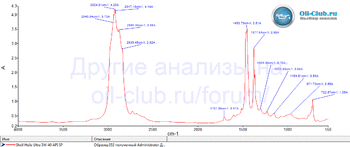
Shell Helix Ultra 5W-40 API SP FTIR copy.gif

Conclusion. Shell, as always, has produced a great product. Shell Helix Ultra 5W-40 is more fuel-efficient, more thermally stable, and safer for direct-injection engines. It's cleaner in ash and sulfur. It's made from a high-performance synthetic GTL basestock . Its parameters are fine; there's nothing to complain about. This oil might not be as popular with performance car enthusiasts because the viscosity has become lower. But I won't try to convince you. You just have to figure it out for yourself... Personally, I don't think it offers any worse wear protection. Ultra is a good fit for European Mercedes, BMW, and Renault vehicles. It's a good option for turbocharged VW TSIs. If you don't mind the expense, you can also use it in a Lada. However, I'd recommend Shell Helix Eco 5W-40 or Shell High Millage 5W-40 based on price and quality. In fact, it's even suitable for Japanese and Korean cars. The viscosity is now low, which means the oil is even closer to the topic.

 
Carbon build up on intake valves is not related to the SAPS of the oil. Any connection folks talk about has never been substantiated much like the use of catch cans.

Exactly, even if it were true it’s clearly a minor contributor compared to the PCV/AOS design. BMW S55 has almost no carbon buildup issues and it specs full saps in the US, meanwhile N54 is terrible with the same oil.
 
Exactly, even if it were true it’s clearly a minor contributor compared to the PCV/AOS design. BMW S55 has almost no carbon buildup issues and it specs full saps in the US, meanwhile N54 is terrible with the same oil.
PCV is definitely bigger issue when it comes to CBU.
However, composition of IVD are same as those that are killing DPF/GPF.
How much you will slow down IVD build up is dependent on an engine, PCV etc. But it is absolutely ridiculous to dismiss that study by Lubrizol bcs. test was done on EA113. I would say test is good precisely because it was done on EA113.
And by the way, BMW uses Low-SAPS in S55 in EU. I would say that as usual, BMW is sloppy with oil recommendations here. But yes, since N54 that is none issue due to PCV design. In VW’s on other hand, well…
 
Back
Top Bottom