0w-40 all year, or 5w-30 in winter?

Status
Not open for further replies.
Originally Posted By: Srt20
Wisconsin winters. Truck mainly sits outside.
2018 F150 3.5L Ecoboost. I am considering using 0w-40 Castrol Edge in this truck because of the shearing and fuel dilution in used oil analysis I see on here. Do you guys feel 0w-40 is fine for WI winters where the temp can reach -30*F? Thanks
What does the 0W in 0W-40 and the 5W in 5w30 tell us??
 
Originally Posted By: Srt20
Originally Posted By: OVERKILL


The number in front of the W is the "Winter" rating for the oil. a 0W-xx offers better winter performance than a 5W-xx at the extreme end of the temperature range. So, while the 5w30 is thinner at operating temperature, as one approaches the CCS/MRV temperatures there's a crossover where the 0w-40 will thicken less than the 5w30.


Interesting. Is there a place I can look it up to find out where that crossover point is?


As has been pointed out, is not universal. But what IS universal is the temperature at which the 0wXX versus 5wXX is measured in order to meet the spec, and IIRC that is about -25 or -30F which happens to be what you said you're concerned with. So wherever the crossover may actually lie, you can be SURE that it is above -30F. So in your specific case, running 5w30 instead of 0w40 each winter is exactly the wrong thing to do. If your minimum expected temperature were, say, 10F or 0F, then it would be a lot more ambiguous and dependent upon the specific oil formulations.
 
Originally Posted By: madeej11
Just a thought but what about getting that 40 weight up to operating temps? Maybe use the 5w30 or 0w30 and do more frequent OCI's.
If the 40 doesn't get up to operating temps what would make a 30 get up to operating temps?
 
Originally Posted By: CT8
Originally Posted By: Srt20
Wisconsin winters. Truck mainly sits outside.
2018 F150 3.5L Ecoboost. I am considering using 0w-40 Castrol Edge in this truck because of the shearing and fuel dilution in used oil analysis I see on here. Do you guys feel 0w-40 is fine for WI winters where the temp can reach -30*F? Thanks
What does the 0W in 0W-40 and the 5W in 5w30 tell us??


I was under the impression that the W rating was a measurement of how much the oil thickens as it cools. Meaning a 0w will thicken less than a 5w. But the 30 is a thinner base than the 40.

So I thought it was like this thin to thick at cold and hot temps; 0w-30, 5w30, 0w-40, 5w-40.
 
Last edited:
Originally Posted By: Srt20
I was under the impression that the W rating was a measurement of how much the oil thickens as it cools. Meaning a 0w will thicken less than a 5w. But the 30 is a thinner base than the 40.

So I thought it was like this thin to thick at cold and hot temps; 0w-30, 5w30, 0w-40, 5w-40.

At least you didn't say it was a 0 weight when cold and a 40 weight when hot.

It's not how much it "thickens" it is what the apparent viscosity is determined to be at the test temperature in accordance with the ASTM procedure. It doesn't really tell you what is happening on the way down to that temperature since some 5W oils could be thinner "on the way down" than the equivalent grade 0W oil. Like has already been mentioned in this thread, you pick the 0W rating you need to accommodate the anticipated starting temperatures for your location and you pick the appropriate grade by what the manufacturer specifies for your engine.
 
Originally Posted By: Srt20
Wisconsin winters. Truck mainly sits outside.
2018 F150 3.5L Ecoboost. I am considering using 0w-40 Castrol Edge in this truck because of the shearing and fuel dilution in used oil analysis I see on here. Do you guys feel 0w-40 is fine for WI winters where the temp can reach -30*F? Thanks


0W30
 
Originally Posted By: Srt20
Wisconsin winters. Truck mainly sits outside.
2018 F150 3.5L Ecoboost. I am considering using 0w-40 Castrol Edge in this truck because of the shearing and fuel dilution in used oil analysis I see on here. Do you guys feel 0w-40 is fine for WI winters where the temp can reach -30*F? Thanks


0w40 is fine for very cold weather, but here is a plan to get the most use out of the viscosity changes you might get over a full oil change interval:
Change the oil now, to 0w40, or at least in the next month or so. Then, the oil may thin a bit over time and usage, which will coincide with the cold weather in December 2018 to February 2019. You'll have thick (hot) oil for the warm weather, and change it in March 2019.

In a 0w40, as the VII mechanically shears, and as you get fuel dilution, cold performance is unaffected or may even get a bit better in the range of 0F to -30F.

Your grandfather in 1950 might have put kerosene (intentional fuel dilution!) in their oil in December thru February to keep it flowing cold.
 
Originally Posted By: Srt20
But the 30 is a thinner base than the 40.
Actually, a 0w40, or any "0w" oil, uses thinner base oils. A 0w40 gets its hot 40 rating because the VII chemicals added to the base oils prop it up when hot; that is, the VII chemicals increase hot viscosity.
As those VII chemicals break apart with usage, you actually get closer to what the base oils do when hot. Oxidation may begin to push viscosity back up though, depending on the conditions in the engine. Good anti-oxidants and antacid actions in the oil delay the onset of oxidation, but it happens eventually too.
 
Originally Posted By: kschachn
Originally Posted By: Srt20
Originally Posted By: madeej11
Just a thought but what about getting that 40 weight up to operating temps? Maybe use the 5w30 or 0w30 and do more frequent OCI's.

Thats a thought also. I guess I should mention, that most of the short trips I do are taking the kids to school. If its -30*F, the school will cancel anyway...

The 0W-40 will warm up faster than the 5w30.


Great answer/point made by kschachn here.

A 40 viscosity will heat up faster due to shearing of the oil.
 
Last edited:
I wonder if say Castrol 0w40 really has that much VII. I bet it's really not all that much. Due to lower NOACK values.... And that fact this oil meets such strict standards regarding deposit formation. Specs like MB 229.5, Porsche A40, BMW LL-01 are WAY, WAY tougher on deposit formation vs API SN. And viscosity index improvers are a big reason for deposit formation. So, I bet Castrol 0w40 actually has not as much VII as say Castrol Edge 5w30.
 
Last edited:
Originally Posted By: OVERKILL
Originally Posted By: Srt20
Originally Posted By: BrocLuno
Originally Posted By: StevieC
It won't be a catastrophic thing but I would rather use something a little thinner in super cold temperatures. You could do a used oil analysis and see how it affects your wear metals being that thick in the cold. Would also show you fuel dilutions as well to see if they really are something to be concerned with in your application. You might not have the problem like others or as bad as others.


What's thinner than 0W ??


I maybe wrong, but is 5w30 not thinner than 0w-40? Maybe Ive been understanding it wrong all this time?


The number in front of the W is the "Winter" rating for the oil. a 0W-xx offers better winter performance than a 5W-xx at the extreme end of the temperature range. So, while the 5w30 is thinner at operating temperature, as one approaches the CCS/MRV temperatures there's a crossover where the 0w-40 will thicken less than the 5w30.


Are you running 5w40 hdeo in the EcoDiesel?
 
Originally Posted By: bbhero
I wonder if say Castrol 0w40 really has that much VII. I bet it's really not all that much. Due to lower NOACK values.... And that fact this oil meets such strict standards regarding deposit formation. Specs like MB 229.5, Porsche A40, BMW LL-01 are WAY, WAY tougher on deposit formation vs API SN. And viscosity index improvers are a big reason for deposit formation. So, I bet Castrol 0w40 actually has not as much VII as say Castrol Edge 5w30.


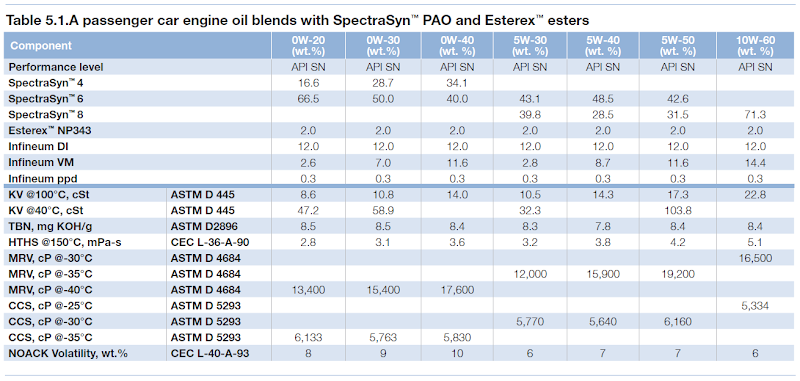
A 0w40, made from quality syn oils, does need a lot of VII to make it work. Here is a chart ghokan posted a few years ago, and shannow posted another better one that I can't find right now:
groupIII-IVblending.jpg


.. Edit: Here is another, again showing the need for lots of shearable VII chemicals to make a 0w40:

exxonmobil_synthetic_PCMO.png
 
Last edited:
Again.... Do VII cause deposit formation ??

I think so.

Those specs like Porsche A40, MB 229.5 and BMW LL-01 are very strict in that regard.

Something there does not add up.

Unless they pick out VIIs that are far, far better than others used in other products. Which don't form deposits hardly at all. Maybe that is the case.
 
That's really not a lot. Here's another example from Mobil for a 5w30:


And this is a 5w30 blended with PAO. One with Group III is going to have more VII, most likely a fair bit more than the 0w-40 blended with PAO, which we see as having 11.6% VM in it according to the previously posted Mobil blend guide, or 9.4% in the earlier one.
 
Originally Posted By: bbhero
Do VII cause deposit formation ??
Yes, but all-PAO or mostly-PAO 0w40's still don't have enough VII to keep them out of the German deposit specs, obviously, as we see this on the shelf every day, and have for many years.
The subject of this thread is VII shear (and fuel dilution), and we've seen Mobil 1 0w40 shear down in used oil analysis like the OP fears.
 
Originally Posted By: oil_film_movies
Originally Posted By: bbhero
Do VII cause deposit formation ??
Yes, but all-PAO or mostly-PAO 0w40's still don't have enough VII to keep them out of the German deposit specs, obviously, as we see this on the shelf every day, and have for many years.
The subject of this thread is VII shear (and fuel dilution), and we've seen Mobil 1 0w40 shear down in used oil analysis like the OP fears.


I think we've seen viscosity loss in a ton of oils and it isn't always just mechanical shear, which is readily apparent when one looks at the flashpoint on many of these used oil analysis. Not saying there isn't evidence of shear, as there of course is, but in many cases what is ascribed to shear is likely fuel.

The VISOM based formula of Mobil 1 0w-40 was actually a stability improvement over its PAO-based predecessor if we are going solely on used oil analysis, but we also saw significant viscosity loss with Pennzoil Ultra Euro 5w-40 for example.
 
Status
Not open for further replies.
Back
Top Bottom