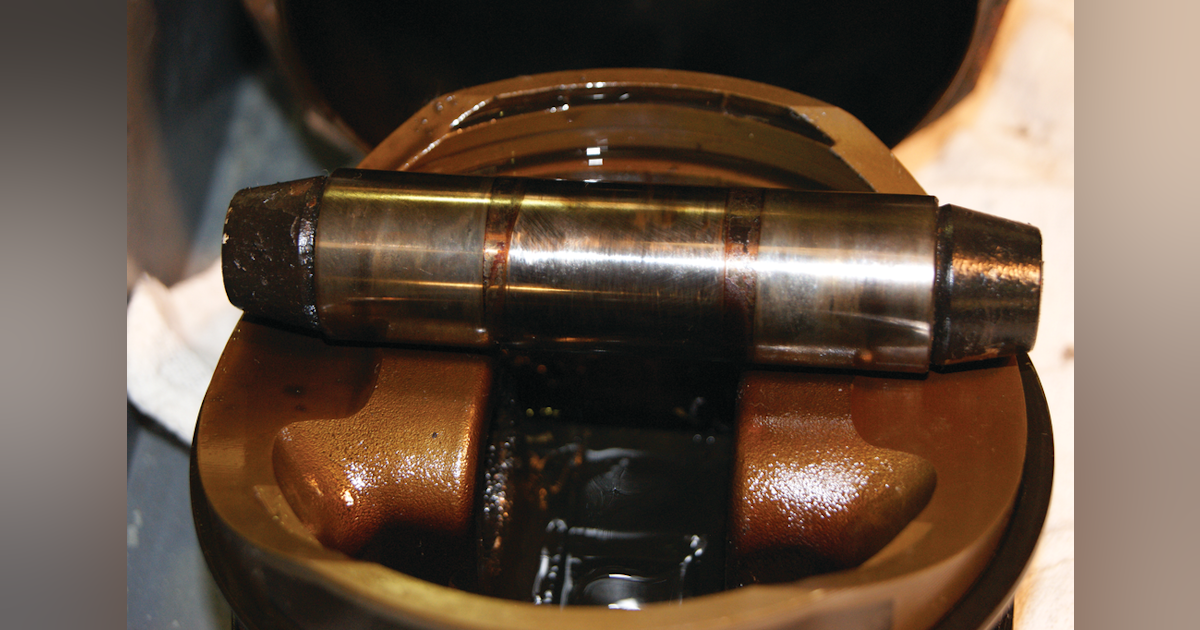
What is a full floating wrist pin?

Status
Not open for further replies.
Joined
Aug 7, 2020
Messages
6,185
I know it joins the connecting rod to the piston, but what makes it "full-floating" and how does it differ from a wrist pin that doesn't float, fully or otherwise? What benefit does a full-floating pin provide? Thanks!
 
Floating pins are held in the pistons with retaining clips as opposed to a friction fit requiring heat to install them.

Beyond that, not sure of the benefits specifically beyond ease of assembly/disassembly.
 
full means the pin is free in the pistons bore, as well as the bushing in the conrod.
Advantage is less friction than if it were fixed at either end.
Downside is the chance for a retaining clip to let loose, scrape up the cylinder wall.
 
Aircraft engines typically don't use retainers or clips on full floating piston pins. Instead, they use aluminum buttons in the ends of the pin. As long as the owner chooses a quality oil and changes oil regularly, the pins won't stick, and the engine will make it to overhaul without piston pin problems.

io-550n-400-stop-2_11519073.png
 
Aircraft engines typically don't use retainers or clips on full floating piston pins. Instead, they use aluminum buttons in the ends of the pin. As long as the owner chooses a quality oil and changes oil regularly, the pins won't stick, and the engine will make it to overhaul without piston pin problems.
Those buttons seem more secure than clips or retainers. They're certainly more substantial looking. How are the buttons secured? Threaded into the pin, press fit, or ... ?
 
While we’re talking about pistons and pins, the loading into the connecting rod, then into the crank journal, and main bearing is immense. This is where oils earn their keep. Power density is one thing, but connecting rod and crank loading is another. High horsepower large displacement supercharged engines may have a lower power density because of large displacement, but can have much higher connecting rod loads because they make so darn much power.

 
Those buttons seem more secure than clips or retainers. They're certainly more substantial looking. How are the buttons secured? Threaded into the pin, press fit, or ... ?
Those are press fit. Others are simply buttons that fit into the piston. Either way seems fine.

s-l640.jpg


And check these ones out!

No idea what the application is, looks automotive.

017-piston-lock-types-installation-techniques.jpg
 
While we’re talking about pistons and pins, the loading into the connecting rod, then into the crank journal, and main bearing is immense. This is where oils earn their keep. Power density is one thing, but connecting rod and crank loading is another. High horsepower large displacement supercharged engines may have a lower power density because of large displacement, but can have much higher connecting rod loads because they make so darn much power.
I've seen the results of the loading while watching a video about connecting rod bearings. In many engines, the top bearing shows significantly more wear than the lower bearing as a result of the downward forces from combustion.
 
Status
Not open for further replies.
Back
Top Bottom