Wet belt engines

Joined
Sep 17, 2025
Messages
292
I will start off with saying I am no mechanic. I just do tuneups/replace parts as needed/obd2 scan for issues/general vehicle maintenance . Sometimes I get brave and attempt a rear brake job or valve cover replacement.
I will not pretend to know every engine parts or how it all comes together , etc, etc.
So i'm curious of a New To Me ''Wet belt''.
Been reading they are junk and problematic. It seems wet belts are being used on the more low budget vehicles, but I could be wrong.

Bottom line, if one day I am searching for a good used car/truck/van....for myself or family member/friend..should I avoid at all costs wet belt vehicles? Or have whatever issues been resolved and not a big problem anymore? https://www.theautopian.com/why-so-many-people-hate-wet-timing-belts/
 
  • Like
Reactions: Arc
Not sure who else uses them, but Ford used a wet timing belt on their early 3cyl Ecoboost, but has since gone to a chain. I think those were pretty much a disaster for them. (But retains the wet oil pump belt, go figure).

The 2.7/3.0 Ecoboost and 5.0 also use wet oil pump belts. (All of the 5.0's or just some, I can't remember)

You don't hear of them blowing up on a regular basis, so it might just be a minor issue.

I'll have to say, personally, I'm not a fan. I think long term (As in my 300+ k mile Accord) that if that car had a wet oil pump belt, it would have needed replacing, and most cars with the wet oil pump belt, aren't designed for easy replacement.

I'd rather replace a Honda J-Series timing belt every day of the week as opposed to any of the wet oil pump belts.
 
Ford's F150 2.7L and 5.0L use a wet oil pump belt. They are trouble free. There has been one known failure on a F150 5.0L with 200K miles. Remember, this is out of millions of engines. This was possibly due to a seized oil pump. As the teeth were ripped off and the belt was broken at the same spot.

Wet belts have some requirements. The oil spec must be correct and the oil must be changed regularly. Fuel contamination reduces belt lifespan considerably. I also speculate that certain oils are preferred, AN based oils for example. I am using Mobil 1 Extended Performance 5w30 in my F150 w/wet belt, changing at 5K intervals.

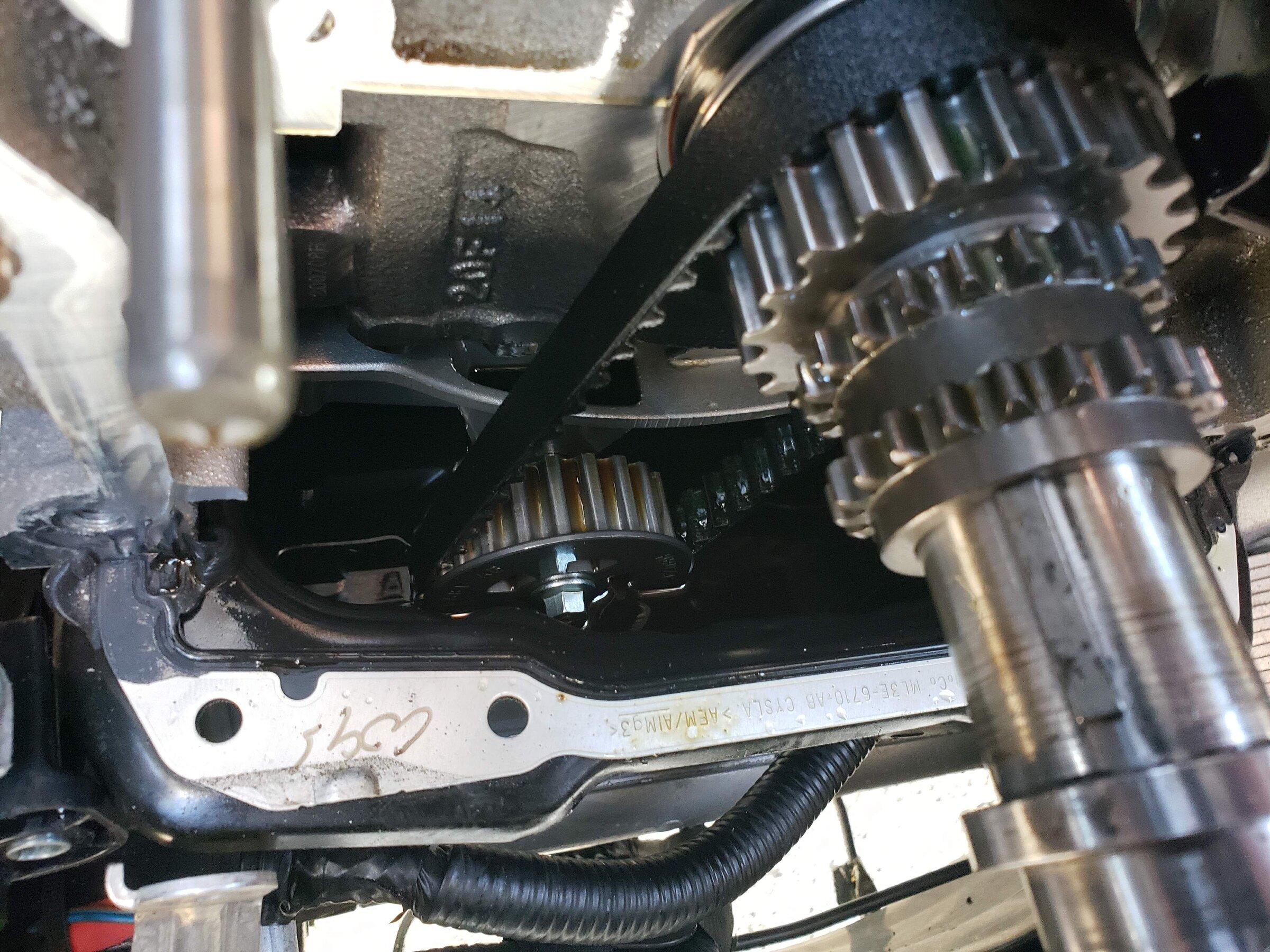
Here's the Ford 5.0L oil pump belt. You'll notice the pulley has a larger diameter than the timing chain sprockets. This is to reduce bending stress on the belt for long lifespan.

Earlier applications were not so well designed.

165404-237f070a3540f7ba4b205dfb35e57f9d.jpg
 
While not my preferred oil pump drive system, I think folks get things out of whack when it comes to sensibilities about this topic.

Yes - wet belts are maintenance items and will need attention at some point. Hopefully to be changed before they would break and cause a loss of oil pressure. Because of the location and packaging, this can be expensive because of the time involved to R&R.

The alternative in these modern engines would be a chain. And guess what ... they also are NOT fail-proof. Chains actually do wear and break, etc. Admittedly not as often as a belt, but they are not foolproof. If chains were indestructible, then we'd never have to replace timing chains on cam drives, etc.

The (nearly) indestructible oil pump drive is that of a direct, crank-driven gerotor type design. As seen in the old modular Ford motors (4.6L, 5.4L, 6.8L) and some other brands. IMO, this type oil pump is the best, and probably one of the reasons you see 4.6L 2v Grand Marquis and Crown Vics with literally hundreds of thousands of miles on them with little trouble.
 
I will start off with saying I am no mechanic. I just do tuneups/replace parts as needed/obd2 scan for issues/general vehicle maintenance . Sometimes I get brave and attempt a rear brake job or valve cover replacement.
I will not pretend to know every engine parts or how it all comes together , etc, etc.
So i'm curious of a New To Me ''Wet belt''.
Been reading they are junk and problematic. It seems wet belts are being used on the more low budget vehicles, but I could be wrong.

Bottom line, if one day I am searching for a good used car/truck/van....for myself or family member/friend..should I avoid at all costs wet belt vehicles? Or have whatever issues been resolved and not a big problem anymore? https://www.theautopian.com/why-so-many-people-hate-wet-timing-belts/

The problem with wet belts is that it's a maintenance item (~80k miles?) and deferred maintenance can result in catastrophic engine failure. A wet belt which exceeds it's change interval will slough off pieces which will then plug the oil pick-up screen.

I would not be surprised if some owners had no idea they had a wet belt which needed to be changed.
 
The problem with wet belts is that it's a maintenance item (~80k miles?) and deferred maintenance can result in catastrophic engine failure. A wet belt which exceeds it's change interval will slough off pieces which will then plug the oil pick-up screen.

I would not be surprised if some owners had no idea they had a wet belt which needed to be changed.
I'd agree that it is a maintenance item. But not at 80K for well designed setups. Ford's wet belts have gone over 400K miles without issue. I'd argue that the lifespan of a well designed belt system mirrors that of chains.
 
Would still depend on how hard it is to change. I mean if it's easy enough to change out I would not be bothered by a wet belt.
By that I mean I'd still get something like a Trax, because it doesn't have a CVT and just deal with the belt.
 
I may be completely ignorant to this, but I haven't actually heard of a bunch of failures of these. I agree it's a design that I can't understand, but in my internet trolling I haven't seen a whole lot of failure talk. That talk of internal wiring harnesses reminds me of the TCM module I had to change out in my sister's 2012 Cruze. Mounted internally bathed in hot transmission oil. Genius.
 
Ford's F150 2.7L and 5.0L use a wet oil pump belt. They are trouble free. There has been one known failure on a F150 5.0L with 200K miles. Remember, this is out of millions of engines. This was possibly due to a seized oil pump. As the teeth were ripped off and the belt was broken at the same spot.

Wet belts have some requirements. The oil spec must be correct and the oil must be changed regularly. Fuel contamination reduces belt lifespan considerably. I also speculate that certain oils are preferred, AN based oils for example. I am using Mobil 1 Extended Performance 5w30 in my F150 w/wet belt, changing at 5K intervals.

Here's the Ford 5.0L oil pump belt. You'll notice the pulley has a larger diameter than the timing chain sprockets. This is to reduce bending stress on the belt for long lifespan.

Earlier applications were not so well designed.

165404-237f070a3540f7ba4b205dfb35e57f9d.jpg
I am pretty sure the 5.0 only had a wet oil pump belt on models 2021 and up (Gen IV).
 
Ford had many problems with wet belts in the small Ecoboost and Ecoblue motors and has tried moving back to chains and the belt quality was a big issue and they switched makers. I think they went to Continental for the latest replacement parts.... they were failing early on even though rated for 10 years 150k miles.
 
Back
Top Bottom