Water in basement

Status
Not open for further replies.

JHZR2

Staff member
Joined
Dec 14, 2002
Messages
56,179
Location
New Jersey
We live in an area with a high water table - most homes have a sump pump, though ours does not. Our basement got a fascia (cement over a wire mesh) probably 50 years ago, and has been painted with drylok type paint more recently.

We get some water though. On one side we had buried drainpipes thatvwere broken- so water would go in the ground and sit alongside the house, and come in. We fixed that 100%.
On the other side of the house we had a clogged gutter that would dump water, but we fixed it. Problem is that water can still sit close to the house due to things like snow melting.

Lately with the snow melts, we have been getting water in. Not much we can do like gutters or downspouts, but is there anything else we can do regarding sitting water alongside the basement walls? We only get small amounts of water in (puddles not floods), but the sitting water alongside it isn't good and I'd guess the cause of the water ingress.

Thanks!
 
What about having the down spouts go out a few feet away from the house. It looks ugly but should help. At least for the rain.

Might have to put a drainage system in at some point.
Someone here hopefully knows more than me or we are in trouble.

If this is for record snows is it a once in a blue moon kind of thing?
 
Last edited:
i would recommend getting a sump pump.

careful drawing the water table down around structures though.
 
What about the outside wall below ground level? Has it ever been sealed?
I have seen shows where they use some kind of rubber membrane on the outside basement walls before it's back filled.
 
First, get your snowblower out and move some of that snow away from the foundation. If you don't have a snowblower then it's time to start shoveling. Move it at least 8 feet or more away.

Once you get rid of the snow make sure the grade is correct all the way around the foundation. If the grade pitches toward the foundation (or is level) then bring in some dirt to correctly pitch the grade away from the house.

Our first home was an older home (1920's vintage) and had the same issues. With years of settling a sidewalk along one side of the house had shifted and pitched toward the foundation. Once we removed the sidewalk and corrected the grade the water issues disappeared.

Even though our current home has a watertight foundation, in heavy snow like we've had this year I pull the snow away from the foundation with the tractor. I'd prefer that much water not sit along the foundation when it all starts to melt.
 
Water sitting against the foundation is not the end of the world. If your basement walls are not structurally compromised over 50 or more years I would not fret much now.

It is a nuisance. Consider your home water tight if under the described conditions you get a puddle.

Really just removing the snow above around the perimeter will help slightly, maybe enough to get rid of those puddles.
 
Our home is from the 1930s. Drainage was the issue, but we have worked to fix it and most every downspouts drains at least 3' away. Great points on grading and shoveling away from the foundation. I feel like given the fact that most homes have one, we should have a sump hole and pump... Some homes seem to have a drain pipe cut into the floor all around that carries water to the pump, I guess so it is all even. Is there a best practice for how to site and install a sump hole/pump into an existing structure?
 
To retro fit a proper drainage system is a difficult and/or expensive job. If your interested PM and I'll provide details.


Once the digging/concrete cutting is done it's a pretty straight forward process. A real system involves two lines, one along the outside wall at the footer and another at the same height along the inside wall. You can just run the inner/inside line along the footers, but then all managed water is by neccessity allowed into the home/sump. If you use two lines inside and outside, you manage the water before it enters the foundation.

If you mentioned it, I missed it. What type of soil do you have? Is it clay, sand, sandy loam? I'm guessing some sort of soil and clay mix.
 
I live in south nj, world's best blueberries, tomatos and 3/4 of the world's supply of eggplant.

It is a very sandy soil, but there is still plenty of organic in there. I guess you would call it sandy loam?
 
Wow, you should have great drainage then.

When you say the water comes in, is it possibly coming in through the wall? I know it collects at the floor where it meets the wall, but are you certain it isnt running through the wall and then down to the floor?

I ask because in that case a drainage/sump system at footer level will not prevent that infiltration. Those systems are much more effective in areas that collect water at the bottom of the basement hole, where clay or other soils hold the water in or the table is so high as to require them.
 
Last edited:
Originally Posted By: JHZR2
Great points on grading and shoveling away from the foundation. I feel like given the fact that most homes have one, we should have a sump hole and pump... Some homes seem to have a drain pipe cut into the floor all around that carries water to the pump, I guess so it is all even. Is there a best practice for how to site and install a sump hole/pump into an existing structure?


The exact location of sump should lowest point in your entire slab. You simply cut a hole (my brother in law used a pipe saw) and put the pipe in with gravel around it.
 
Originally Posted By: LS2JSTS


When you say the water comes in, is it possibly coming in through the wall? I know it collects at the floor where it meets the wall, but are you certain it isnt running through the wall and then down to the floor?


it really comes through the wall, I think. You're right - unless we have severe rains, I've not seen water coming up through the floor.
 
I have the exact same problem. We put up new gutters on the house, and painted with drylok.

I extended the gutters but the houses are so close, that my neighbor doesn't want me pumping water in his basement.

We do not have a sump pump either. I will get some water when the snow melts and during heavy rain, but its more of a nuisance than anything else.

I invested in a good floor squeegee, and I push it to the drain in the floor.

Usually the next day, the concrete floor is bone dry.
 
You will probably want to build up the ground so the water will flow away from the house. Also hook some 10'-15' drain pipe up to the downspouts and bury it.
 
- JHZR, that "fixed" drain tile could be acting as a sponge, attracting more water to your basement wall area as described in my link below, where he recommends against shallow "french drains" near a house.

- Do you have uncovered, improperly installed window wells that allow water in/near the basement wall?

- Here is an innovative idea I tried with success in the 50's era home I live in. It has no footing drainage as described above by LS2 and it has cracked block basement walls.

First, go to this site and open his PDF down the page at Open Document "Keeping Your Home’s Feet Dry".
http://www.ruralhometech.com/WetBasements/tabid/36/Default.aspx or
http://www.builderswebsource.com/techbriefs/drainage.htm

The concept is to prevent ALL surface water from pooling near the basement wall. Gutters, window well treatments, and proper surface grading away from the walls is required. Spongy, water absorbing, mulched beds along the walls can be problematic.

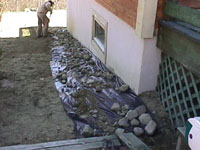
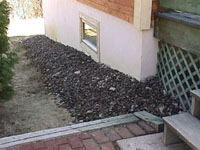
Go to section 3 (3.1.1) of the above pdf and study about "flashing apron" around your house. Its akin to flashing on a chimney. I made ours 2 feet wide/out with aluminum landscape edging. I used packed soil, sloped (10%)away from the basement wall , covered with 20 mil pond liner, then covered with smooth round roof stone (for looks). This diverts all water away from the wall and into the lawn graded away from the wall. It is cheap and easy compared to digging and concrete work.

Study the rest of the link to learn about ground and surface water solutions.

plasticflashing.jpg
I made mine much more attractive than this, but you get the idea. I used rubber pond liner and more attractive stone, with lawn edging.
placedstone.jpg
 
I agree the first step is getting the water draining away from the house. I had to cut swales from in back of my house all around to the front. If it is a fairly new house, the builder may have fix their poor workmanship at their expense.

The swales are cheap and easy and you can do them yourself. Hardest part may be getting rid of the dirt.
 
Status
Not open for further replies.
Back
Top Bottom