Was told brake flush should be done every 2 years

Status
Not open for further replies.
Originally Posted By: Tegger
Originally Posted By: Carnoobie
Well I had the brakes flushed yesterday and the guy took the wheels off and we did the pedal pump method. It took an hour. Bad?

Does the brake pedal feel the same as it did before? Then no harm done.

If you're sitting at a light and the pedal s-l-o-w-l-y goes to the floor, then the master cylinder seals are bad, and were possibly damaged during the bleed procedure.


Brake pedal actually feels noticable firmer, less travel when braking. I guess thats from any air or moisture that was in the lines before.

My old fluid wasnt even that dirty, just bit yellow with couple small pebbles that came out. He said I could probably go 3 years before doing my next flush.
 
Originally Posted By: Tegger
Originally Posted By: antiqueshell
their is a sharp ridge that develops which can dig into the seal damaging it, and causing the MC to fail.

Not a sharp ridge, just some corrosion or deposits on the surface of the bore. If this corrosion or crud is heavy enough, it can tear the delicate lip of the rubber seal, causing it to eventually leak.


Where can I check to see if i have any corrosion or deposits? Would like to clean it if i have any. I dont even know where my MC seal is. I know where the MC res itself is.
 
Originally Posted By: Carnoobie
Where can I check to see if i have any corrosion or deposits? Would like to clean it if i have any. I dont even know where my MC seal is. I know where the MC res itself is.

You don't want to be doing that. Just leave well-enough alone.

If the pedal feels fine now, and if the fluid that came out was clear yellow, then there were likely no deposits or corrosion in the bore, in which case the pedal-push method did zero harm. When I see corrosion and deposits, I see black fluid, sometimes old enough to be goopy.

By the way, the pebbles you saw would have come from the bleed nipple's center hole, not the hydraulic lines. Make sure you have rubber caps on the nipples.
 
Originally Posted By: Tegger
Originally Posted By: Carnoobie
Where can I check to see if i have any corrosion or deposits? Would like to clean it if i have any. I dont even know where my MC seal is. I know where the MC res itself is.

You don't want to be doing that. Just leave well-enough alone.

If the pedal feels fine now, and if the fluid that came out was clear yellow, then there were likely no deposits or corrosion in the bore, in which case the pedal-push method did zero harm. When I see corrosion and deposits, I see black fluid, sometimes old enough to be goopy.

By the way, the pebbles you saw would have come from the bleed nipple's center hole, not the hydraulic lines. Make sure you have rubber caps on the nipples.


Oh ok. Yes the pebbles came out of the bleed nipple, not the MC. When I did a brake flush 2 years ago, the old brake fluid was grey! the previous owner never flushed it!

Now that its crystal clear, i might be able to go 3 years til the next one. Hopefully will have a new car by then.
 
Originally Posted By: Carnoobie
Yes the pebbles came out of the bleed nipple, not the MC.

Put rubber caps, OK? They're cheap and you can install them with the car on the ground.
 
Originally Posted By: Tegger
Originally Posted By: Carnoobie
Yes the pebbles came out of the bleed nipple, not the MC.

Put rubber caps, OK? They're cheap and you can install them with the car on the ground.


Rubber caps? where do they go? Can i do this without air getting into the lines? Whats the benefit of rubber over whats on them now (im guessing metal)?

I could be wrong but pretty sure the rears on civics are rubber caps from factory, just the fronts arent.
 
Originally Posted By: Carnoobie
I could be wrong but pretty sure the rears on civics are rubber caps from factory, just the fronts arent.

ALL bleed screws need to be covered with special rubber caps. If pebbles came out when you bled, then the caps were missing.

Peek at (or feel) your brake-bleeder screws to see if there are rubber caps. If your "mech" has an IQ above zero, he will have installed caps after he did the job. If not, then you need to put them back.

Canadian Tire has them. They're cheap. Buy 'em, reach around each tire, feel for the nipple (feel for the nipple, har-har-har), then pop the cap on. Done.
 
Originally Posted By: Tegger
Originally Posted By: antiqueshell
their is a sharp ridge that develops which can dig into the seal damaging it, and causing the MC to fail.

Not a sharp ridge, just some corrosion or deposits on the surface of the bore. If this corrosion or crud is heavy enough, it can tear the delicate lip of the rubber seal, causing it to eventually leak.


Very interesting... I'm going to take a different tact here, and state that I think I'd rather do this method, where the master cylinder may be induced into failure. Why? I had a brake pad fall off one winter, and the pedal went to the floor as a result. I hope to never do that again, but who knows? Point is, it took at least 10 pumps to get a pedal back, and I'd rather limit brake failures to one failure at a time. I'd rather have the MC fail at teh shop, and get replaced, in a situation where no one will be put in harms way.

Thoughts?
 
Commenting on a few of these posts at once. Honda has specified a 30K brake fluid change for decades. I did it religiously on my 89 Accord using predominantly Valvoline DOT 4 fluid. The car went through M/C's every 100K like clockwork. Seriously! At least they were not hard to replace but it made me wonder what the heck was with Honda M/C's. It didn't matter whether it was a new OEM M/C or aftermarket. The lifespan was the same.

In the entire 23 years and 355K miles I never had to touch the innards or rubber seals at the wheels. The hoses were also still original. I purchased a pack of small rubber vacuum caps online and used to use them for bleeder screw caps. The high heat causes the rubber to crack so the caps were only really good for about 30K miles, anyway.
 
Originally Posted By: JHZR2
Every car I own except the Chevy says 1-3 year intevals.

I wouldnt vacuum, Id use the motive pressure bleeder.

With a pressure bleeder on a lift, this is a 30 minute job. 1.5 hr is excessive. I can see him having to round up to 1hr to make ends meet, but 1.5 is a lot at $100/hr.

+1 for the Motive. I bought one and its much easier and idiot proof of a job to do.

Regards, JC.
 
Originally Posted By: Tegger
Originally Posted By: Carnoobie
I could be wrong but pretty sure the rears on civics are rubber caps from factory, just the fronts arent.

ALL bleed screws need to be covered with special rubber caps. If pebbles came out when you bled, then the caps were missing.

Peek at (or feel) your brake-bleeder screws to see if there are rubber caps. If your "mech" has an IQ above zero, he will have installed caps after he did the job. If not, then you need to put them back.

Canadian Tire has them. They're cheap. Buy 'em, reach around each tire, feel for the nipple (feel for the nipple, har-har-har), then pop the cap on. Done.


I called CDN tire and they dont have it, they said they only have vacuum plugs.

Called Auto value and the guy asked what size i need and I didnt know but he said he has vacuum plugs which he said will forsure fit and comes in different sizes. $4.50 for a bag of all sizes.

When i get them, where exactly do they go? I dont know where to look in the wheel well. Im guessing I have to reach from back of each wheel?

How do i put the cap on if the brake line is connected to the nipple?

brake-bleed02.jpg
 
Last edited:
Originally Posted By: Carnoobie
How do i put the cap on if the brake line is connected to the nipple?

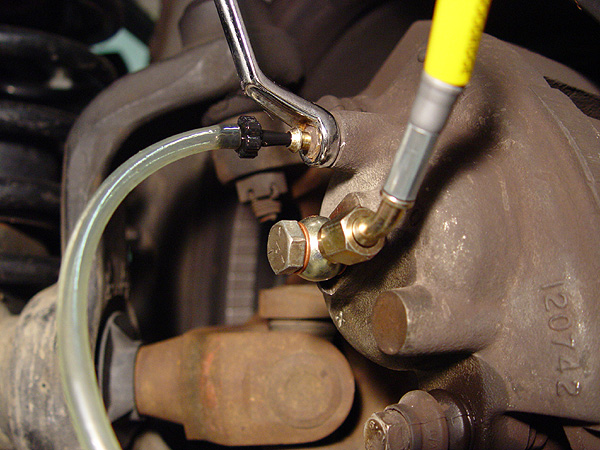
What a weird setup in that photo! See the brassy-looking thing with the wrench on it? That's the bleed nipple. In the photo, somebody has stuck a black plastic thing into the nipple, then attached the vinyl hose to that. Ordinarily you'd just push the vinyl hose directly onto the nipple. The hose would be 3/16" inside diameter.

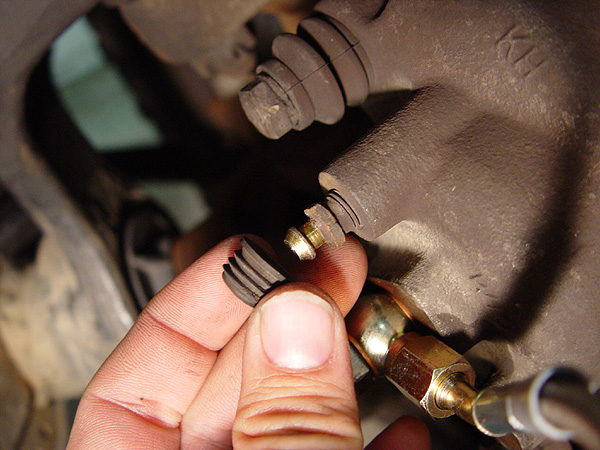
The rubber caps go on the bleed nipple once you pull the vinyl hose off of it.

The guy at Canadian Tire is clueless. Tell him to go ask one of the mechanics.

If you turn your steering wheel ALL the way to the LEFT, then look at the inside face of the driver's side wheel, you may be able to see the nipple on your caliper.
 
How does brake fluid circulate through the system? It's a one way flow and just sucking out the MC will leave the worst stuff where it will do the most damage.

Any leakage at the seal in the calipers or wheel cylinders will introduce air. If they are leaking it's time for rebuild.

When using a vacuum bleeder I always take the bleeders out and apply some paste thread sealant to them, seat them then crack them open a 1/4 turn.
 
I must have missed something--you use the turkey baster to suck out old fluid in the MC. Then you fill it with some good stuff--then use either pressurize the system and crack open bleeders; or get someone to pump the pedal. I'm not sure if anyone is advocating just replacing the cylinder fluid.
 
I bought my bag of all one size vacuum caps on eBay. If they are "taller" than a bleeder cap I just cut them shorter with a utility knife. If you buy assorted sizes - which I have done in the past - you'll just end up with a number of caps you'll never use.
 
Originally Posted By: Tegger
Originally Posted By: Carnoobie
How do i put the cap on if the brake line is connected to the nipple?

What a weird setup in that photo! See the brassy-looking thing with the wrench on it? That's the bleed nipple. In the photo, somebody has stuck a black plastic thing into the nipple, then attached the vinyl hose to that. Ordinarily you'd just push the vinyl hose directly onto the nipple. The hose would be 3/16" inside diameter.

The rubber caps go on the bleed nipple once you pull the vinyl hose off of it.

The guy at Canadian Tire is clueless. Tell him to go ask one of the mechanics.

If you turn your steering wheel ALL the way to the LEFT, then look at the inside face of the driver's side wheel, you may be able to see the nipple on your caliper.


Do you know what size i need? 7th gen civics should all be the same. 01-05 years. Called and the guy said i need to find out what size i need.
 
Originally Posted By: Tegger
Originally Posted By: Carnoobie
How do i put the cap on if the brake line is connected to the nipple?

What a weird setup in that photo!

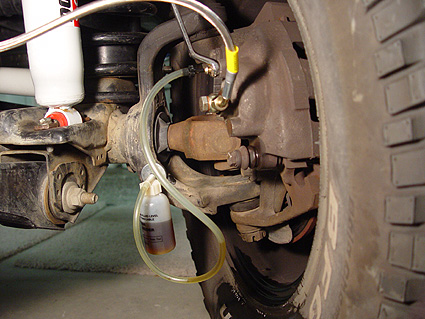
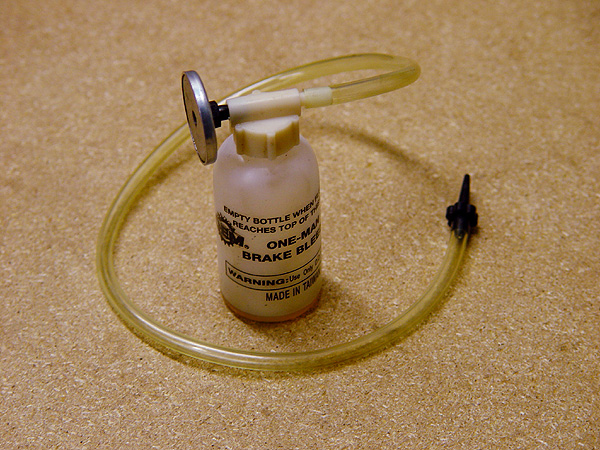
The reason Carnoobie's picture http://www.4x4xplor.com/images/brake-bleed/brake-bleed02.jpg is "a wierd setup": it is from a Jeep website 4x4xplor.com, with pictures of someone removing the bleed rubber cap and showing how to do a brake bleed.
brake-bleed00.jpg
brake-bleed05.jpg
brake-bleed01.jpg
 
Originally Posted By: carwreck
The reason Carnoobie's picture http://www.4x4xplor.com/images/brake-bleed/brake-bleed02.jpg is "a wierd setup": it is from a Jeep website 4x4xplor.com, with pictures of someone removing the bleed rubber cap and showing how to do a brake bleed.

OK, but what's with the little black needle sticking into the bleed screw? Is that so the system will fit any bleeder screw on the market?
 
Status
Not open for further replies.
Back
Top Bottom