Tire Cupping

Joined
Feb 6, 2025
Messages
688
Tire cupping is caused by the tires being dribbled down the road like a basketball; correct?

And the reason why they're being dribbled is because the shocks are shot; correct?

Is there any other reason for tire cupping?
 
The term "cupping" is frequently used where the term"irregular wear" would be more appropriate. Irregular wear is caused by misalignment, and the term "misalignment" also means when the vehicle manufacturer deliberately publishes a spec that is supposed to make the car handle better. Typically that involves too much camber.

It is my opinion that anything over 1degree of camber is too much.

It is also my opinion that the published alignment tolerances are too wide by half. In other words, the alignment has to be within the inner half of the tolerance to get good tire wear and to prevent cupping.
 
Shocks may dampen the oscillation that causes cupping to progress, but generally that oscillation is a product of the tires fighting each other due to some combination of toe and excessive camber. So you can either try to dampen the problem, rotate the tires often enough to hide the problem, or fix the root cause (alignment.) In my experience toe isn't bad, and camber isn't necessarily bad, but in combination some bad things can happen depending on the dynamic behavior of the suspension.

I say this as a person that replaced two cupped tires last week (at >6/32" tread) and spoke to a trusted alignment shop about it. Adjustable camber links currently sit on my workbench for the rear of the Mazda 3. It likely left the factory with "too much" rear negative camber, which has worsened over time with suspension settling.
 
Toe kills tires not camber. I daily drive -2.7 up front with no abnormal wear.
It will start more wear on inner side in the rear if not rotated often enough. I see that on my snow tires as their compound is very soft (-1.7).
But, it will save tires on track.
 
I thought cupping was wear in the middle of the tread - or across a specific area of the thread. ie not caused by caster/ camber or suspension?

I had 2 goodyear tires "cup" years ago. They litterally wore out faster on one part of the tire. Goodyear said it was a material quality issue and replaced them free of charge.

Pictures?
 
I thought cupping was wear in the middle of the tread - or across a specific area of the thread. ie not caused by caster/ camber or suspension?

Here's a copy of a photo of what the Tire Industry Association says Cupping/Scallop wear is in their Passenger and Light Truck Tire Conditions Manual.

You can get the manual here: TIA Passenger Car and Light Truck Tire Conditions Manual

It's pricey - $235 - but it is the definitive publication on tire conditions.

Cupping.webp


Here's the photo for Diagonal Wear, which is frequently called "Cupping".

Diagonal Wear.webp
 
Toe kills tires not camber. I daily drive -2.7 up front with no abnormal wear.
Thanks for posting the reality of the situation. I keep mentioning just how important toe adjustments are and people here constantly tell me I'm wrong. It's not like I've been doing this for 45 years and have decades of high end race car experience under my belt.

Here and there, now and then, there are situations that are unique. But for most of us, abnormal tire wear is toe related. There really is a reason why most manufacturers don't provide camber adjustments anymore. For the average appliance vehicle, it makes little difference.

If the inside of the tire is worn and the rest of the tread is good, ya-hav too much toe-out for your situation.


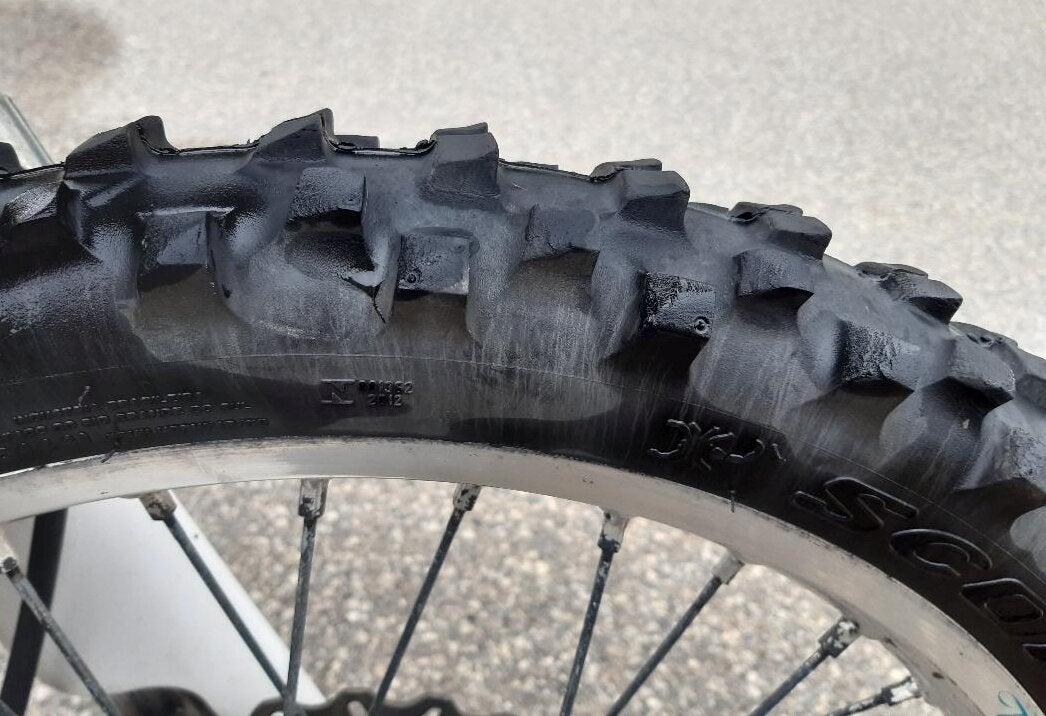
If the tread block is higher at the front than the back (at the top of the tire), that is normal and due, at least in part, to hard braking. Rotate the tires side to side. Although this is a dirt bike front tire, it is a great example.

t3.jpg.580b5e18a751c0a1f22f5cd02566ffa3.jpg
 
Last edited:
Here's the photo for Diagonal Wear, which is frequently called "Cupping".

My front tires that used to be on the back, look like the tire in the 1st picture and they are noisy!

They are far noisier up front than when they were on the back.

I imagine the sound of the tire in the 2nd picture would be terrifying.
 
Back
Top Bottom