timing chain service life

Status
Not open for further replies.
Joined
Nov 5, 2009
Messages
146
Location
Southern California
I've noticed a lot of newer cars have reverted from timing belts back to chains. The automakers are claiming, from what I've seen, that these are "lifetime" timing chains. I'm wondering if this means:

1) "after 200K miles nobody's going to care anyway"

- - or - -

2) "if the rest of the engine can last over 300K miles, then so will the timing chain"

Any thoughts?
 
I've seen chains go as long as 300k with no issues, I can't say I physically check it for slop, but in theory it should hold up for life of motor, assuming it wasn't ol starved.
 
My Cavalier in my autosig still has the original timing chain. However, I feel that they should be replaced every 200k since they stretch. As for why I didn't replace mine at 200k......well, I felt like I didn't drive my car hard and I took extremely good care of it......and if it does snap, it's probably time for another car anyway at this point.
 
I agree a properly designed chain should last the useful life of the engine, but they don't always do. You have to make a judement call on when and if to replaced it. Holy cow 334,000 miles on a '98 Cavalier. I thought they were junk and so uncomfortable. I heard it on BITOG and elsewhere so it must be true. How can you stand to drive it that much
smirk.gif
?
 
I won't buy another car with a timing belt which currently rules out the Pilot or the Odyssey for me. Chains last the life of the car (at least in the rust belt) with average maintenance. IMO, any car with a timing belt is 1000 more than the sticker price since that's what you'll pay to do it once (twice?) in the life of the car.
 
MB diesels have two means of checking for "stretch" in them. Woodruff keys can be added to take timing back to spec.

They can last 500K+, no issues. I have heard that they can sometimes snap at startup when the first get accelerated against a high compression from the diesel. Not sure about that though.

Keep track of the tensioner, whether oil pressure actuated directly on the chain or some kind of plastic rails, Ive seen them fail.
 
I have worked on lots of low mileage (10K to 60K miles) late model vehicles to install aftermarket camshafts. To do this, the timing chain is removed.

In every case wear is already evident by 40K miles. So, in every case we install a new timing chain and appropriate tensioner hardware.

All the newer engines have a relatively light weight and small size timing chain and a hydraulically operated tensioner with a HDPE contact pad(s) that touches the chain. You see wear on both the contact pad, as 2 grooves, and the chain as stretch.

It is likely that as the pad wears down, pad wear decreases when the center roller pin starts contacting the pad as well as the outside links.

I can see these will last a long time, although the cam timing starts getting retarded as soon as 40K miles with the subsequent reduction in performance.

Keep your oil changed often in my recomendation.
 
More trouble with chains, tensioners, guides plus chains are tough on oil. Almost all engine problems I've seen lately have been Chain timing drive related. Belt is the way to go on OHC. The Short chain on pushrod V engines are OK but have median service life of about 3000 hours with silent nylon gear overmolds.
 
Originally Posted By: Cristobal
Back in the day timing chains almost always lasted until the motor was replaced, rebuilt, or the car got junked.


The good old days when a small block ford or chevy had the gears spaced so close together they almost touched and used a hefty and short chain compared to todays chains. There was no way it could fail except for the few years they used plastic teeth on the upper pullys to "quiet" the engines.

You can also degree the cams in these older engines and it would maintain the cam phasing for years. Now with VVT you never know what the cam is doing after all the gadgets and chains start wearing.
 
Chains are lifetime if taken care of.
I've had 3 Saturns and one had a loud timing chain (low on oil probably more than once) The other 2 had whisper quiet chains, one at over 150K miles. My Honda has a timing chain and I am confident it will never require service as long as I own the car (I take care of it) My Fathers' Maxima has about 130K miles on it, its 11 years old, and its just silent at idle. Has a main drive and 2 smaller drive chains (DOHC V6)
Chains are the only way to go.
 
Originally Posted By: ARCOgraphite
More trouble with chains, tensioners, guides plus chains are tough on oil. Almost all engine problems I've seen lately have been Chain timing drive related. Belt is the way to go on OHC. The Short chain on pushrod V engines are OK but have median service life of about 3000 hours with silent nylon gear overmolds.


Explain the Modular then....... And most BMW and Mercedes engines.
 
Most good timing chain systems last as long as most engines will stay in service. There are notable examples or poor chain designs. But most are good.

I used to be a firm believer in chains, or at least firm in my stance that I'd never own a vehicle with a timing belt. Now that I own one, and now that I really know what's involved to replace it (not all that heckuva lot), I'm more open to belts. You don't have tensioner/guide issues with belts, you don't really have stretch issues with belts, the system is designed so that it can be easily replaced and the timing is back to factory-correct. And it can often be done DIY for $250, or by an indy for $500, every 100k miles. In the grand scheme of things, that's not too much in my opinion.
 
My 98 Yukon had a roller type chain in it. At around 200,000 miles, the truck developed some strange things that I couldn't "tune" out. I swapped the timing chain and it immediately ran better. With the old chain, when I accelerated onto the highway, it would misfire and activate the check engine light.... Code was random misfire. I guess the chain slop was making the rotor spin funny. Anyway, that all went away and the truck served me well for another 75,000 miles.
I guess for the general public, 200,000 miles is lifetime.
 
Originally Posted By: ARCOgraphite
The Short chain on pushrod V engines are OK but have median service life of about 3000 hours with silent nylon gear overmolds.
Every chain failure I've seen has been caused by either the plastic overmold on a gear or plastic guides failing. Other than some small frictional losses (?) and the chain being a little more expensive-I can't imagine why a belt would be preferable to a chain.
 
That AGCO link is actually very educational, too-looks like the Ford reasoning behind the 5W-20 oil is THINNER is better-oil pressure builds more quickly on a winter cold start, less chance to snap off one of those flimsy plastic timing chain guides!
 
Originally Posted By: bullwinkle
That AGCO link is actually very educational, too-looks like the Ford reasoning behind the 5W-20 oil is THINNER is better-oil pressure builds more quickly on a winter cold start, less chance to snap off one of those flimsy plastic timing chain guides!


They are all like that....

Northstar:

2009-12-29_232251_mark_0000.jpg


Chrysler 4.7:

2009-03-02_152020_4.7_timing.gif


Ford 4.6:

F150_46_97_WEP_chain-guidesL.gif


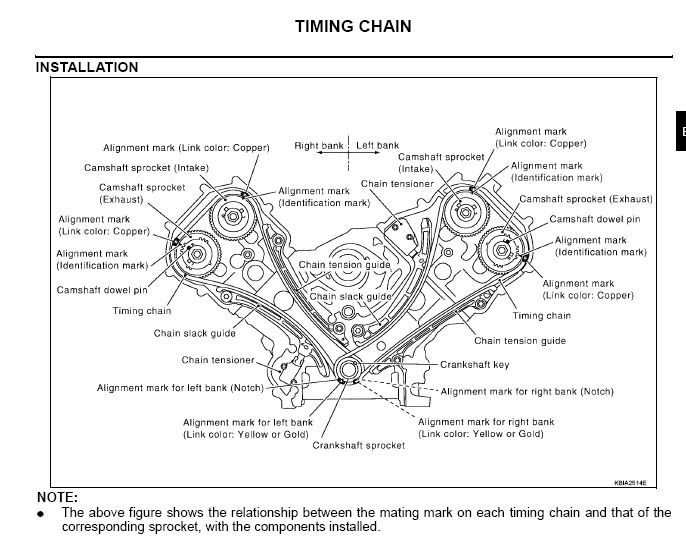
Nissan 5.6:

Timingchain.jpg


BMW S62:

73.jpg


Mercedes 5.0L V8:

78051901.gif


I think Ford's issue for the affected years was choice of materials.
 
Status
Not open for further replies.
Back
Top Bottom