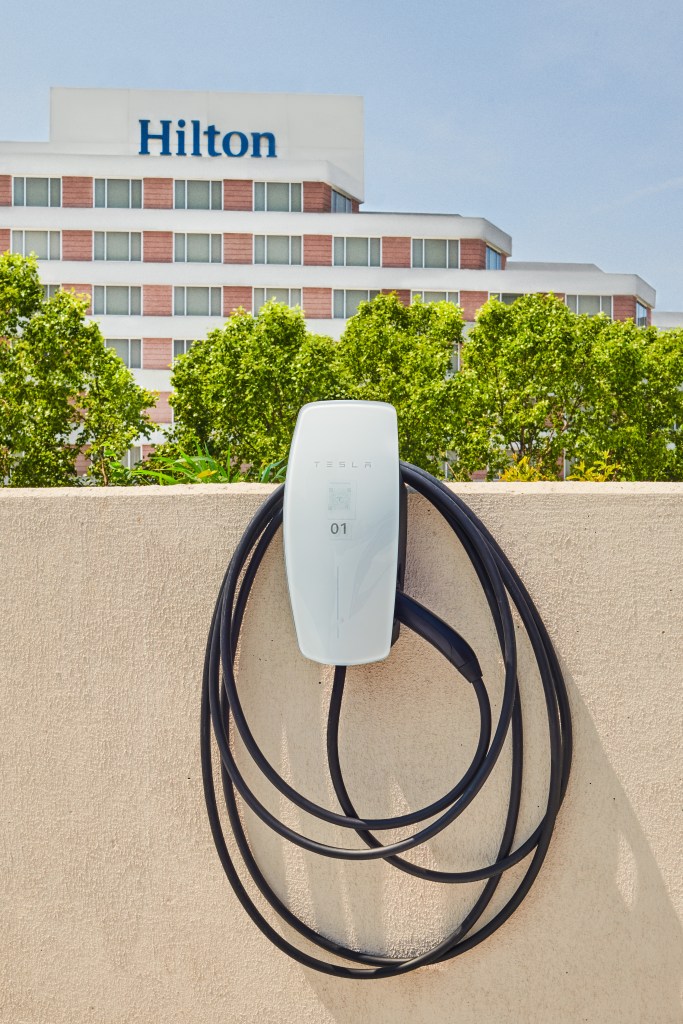
Tesla chargers at Hilton Hotels

JHZR2

Staff member
Joined
Dec 14, 2002
Messages
56,131
Location
New Jersey
I’ve often mentioned the challenges with going on overnight trips in an EV, outside of its range. That is, the impracticality of it compared to an ICE because of the need to waste time finding a charger and using it.

But call a spade a spade, Tesla is looking to install chargers at 2000 hiltons. I have Hilton diamond status… so this is useful. If I ever had an EV (I have as a rental car more than once, and wasted time at a supercharger), this helps.

https://stocks.apple.com/Aj9ROPSW4RRWae7PWBjcrtw
 
A smart business move. The plan is to charge up at your hotel whenever possible (using so called "destination charging"). While on the road you only charge enough to get to the next supercharger or to your destination with a 10 - 15% charge, but you charge to probably 90% at the hotel when you're stopped anyway. You plug in, set the desired charge %, and your cell phone tells you when it's done. I'm usually in my hotel room having a cold drink when it's done. So there is no waiting around for the battery to charge and yet you have a full charge for a good start in the morning.
 
They say it's their plan with Hilton is to use the Universal Wall Connector, which isn't for sale to the public until October. They call it an integrated J1772 adapter, but it's actually a separate piece where I'm thinking there's potential to lose it or be subject to theft. Not that there isn't the potential for the current Tesla adapter (that comes with every Tesla) to be stolen when used with a J1772 connector.

https://shop.tesla.com/product/universal-wall-connector

Here's Hilton's specific release.

https://stories.hilton.com/releases...esla-universal-wall-connectors-at-2000-hotels

This guy got a sample to review. Looks like there's some mechanism where it the adapter only releases when attached to the NACS connector and is locked until it's inserted back into the caddy hole.

 
A smart business move. The plan is to charge up at your hotel whenever possible (using so called "destination charging"). While on the road you only charge enough to get to the next supercharger or to your destination with a 10 - 15% charge, but you charge to probably 90% at the hotel when you're stopped anyway. You plug in, set the desired charge %, and your cell phone tells you when it's done. I'm usually in my hotel room having a cold drink when it's done. So there is no waiting around for the battery to charge and yet you have a full charge for a good start in the morning.

They're typically not "networked" and I haven't heard of any that have idle fees, so there might be an incentive to not have to get out of bed in early morning to disconnect for the next guy. I heard of a pilot program that allows businesses to require payment for the use of Destination Chargers.

I'm thinking there probably won't be many waiting early in the morning. If they're all used then there should probably be a backup plan.
 
Tesla chargers are level 3 fast chargers. So you plug in as soon as you get to the hotel and charge for maybe 45 minutes or an hour to get to a 90% charge. Tesla is able to charge an idle fee but more importantly it's just good etiquette to move your vehicle as soon as it's charged. At the places we stayed people were good about moving their vehicles once they had finished charging and there were always charging stations free.

Some hotels in smaller places have only one or two level 2 chargers where it might take a few hours to get charged up to 90%. In that case it would be even more important that you move your vehicle once you're done. It would be really annoying to have someone leave their car in the only charging space available overnight. That's the equivalent of blocking the only gas pump in town and going out for the evening. I think you could expect to find a note under you windshield wiper.
 
Tesla chargers are level 3 fast chargers. So you plug in as soon as you get to the hotel and charge for maybe 45 minutes or an hour to get to a 90% charge. Tesla is able to charge an idle fee but more importantly it's just good etiquette to move your vehicle as soon as it's charged. At the places we stayed people were good about moving their vehicles once they had finished charging and there were always charging stations free.

Some hotels in smaller places have only one or two level 2 chargers where it might take a few hours to get charged up to 90%. In that case it would be even more important that you move your vehicle once you're done. It would be really annoying to have someone leave their car in the only charging space available overnight. That's the equivalent of blocking the only gas pump in town and going out for the evening. I think you could expect to find a note under you windshield wiper.

This deal with Hilton is part of Tesla's "Destination Charging" program where there is no additional cost to the customer to charge, and they're all using some form of Tesla's Level 2 Wall Connector. The participating business pays for the electricity. However, looking at some of the proposed setups, it might be walled behind pay parking at each hotel.

https://www.tesla.com/destination-charging

I'm not sure how it works, but if you look up different Destination Charging locations, they're not all listing a maximum 11.5 kW that the Wall Connector can put out. Some list more than that, so I'm thinking maybe Tesla is making something available for businesses that's different than the version that anyone can buy. Some are less - like 8 kW, so those might be programmed with an output limit.
 
"Deepwater Asset Management’s managing partner Gene Munster predicts electric car adoption in the U.S. will steadily increase in the coming years, from 2% in 2020 to 22% by 2025."

That's a bold prediction. I'll take that bet.
 
I stayed at a Hilton hotel just a few weeks ago and they had a section of the parking lot set up with chargers. The slots were probably 80% occupied each time I walked by them. I was 200 miles from home so if I had an EV I would certainly have topped off the charge before heading back home and experienced no range anxiety.

I was driving my Jaguar and surprisingly got 30.5 MPG on the trip there and 27.5 MPG on the way home where I encountered some stop & go freeway traffic going through the Los Angeles area. That was pretty good for a supercharged V8. Of course the gas cost me just under $6 per gallon. An EV would have been a practical vehicle for that trip.
 
We need the capital cost of each charger and the details on how much is profit per kWh to determine a payout in years. Then we can decide if it’s a money maker or just another lost leader.
There is more to it than that. Destination chargers are installed to draw customers to the merchant's primary business. It becomes an added benefit to potential customers, even though they will still pay for it indirectly.
 
We need the capital cost of each charger and the details on how much is profit per kWh to determine a payout in years. Then we can decide if it’s a money maker or just another loss leader.
If a customer stays at your hotel because you have an EV charger when that room would have been empty otherwise you win big. It wouldn't have to happen many times to break even. But the payout would be hard to calculate - perhaps all you would see is more filled rooms and that might happen for many reasons.

A complication in that calculation would be Tesla installing a Supercharger nearby, a popular restaurant being built across the street, a new traffic route, a business with many commercial visitors opens nearby, etc. You win big in those cases too but not because you installed a charger.
 
We need the capital cost of each charger and the details on how much is profit per kWh to determine a payout in years. Then we can decide if it’s a money maker or just another lost leader.

There is no “profit”. They claim that it’s going to be their new Universal Wall Connector which is currently on preorder for $595. There will be no cost for the electricity for the customer, which will be paid for by the hotel. That’s pretty much how Tesla’s Destination Charging program works.

https://shop.tesla.com/product/universal-wall-connector

My big worry would be vandals stealing the adapter. It’s got some funky locking mechanism, but I’m sure there will be ways to defeat it. I’m pretty sure it’s useless (likely designed to not work with anything else) but people do stupid things.
 
There is a lot of conflicting info, but to go onto the grounds of a commercial business, run the appropriate lines from the nearest transformer, and install another transformer and electrical gear is about $100,000 per supercharger. Show me I’m wrong. ;)
 
There is a lot of conflicting info, but to go onto the grounds of a commercial business, run the appropriate lines from the nearest transformer, and install another transformer and electrical gear is about $100,000 per supercharger. Show me I’m wrong. ;)
Well, I'm pretty sure merchants don't go to that expense because they think I am cute. They are in the business of making money.
 
If a customer stays at your hotel because you have an EV charger when that room would have been empty otherwise you win big. It wouldn't have to happen many times to break even. But the payout would be hard to calculate - perhaps all you would see is more filled rooms and that might happen for many reasons.

A complication in that calculation would be Tesla installing a Supercharger nearby, a popular restaurant being built across the street, a new traffic route, a business with many commercial visitors opens nearby, etc. You win big in those cases too but not because you installed a charger.

The incentive to use a Destination Charger is that the customer isn’t directly charged for the energy. Same as turning on the lights, watching the TV, using an in room coffee maker, keeping a refrigerator in, etc. It’s baked into their overall costs, but even a Level 2 charger is going to mean way more electricity than someone charging a laptop from an outlet.

I could see someone risking it and arriving with 10% charge left and leaving a vehicle (and these will support more than Teslas) overnight where it’s using 90 kWh. Depending on the hotel’s rates, that could cost from maybe $15 to $50.
 
There is a lot of conflicting info, but to go onto the grounds of a commercial business, run the appropriate lines from the nearest transformer, and install another transformer and electrical gear is about $100,000 per supercharger. Show me I’m wrong. ;)

These aren’t Superchargers. They’re more or less the same as the Universal Wall Connectors that Tesla sells for home installations. But the installation costs aren’t going to be trivial.


Hilton-Tesla-Universal-Wall-Connectors-2.jpg
 
OK, let's simplify this. An empty hotel room is bad for Hilton's bottom line.
It's called asset utilization. An asset that is not in use is zero revenue yet incurs all the fixed costs.
Hilton is in the business of filling rooms; destination chargers will draw more customers as EVs gain marketshare.
A businessman can charge while at meetings, overnight, etc. Time saved for him/her and increased asset utilization for Hilton.
 
"Deepwater Asset Management’s managing partner Gene Munster predicts electric car adoption in the U.S. will steadily increase in the coming years, from 2% in 2020 to 22% by 2025."

That's a bold prediction. I'll take that bet.


I think that is over optimistic on the part of Munster. I suspect he has a large position in TSLA so some pumping via the media is expected.
 
OK, let's simplify this. An empty hotel room is bad for Hilton's bottom line.
It's called asset utilization. An asset that is not in use is zero revenue yet incurs all the fixed costs.
Hilton is in the business of filling rooms; destination chargers will draw more customers as EVs gain marketshare.
A businessman can charge while at meetings, overnight, etc. Time saved for him/her and increased asset utilization for Hilton.

There's a lot of that, but the cheapest I've stayed at a Hilton in "recent" years the nightly rate was $59. My dad was at a group meeting at a local Hilton and they got a massive group rate with that hotel. And the cost of the electricity could be variable. One customer might just top off an EV at a local business meeting while others traveling long distances might be looking to fill 80% of capacity overnight.

One issue might be turnover since most Destination Chargers don't have idle fees (not sure how it works for the ones where the customer is charged although I'm thinking they're networked). But they're really more like home chargers anyways. Most customers at hotels are going to be guests staying there overnight. This would be different than the Destination Chargers at restaurants where it might just be an hour or two and there's likely turnover.

The only time I've ever used a Destination Charger was at Russian River Brewing in Windsor. I had to look around for it through. They had other chargers (not sure if they were free/subsidized) close to the entrance, but these were a good 150 feet away from the entrance and none were being used. I'm also not sure what the deal is now because Tesla says they require a minimum of six, but when I look at existing setups it's often just one or two. I think there were four at the RRBC.
 
Back
Top Bottom