Ok! I hd a bit of time so i went for a look. what metal purolator use for end cap! Flash binite stainless? Every other filter looked dirty by comparison.carquest filter are filty now i know why drivework seal with saran wrap the screwing end.but this aside.the st is a better value (nvm the model)its as clean as puroboss. Dont get me wrong look wise purolator inside and outside look pristine.Yes literally pristine.if look is important to you puroboss is the way to go. There probably will be an outside finish option i suspect.but i can say SuperTech ST-2016is THE FILTER TO GET

You are using an out of date browser. It may not display this or other websites correctly.
You should upgrade or use an alternative browser.
You should upgrade or use an alternative browser.
Supertech st6607(2016) vs purolator boss
- Thread starter yvon_la
- Start date
- Status
- Not open for further replies.
Ill never use the BOSS because to me the center tube is too restrictive.
Originally Posted By: yvon_la
but i can say SuperTech ST-2016is THE FILTER TO GET
Lol not with it's efficiency specs it's not!!
Originally Posted By: yvon_la
but i can say SuperTech ST-2016is THE FILTER TO GET
Lol not with it's efficiency specs it's not!!
What makes the Supertech the filter to get other than cleanliness? You got me curious. I had a Fram Ultra XG2 on the shelf in the box and a Purolator PureOne PL24651 purchased last year. The Puro metal does have a more polished look than the Fram--looking almost like stainless, though I doubt it is. Deep down in the Fram near the bypass valve there is something showing in the filter--I'm going to guess some sort of assembly grease. They both have a distinct smell of some sort of machinery oil I'm guessing--I bet a hound dog could tell the two brands apart from the smell! However, not much to note in terms of dirt--both seemed quite clean to me, and nothing to worry about. One interesting thing is look at the difference in the size of the holes for the incoming oil--I would guess the Purolator has at least 50% greater because you could fit more than two of the Fram holes into each single Puro elongated one.

Last edited:

Originally Posted By: daman
Ill never use the BOSS because to me the center tube is too restrictive.
No need to worry about restriction with a Purolator.

Ill never use the BOSS because to me the center tube is too restrictive.
No need to worry about restriction with a Purolator.
yvon_la
Thread starter
I like the inner tube and for me specifically i love the combo bypass. I think every application have one of each.i didnt like the deep down bypass even tho the tg was the best design. Oil still had to cross the anti return reach deep to the bypass valve create an diffetence in pressure strong enough to make oil flow. I did have sound like engine was running without oil gor a minute or so. So now im trying the combo version.the other st with bypass at the bottom is also nice. What make it uber is its price.sure i wish i had seen how the st6607(2016)is in picture here but havent seen one so i ll install when i m back home and we ll see

- Joined
- Sep 26, 2010
- Messages
- 9,835
Originally Posted By: AuthorEditor
What makes the Supertech the filter to get other than cleanliness? You got me curious. I had a Fram Ultra XG2 on the shelf in the box and a Purolator PureOne PL24651 purchased last year. The Puro metal does have a more polished look than the Fram--looking almost like stainless, though I doubt it is. Deep down in the Fram near the bypass valve there is something showing in the filter--I'm going to guess some sort of assembly grease. They both have a distinct smell of some sort of machinery oil I'm guessing--I bet a hound dog could tell the two brands apart from the smell! However, not much to note in terms of dirt--both seemed quite clean to me, and nothing to worry about. One interesting thing is look at the difference in the size of the holes for the incoming oil--I would guess the Purolator has at least 50% greater because you could fit more than two of the Fram holes into each single Puro elongated one.
Some time ago (because I was equally curious) I did a comparison and a calculation based on the inlet and outlet holes on an XG2 and a FL-820s (which looks to have the same base plate as the Purolator) and the FRAM still flows 21% more than is needed.

What makes the Supertech the filter to get other than cleanliness? You got me curious. I had a Fram Ultra XG2 on the shelf in the box and a Purolator PureOne PL24651 purchased last year. The Puro metal does have a more polished look than the Fram--looking almost like stainless, though I doubt it is. Deep down in the Fram near the bypass valve there is something showing in the filter--I'm going to guess some sort of assembly grease. They both have a distinct smell of some sort of machinery oil I'm guessing--I bet a hound dog could tell the two brands apart from the smell! However, not much to note in terms of dirt--both seemed quite clean to me, and nothing to worry about. One interesting thing is look at the difference in the size of the holes for the incoming oil--I would guess the Purolator has at least 50% greater because you could fit more than two of the Fram holes into each single Puro elongated one.
Some time ago (because I was equally curious) I did a comparison and a calculation based on the inlet and outlet holes on an XG2 and a FL-820s (which looks to have the same base plate as the Purolator) and the FRAM still flows 21% more than is needed.
I was pretty close guessing that there is 50% more area on the Purolator. Thanks for those measurements!
Bigger holes aren't better, it makes the baseplate weaker, a lot weaker. They aren't flowing any more oil, there is no purpose to larger holes. For some reason Fram makes the smaller filters with more holes, and Purolator makes smaller filters with round holes, although the outlet tubes can be the same size. It's all a gigantic mystery. Fram XG4967 inlet holes:
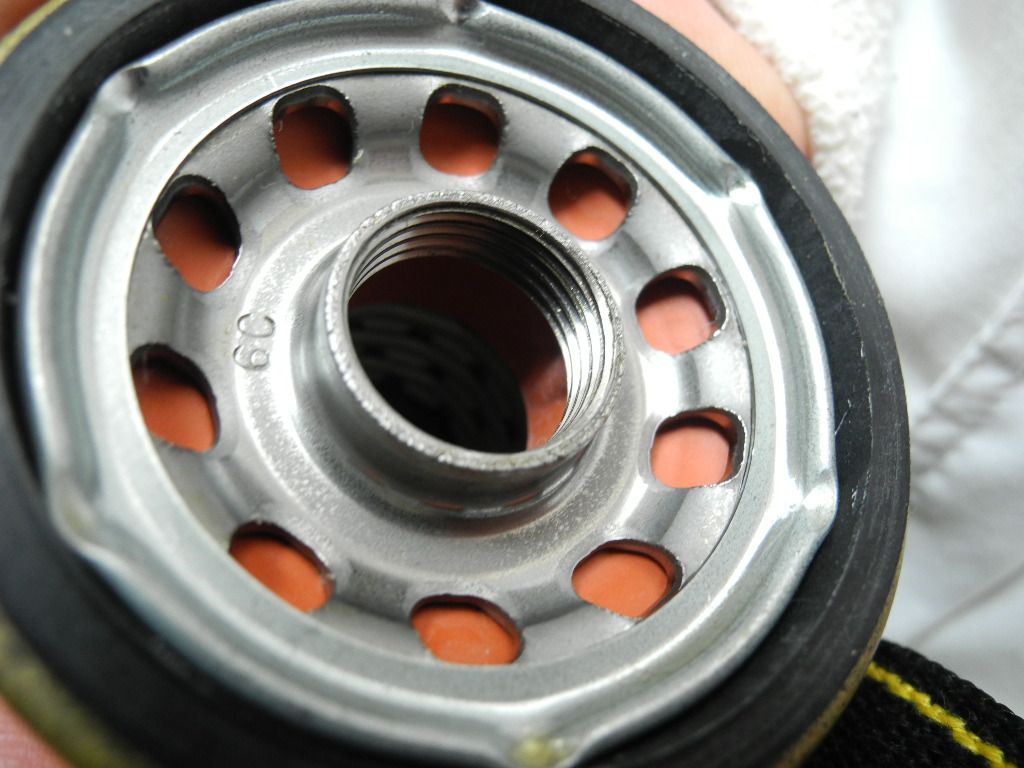
yvon_la
Thread starter
I wish those filter engineer started learning what gallon per minute is
Quote:
Bigger holes aren't better, it makes the baseplate weaker, a lot weaker. They aren't flowing any more oil, there is no purpose to larger holes.
Sure, weaker, but it only has to be strong enough for the purpose. I have never blown a filter off its mount. Obviously more and bigger holes can flow more oil, but it would seem that as long as they can match the volume of the output hole there is little to gain unless there is a consideration of allowing the filter to fill up faster on first start.
Bigger holes aren't better, it makes the baseplate weaker, a lot weaker. They aren't flowing any more oil, there is no purpose to larger holes.
Sure, weaker, but it only has to be strong enough for the purpose. I have never blown a filter off its mount. Obviously more and bigger holes can flow more oil, but it would seem that as long as they can match the volume of the output hole there is little to gain unless there is a consideration of allowing the filter to fill up faster on first start.

Originally Posted By: AuthorEditor
Quote:
Bigger holes aren't better, it makes the baseplate weaker, a lot weaker. They aren't flowing any more oil, there is no purpose to larger holes.
Sure, weaker, but it only has to be strong enough for the purpose. I have never blown a filter off its mount. Obviously more and bigger holes can flow more oil, but it would seem that as long as they can match the volume of the output hole there is little to gain unless there is a consideration of allowing the filter to fill up faster on first start.
Bigger and more holes might just slightly reduce the delta-p across the filter. With a positive displacement oil pump, there really isn't 'more oil' be be flowed because of bigger holes. The oil volume coming out of the pump is a fixed displacement per engine revolution. It's not a gigantic flow source like a water tower full of oil where less resistance down stream would increase the flow rate.
Quote:
Bigger holes aren't better, it makes the baseplate weaker, a lot weaker. They aren't flowing any more oil, there is no purpose to larger holes.
Sure, weaker, but it only has to be strong enough for the purpose. I have never blown a filter off its mount. Obviously more and bigger holes can flow more oil, but it would seem that as long as they can match the volume of the output hole there is little to gain unless there is a consideration of allowing the filter to fill up faster on first start.
Bigger and more holes might just slightly reduce the delta-p across the filter. With a positive displacement oil pump, there really isn't 'more oil' be be flowed because of bigger holes. The oil volume coming out of the pump is a fixed displacement per engine revolution. It's not a gigantic flow source like a water tower full of oil where less resistance down stream would increase the flow rate.
Quote:
With a positive displacement oil pump, there really isn't 'more oil' be be flowed because of bigger holes.
What I should have written is that more and bigger holes "could" flow more oil, if there was more oil to be flowed. But, the total volume is still restricted downstream by the diameter of the outlet hole. In general, filter design and construction seems to allow a lot of variables.
With a positive displacement oil pump, there really isn't 'more oil' be be flowed because of bigger holes.
What I should have written is that more and bigger holes "could" flow more oil, if there was more oil to be flowed. But, the total volume is still restricted downstream by the diameter of the outlet hole. In general, filter design and construction seems to allow a lot of variables.
Originally Posted By: AuthorEditor
Quote:
With a positive displacement oil pump, there really isn't 'more oil' be be flowed because of bigger holes.
What I should have written is that more and bigger holes "could" flow more oil, if there was more oil to be flowed. But, the total volume is still restricted downstream by the diameter of the outlet hole. In general, filter design and construction seems to allow a lot of variables.
Agreed ... and to add, the oil flow is also even more restricted down steam by the engine's oiling system - which is typically about 15 times more restrictive than the average oil filter.
Quote:
With a positive displacement oil pump, there really isn't 'more oil' be be flowed because of bigger holes.
What I should have written is that more and bigger holes "could" flow more oil, if there was more oil to be flowed. But, the total volume is still restricted downstream by the diameter of the outlet hole. In general, filter design and construction seems to allow a lot of variables.
Agreed ... and to add, the oil flow is also even more restricted down steam by the engine's oiling system - which is typically about 15 times more restrictive than the average oil filter.
I Choose the Fram Ultra Over Purolater and anything else made by fram because the fram Ultra is built very well
I still like the bigger holes on the center tube and i wont change my mind.. This was talked about at our last engine rebuilding seminar and everyone seems to agree. There is plenty of restriction in the engine the filter don't have to be one of them. Most GM engines can deal with a restrictive filter because they just go into bypass and still get the oil they need.
yvon_la
Thread starter
Filter get filled with new oil faster when cold. If you live in the desert. Sorry this is useless
Originally Posted By: crazyoildude
I still like the bigger holes on the center tube and i wont change my mind.. This was talked about at our last engine rebuilding seminar and everyone seems to agree. There is plenty of restriction in the engine the filter don't have to be one of them. Most GM engines can deal with a restrictive filter because they just go into bypass and still get the oil they need.
An engine is typically around 15 times more restrictive than the average oil filter. The oil filter needs to be looked at as it's own little system in terms of 'restrictiveness'.
If the media and/or center tube are really restrictive for some reason (clogged media, mis-formed louver slits, etc), then the bypass valve should open up ... that's it's main purpose. Even if the bypass valve is wide open, the filter should be designed to still provide enough oil flow to the engine to prevent any damage from lack of oil. That's also why a good bypass valve design is required ... ie, it can't be super small to choke the flow to the point of causing engine damage.
The red part in your post is true about any oil filter with a good bypass valve.
I still like the bigger holes on the center tube and i wont change my mind.. This was talked about at our last engine rebuilding seminar and everyone seems to agree. There is plenty of restriction in the engine the filter don't have to be one of them. Most GM engines can deal with a restrictive filter because they just go into bypass and still get the oil they need.
An engine is typically around 15 times more restrictive than the average oil filter. The oil filter needs to be looked at as it's own little system in terms of 'restrictiveness'.
If the media and/or center tube are really restrictive for some reason (clogged media, mis-formed louver slits, etc), then the bypass valve should open up ... that's it's main purpose. Even if the bypass valve is wide open, the filter should be designed to still provide enough oil flow to the engine to prevent any damage from lack of oil. That's also why a good bypass valve design is required ... ie, it can't be super small to choke the flow to the point of causing engine damage.
The red part in your post is true about any oil filter with a good bypass valve.
Originally Posted By: yvon_la
Filter get filled with new oil faster when cold. If you live in the desert. Sorry this is useless
Say what? ... care to explain. With a PD oil pump, the filter is going to fill the same no matter what the temperature is. Please go on the 'net and bone up on positive displacement (PD) oil pumps.

Filter get filled with new oil faster when cold. If you live in the desert. Sorry this is useless
Say what? ... care to explain. With a PD oil pump, the filter is going to fill the same no matter what the temperature is. Please go on the 'net and bone up on positive displacement (PD) oil pumps.
- Status
- Not open for further replies.
Similar threads
- Replies
- 10
- Views
- 4K

- Replies
- 12
- Views
- 2K

- Replies
- 31
- Views
- 10K