
Pulled rod caps off...

Status
Not open for further replies.
Joined
Jan 10, 2008
Messages
1,295
Location
TX
Long story short, I changed my oil this weekend and found some metal in it. The car is a 2003 Jetta VR6 with about 110K miles on it. I put a fair amount of track time on the car; the last 4K miles have about 15 hours of track time in it, for example.

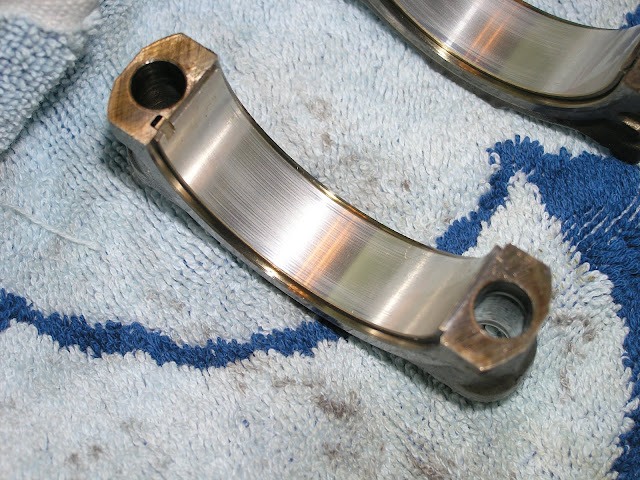
The metal looked like Al with some Cu, non-magnetic. My first through was rod bearings, so I decided to pull the oil pan and take some of the rod caps off. I think they look pretty good (the other half looks similar):
P1010056.JPG


I've only pulled two caps, one on each end of the crank, and both sets of bearings look good. I'll pull more once I have new rod bolts and bearings in hand.

Of course, now I am still left wondering where the metal came from.

Oil was AMSOIL AFL for the firsr 90K or so, Mobil 1 0W40 since then.

robert
 
The bottom shells won't tell you a whole lot; most wear will be on the top bearing shells.

I'd suggest that you feel the remaining rods for thrust. If you can move them by hand and feel a little thrust, they're probably fine. If one won't move, then you've likely found the failure.

Now I know next to nothing about a VW engine, specifically. But in general, I'd say that main bearings and cam bearings are also a possibility. How much metal are we talking about here? Any pictures?
 
Damant: Mann

Onion: Yeah, the upper bearing looks the same. The rest of the rods move fine. I will pull them apart when I have new rod bolts.

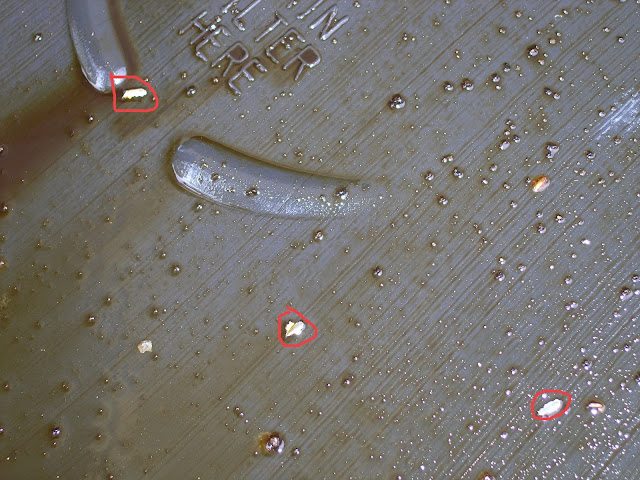
It wasn't that much metal. Just enough to concern me. I will post pictures in a bit.

robert
 
Originally Posted By: daman
Does this engine have a timing chain maybe two?


It does, but I would expect the chain to be made of steel or some other magnetic metal.

Here's a picture showing a few fragments. Note that the oil pan I was using was generally dirty, so there is dirt and bubbles that may make this look worse than it is:

MetalPieces.JPG


robert
 
Have you checked the valvetrain? If the engine wasn't knocking or making noise, I probably would've ran a compression test, then inspected the valvetrain.
 
Originally Posted By: mechanicx
Have you checked the valvetrain? If the engine wasn't knocking or making noise, I probably would've ran a compression test, then inspected the valvetrain.


Have hot checked the valve train. To be honest, the bottom end is easier to inspect on this car. I'd have to pull the intake to pull the valve cover, which is more involved that pulling the oil pan. A compression test is reasonable enough of an idea, though.

The other reason I suspected the rods -- last year I had a pretty major over-rev situation on track, at about 7K RPM I meant to shift 3-4 but went 3-2 instead. Didn't blow up and has been running fine sense, but there is a noise that an Audi tech at the track thought might be a rod. I decided at the time to run it and find out and it has run fine since then, but perhaps damage was done.

robert
 
Pistons ? any kind of new noises? Sometimes metal happens. I would think 7,000+ rpm would be easy for an V.W. engine to handle. Let us know what you find upon inspection.
 
No new noises that I've heard, and I'm generally pretty good at that. I agree, 7K shouldn't be a big deal; lots of people have turbo'ed VR6s that are putting out more power with this bottom end without issue. But you never know, I bet I hold it at those RPMs longer than most of those guys since my car actually sees the track. I figured 'better safe than sorry', for once in my life :)

robert
 
Make measurements of the rod's clearance, while you are in there. Also check the mains and the thrust bearing surfaces.
Plastigauge is great, but has to be used right. One side has to be loaded/pressed while the other is measured.
This is not as easy as it seems, and is often done wrong with tighter clearances therefore 'measured'.
Why do this? Because the mechanic heard a rod knock.

Aluminum is plentiful in the head. All sorts of places to wear there.
The bearings looks pretty good - normal.
BTW, if you have TTY bolts, you need new ones for final assembly.
 
Last edited:
Yeah, was thinking about Plastigauge'ing at least a few of the journals. Can't hurt to at least spot check things. Probably should do them all, but given the condition they appear to be in, probably safe enough not to. We'll see what the rest look like later this week.

I have some ARP bolts on order. May as well upgrade while I've got it apart. Plus they cost less than the OEM part, I believe.

robert
 
I just have to repeat my advice about loading one side when you use Plastigauge to check the other.
Another common misuse is to lay the crankshaft on it's bearings, and use plastigauge to then measure the clearances. You really have to do only TWO at a time for meaningful results. Otherwise, the crank may be held off by two, and there is more clearance at some others.

Do you get what I'm saying?
 
To be honest, I'm not sure I understand what you're saying. What do you mean by 'loading one side'? The way I have done this in the past is to lay the Plastiguage down and then torque the rod bolts. This is the procedure that the factory repair manual indicates. Is this correct?

Makes sense to only do one or two mains at a time, I think. I guess I never considered it any other way, though, so that isn't a problem!

robert
 
Originally Posted By: mechtech2
I just have to repeat my advice about loading one side when you use Plastigauge to check the other.
Another common misuse is to lay the crankshaft on it's bearings, and use plastigauge to then measure the clearances. You really have to do only TWO at a time for meaningful results. Otherwise, the crank may be held off by two, and there is more clearance at some others.

Do you get what I'm saying?


I get what you are saying but haven't seen that recommended anyplace else. Being somewhat retentive myself, I might try it if I ever use Plastigage again.

Thanks for pointing out something interesting I hadn't considered.
cheers3.gif


Translating what mechtech2 said to Simplese... Crankshafts aren't perfectly straight and main bearing bores aren't perfectly aligned. So, if you support the crank on more than 2 main bearings at a time your Plastigage measurement may be effected by the crank or main bearing bores not being in perfect alignment.
 
Status
Not open for further replies.
Back
Top Bottom