
Oil Level High after installing remote filter Kit

Status
Not open for further replies.
Joined
May 25, 2005
Messages
4,009
Location
Calgary Canada
All,

I've just installed a transadapt remote oil filter (full flow) kit. I did this because every time I change the filter on my '98 Chev K1500, oil runs all over the front axle U-joint and makes a mess. Plus, because of close quarters in there, a special skinny filter (ph3980) is used, and not the big GM filter for small block GM v8's.

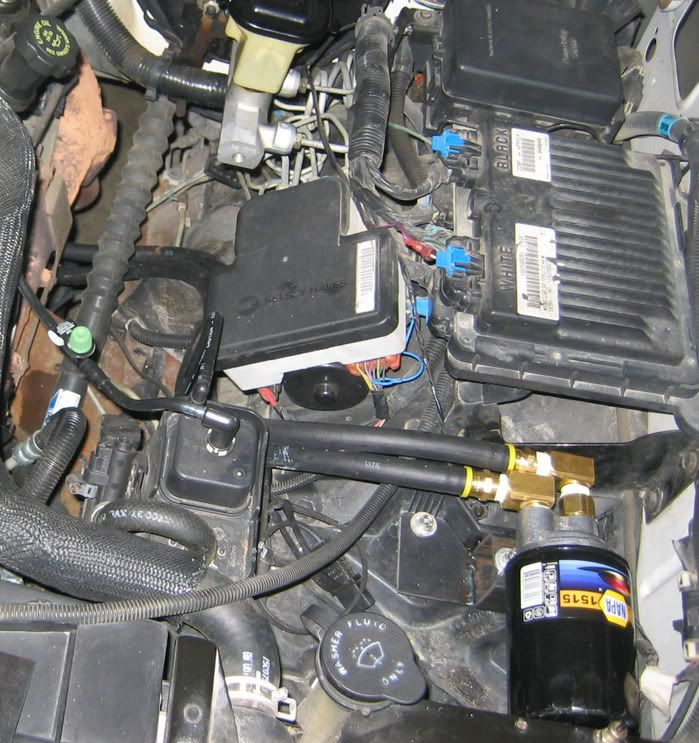
So now I have added a big remote filter (napa gold equivalent of the PH8A - Big ford v8 filter). The filter alone probably took 3/4 of a quart just to fill. Plus there are two hoses of 1/2" inner diameter at 38" each. The box says the remote filter kit adds 1 quart in capacity. I added an extra 1.2 litres of oil which is just over a quart, (a little extra because I had to have 2 oil hoses made up that were 10" each longer than what was provided in the kit).

The oil is too clean right now to get a level on the dipstick, but I'd say it's showing too high. I suspect this is because oil is draining back out of the remote filter hoses and giving a false "high" reading. The threads of the filter are pointing up in this install, so the filter itself can't be draining back.

Is anyone else experiencing this situation? And how can I get an accurate oil level reading?

I was thinking of doing a little math using the diameter and size of the old filter, against the new and finding the difference, then adding the inner diameter of the hoses x the overall length to establish an approximate volume of additional oil needed. Woud it be as simple as this?
 
Gary,

Thanks for the response. I'll give that a try!

The filter is as high as it can be underneath the hood. The top of the remote filter mount is 1/2" below the hood.

I don't get any more startup rattle than I did before, I have had a noisy lifter on cold start-up for quite some time. However, if the truck is warm, for example, if I come out of a store that I've been in for 1/2 hour, and the truck is still warm, I don't get any start up rattle.

Any suggestions for troubleshooting a pinhole leak at one of the fittings/connections? I used heavy natural gas-fitter's teflon tape, and I still have a few drips every time I drive somewhere near the remote filter mount. I can't see any leaking when it's idling, and I can't tell which fitting it's coming out of.
 
I experienced some seepage/weepage from my Permacool mount. It appeared to actually be coming from the filters themselves. No matter how I tightened the filters, there would be a "dirt collection" on the remote. My ss lines/AN fittings had their own very minor weepage issues.

I think that these are pretty crude castings ..and the machining process is probably at par with it. I would attempt to reassemble the setup with the same teflon tape and the addition of a plastic pipe dope. I would say aviation Permatex® ..because it almost assures an absolute sealed thread ..but it's like working with toxic molasass. You just have to be tidy with applying it ..or you'll have a mess and about a week to get it off your hands.
 
Went on a test drive and wrapped clean white paper towels around each fitting. None of the fittings were leaking. I have concluded the same thing as you have. It's coming from the seal of the oil filter to the housing. Not much I can do there. I'm going to keep the paper towels wrapped around the fittings a little longer to ensure there's no weepage there.

As far as oil volume to add because of the remote set-up, I did some math.

First step is to convert everything to metric:

0.5" I.D. of hose = 1.27 cm or 0.635cm Radius
80" of hose and fittings = 203.2 cm

Calculate Volume of hoses & fittings:

Pi x (R x R) x L = Volume

3.14 x (.635 x .635) x 203.2 = 257.27 Cubic CM

257 CC's = .25L of oil to fill the hoses (less than I thought)

Now I put 6L of oil in the sump and the truck calls for 4.8L with a filter change. Add a quarter litre to that and you've got 5.05L sump (with hoses).

Add another 200ml (guestimate) to account for the difference between a PH3980 (skinny filter) and the PH8A (fatty) and that brings me to a 5.25 L sump. I guess I've overfilled it by .75L.

Unless I've made an error in the math, it looks like I've got to get out the oil extractor and draw off around 3/4 of a L. Anybody see an error in my calculations?

How bad is it to run an extra 3/4 L of oil in the sump? I like the nice round number of 6L.

Even though this truck has 173k miles, it doesn't use a drop of oil in an 8k mile OCI (on account of religious 3k mile OCI's for the first 160k miles - before I had heard of BITOG and saw the light).
 
Good tip on the pipe dope. I had thought of using the white permatex stuff that is used when threading head-bolts into an engine block where the bolt goes into the water-jacket. I wasn't sure of its resistance to oil.

I'll see if I can track down some of that aviation permatex. Might be a handy item to have in the shop anyway. Is there any reason why a simple RTV silicone wouldn't work in the threads?
 
How high is your remote mount?

If you're not getting startup rattle, then you're not draining back all that much oil.

I'd just check it quickly (oil fluid enough to drain back quickly) after shut down, starting with the standard sump +1 quart and adding until full. Once there, I'd allow it to it overnight and then remark the stick. That's what I did before I installed check valves on my jeep. It sat high on the fender and one of them was an Amsoil bypass filter ..which has no ADBV, IIRC.
 
No ..RTV should do fine. I just used the aviation stuff on a few stainless steel applications in my old job. We threaded our own pipe and the wear and tear on the cutters was substantial. We sealed everything excessively that we threaded. Stainless seemed to give us the most trouble.

I wouldn't worry about your extra 3/4 liter in there. If you have a functional gauge, it will tell you if you are experiencing any aeration from crankshaft windage (whipping up the sump into a 'frape~". This is your only concern. I seriously doubt it will be an issue. You probably have a deep pan compared to some of the low profile passenger cars.
 
Gary, to add to our collective knowledge base...

Here's an unexpected turn of events...I've wrapped each fitting as well as the oil filter seal with white paper towel. These paper towels stay pristine white. I couldn't understand where the oil puddling on the top of the filter mount was coming from so I did a little internet research.

Some people have noted leaking THROUGH THE CASTING ITSELF. The oil can be forced through hairline/microscopic cracks or porosity in the aluminum casting.

At this point, this is the only physical explanation for the leaking, because there is no leaking whatsoever at any fitting/seal.

I have contacted the Mfg. to find out if this was common. However, I found two different instances of this on the internet (I belive one was here on BITOG), and in both, the Mfg. promptly provided new castings (indicating to me that the problem is known to the Mfg's).

I'll wait and see how they respond, however their warranty states they have see the actual problematic unit before they will warranty it. I'm probably screwed because I used the die grinder to remove casting flash and sharp edges throughout left by cursory machining/manufacturing. As such I have altered their product (I say improved) and they will likely deny. In any case, for $14 I'll just buy a new one to avoid the hassle of removing the whole remote filter set up while they inspect the offending part.
 
Here's a photo of my install in the extra battery tray of the '98 Chev full sized truck.

The stainless socket head cap screw fastens the custom bracket to the existing battery hold down bolt location.

To change the filter, just undo this one fastener, bring the filter to vertical with a paper towel underneath, spin off filter. Pre-fill a new filter, spin on in threads-up orientation, and secure down to battery hold-down bolt location.

 -


If anyone's interested, here's the hairline crack (vertical crack below right fitting)in the casting causing the small leak. I'm waiting for Transdapt to review this picture and hopefully replace the filter mount. Alternatively, I'll just buy another.

 -
 
A product called TiteSeal is the prefered thread sealent generally used in aviation. Good stuff.

The threads on that remote mount are NPT and as such are tapered. With that in mind it looks like you ran that fitting down way too far.
 
The one on the right at the lowest point is an adapter to extend the right angle fitting above the one beside it. It had quite a few less threads, than the right angle adapters, so they can't be compared head to head. In in any case all were torqued with a torque wrench.

You're right that they are NPT fittings and in this orientation are wider at the top and narrower in the bottom, and if this were the problem, the crack would begin closest to the fitting. However the crack begins at the bottom and ends when you get closer to the fitting.

Thanks for the input though!
 
Status
Not open for further replies.
Back
Top Bottom