
Mobil 1 ESP possibly using diblock polymer

Joined
Nov 16, 2002
Messages
42,089
Location
NJ
https://www.infineuminsight.com/en-gb/articles/the-diblock-advantage/

On the ROC, they subjected Mobil 1 ESP 5w30 and Mobil 1 ESP 0w20 to the shear stability test. What they found was the viscosity went up after the test. This is likely due to the diblock polymers. Per ROC, they also claim there could be some mPAO in current SP Mobil 1 ESP 5w30.

"Both of these structures have good thickening efficiency and shear stability index. However, only the diblock is able to form self-assembled micelle structures when dissolved in base oil, which provides unique performance benefits in modern formulations."

1739884297585.webp


1739884270835.webp
 
The shear stability of the next generation diblock vs. current diblock was also assessed in SAE 15w40 oils in a Mack MP-8 field test. Viscosity loss for both oils over the oil drain interval was very similar, and both were above the minimum KV limit for SAE 15w40 oils after 35,000 miles.

The Mack T11 test was used to assess the soot handling capability of HSD star, current diblock and next generation diblock VMs in SAE 10W-40 HDD formulations. While both diblocks outperformed the HSD star, the next generation VM also achieved this at a lower treat rate.

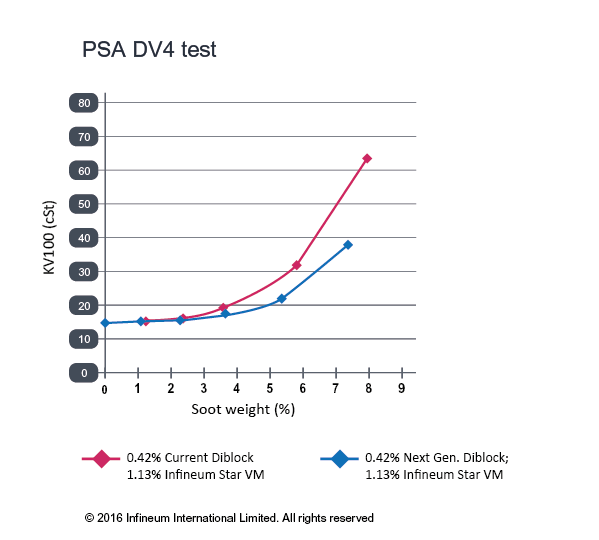
The excellent soot handling capabilities of the new diblock were also demonstrated in the PSA DV4 engine test in SAE 5W-40 passenger car formulations. Here, the next generation diblock gave equal or better soot handling performance when compared to a current diblock at an equal treat rate.

Dec 16 Diblock 4 1
Next generation diblock retains soot credit in the PSA DV4 test
The diblock and star VMs have also been assessed in the PSA DV6 engine test, which is more representative of modern engines. Here, a similar improvement in soot induced viscosity increase control was observed for diblock vs. star VM.

Conclusions​

The work undertaken by Infineum clearly demonstrates the advantages diblock HSD VMs can deliver to crankcase lubricants. The tuneable molecular structures, excellent soot handling capabilities and good shear stability mean they can provide significant benefits.

However, to meet evolving industry requirements, Infineum has optimised the HSD diblock chemistry so that it delivers superior performance in lower viscosity grade oils formulated using higher quality base stocks at lower polymer treat rate than current diblock technology. These advanced chemistries are being used to create lubricants that can help automotive OEMs as they work to address today’s key drivers for change.
 
Not to change the subject but is the Mobil 1 ESP the new M1 king of the hill?

I don't hear much about the manly Mobil 1 Full Synthetic 0w40 anymore! Is the honeymoon over? Lol
 
https://www.infineuminsight.com/en-gb/articles/the-diblock-advantage/

On the ROC, they subjected Mobil 1 ESP 5w30 and Mobil 1 ESP 0w20 to the shear stability test. What they found was the viscosity went up after the test. This is likely due to the diblock polymers. Per ROC, they also claim there could be some mPAO in current SP Mobil 1 ESP 5w30.

"Both of these structures have good thickening efficiency and shear stability index. However, only the diblock is able to form self-assembled micelle structures when dissolved in base oil, which provides unique performance benefits in modern formulations."

View attachment 264081

View attachment 264080

1.4% well inside the margin of error imo....
 
Not to change the subject but is the Mobil 1 ESP the new M1 king of the hill?

I don't hear much about the manly Mobil 1 Full Synthetic 0w40 anymore! Is the honeymoon over? Lol
Naw. It's just that European automakers have been moving away from A3/B4 oils especially with ULSG (circa 2020). It's essentially ACEA Cx these days.
 
Infineum says the diblock VIIs can reassemble after coming apart, which is surprising. The only explanation I can think of is the force causing that is some kind of electrostatic attraction, since I doubt it is due to a chemical reaction. I wonder if diblock VIIs are unique in this regard.

https://www.infineuminsight.com/en-gb/articles/the-diblock-advantage/
However, when a shear force is applied the micelles can partially or fully disperse. Although the overall thickening efficiency is reduced, the molecules are not permanently sheared so that when the shear force is removed they self-assemble and provide their original contribution to viscosity.
Edit: After reading more carefully, I see that diblock VIIs can form micellar assemblies and those are, I believe, formed by electrostatic forces.
 
Last edited:
Not to change the subject but is the Mobil 1 ESP the new M1 king of the hill?

I don't hear much about the manly Mobil 1 Full Synthetic 0w40 anymore! Is the honeymoon over? Lol
The honeymoon for FS 0w-40 mainly ended when they reformulated and removed the ester content. Still good stuff, but not as great on paper as it was. I would still use it.
 
That description of the polymers re-forming sounds just like the claim Pennzoil made about its synthetics years ago, that their VI’s reformed to maintain viscosity protection.
What did they call it - ‘adaptive molecules’ with the little picture on the bottle of them being sheared apart and re-forming?
It was a part of Pennzoil Platinum marketing when it first came out.
Anyone else remember this??
 
That description of the polymers re-forming sounds just like the claim Pennzoil made about its synthetics years ago, that their VI’s reformed to maintain viscosity protection.
What did they call it - ‘adaptive molecules’ with the little picture on the bottle of them being sheared apart and re-forming?
It was a part of Pennzoil Platinum marketing when it first came out.
Anyone else remember this??
Castrol's "Smart Molecules" :LOL:
I do wonder who will buy them out though. Looks like the Saudi's might be interested.
 
Back
Top Bottom