
Load & Inflation Tables

Status
Not open for further replies.
Joined
Feb 10, 2015
Messages
541
Location
Greece
Have a look at these 2 Toyo's links:

  1. Load & Inflation Tables
  2. Guidelines for the Application of Load and Inflation Tables


On the 7th page of the PDF – in the chapter "Basic Procedures for reading and applying the load inflation tables" – the process of how to determine the correct inflation pressure when replacing tires with new ones that have a different load index is explained.

Here is my question: Does these guidelines apply only to the weight that the tires can carry or also to their grip levels?

For example if I have an ISO Metric (ETRTO) tire with a load index of 92 and the car's manufacturer recommends an inflation pressure of 32 psi according to the tables on pages 29 and 31 if I replace it with a tire with a load index of 99 XL, 25 psi are sufficient for the new tire in order to carry the same load.

But what about grip levels? Is 25 psi OK for them or should I stick with the original 32 psi car manufacturer's recommendation in order to maintain the same performance grip-wise?

I would really appreciate your input on this matter!
 
Originally Posted By: inquirer
Have a look at these 2 Toyo's links:

  1. Load & Inflation Tables
  2. Guidelines for the Application of Load and Inflation Tables


On the 7th page of the PDF – in the chapter "Basic Procedures for reading and applying the load inflation tables" – the process of how to determine the correct inflation pressure when replacing tires with new ones that have a different load index is explained.

Here is my question: Does these guidelines apply only to the weight that the tires can carry or also to their grip levels? ......


They only apply to the load. Grip is a totally independent property.

Grip (traction), treadwear, and rolling resistance are in a 3 way relationship. To get better properties in one, you have to sacrifice one (or both) of the others.

So within a given size, you will find a whole range of grip and wear levels - usually in direct opposition to each other. You have to decide what is important to you and buy accordingly.

Originally Posted By: inquirer
.........For example if I have an ISO Metric (ETRTO) tire with a load index of 92 and the car's manufacturer recommends an inflation pressure of 32 psi according to the tables on pages 29 and 31 if I replace it with a tire with a load index of 99 XL, 25 psi are sufficient for the new tire in order to carry the same load.

But what about grip levels? Is 25 psi OK for them or should I stick with the original 32 psi car manufacturer's recommendation in order to maintain the same performance grip-wise?

I would really appreciate your input on this matter!

I think Toyo took this a bit too far. Here's my take on the subject.

For practical purposes, passenger car tires behave the same regardless of which standard they are built to. The differences in the standards have much more to do with the way each group analyzed how tires behave. Ergo, I would ignore the differences between standards.

HOWEVER, if you are changing tire sizes, then that link will help you sort out what pressure to use.

On the other hand, if you do the sizing thing properly, you ought to wind up with very close to the same answer (except when that involves going from SL to XL!)

If you have a specific question, go ahead and ask it. I'll do my best to answer it. Be sure to include the year, make, and model of your vehicle and the tire sizes involved.
 
Thank you very much for your time!

I'm looking to go from 205/60R16 92H to a 225/55R16 99Y XL tire. The car is a Lancer. Last model, 110 hp. I'm looking to a Plus 0 size, because it's somewhat difficult to find a high performance tire at the OE size.

I just found this guide from Continental about plus sizing:

http://www.conti-online.com/generator/ww...plus_sizing.pdf

which recommends maintaining at least the OEM tire pressure even if the replacement tires have a greater load index and gives a table for going from SL to XL tires. According to the table if the new load index of the XL tire is ≥ OEM SL + 4 then the OEM pressure should be maintained the same which is the case if I eventually go from 92 to 99 XL.

But here is my question: Doesn't maintaining the same pressure with the OEM tires leads to overinflation of the tires with the greater load index and thus more damage in the center of the tire and at the same time less grip?
 
Originally Posted By: inquirer
But here is my question: Doesn't maintaining the same pressure with the OEM tires leads to overinflation of the tires with the greater load index and thus more damage in the center of the tire and at the same time less grip?


You are correct if the tires have a different max weight rating and maximum pressure than the OEM size. The OEM recommendation is only relevant to the OEM size and load index. You will need to stick with the recommendation of the tires you buy based on the size/load index. You'll also have to know the weight of your vehicle as you normally travel, IE number of occupants and cargo. A few hundred pounds one way or the other will make a negligable difference but you'll need a baseline to determine your pressure. Does the sticker on your door list an empty weight? Most will list the max GVWR of the vehicle and that may or may not be close to your actual weight (depending on all the above mentioned variables, number and weight of occupants, cargo, etc).
 
Last edited:
Originally Posted By: jrmason
Originally Posted By: inquirer
But here is my question: Doesn't maintaining the same pressure with the OEM tires leads to overinflation of the tires with the greater load index and thus more damage in the center of the tire and at the same time less grip?


You are correct. The OEM recommendation is only relevant to the OEM size and load index. You will need to stick with the recommendation of the tires you buy based on the size/load index. You'll also have to know the weight of your vehicle as you normally travel, IE number of occupants and cargo. A few hundred pounds one way or the other will make a negligable difference but you'll need a baseline to determine your pressure. Does the sticker on your door list an empty weight? Most will list the max GVWR of the vehicle and that may or may not be close to your actual weight (depending on all the above mentioned variables, number and weight of occupants, cargo, etc).


32 psi and 36 psi for traveling over 160 kph is what the car's sticker says. But didn't you read what Continental suggests? Go with the OEM tire pressure even if the replacement tire has a greater load index, is what Continental suggests in short. For more details follow the link I gave in my previous post.
 
The only thing I see is this:

"Never use tire inflation pressures below the original equipment manufacturers recommendations even if the replacement tire has a higher load index."

I take that as not going below the OEM minimum recommended pressure, not the maximum rated pressure. For that matter i almost always run my tires under the max rated pressure. That number is assuming you are at the rated capacity of the tire. You should not be running the max pressure of any tire unless you are at or close to the max gvw of the vehicle. As you are aware, running a higher than needed pressure will wear the tires unevenly and also creates a harsher ride.
 
Originally Posted By: inquirer
Originally Posted By: jrmason
Originally Posted By: inquirer
But here is my question: Doesn't maintaining the same pressure with the OEM tires leads to overinflation of the tires with the greater load index and thus more damage in the center of the tire and at the same time less grip?


You are correct. The OEM recommendation is only relevant to the OEM size and load index. You will need to stick with the recommendation of the tires you buy based on the size/load index. You'll also have to know the weight of your vehicle as you normally travel, IE number of occupants and cargo. A few hundred pounds one way or the other will make a negligable difference but you'll need a baseline to determine your pressure. Does the sticker on your door list an empty weight? Most will list the max GVWR of the vehicle and that may or may not be close to your actual weight (depending on all the above mentioned variables, number and weight of occupants, cargo, etc).


32 psi and 36 psi for traveling over 160 kph is what the car's sticker says. But didn't you read what Continental suggests? Go with the OEM tire pressure even if the replacement tire has a greater load index, is what Continental suggests in short. For more details follow the link I gave in my previous post.
That rule of thumb has been in place for years. I saw it in an R&T article from 20 years ago
 
Originally Posted By: jrmason
The only thing I see is this:

"Never use tire inflation pressures below the original equipment manufacturers recommendations even if the replacement tire has a higher load index."

I take that as not going below the OEM minimum recommended pressure, not the maximum rated pressure. For that matter i almost always run my tires under the max rated pressure. That number is assuming you are at the rated capacity of the tire. You should not be running the max pressure of any tire unless you are at or close to the max gvw of the vehicle. As you are aware, running a higher than needed pressure will wear the tires unevenly and also creates a harsher ride.


Yeah, that's what they say. So according to them when going to a greater load index you don't change the air pressure (with an exception for going from SL to XL tires depending on the indexes' difference). Of course using even higher pressure doesn't make sense to me for a tire with a greater load index (as I already explained), only if you are using a tire with an index less than the OEM - which is not recommended for safety reasons - higher pressures would be reasonable. And of course inflating the tire over the Maximum Inflation Pressure isn't also a safe practice.

What I'm asking is what happens traction-wise and wear-wise if you use the same inflation pressure for the tire with the higher load index as Continental suggests and what happens if you use the minimum allowed pressure according to Toyo's tables. Which gives the best performance to the field of traction and which makes the tire to wear more evenly?
 
Originally Posted By: inquirer
[...]
What I'm asking is what happens traction-wise and wear-wise if you use the same inflation pressure for the tire with the higher load index as Continental suggests and what happens if you use the minimum allowed pressure according to Toyo's tables. Which gives the best performance to the field of traction and which makes the tire to wear more evenly?


Tough question, eh?
 
OK, yes, this is a tough question! It's difficult because the reasoning behind Continental's statement isn't explained. Allow me to take a shot at explaining why (perhaps) they said that.

First, evenness of tire wear is not strongly affected by inflation pressure. While it is true that it is affected, there are many things that have more effect - and the likelihood of small changes in inflation pressure having a significant affect on tire wear are pretty small.

Same is true of traction.

But the same is not true of handling. Lower inflation pressures (even with larger tires) tends to make the vehicle LESS responsive - and that's why they went there.

So based on what you've posted, I would agree that the vehicle manufacturers specification are appropriate.
 
Originally Posted By: CapriRacer
OK, yes, this is a tough question! It's difficult because the reasoning behind Continental's statement isn't explained. Allow me to take a shot at explaining why (perhaps) they said that.

First, evenness of tire wear is not strongly affected by inflation pressure. While it is true that it is affected, there are many things that have more effect - and the likelihood of small changes in inflation pressure having a significant affect on tire wear are pretty small.

Same is true of traction.

But the same is not true of handling. Lower inflation pressures (even with larger tires) tends to make the vehicle LESS responsive - and that's why they went there.

So based on what you've posted, I would agree that the vehicle manufacturers specification are appropriate.


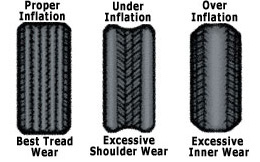
tireinflation.jpg


For the tire load indexes I mentioned in my 1st post according to Toyo 25 psi are enough. Continental states that the 32 psi that the manufacturer suggests should be also used for the new tires.

That's a 7 psi difference. Or in other words -21.875% less pressure than 32 psi if you go with 25 psi as the preferred pressure or +28% more pressure than 25 psi if you go with 32 psi as the selected pressure.

I don't know for sure if these differences are significant enough to cause phenomena like the ones shown in the picture, but looking at the percentages (-21.875% and +28%) I would say that they aren't negligible either.

Anyway, in case that the tires end up to take a distorted shape that prevents proper contact of the center portion of the tire or its shoulders, I guess that the uneven wear issues are accompanied by an adversely affected traction performance and poorer handling.

So I still am in dilemma: Which guide should someone follow when changing load indexes?
 
Last edited:
I think you are reading too far into this. I've ran various different sized tires/wheels on my HD pickups for years towing heavy 5th wheels a d goosenecks and this is what I've always done.

First, you have to know the weight of your vehicle as it is typically loaded (a certified CAT scale or equivelant that reads individual axles is needed here). So my front axle typically weighs 4400 lbs empty and my Toyo 285/75/17s are rated for 3195 lbs each @ 80 psi.

Simple formula to determine tire pressure:

(Axle Weight / 2 tires) / Tire Capacity weight x Tire Max Pressure = Inflation Pressure

So 4400 lbs ÷ 2 tires = 2200 lbs

2200 lbs ÷ 3195 = .69% of the tires capacity.

.69 × 80psi = 55.2 psi.

This is what I run my front tires at when running empty, I've got weights of both my front and rear axle with the most common loads I haul (12,000 & 15,000 lbs) and adjust my tire pressures accordingly for the load. I follow the recommended pressure of whatever size tire I am running and in 300k+ miles of driving/towing have never had any issues of uneven wear or poor handling.
 
Last edited:
Originally Posted By: inquirer
For the tire load indexes I mentioned in my 1st post according to Toyo 25 psi are enough. Continental states that the 32 psi that the manufacturer suggests should be also used for the new tires. .......


Are you sure about that? I did a quick look and I estimated something along the lines of 3 psi. Sure, I didn't go through all the math, but 7 psi just doesn't sound right. When I get in the mood, I'll go through the whole thing, but it is a bit tedious.
 
Originally Posted By: CapriRacer
Originally Posted By: inquirer
For the tire load indexes I mentioned in my 1st post according to Toyo 25 psi are enough. Continental states that the 32 psi that the manufacturer suggests should be also used for the new tires. .......


Are you sure about that? I did a quick look and I estimated something along the lines of 3 psi. Sure, I didn't go through all the math, but 7 psi just doesn't sound right. When I get in the mood, I'll go through the whole thing, but it is a bit tedious.


There aren't any maths involved. Just look at the tables in Toyo's PDF (1st post, 2nd link).


  1. Page 29 for SL ETRTO tires. For load index 92 and 32 psi (per the specifications of the car manufacturer) the tire can support up to 1257 lbs.
  2. Page 31. The new tire has a load index of 99 and is an XL ETRTO tire so this is the page to look at. We have to find which pressure of the row that corresponds to 99 load index gives a load equal to 1257 lbs. or the next bigger value if 1257 isn't available. According to the table 1257 lbs. can be achieved with 25 psi.


If I'm not doing anything wrong that's the procedure. You can check the procedure for yourself. It's on page 7 of the same PDF file. And on pages 8 to 11 you can read some examples (4 to be specific, 1 example per page).
 
Last edited:
OK, I see the problem. The 92 Load Index tire is a Standard Load (SL) and the the 99 Load Index tire is an Extra Load (XL). That means they need to use different charts - AND the XL (Reinforced) chart is WRONG!! Notice, it is identical to the SL chart.

What is wrong about the XL chart is the inflation pressure at the top. It should be 6 psi higher than stated. For example, the column labeled 36 psi should be labeled 42 psi.

That means the column labeled 25 psi should be labeled 31 psi - and that's the value you should have gotten.

I'll email Toyo and tell them about it.
 
Originally Posted By: CapriRacer

OK, I see the problem. The 92 Load Index tire is a Standard Load (SL) and the the 99 Load Index tire is an Extra Load (XL). That means they need to use different charts - AND the XL (Reinforced) chart is WRONG!! Notice, it is identical to the SL chart.

What is wrong about the XL chart is the inflation pressure at the top. It should be 6 psi higher than stated. For example, the column labeled 36 psi should be labeled 42 psi.

That means the column labeled 25 psi should be labeled 31 psi - and that's the value you should have gotten.

I'll email Toyo and tell them about it.


Well that makes more sense. (I hadn't compared the tables, I had only checked the values needed for my case.) in that case it's just 1 psi less than Continental's guide which is an insignificant difference. Good decision to notify Toyo, you may save someone from ending up with wrong tires' pressure!
 
Such mistake is worse than not posting info at all.
I hope they will fix it ASAP or call their lawyers ;-)

Krzys
 
I'm checking again Toyo's inflation tables now, because I'm changing tires and I read at the bottom of page 7:
"Warning! Never use an inflation pressure lower than what is recommended by the vehicle
manufacturer."

Does this mean in case the inflation pressure for the new tires according to the inflation tables is lower than the one the car's manufacturer suggests, then it should be ignored and the original value should be used as the appropriate inflation pressure?
 
I'm checking again Toyo's inflation tables now, because I'm changing tires and I read at the bottom of page 7:
"Warning! Never use an inflation pressure lower than what is recommended by the vehicle
manufacturer."

Does this mean in case the inflation pressure for the new tires according to the inflation tables is lower than the one the car's manufacturer suggests, then it should be ignored and the original value should be used as the appropriate inflation pressure?
That is the way I've always seen the rule applied. If I understand this correctly, the spring rate of a tire is very closely matched to its inflation pressure regardless of the brand, where grip and wear are not. So they are trying to get the closest to the handling of the original tire.
 
Status
Not open for further replies.
Back
Top Bottom