Infineum - Ultra Low Viscosity Challenges

Status
Not open for further replies.
Joined
Nov 16, 2002
Messages
42,419
Location
NJ
Link

Quote:
We already see SAE 0W-16 in the market, and some OEMs are beginning to look at viscosities as low as SAE 0W-8, or even 0W-4. In this low viscosity era it is becoming increasingly important for us to understand the implications this has on the formulation envelope and on hardware protection.


Quote:
Low viscosity and durability challenges
The first formulation challenge presented by moving to lower viscosity lubricants is how to balance the desire for fuel economy with the need to protect the engine and all its components.

The thinner oil films associated with low viscosity fluids mean it is harder for the oil to keep the loaded contact surfaces in the engine sufficiently apart from each other. This can lead to accelerated wear rates, and even locally increased friction.

It makes little commercial sense to trade engine durability for fuel economy gains.
Infineum studies indicate that, in some engines, reducing lubricant viscosities to 2.3 HTHS presents little risk of engine component wear. Below this level, specific engine components, for example the top ring and bearings, observe higher wear rates. To ensure ultra low viscosity lubricants deliver fuel economy and wear protection it is becoming increasingly important to co-engineer the vehicle hardware and lubricant system.
 
My wife owns a 2015 Audi and I own a 2013 VW. I sure wish I could use a normal 5W30. Too thin for VW & Audi however.
 
Wouldn't the 'add pack' of zinc, calcium, phosphorus, boron, magnesium, moly, sodium,......etc... protect against wear when using very thin oils ?
 
Re-hash of an 2011 Doc.
Super Finishing, very tight tolerances will be the key to oils below 0w-10 even w10. The tighter the tolerances the better for vibration of every sort and friction.
 
Originally Posted By: skyactiv
My wife owns a 2015 Audi and I own a 2013 VW. I sure wish I could use a normal 5W30. Too thin for VW & Audi however.


What's the big deal with using a thicker 30 weight or a 40 weight oil? I actually wished my vehicles called for those weights instead of 20 weight oils.
 
https://bobistheoilguy.com/forums/ubbthreads.php/topics/3664975/Re:_Sub-micrometer_carbon_sphe#Post3664908

is looking at one solution to low-visc oils. Now they think they know how to manufacturer the little spheres cheaply.

Its all about dealing with that thinner oil film you get when going to low-visc oils. Must have cleaner oil with less hard particles in it first, then you must have some kind of anti-wear and anti-friction film laid down better than before perhaps. Castrol advertises that film toughness concept.
 
Originally Posted By: Koz1
Re-hash of an 2011 Doc.
Super Finishing, very tight tolerances will be the key to oils below 0w-10 even w10. The tighter the tolerances the better for vibration of every sort and friction.


I don't think so. Tolerances are based on expansion of metals at operating temps and above. You know what happens to a super tight engine? It seizes up the first time you get it a little over temp.
 
Originally Posted By: turtlevette
Originally Posted By: Koz1
Re-hash of an 2011 Doc.
Super Finishing, very tight tolerances will be the key to oils below 0w-10 even w10. The tighter the tolerances the better for vibration of every sort and friction.


I don't think so. Tolerances are based on expansion of metals at operating temps and above. You know what happens to a super tight engine? It seizes up the first time you get it a little over temp.


Dimensional tolerance is related to, but different from fit in mechanical engineering, which is a designed-in clearance or interference between two parts.

Im taking Dimensional Tolerance and super fine finish, your talking Mechanical fit or Part clearance.
Cheers.
 
Originally Posted By: Koz1
Originally Posted By: turtlevette
Originally Posted By: Koz1
Re-hash of an 2011 Doc.
Super Finishing, very tight tolerances will be the key to oils below 0w-10 even w10. The tighter the tolerances the better for vibration of every sort and friction.


I don't think so. Tolerances are based on expansion of metals at operating temps and above. You know what happens to a super tight engine? It seizes up the first time you get it a little over temp.


Dimensional tolerance is related to, but different from fit in mechanical engineering, which is a designed-in clearance or interference between two parts.

Im taking Dimensional Tolerance and super fine finish, your talking Mechanical fit or Part clearance.
Cheers.


Not feeling it. You're going to need a better explanation than that or direct me to one. Tolerances come up every time ultra thin oils are discussed. It's time we get an understanding rather than throwing terms and assumptions out in one liners.
 
Originally Posted By: turtlevette
Originally Posted By: Koz1
Originally Posted By: turtlevette
Originally Posted By: Koz1
Re-hash of an 2011 Doc.
Super Finishing, very tight tolerances will be the key to oils below 0w-10 even w10. The tighter the tolerances the better for vibration of every sort and friction.


I don't think so. Tolerances are based on expansion of metals at operating temps and above. You know what happens to a super tight engine? It seizes up the first time you get it a little over temp.


Dimensional tolerance is related to, but different from fit in mechanical engineering, which is a designed-in clearance or interference between two parts.

Im taking Dimensional Tolerance and super fine finish, your talking Mechanical fit or Part clearance.
Cheers.


Not feeling it. You're going to need a better explanation than that or direct me to one. Tolerances come up every time ultra thin oils are discussed. It's time we get an understanding rather than throwing terms and assumptions out in one liners.


http://engineering.pages.tcnj.edu/files/2012/02/dimensioning_and_tolerancing.pdf

Your talking Dimensions Im talking Tolerances.

Tolerance
is the amount a particular
dimension is allowed to vary.
The plus or Minus of a part. Amount of deviation.

Dimension
is the numerical value that
defines the size or geometric characteristic
of a feature.
The overall defined size, Measurement.

Is that better?
 
A sister article to buster's OP link:
http://www.infineuminsight.com/insight/dec-2014/hybrid-lubrication

Says they have been running 3 Camry hybrids as NYC taxis, and their past 100,000 miles with no ill effects using a special HTHS=2.0 oil !!! They get better MPG too of course. Dats a good way to check if an ultra low viscosity oil can handle it in an engine, run it in a NYC taxi for over 100,000 miles or more, and if it survives all the hot idling and WOT transients, then hths of 2.0 works in that engine.
 
Originally Posted By: Koz1

Is that better?


You're not a technical person. Are you? Anyone can Google.

Going back to your original statement. What does tolerance and finishing have to do with oil viscosity and vibration.

Are you just repeating things you've overheard.
 
That's interesting. I understand that the Xw-20 engines oils have shown to be able to lubricate and protect an engine just fine. But I like using a good 5w30. Even though my had knows a 0w-20 is fine, I just find a good 5w30 more comforting. If I bought a car and it called for a 0w-16, I'd probably sneak 0w-20 in there just so I wouldn't lose sleep at night thinking about the thin oil in my engine.
 
Originally Posted By: sicko
That's interesting. I understand that the Xw-20 engines oils have shown to be able to lubricate and protect an engine just fine. But I like using a good 5w30. Even though my had knows a 0w-20 is fine, I just find a good 5w30 more comforting. If I bought a car and it called for a 0w-16, I'd probably sneak 0w-20 in there just so I wouldn't lose sleep at night thinking about the thin oil in my engine.


I'm suspicious too about low viscosity oils when our governments push for greater fuel economy to conserve fuel as a society, sacrificing some wear rate performance. I've never heard of any engine speced for a -20 that doesn't do as well or better with a -30 hot visc, and specs for -30 can really use a -40. (Probably no need to throw in a -40 in a -20 speced car though, excessive.)
 
Originally Posted By: buster

Quote:
Low viscosity and durability challenges
The first formulation challenge presented by moving to lower viscosity lubricants is how to balance the desire for fuel economy with the need to protect the engine and all its components.

The thinner oil films associated with low viscosity fluids mean it is harder for the oil to keep the loaded contact surfaces in the engine sufficiently apart from each other. This can lead to accelerated wear rates, and even locally increased friction.

It makes little commercial sense to trade engine durability for fuel economy gains.
Infineum studies indicate that, in some engines, reducing lubricant viscosities to 2.3 HTHS presents little risk of engine component wear. Below this level, specific engine components, for example the top ring and bearings, observe higher wear rates. To ensure ultra low viscosity lubricants deliver fuel economy and wear protection it is becoming increasingly important to co-engineer the vehicle hardware and lubricant system.


IMO this is going to be the key going forward. I think that the time may not be too distant where OEM's specify specific fluids and provide free service work (ensure that the correct fluid is used) during the warranty period. When Automatic transmissions switched over to lower viscosity fluids, many of them became lifetime fluids - not needing to be changed until well after the warranty expired. Since a lifetime engine oil is not an option, a free/included service plan may be the next best option.

Plus that gets the car into the dealership more often and may increase add-on sales/upgrades (a freemium model if you are familiar with that term).
 
Originally Posted By: Clevy
What does tolerance have to do with this.

Wont it be the clearances that need to be tighter


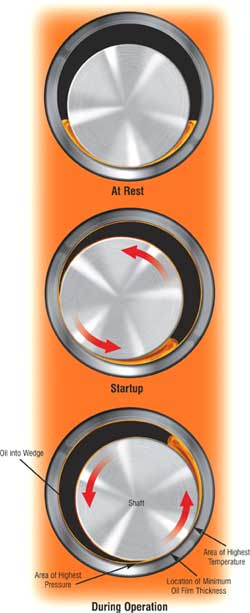
Sounds like some weird things happen when a journal crankshaft bearing when using thin oil in a high-revving engine with excessive clearance eccentricity:
"Oil whirl is a phenomenon that can occur in high-speed journal bearings when the shaft position within the shell becomes unstable and the shaft continues to change its position during normal operation, due to the fluid forces created within the bearing. Oil whirl may be reduced by increasing the load or changing the viscosity, temperature or oil pressure in the bearing. A permanent solution may involve a new bearing with different clearances or design. Oil whip occurs when the oil whirl frequency coincides with the system’s natural frequency. The result can be a catastrophic failure." - http://www.machinerylubrication.com/Read/779/journal-bearing-lubrication
Backup_200507_lubapp-shaft_motion.jpg
 
Status
Not open for further replies.
Back
Top Bottom