How long does a cam belt really last?

Status
Not open for further replies.
Originally Posted By: Rick in PA
Belt life is a mostly factor of how tortuous the belt path is and run time. Imagine a belt that runs over two very large pulleys, it would last about forever. Imagine a belt that runs over many small pulleys and gets flexed backwards a bunch of time, the belt wouldn't last long. The engineers can calculate out belt life expectancy.

My wife had an Ford Escort that snapped it's belt at about 60K miles. Then I found out they typically lasted 50~60K miles. Not an interference engine, so more of an annoyance than a problem.

I had a friend with a Renault Alliance, it snapped it's belt at something like 70K miles. Problem was it was an interference engine and the engine was toast. Car in nice condition, but a badly damaged engine. A lot of Alliances, in nice shape, ended up in the junk yard, there were no "junkyard motors" to resurrect them.

I just got a Neon with 97K miles and am going to pro-actively do the timing belt. They seem to have a belt failure window of 100K to 150K miles, which seems about typical.


I have had 2 Neons. At 100 k the water pump is generally shot.
 
I've seen a belt let go at sub 65k, so I say don't push it in a Hyundai. The rest I've seen looking good at past 100k.
 
Originally Posted By: redbone3
I have had 2 Neons. At 100 k the water pump is generally shot.


Good to know. I got the "kit" on order: a belt, tensioner & water pump. I got the accessory belts and tensioner pulley for good measure.
 
Last edited:
Cambelts last longer these days than they used to, modern technology makes the old stuff catch up. Cambelts were letting go all the time in the '90's, now it's pretty rare. I've had belts from the early '80's where you could just rip it in half, you can't do that to one made for the same car these days.
 
This from contitech, and Fords 1.0 3 cylinder Ecoboost uses it:

Belt in Oil
Timing Belt in Oil Reduces Friction and Noise

Number of engines with belt drives growing faster than those with chain technology
Timing belts in oil can be narrower than the dry-running version
System competence for the entire drive
Frankfurt, Germany, September 10, 2013. Less friction + less weight = less fuel consumption – and so fewer CO2 emissions. This simple formula is a dominant theme today in the development departments of automotive manufacturers and their suppliers. It has long ceased being all about grand savings and has instead become a matter of highly detailed work, since every saved gram of CO2 counts in the final analysis.

This is one of the reasons why the timing belt in the timing assembly has gained significantly in importance once again in recent years. Volkswagen is again fitting belts instead of chains in the Golf VII and Audi A1. And other manufacturers too are increasingly designing their new engines for high-tech drive belts made from rubber and plastic, because they know that belts have distinct advantages over chains in reducing fuel consumption and CO2 emissions from combustion engines.

Studies also confirm this: According to FEV GmbH, an independent engine designer, the belt drive lowers fuel consumption compared to the chain, and therefore reduces CO2 emissions. In a 1.6 liter gasoline engine, for example, the belt drive reduces fuel consumption by more than 1% and saves up to 1.5 grams of CO2 per kilometer. "Belt drives are lighter and run a lot more quietly too. Belts don't tend to lengthen either," says Hermann Schulte, head of Timing Belt Development at the ContiTech Power Transmission Group. "A significant advantage, because a lengthening chain alters the engine timing. As a result, consumption increases and performance drops. Emissions levels are quickly exceeded." In endurance tests, a belt lengthened by just 0.1% after 240,000 kilometers of service life – the figure was five times greater with a chain.

Many large automotive manufacturers in Europe are now making use of the benefits of timing belts in their engines and this number is growing. ContiTech supplies dry-running timing belts to manufacturers including Audi, Volkswagen, Volvo, Ford, Opel, and PSA. It's not only camshafts that are controlled by timing belts, but injection systems and oil pumps too. ContiTech developers are already considering whether to use a timing belt to drive balance shafts as well and therefore make spur gears superfluous. And their focus is on unconventional yet safe solutions, such as the timing-belt-in-oil system. "Since the start of 2013, the ContiTech Power Transmission Group has been part of the group of series production suppliers for these applications. Timing belts are already in use for oil pump and timing drives in the newer Ford, PSA, and Volkswagen engines," says Ralf Berger, head of Key Account Management and Application Engineering at the ContiTech Power Transmission Group.

What was previously unthinkable is today running along without a hitch in series production. To achieve this, ContiTech has adapted the elastomer, the fabric, and the cord to the new environment. In addition to polyamide and aramid fabric with a Duralon coating containing Teflon, an ultra-durable rubber compound made from ACN-HNBR (hydrogenated acrylonitrile butadiene rubber), as well as E-glass and K-glass, is also being used for high length stability. Because of these special components, even impurities in the oil cannot harm the belt, whereas simple soot particles in the oil can destroy chains.

The advantage of the timing belt in oil is that it has a narrower construction than the dry-running version and it is even quieter. In the case of a crankshaft pulley with 19 teeth, no noise can be detected, even with the engine operating under full load, because the oil not only reduces friction, it absorbs sound as well. This is important for the simple reason that the increasingly popular downsized engines generally run less smoothly. Here is where a belt can help minimize vibration and make driving a pleasant experience despite the use of environmentally friendly technology.

Benchmark trials also demonstrate that belts today have at least the same and often even better properties than chain drives with their hydraulic tensioners and plastic guides. This is why developers are no longer concentrating on durability – this has long been a given. In on-road tests, the belts still ran without a hitch even after 300,000 kilometers.

The question today is one of making the belts even narrower – every millimeter counts, because installation space in vehicles is becoming ever tighter. "This is where the belt has another advantage. The engine designer has more flexibility in designing the belt drive than with a chain," says developer Hermann Schulte. The aim is to reduce belts for the camshaft drive in the next generation of engines from today's 16 – 20 mm width to 14, 12 or even 10 mm. Belts for oil pump drives currently measure just 9 mm – and so are as narrow as a chain.

Yet when it comes to the issue of reducing weight, it is not enough to consider the belt alone. Tensioners, idlers, and toothed pulleys are critical too. This is why developers at the joint venture company ContiTech-INA are already working on drives that can make do with simpler, and therefore lighter, tensioning systems. Or even none at all. In this way more grams can be saved and the CO2 emissions ultimately reduced even further. Vehicle manufacturers are backing this trend with their development commissions and in so doing reveal their confidence in ContiTech's many years of experience in the field of drives.The many advantages offered by modern timing belts, including their long service life, reduced friction and reduced noise, will again expand the market share of timing belts. Experts estimate that it will include at least two thirds of European vehicles in 2015 and over 70% in 2017. The share of belts running in oil will more than double from today's 8% to over 20%. A development that will benefit the environment and motorist alike.

Belt in Oil
Tepeo 2 Protect
High-performance Hoses
Lighter Materials = Less CO2
Sitemap Imprint Legal PDF Print
RSS
© Continental AG 2017

 
Doesn't Honda require derating of the timing belt to 60,000 miles (from the standard 105,000 miles) if the vehicle is used in very hot or very cold climates, or if used for extensive towing? I read that online in a Honda manual for a 2017 Pilot or Ridgeline.
 
Last edited:
There is no doubt that a timing belt will last well beyond the recommended change intervals. A thirty percent margin for critical services is customary.
There is also little doubt that some fail not too far beyond those intervals.
With an interference engine, I prefer to err on the side of caution and change the belt, WP and tensioners on schedule.
With a non-interference engine, it's more a matter of how much inconvenience you want to endure.
A dead engine is not always a handy event even if you'll only need to get the car home, do the disassembly and line up the timing marks, which are often quite vague.
Sometimes we really need our vehicles to run without fail and a broken belt might occur at a very inconvenient time.
Now, as someone pointed out in another thread, some folks reach really heroic mileages on their original timing belts and associated components, like double the recommended interval.
I guess the question on timing belt service requirements is whether you feel lucky or not.
Anything beyond the recommended interval is no more than testing one's luck.
 
I go by the manufacturers time (if stated) and mileage interval only, anything beyond that is too risky for me. I don't want to find out how much "wiggle" room they have built into their recommendation, engines cost too much money (interference engine) and being stuck with a dead car on the side of the road is too big a PITA to deal with because I skimped.
 
Originally Posted By: Linctex
Originally Posted By: Rick in PA


I had a friend with a Renault Alliance, it snapped it's belt at something like 70K miles. Problem was it was an interference engine and the engine was toast. Car in nice condition, but a badly damaged engine. A lot of Alliances, in nice shape, ended up in the junk yard, there were no "junkyard motors" to resurrect them.


You could *maybe* assemble 1 good engine from 2-3 bad ones. Not all the valves and pistons will "take a hit", correct?


sometimes they are all bent, especialy if the belt skipped a few teeth but didn'tbreak.
 
A diesel is always interference, if they use bucket followers, there is always major destruction, same if using finger followers. If using rockers they will break, if using pushrods, they will bend.
 
To all of you timing belt haters... timing chains can (and do) break! If the timing chain breaks on a OHC engine you can usually kiss the engine goodbye. Also, the chain (and/or tensioners) DO eventually wear out and need to be replaced, at a MUCH higher cost (usually prohibitive on high mile OHC vehicles). Some manufacturers even include the replacement of timing chain tensioners in their recommended maintenance.
 
Last edited:
I've had a chain break at 75k miles in the past and on my Gen Coupe the chain is stretched and will need replacing soon.
 
Originally Posted By: Trav
I go by the manufacturers time (if stated) and mileage interval only, anything beyond that is too risky for me. I don't want to find out how much "wiggle" room they have built into their recommendation, engines cost too much money (interference engine) and being stuck with a dead car on the side of the road is too big a PITA to deal with because I skimped.


Exactly what I was trying to convey.
If you have a T-belt engine, change as recommended and then find something else to worry about.
Dead engine by the side of the road would not be a fun place to be.
 
The 2.7L M 20 in a 528e has a timing belt. I bought my first one with 150K miles on it. I had a mechanic change the belt at 180K. The prescribed interval is 4 yrs/60 K. I almost fainted when I saw the frayed belt. The neat thing about the 528e was that it was an afternoon's easy driveway job. A Conti Belt and a tensioner was $30. They were the cheap parts in a series 2, 60 K mile service. The routine was to change everything you had to take off to swap the belt. A cam seal was like 3.50. The cap and rotor were about 90. add a water pump and some plugs and the engine service was like $300 in parts. I put 200K on my first In 12 yrs, it never once failed to get itself home.
 
I'm curious how the cambelt in engine oil will hold up. I know they test these things out but...
 
I don't think its a problem. Today they have some amazing compounds that oil doesn't effect them just look at modern engine seals. other compounds resist brake fluid and coolants sometimes for 20 years or more even though the parts live in these fluids.
 
Chances are much greater that one of the rotating elements that touches the T-belt is going to fail first. I've never seen a T-belt fail where some other associated component did not need to be changed as well.
 
Originally Posted By: quint
The belt in my Corolla went 315,000 miles before it finally gave up on the highway. It was my dads car, he had bought it new and I was the only person to ever maintain the car so I know it was the original belt.


You are talking about Serpentine (accessory) Belts, while everyone else is talking about Camshaft Timing belts.
If your Serpentine belt breaks, your pistons are in no danger of hitting the valves.

Your '99 Corolla also has a timing chain, which keeps the valves in time with the crankshaft.
No fear of a timing belt in your car.

BC.
 
Originally Posted By: Bladecutter
Originally Posted By: quint
The belt in my Corolla went 315,000 miles before it finally gave up on the highway. It was my dads car, he had bought it new and I was the only person to ever maintain the car so I know it was the original belt.


You are talking about Serpentine (accessory) Belts, while everyone else is talking about Camshaft Timing belts.
If your Serpentine belt breaks, your pistons are in no danger of hitting the valves.

Your '99 Corolla also has a timing chain, which keeps the valves in time with the crankshaft.
No fear of a timing belt in your car.

BC.


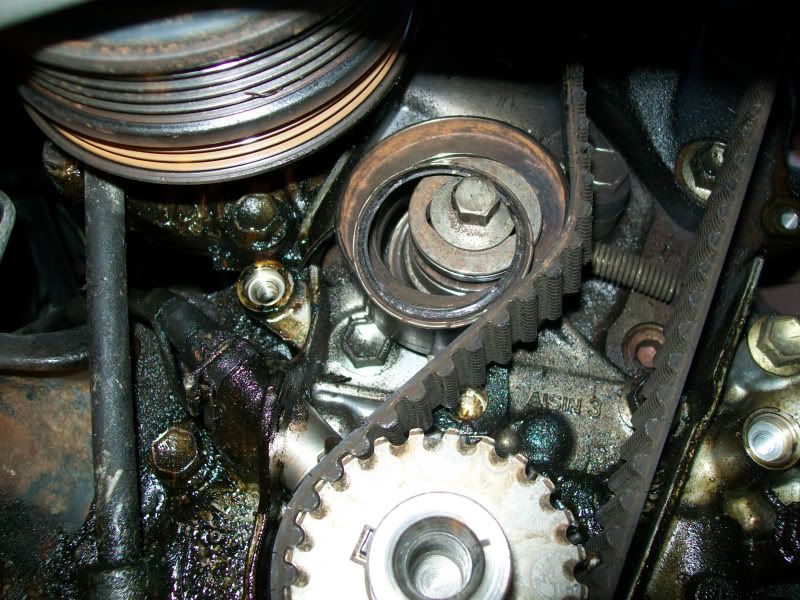
Uh....no. Did you quote the wrong persons post? It was a timing belt. I'm also not sure where you are getting it is a '99 when my signature shows '97. The '97 Corollas, both the 1.6 and 1.8 used a timing belt. And neither used a serpentine belt. They have a separate belt for the a/c, one for the alternator and water pump, and a small belt from the water pump to the power steering pump. Here are some pictures I took of the carnage of the timing belt. If you zoom in on the belt you can see the cracks on the outer surface. Also notice one of the roller balls from the idler bearing on top of the crank sprocket. You can also see, on the upper left, where one of the roller balls jammed between and dented the crank position sensor and the crank, which ruined the sensor.

101_4946.jpg

101_4947.jpg
 
Status
Not open for further replies.
Back
Top Bottom