
Heel/toe tread wear

Status
Not open for further replies.
Joined
Sep 12, 2012
Messages
1,984
Location
Greatest Earth on Show, UT
The tires on the Burb are wearing in a way I have not seen before and I assume is not normal. The rear of each tread block is wearing faster than the front, resulting in the fronts of the blocks being slightly higher and sloping slightly back. Here is a photo, but you can't really see what I am talking about all that well. If you ran your hand along the tread, it would be unmistakable.

IMG_20131118_205929_039_zps55886665.jpg


I searched online and could not find this wear pattern mentioned on any passenger car oriented sites, but did find this commercial trucking tire site, which calls this condition heel/toe wear (near the bottom): http://www.kaltire.com/commercial/truck/tire-wear-conditions/.

The tires are Fallen Ziex S/TZ04, have about 14,000 miles on them, and were last rotated about 5,000 miles ago. The wear is the same on all tires, all the way around each tire, and is consistent on the inside and outside shoulder and inner tread blocks. Looking at the Kaltire site, it may just be due to the design of the tire, but wanted to check with BITOG to see if there is anything I can do to address this wear. Maybe just increase my rotation frequency from 7,500 to 5,000 miles?
 
Originally Posted By: Eddie
Called feathering but, can't remember the reason for it yet.

It is different than what I have found most sites referring to as "feathering", which they use for uneven inside/outside tread block wear, not front/back. That feathering is caused by improper alignment.
 
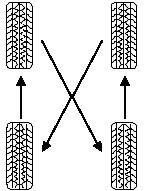
It's due to your front end alignment. If the front and back tires never change the heel/toe pattern, it means that when you rotate them, you aren't crossing them from side to side. This cross rotation keeps this directional wear pattern evened out. If you swap the tires from left to right, you'll notice now that the heel/toe is "backwards" from what it was before. Run them for a few thousand miles, and you'll observe the pattern becoming less severe, then evened out, then begun in the opposite direction (in general).

This pattern is caused, in my experience, by front toe (in). Every vehicle I've owned has worn the tires this way, some to a greater extent than others. You can toe the front tires outward very slightly by yourself, in your driveway, by turning the tie rod end adjusters. Start with 1/4 turn on each adjuster (to keep them even) and work from there.
 
The wheels are toed in a bit. A lot of manufacturers will specify some toe-in.

Rotating the tire from the right front to the left front, for example, will subject it to the same mount of toe.
 
Does that mean that my rear tires are also toed in?

I have been using DT for tire rotations so I have documentation for the tread life warranty and to take advantage of the free balancing every other rotation. I believe they use the standard RWD/4WD rotation pattern (below), which would mean the rear tires moved to the front do not get the side-to-side switch needed to even out the wear. Should I just swap the front tires as soon as I get home or will they do an X-pattern rotation if I ask?

tireRotation_rwd_4wd_awd.gif
 
I've seen the front tires on my Jeep get pulled into that shape where the sipes meet, usually after backing into a parking spot where I had to turn tightly. I've yet to see them actually wear that way though.
 
I think some responders here have a misunderstanding of the wear I am trying to describe. The photo in my original post is a side view of the tire, not looking along the tread. There is no side-to-side slanting, it is all front-to-back.

Not this:
featherEdge.jpg


But this:
heelToe.jpg


I can see how the first condition can be caused by too much toe-in, but not really the second. I can see how swapping tires side to side could help even the wear, but not changing the toe.
 
NMBurb02,

To some extent, this is normal. Also, please note you have a bit of "feathering".

When tires are rotating, the edge of a tread element that enters the footprint is called the leading edge - and the other edge is called the trailing edge.

The leading edge gets pulled into the footprint and causes the edge to become rounded - while the trailing edge hangs on until it can't resist, then scrapes out of the footprint, causing that edge to wear and create the "feather".

Add torque, and the wear gets worse.

Mis-alignment further aggravates the situation. Plus, once a wear pattern like this starts in a tire, it tends to continue. Put another way, you could develop a wear pattern because of one position, but when the tire is rotated to another position, the wear is already there and the new wear pattern is put on top of what is already there - ergo, it looks like ALL positions are wearing the same way.

So a small amount is expected. All my cars have this to some extent.

But your photo is excessive, so I'm going with too much toe in. Please note that your vehicle may not pull and you can still have mis-alignment.
 
Originally Posted By: NMBurb02
Does that mean that my rear tires are also toed in?


Nope. The rear tires should never gain any odd wear patterns if purely left on the rear. It's a solid axle vehicle, so it will always stay straight unless you manage to bend the axle.
 
Originally Posted By: CapriRacer
The leading edge gets pulled into the footprint and causes the edge to become rounded - while the trailing edge hangs on until it can't resist, then scrapes out of the footprint, causing that edge to wear and create the "feather".

...

Plus, once a wear pattern like this starts in a tire, it tends to continue. Put another way, you could develop a wear pattern because of one position, but when the tire is rotated to another position, the wear is already there and the new wear pattern is put on top of what is already there - ergo, it looks like ALL positions are wearing the same way.

That was why I asked about doing an X-pattern tire rotation, in order to make the leading edges into trailing edges and visa versa in order to cause the tire to wear in the opposite direction while still getting the benefits of the front-to-back rotation. Make sense?
 
Some cross-rotate tires incorrectly...the FRONT PAIR SHOULD BE CROSSED to the other side at the rear while the rear go straight forward...some cross the rear by mistake.
 
Originally Posted By: KitaCam
Some cross-rotate tires incorrectly...the FRONT PAIR SHOULD BE CROSSED to the other side at the rear while the rear go straight forward...some cross the rear by mistake.


From what I've always read FWD cars should cross the fronts to the rears, RWD should cross the rears forward.
 
Rotation Pattern?

IMHO, I don't think it matters much about which way the "X" pattern goes. The important thing is the front to rear swap. There is soooo much difference in what happens at the front vs the rear, but not so much side to side.
 
My 4 Runner has always worn tires this way...despite replacement of every suspension bushing and part (like ball joints). Seems it just does that. I rotate in an X but the pattern persists, only slightly reduced by the rotation. With 245,000 miles on it, it's seen several sets of tires, and the pattern just comes back, regardless of brand of tire, or frequency of rotation....
 
Originally Posted By: NMBurb02
Originally Posted By: CapriRacer
The leading edge gets pulled into the footprint and causes the edge to become rounded - while the trailing edge hangs on until it can't resist, then scrapes out of the footprint, causing that edge to wear and create the "feather".

...

Plus, once a wear pattern like this starts in a tire, it tends to continue. Put another way, you could develop a wear pattern because of one position, but when the tire is rotated to another position, the wear is already there and the new wear pattern is put on top of what is already there - ergo, it looks like ALL positions are wearing the same way.

That was why I asked about doing an X-pattern tire rotation, in order to make the leading edges into trailing edges and visa versa in order to cause the tire to wear in the opposite direction while still getting the benefits of the front-to-back rotation. Make sense?


With nearly 400lb/ft of torque and full-time AWD, my Audi does this to tires at an alarming rate. It's the reason that I will only buy non-directional tires from now on.

The tires that the car had when I purchased it were directional Hankooks, and it didn't take long for them to heel/toe wear and get loud.

I also rotate every 5k miles in a full X pattern. FR goes to the RL, and FL goes to the RR. This seems to diminish the effects of heel/toe on my car, but it still happens to an extent.
 
OP, Discount Tire may not actually cross the tires. I've seen many stores simply rotated front to back and call it good. If all of your tires are feathered toward the front, that is, the raised edge of the tread is the leading edge, and if it stays that way perpetually, then I'd say that chances are good they're not getting rotated from side to side. There will generally be some teel-and-toe wear patterns on the rear axle, but they should be consistent across the tire, since it's a solid axle and not generally subject to toe and camber issues. But what you show in your original photograph is very indicative of too much toe-in on front tires.

If these front tires get rotated to the back, and then rotated to the front on the next rotation, without ever changing sides, the wear pattern will continue. If you can switch them from side to side, the mechanism by which they feather will continue to operate on the tire, but it'll be spinning in the opposite direction, so the wear pattern will reverse itself, eventually evening out, and then wearing into the tire again in the "other" direction.

This is the reason for cross rotational patterns.
 
Well, the sooner the pair with the most heel-toe "feathering" get crossed the quicker the the feathering "evens out"...and I suppose the longer the tread life...
 
Status
Not open for further replies.
Back
Top Bottom