Hardened valve stem seals - What is this?

Status
Not open for further replies.
Joined
Jan 23, 2014
Messages
566
Location
Australia
I keep reading about hardened valve stem seals.

I understand and have seen how soft rubber can become brittle, hard and no longer seal on engines, but how does this apply to to valve seals?

Since they have a metal ring that surrounds the valve seal why would the rubber hardening have an impact on the overall function?

And, what is it that makes them harden? Age, km, prolonged periods of engine not being started, wrong oil, overheating?
 
Originally Posted By: earlyre
oh... what am i thinking of.... hardened something...more or less the Difference between Running Leaded Gas or Unleaded...

The would be called valve seats. Those are completely different from valve stem seals.
 
Many older engines used an O-Ring between the valve stem and the valve retainer. If the O-Rings shrank or cracked oil would run down the valve stem, past the guides and into the backside of the valve where it would be sucked into the cylinder or out the tailpipe. Nerew cars use a posative seal with a spring which is a much better design.
 
And do the valve stems suffer wear from the valve seals, or are the seals much softer so they take more of the wear?
 
See the link for the replacement procedure I provided. It has pictures as well. Valve seals are really tiny fragile things. The spring is very small and weak and the entire thing could easily be damaged during installation if not utmost care is provided. There is hardly any friction between the valve seals and stems when they are lubricated; so, no noticeable wear occurs on the valve stems. Inside the Viton neck, it's coated with metal to reduce the wear on the seal but Viton will eventually harden and fail regardless.

Apparently valve guides can wear too but probably not with a good engine design and normal use.
 
Thanks Gokhan, I've read your guide and will follow it when I do mine.

Is there a reason as to why some cars are more prone to valve seals leaking as opposed to others?
I have a 6G74 Mitsubishi motor and this seems like a very common fault whereas some cars never have this issue.
 
Originally Posted By: Spetz
Thanks Gokhan, I've read your guide and will follow it when I do mine.

Is there a reason as to why some cars are more prone to valve seals leaking as opposed to others?
I have a 6G74 Mitsubishi motor and this seems like a very common fault whereas some cars never have this issue.

They will all start failing after about 150,000 miles or 15 years. Since they are very fragile things, it makes a big difference how they were installed in the factory. It's very easy to damage them during installation, shortening their lifespan. So, chances are that they are messed up during assembly. Lubricate them and the stems very well and use a thin layer of tape on the stems. Install them only with your fingers -- no tools -- but make sure that you hear the "click" so that it locks in place, as otherwise, it will move up and down with the stem.

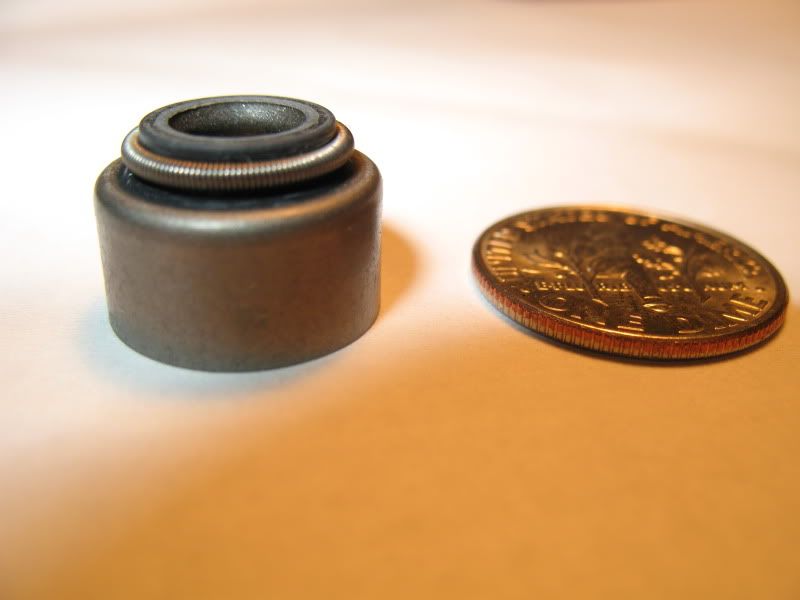
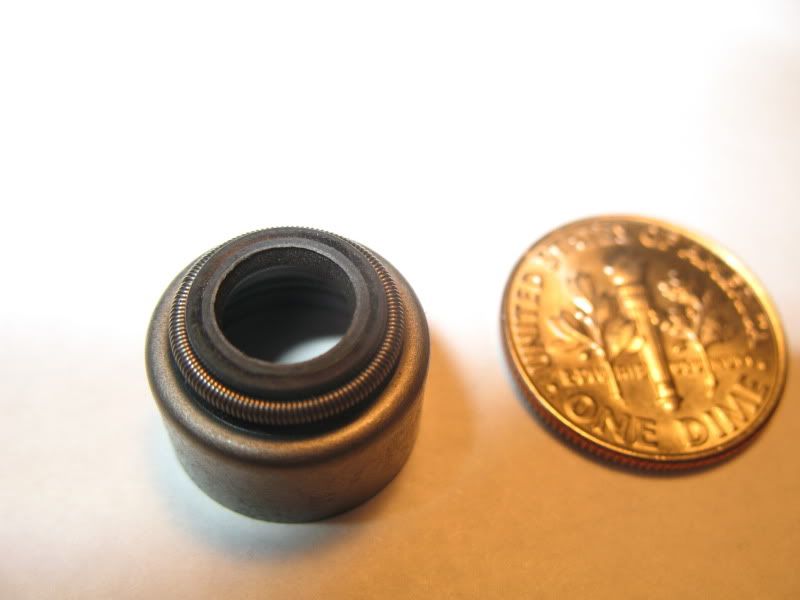
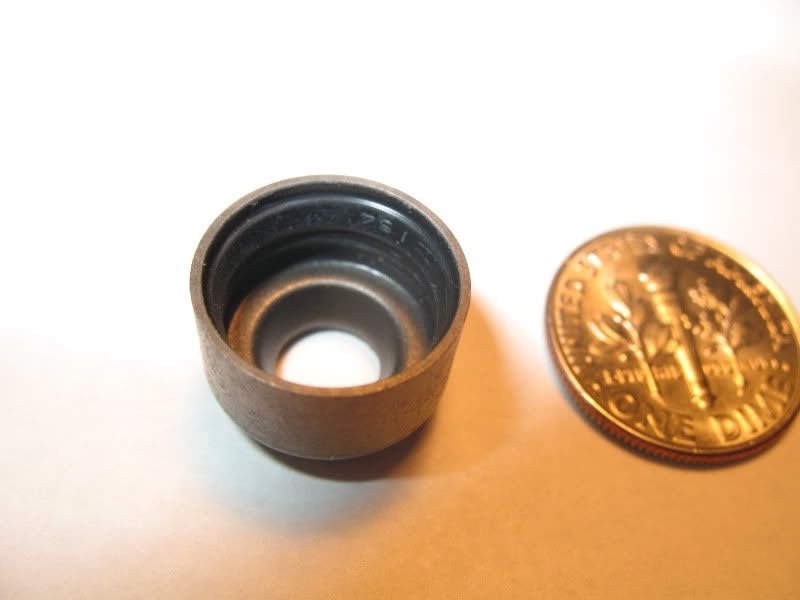
Note that the US dime (10¢) is only 17.91 mm in diameter, just to give you an idea of how tiny these seals are:

IMG_2052.jpg

IMG_2051.jpg

IMG_2050.jpg
 
@Spetz,

I've been asking that very same questions for over 25 yrs now (starting with those mid-80s Mitsu turbo 1.5L engines on a hatchback to 3L V6 engines commonly used in caravans, etc. RE: why Mitsu (rebranded as Dodge colt) gasoline engines all suffer from some kind of premature valve stem seal failure, and to this day: I'm still not able to find a plausable answer to that.

Nothing like that happened to their earlier gasoline engined cars (my first automobile was a Mitsu celeste 1.6L 4spd, built in 1976), and none of the other Japanese brand automotive engines have suffered from premature valve stem seals failure (not Honda, Nissan or Toyota that I'm aware of).

Other than commencing for frequent valve stem seal replacements on those Mitsu engines (make sure you check for valve guide wear also...a must!), their engines are quite ok.

Good luck on your endeavours.

Q.
 
Gokhan, did you notice your car running any different after you installed the new valve seals?

Quest, to be honest I would naturally assume that whatever conditions degrade valve seals most are present in the Mitsubishi motors/heads.
So maybe there is more heat, or less oil going on them, or a type of oil.
I originally also thought maybe it is the valve seals themselves but from what I've read OEM or aftermarket suffer the same issue.
 
Originally Posted By: Spetz
Gokhan, did you notice your car running any different after you installed the new valve seals?

Quest, to be honest I would naturally assume that whatever conditions degrade valve seals most are present in the Mitsubishi motors/heads.
So maybe there is more heat, or less oil going on them, or a type of oil.
I originally also thought maybe it is the valve seals themselves but from what I've read OEM or aftermarket suffer the same issue.

Before I replaced them, it was consuming 2.5 US quarts in 1000 miles with fully synthetic 5w30. Oil consumption virtually completely stopped after I replaced them. I also no longer get spark-plug deposits. There would be tailpipe smoke when taking off from a traffic-light stop after idling for a minute with a hot engine but that's obviously gone too. Engine runs very well but I can't tell if there is a difference in performance (fuel economy, horsepower, idling smoothness) resulting from replacing the valve seals -- probably not much. It just stops the oil consumption.
 
Originally Posted By: Spetz
Thanks Gokhan, I've read your guide and will follow it when I do mine.

Is there a reason as to why some cars are more prone to valve seals leaking as opposed to others?
I have a 6G74 Mitsubishi motor and this seems like a very common fault whereas some cars never have this issue.

Sometimes the valve guides are made cheaply, and with the valve moving erratically, there is no way a seal can contain the oil.

One thing I think about is how the Mitsubishi 4B11 shares a large number of parts with Hyundai and Chrysler. Will it mean I get better valve seals, or will it mean that Hyundai and Chrysler will get weaker valve seals?
 
Gokhan,
Did you do any kind of clean on the motor? As I assume the valves must be quite coated from all the oil going through?

Currently my consumption seems to be 1 quart per 1K miles or so
 
Originally Posted By: Quest
@Spetz,

I've been asking that very same questions for over 25 yrs now (starting with those mid-80s Mitsu turbo 1.5L engines on a hatchback to 3L V6 engines commonly used in caravans, etc. RE: why Mitsu (rebranded as Dodge colt) gasoline engines all suffer from some kind of premature valve stem seal failure, and to this day: I'm still not able to find a plausable answer to that.


That was a TOTALLY different problem, and all you have to do is find the technical service bulletins from the 1990s to see what the issue was. I had some friends who worked at dealership service departments and watched the whole process unfold as Chrysler and Mitsubishi went back and forth about how to try to solve the problem. In those engines (3.0), it was NOT the valve stem seals that were failing- it was the pressed-in valve GUIDES themselves that would begin to move up-and-down in the aluminum cylinder head along with the valve. They're not supposed to do that, they're supposed to stay pressed into the head! On some engine designs that would be a catastrophic failure, but the guides in the 3.0 were long enough that they wouldn't actually drop out of the head and hang the valve open. After riding up and down with the valve for a while, the guide would get pretty loose in the head and oil would leak between the guide and the head. When the stem seal fails on most engines, oil passes between the guide and the VALVE, not between the guide and the head. There were multiple TSB's from Mitsubishi to try and band-aid that piece-of-junk head design, including putting snap-rings around the top of the valve guides to prevent them moving in the heads. The 3.0 also had issues with poor ring pack design so they burned oil THAT way, also. On the plus side (well, its a plus if you were stuck owning one...) the bottom-end and timing belt on that engine would last nearly forever while the top end came apart and the tailpipe spewed blue smoke. Ultimately, the fix was for all the dang things to wear out and go to the junkyard.

I have NO idea why Mitsubishi has persistently had such a big problem with oil consumption, but to this DAY if I see a blue cloud ahead of me in traffic, chances are about 80% that its a Mitsubishi product. Most of the Mitsu-powered Chrysler products from the 80s and 90s are long dead, so these days its typically an Outlander, Endeavor, Montero, or Lancer.

 
Originally Posted By: Spetz
Gokhan,
Did you do any kind of clean on the motor? As I assume the valves must be quite coated from all the oil going through?

Currently my consumption seems to be 1 quart per 1K miles or so

No, I didn't do anything other than replacing the valve seals and, of course, adjusting the valve clearances. The tops of the pistons looked fairly clean through the spark plug holes. I don't think you need to do any cleaning. There weren't any ash deposits on the rope (inside the cylinder to hold up the valves) when I pulled it out from the cylinders but there was some carbon staining on the rope.

1 qt per 1000 miles is not bad with 5w30. I was getting 2.5 qt per 1000 miles with 5w30 and 1 qt per 1000 miles with 15w40 before I replaced the valve seals.
 
I assume once the valve guides start moving the deterioration should be quite rapid?

At this stage my cheapest solution is a DIY valve seal replacement (some $100 in parts) and hopefully this fixes the oil consumption.


Also it is about 1 quart per 1,100 miles with 5W40 oil
 
Originally Posted By: Spetz
I assume once the valve guides start moving the deterioration should be quite rapid?

At this stage my cheapest solution is a DIY valve seal replacement (some $100 in parts) and hopefully this fixes the oil consumption.


Also it is about 1 quart per 1,100 miles with 5W40 oil

Do it! Trickiest part is pushing in the new seals but follow my detailed instructions. OEM seals may be better than aftermarket seals. However, Toyota OEM seals were pricey.

Give it two days. Start it on Saturday morning in case you can't finish it in one day.
 
I know it'll be a fairly tedious job for me seeing as I have 24 of them to change and the rear bank will be hard to get to.

Though seeing as I don't need the car I can take my time and can do a cylinder a day or even less.

I replaced my rocker cover gaskets some 10,000 miles ago, will they be ok to reuse?

The cost for OEM seals is only about $4, so no reason to go aftermarket (unless they are better)
 
Status
Not open for further replies.
Back
Top Bottom