Galaxies Underestimated

Discussing the potential for multiple dimensions using terms that are limited by the physical boundaries of human senses and our limited technology. I don't think you can actually get there from here.
 
IC 1101. located in the Abell 2029 Galaxy cluster. distance 1.04 Billions light years from earth. Virgo Constellation. 100 Trillions Stars and 6 Millions light years across.


IC-1101-compared-to-the-Milky-Way-Andromeda-Galaxy-and-Messier-87.webp
 
We are told universe is expanding, so it's expanding into something outside it, no? How do we know this universe is the only thing?
Nothing is the absence of matter and energy we can sense and detect. So no, it doesn't need to be expanding into something else. It can be the matter and energy we can sense and detect expanding into the place there is no matter and energy we can sense and detect. It doesn't need a defined edge like a balloon.
 
So, we must ask, of the central claims of the standard model, which of them have been observationally or experimentally demonstrated?

If we're discussing the Standard Model of particle physics, it is simply incorrect to characterize its central components as merely inferred. Virtually every particle predicted by the model has been observed experimentally, including the W and Z bosons, gluons, top quark, and Higgs boson. The model's predictions have been tested repeatedly through collider experiments and precision measurements, often matching observations to extraordinary accuracy.

The existence of quarks, for example, is not based on speculation. Deep inelastic scattering experiments revealed the internal structure of protons exactly as predicted by quark theory. Likewise, gluons were confirmed through characteristic jet patterns in high-energy collisions. The discovery of the Higgs boson in 2012 completed the particle content predicted by the Standard Model and provided direct evidence for the Higgs mechanism responsible for electroweak symmetry breaking.

Critics sometimes point out that the Standard Model does not explain everything, such as dark matter, dark energy, or gravity. This is true, but it does not diminish the overwhelming experimental success of the theory within its domain. A theory can be incomplete and still be extraordinarily well supported by evidence.

If the discussion instead concerns the standard cosmological model, then a distinction must be made between observations and interpretations. The expansion of the universe, the cosmic microwave background, gravitational lensing, and large-scale structure formation are all directly observed phenomena. What remains debated is whether dark matter and dark energy are the correct explanations for these observations or whether alternative theories could account for the data.

Even here, however, it would be inaccurate to suggest that the model lacks observational support. The model was developed precisely because it successfully explains a wide range of independent observations using a single framework. The real scientific debate concerns the nature of certain components of the model, not whether the underlying observations exist.

Science rarely "proves" theories in an absolute sense. Instead, theories earn credibility by making successful predictions and surviving attempts at falsification. By that standard, both the Standard Model of particle physics and many aspects of the standard cosmological model have accumulated substantial empirical support. The unanswered questions are important, but they should not be confused with a lack of evidence for the models themselves.
Effectively 0% I would theorize, or hardly enough to teach as scientific fact.

It seems like whack-a-mole to me.

I see complexity to simplicity here: https://gizmodo.com/app/uploads/2020/10/ybeqwnddqp1rr5s8kgf7.gifView attachment 344226
I don't mean this disrespectfully, but your comment suggests a misunderstanding of what the Standard Model actually is and the evidence supporting it.

The Standard Model is not a speculative idea that physicists simply assume to be true. It is one of the most extensively tested scientific theories ever developed. Its predictions have been confirmed repeatedly through particle accelerator experiments, scattering experiments, precision measurements, and the direct discovery of particles that the theory predicted long before they were observed.

To argue that the Standard Model lacks experimental support is a bit like arguing that multiplication has never been demonstrated because you haven't personally worked through the mathematics. Honest question, what attempt have you made in earnest to understand the Standard Model? The question is not whether every aspect of modern physics is fully understood. The question is whether the theory's core predictions have been tested against reality. In the case of the Standard Model, they have, and with remarkable success.

Of course, the Standard Model is incomplete. It does not explain gravity, dark matter, or dark energy. Physicists openly acknowledge these limitations. But recognizing that a theory is incomplete is very different from claiming it lacks observational or experimental support.

Before dismissing the Standard Model, it's worth spending some time with the actual literature and experimental history behind it. You may still disagree with aspects of modern physics, but the claim that its central predictions have not been demonstrated simply isn't consistent with the evidence.

Here is my real question - you clearly have not done any homework to justify your position and you clearly don't understand the evidence for the standard model, yet, here you are confidently opining and giving us your theory on something you know nothing about. How does this jive in your head?
 
Last edited:
...If the discussion instead concerns the standard cosmological model, then a distinction must be made between observations and interpretations. The expansion of the universe, the cosmic microwave background, gravitational lensing, and large-scale structure formation are all directly observed phenomena. What remains debated is whether dark matter and dark energy are the correct explanations for these observations or whether alternative theories could account for the data.

Even here, however, it would be inaccurate to suggest that the model lacks observational support. The model was developed precisely because it successfully explains a wide range of independent observations using a single framework. The real scientific debate concerns the nature of certain components of the model, not whether the underlying observations exist...
In the context of the discussion the reference is to the standard cosmological framework because I know the difference between particle models and cosmological models since I teach physics courses.

(Here is an an example I have previously used here in similar discussions.)

"The Big Bang is a series of hypotheses of the Universe incorporated in the “Standard Model” because the Standard Model is the working paradigm for many scientists.

Singularity: The entire universe is theorized to be contained in a point of zero size called a singularity. The energy that would later become everything else is contained in this point, and there is literally nothing that is not contained within it. The energy density would be infinite, and therefore the temperature would be infinite.

The physics discovered by Einstein shows that black holes have a singularity in their exact center which contains all the mass of the black hole. However, the singularity of a black hole is surrounded by space. You can orbit around a black hole in that surrounding space. Every black hole is surrounded by an event horizon – a conceptual sphere marking the “point of no return.” Anything entering the event horizon of a black hole can never leave, and must eventually intersect the singularity. The BB singularity is a naked singularity with no external space.

But: a principle in physics which forbids the existence of a naked singularity is the “cosmic censorship hypothesis”, the principle states that all singularities must be surrounded by an event horizon. Usually, the big bang is arbitrarily exempted from this principle (because it would violate it.) The hypothesis is not proved. There is no observational or experimental evidence for a big bang singularity, nor for any of the conditions associated with it."

The value of this discussion and these new JWST findings is that so many new findings run counter to the Standard Model and that we need to recognize alternative hypotheses to the Standard Model.
 
Last edited:
The incomprehensible numbers of galaxies pales in comparison to level of knowledge we have thus far.
Astronomy is an ancient observational science.

Cosmology is a relatively new science that incorporates and integrates astronomical observations, particle physics, nuclear physics, and layers of hypotheses to explain the origin and current makeup of the universe so yes, we are just in the beginning stages of understanding the universe.
 
Last edited:
Here is my real question - you clearly have not done any homework to justify your position and you clearly don't understand the evidence for the standard model, yet, here you are confidently opining and giving us your theory on something you know nothing about. How does this jive in your head?
Argumentum ad Verecundiam.

No, I am not a physicist, but matter how you slice it... if the basis of a theory that has it foundation in something that contrary to other known basics, then theory in question is worth questioning.
 
Argumentum ad Verecundiam.

No, I am not a physicist, but matter how you slice it... if the basis of a theory that has it foundation in something that contrary to other known basics, then theory in question is worth questioning.
Throwing around latin terms you don't understand too? This must be your MO. That's not argumentum ad verecundiam.

An appeal to authority would be saying the Standard Model is true because physicists say so. I'm saying the Standard Model is supported because of decades of experimental evidence, and that you appear unfamiliar with that evidence. Those are two very different things.

Also, "if the basis of a theory is contrary to other known basics" sounds profound, but you've never actually identified which "known basics" the Standard Model supposedly contradicts. You just keep asserting that it does.

Questioning a theory is fine. Physics advances because people question theories. But the next step is usually to understand the theory and the evidence before rejecting it. Otherwise, you're not really questioning the Standard Model. You're questioning your understanding of the Standard Model and assuming the theory is the thing that's wrong. I, in turn, question your understanding of the theory as well.

Let's be honest here - there is a difference between questioning a theory and misunderstanding it. So far, you've provided plenty of confidence and very little evidence. Why not consider the possibility that you're out of your depth on this topic instead of insisting that an entire field of physics is wrong?
 
Last edited:
As a rank amateur astronomer with a 10" Meade telescope, I truly love a clear dark night to observe what is and what was from this rotating and orbiting ball in space. My eye on the eyepiece receives actual photons from the object in question. To me that is a reality-check that is far beyond an electronic image. My very favorite observable 'thing' are globular clusters. Millions of stars resolved as pinpoints of light. A picture just can't come close to what the eye sees. To the eye, all the stars are the same size. Resolving each pinpoint perfectly.
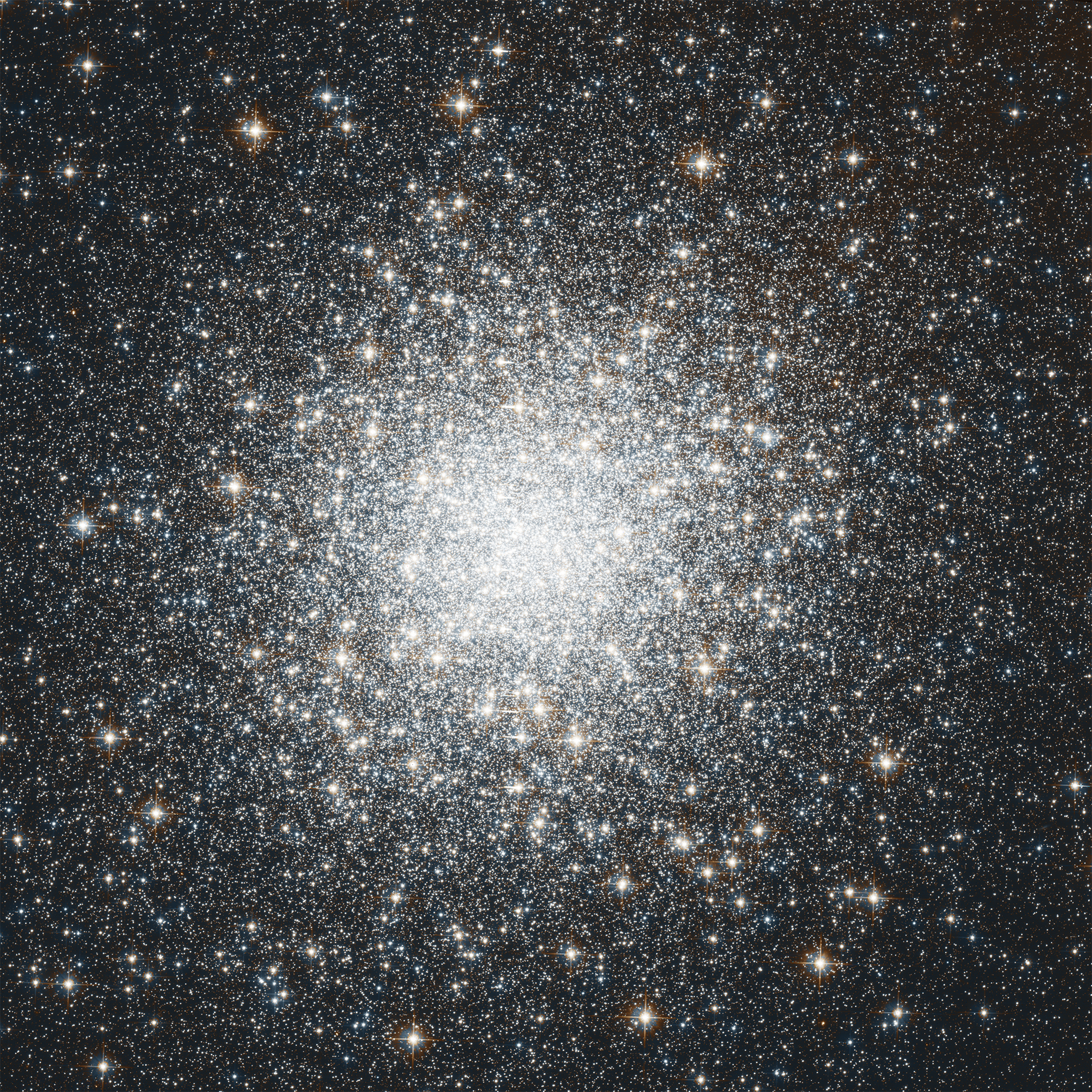
Globular_Cluster_M2.jpg
It's nice to know that you are an ameteur astronomer. Is that M13?
 
The incomprehensible numbers of galaxies pales in comparison to level of knowledge we have thus far.
The problem with that statement is that it doesn't actually say anything.

Compared to what? How are those two things being measured against each other? The number of galaxies and the amount of human knowledge aren't even quantities that can be meaningfully compared. If the point is that the universe is vast and our knowledge is limited, I'd agree. If the point is that our knowledge is vast despite the size of the universe, I'd agree with that too. But as written, it's more of a poetic-sounding observation than an actual argument.

That sounds profound until you stop and think about it for five seconds. One is a count of physical objects. The other is an abstract concept. There's no argument there to agree or disagree with.

It's the kind of sentence that sounds deep but doesn't communicate anything meaningful.
 
Back
Top Bottom
