Frozen pipes anyone?

Status
Not open for further replies.
Joined
Sep 25, 2009
Messages
20,783
Location
OH
We saw below 0F the last two nights without much warming through each day.
It actually got colder through the day Monday.
The day started out a little below zero, but was a solid -10F when I got home from work, although it got only a little colder overnight, with around -12F this morning.
We saw a balmy 7F high today, with well above freezing temps forecast for the weekend.
After a couple of days of cold soak, both of the supply lines under the kitchen sink were frozen this morning.
They were frozen again when I got home from work, which included a trip to Columbus.
I opened both taps and then thawed them with an old hair drier that has a very high heat setting.
Both lines were free and running after about twenty minutes of applied heat.
Did the same this evening when I got home.
They are copper and so conduct heat well. Might not be so easy with plastic plumbing.
We've not had enough cold the last couple of winters to have these pipes freeze, although they have in the past.
They never seem to break from this freezing.
 
I have had the pipes going to my kitchen sink freeze in the past and it always thawed without breaking the pipes.

This year my heating guy after a second look realized my kick heater was installed a few years ago without a Monoflow tee so there was not a lot of heat going to the kick heater. Once he added a Monoflow tee, there is a lot more heat in that section where the water pipes are and no more freezing.
 
The girlfriend just told me they are without water now because of a pipe freezing and breaking. They say that the house was built by a "contractor", but why a few water pipes run right along the foundation (in Indiana for that matter) is beyond me. Don't get me wrong.. Its a beautiful house.. It just has its quirks. Like other homes i guess. lol
 
We've never got below -11C (+12F), and we lose water a couple times per year (leave the shower drip on really (LOL) cold nights).

Had one split tap (faucet), but neighbours have had roofs cave in.

I remember one day at work, when I was looking after fire services that we had 37 galvanised steel 1" pipes split, which we obviously didn't know about until about lunchtime when systems started activating all over the place.
 
I had the toilet freeze in my shop on the last cold snap we had. Never had to thaw a toilet before...
eek.gif
 
The laundry room I just redid has the 1 hot water pipe frozen. It's one of the originals to the house and I think it's because the hack plumbers reduced the sill plate to the outside sheeting to install the drain line and I have an air leak.

Once I get it defrosted this evening I've got a can of Great Stuff to seal it all real well so it hopefully doesn't happen again.

It's just the one hot water pipe - the cold in the same cavity is perfectly fine.
 
Two things you can do.

1. Drip faucets.
It's obvious, it prevents pipes from bursting as water freezes and expands.

2. Leave cabinet doors open to under the sink. It helps warmer air get in there so that the heat from your house can keep them thawed.

Last year I kept the door to the laundry room closed thinking that it would help save on gas and electric heating costs.

However, the pipes that lead to the washer in the walls froze.

I've kept the door to the wash room open this year, it has been much colder, and everything has been fine.

It won't prevent everything from freezing, but it will help.
 
I've chased them all over in years past.

My main failing was running the woodstove to "save" the oil/ baseboard system. On below zero nights, that's gotta run. And I can't run the setback thermostat, just have to keep it locked at 65'F so it doesn't go hours at a time "coasting" down to temp.

It used to freeze where a heat pipe passes by my dryer vent. A toughie but I have it sealed now, I hope.

My house follows a new england tradition of starting with a 100 year old "core" and having additions added on willy nilly. Indoor plumbing may even have been an afterthought. A hallway passes around the OUTSIDE of my foundation and has a mere frost wall/ crawl space under it. Needless to say, this sucks to walk barefoot on. Pipes lead to my washing machine; I recently built/ rebuilt a "coffin" of insulation, wood, and foam board around them.

This crawl space is as hospitable as the moon. I have to crawl through a hole one shoulder blade at a time then turn around in decades old dusty dry dirt. Broken glass and nails from a demo job were chucked under here to avoid paying $15/yard at the dump. I took a picture of a rotten sill, since fixed, and when I got to my computer noticed spiders in the camera flash I hadn't noticed when I was under there.
27.gif


Anyway, I hope I found most of my house's idiosyncracies. I shovel snow around the foundation the first storm of the winter to add insulation.
 
I just finished a broken pipe repair in the laundry room behind the washer. My laundry room is a nook(7'x7') in the corner of the garage which also contains the hot water heater. On the colder nights and days, I leave an electric heater on to keep the temp at about 45F, but with the -10 F we have had that didn't work and froze a pipe going to the outside faucet.
 
I fought a 16 below zero night and 14 below zero night with a broken furnace (and had to wait 5 days for the parts, because UPS has apparently forgotten how to deliver anything on time anymore)
I didn't have any frozen pipes.

I think that's a pretty good accomplishment, considering that some people can have a fully functioning furnace, and still end up with frozen pipes.

Of course, I built my house, and I know how it was insulated as well.

Leave cabinets open underneath sinks, especially those that are on exterior walls.

Make sure your crawlspace is *tight*. Fill in gaps around any holes that have been drilled through the box plate for A/C lines or for exterior water faucets. Close the crawlspace vents and stuff the inside of the vents with scrap pieces of fiberglass insulation.

Make sure your box plate is insulated.
 
Wow, this is surprisingly common!!
crazy2.gif


No issues here and my old dwelling was build in the early 1900's
21.gif


Interesting note: My water feed to the house comes in through the basement floor, not a wall.... Which I thought was interesting. That puts it at least 6ft under the ground level of my lawn (which does taper down as it heads toward the street).

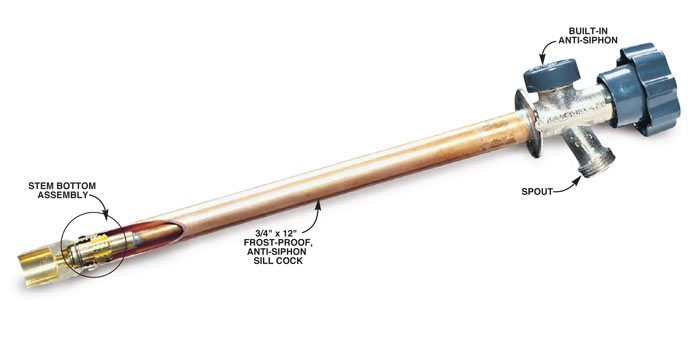
My outdoor tap is of this style:

FH01MAY_OUTFAU_01.JPG


So the majority of it is in in the house, where it won't freeze.
 
Our very first home was a bungalow built in 1928. The kitchen sink pipes were run against the sill plate, up against an uninsulated outside wall to the kitchen sink (which was under a leaky window). We had to put heat tape on them that first winter to keep them from freezing.

Needless to say the following spring I tore the kitchen out down to the studs, fixed everything correctly, insulated, and remodeled the kitchen. There was never a problem after that, and in our second and now our current home it's something I made sure would never happen.
 
I find it amazing that homes in cold areas of any semi-modern vintage (say 1920 and after) have exterior exposed pipes or mains that don't come from underground below the frost line.

Never even thought of this condition unless you're away in the winter, cold spell hits, furnace breaks, and on and on...

What am I missing here?
 
Originally Posted By: JHZR2
I find it amazing that homes in cold areas of any semi-modern vintage (say 1920 and after) have exterior exposed pipes or mains that don't come from underground below the frost line.

Never even thought of this condition unless you're away in the winter, cold spell hits, furnace breaks, and on and on...

What am I missing here?


That's what I was thinking
crazy2.gif
But the number of posts in this thread would indicate that it is surprisingly common!
shocked.gif
 
Originally Posted By: dlundblad
The girlfriend just told me they are without water now because of a pipe freezing and breaking. They say that the house was built by a "contractor", but why a few water pipes run right along the foundation (in Indiana for that matter) is beyond me.


I lived in Kentucky right across the river from Cincinnati 20 years ago. We had a cold snap to 0 F for a couple of days. Went to work in the morning and came home to about 2 inches of water on the ground floor of my condo.

The idiot developer had run the outside water line along the outside wall with zero insulation. Split about 6" of line.

We moved the line to lay against the inner surface and then shot the space full of expanding foam.
 
No problems here, but, we've seen colder temps in years past, so I wasn't worried about the balmy 0F we've been having. But all the pipe in my house is no more than twenty years old, if that.
 
Originally Posted By: JHZR2
I find it amazing that homes in cold areas of any semi-modern vintage (say 1920 and after) have exterior exposed pipes or mains that don't come from underground below the frost line.

Never even thought of this condition unless you're away in the winter, cold spell hits, furnace breaks, and on and on...

What am I missing here?


Unfortunately, especially with older homes, there have been substandard DIY projects done in the past. In my case it was a shabby kitchen remodel that had been done in the (my guess) 1940's or early 1950's. Standards and "code" were almost non-existent in the 1920's through the 1940's, and builders could do pretty much anything they wanted.

There are all sorts of bizarre things that you'll find in older homes-sewer pipes that have been patched together, mismatched vinyl windows, hardwood floors installed with no subfloor, knob and tube wiring, walls and sill plates with no insulation, etc..

Since it was our first house we planned to build equity by gutting and remodeling it anyway, so I knew going in that there were a lot of things not up to standards. Safe to say when we sold it (at a hefty profit) everything met or exceeded standards.
 
Originally Posted By: SuperDave456
Two things you can do.

1. Drip faucets.
It's obvious, it prevents pipes from bursting as water freezes and expands.

2. Leave cabinet doors open to under the sink. It helps warmer air get in there so that the heat from your house can keep them thawed.

Last year I kept the door to the laundry room closed thinking that it would help save on gas and electric heating costs.

However, the pipes that lead to the washer in the walls froze.

I've kept the door to the wash room open this year, it has been much colder, and everything has been fine.

It won't prevent everything from freezing, but it will help.


I lived in Montana one winter when it never got above 32°F between Nov1 and Mar1...and half those days it was below 0....and I heated the house entirely by wood I harvested, cut and quartered...
All the houses around me had frozen pipes...I just let my faucets run a slow stream all winter, just like that fire never once went out while I was there...
 
Last edited:
I turned on the cold water this morning in the kitchen and for about 10 seconds I had what looked like a very dark tea coming out. Clearly rust from iron. Everything else in the house is fine. The kitchen water is now clear no reduction in pressure. For now I'm calling it an anomaly, if it happens again I'll have to dig in. It it came out of the hot water I'd be more concerned.
 
And remember the code/standard assumes a normal winter with some (but not too much) margin. Take the "known" frost depth and add six inches and bury the pipes there. 3'6" to 4 feet here, less elsewhere. Funky stuff up in Permafrost.
 
Status
Not open for further replies.
Back
Top Bottom