Given direct injection motors propensity for forming intake valve/tract deposits, which is the better indicator of an oil's tendency to volatilize in the crankcase and form oily vapors - - flash point or Noack volatility, and why?

You are using an out of date browser. It may not display this or other websites correctly.
You should upgrade or use an alternative browser.
You should upgrade or use an alternative browser.
Flash Point vs Noack re intake deposits
- Thread starter m6pwr
- Start date
- Status
- Not open for further replies.
NOACK is about the vaporizing of the lighter factions of the oil which contribute to crackcase vapors.
But I'm not sure how well the NOACK spec' at 250C translates into crankcase vapor that's typically under 100C.
Wouldn't oil that gets past the valve guide seals (and some does) be the largest contributor to intake valve deposits?
Wouldn't the oil with the lowest ash content (leaves the least residue when burnt) be what one would want in an DI engine?
But I'm not sure how well the NOACK spec' at 250C translates into crankcase vapor that's typically under 100C.
Wouldn't oil that gets past the valve guide seals (and some does) be the largest contributor to intake valve deposits?
Wouldn't the oil with the lowest ash content (leaves the least residue when burnt) be what one would want in an DI engine?
Hi,
m6pwr - These are issues the Oil Companies have researched well. The latest Castrol "Professional" range will give you a clue - these were developed by Castrol for one of the largest DI petrol engine Manufacturers - the VW Group
Primarily any deposit issues are OEM and not lubricant related
Perhaps in some engine families it is more a question of how the engine ventilation systems function
m6pwr - These are issues the Oil Companies have researched well. The latest Castrol "Professional" range will give you a clue - these were developed by Castrol for one of the largest DI petrol engine Manufacturers - the VW Group
Primarily any deposit issues are OEM and not lubricant related
Perhaps in some engine families it is more a question of how the engine ventilation systems function

I read that Lubrizol presentation also. I even went out and bought some Pento High Performance II 5w30 for my 2010 GTI. I did a VOA on it. After reading more into VW 504 oils and our [censored] gas here in the US. I bought Redline 5W-40 instead.
Hi,
Bob (thanks) and dOOdfOOd - Remember that ACEA included a new "C" Catalyst compatibility Quality category in the mid 2000s. And remeber too that the Euro emmission controls have been steadily advancing over a very long period and ACEA are an integral but late partner
Of course the reference I made to Castrol's "Professional" range alludes in no small way to this - it's the product of some of the very best brains and millions of kms of field testing!
It is clear that some Oil Company's Engineers believe that more development work needs to be done from the OEMs perspective. Deposits are intermittent over Brands and engine families and will be around for a while yet
It is all the more reason to use only those lubricants Approved by the engine's Manufacturer! This caveat applied to many diesel engines over 60 years ago - CAT and MB could tell a few stories about that!
Bob (thanks) and dOOdfOOd - Remember that ACEA included a new "C" Catalyst compatibility Quality category in the mid 2000s. And remeber too that the Euro emmission controls have been steadily advancing over a very long period and ACEA are an integral but late partner
Of course the reference I made to Castrol's "Professional" range alludes in no small way to this - it's the product of some of the very best brains and millions of kms of field testing!
It is clear that some Oil Company's Engineers believe that more development work needs to be done from the OEMs perspective. Deposits are intermittent over Brands and engine families and will be around for a while yet
It is all the more reason to use only those lubricants Approved by the engine's Manufacturer! This caveat applied to many diesel engines over 60 years ago - CAT and MB could tell a few stories about that!
Originally Posted By: CATERHAM
NOACK is about the vaporizing of the lighter factions of the oil which contribute to crackcase vapors.
But I'm not sure how well the NOACK spec' at 250C translates into crankcase vapor that's typically under 100C.
Wouldn't oil that gets past the valve guide seals (and some does) be the largest contributor to intake valve deposits?
+1, No getting around the EGR.
NOACK is about the vaporizing of the lighter factions of the oil which contribute to crackcase vapors.
But I'm not sure how well the NOACK spec' at 250C translates into crankcase vapor that's typically under 100C.
Wouldn't oil that gets past the valve guide seals (and some does) be the largest contributor to intake valve deposits?
+1, No getting around the EGR.
Last edited:
m6pwr
Thread starter
Thanks for the input so far (keep it coming). Maybe I should have mentioned that I'm asking the question with a BMW N54 twin turbo di engine (heat shear and fuel dilution) in mind. I know the design of the EGR system plays a big part in controlling deposit formation, but I don't think its the only factor involved. As for the Castrol Professional range, I don't think its available yet in the US (Castrol USA site doesn't show it), and the only Castrol Professional oil I know of at VW dealers is the Castrol Professional SLX LL03 used for the TDI diesels (and not BMW LL01 approved). So how do I recognize a low SAPS oil? Is it the API SM-rated oils (eg. Pennzoil Euro Formula 5w40 that has BMW LL-01 approval - - or does it have to be a 5w30)? The trouble is that PDSs, VOAs, and used oil analysis don't really tell you what's going on with deposit formation. Maybe I should buy a borescope? Incidentally, very few of the oil companies now days seem to list the NOACK numbers for their oils. I asked Castrol and they said this information was "unavailable".
BMW LL-04 is low saps (or "mid") but LL-01 is specified instead. Majority opinion is because of our fuels' ethanol and sulphur deplete the low saps additives. Same dilemma for VWs, 504 in Europe and 502 in N.A..
Therein lies a contradiction, in my mind. How can older spec oils be preferred if DI requires low saps? If the mfgs can use an old formula, from 2001(BMW) or 1998 (VW), why can't the consumer opt for their own newer unspeced oil, like Rotella Synth, or like I'm using, Castrol EDGE 5w30?
Castrol EDGE, Pennzoil Platinum / Pennzoil Ultra, Mobil 1 High Mileage, they do represent a good product with the newest additives and base oils, although not low saps surely they can be as good or better than an old high magnesium formula like Syntec 5w-40.
Therein lies a contradiction, in my mind. How can older spec oils be preferred if DI requires low saps? If the mfgs can use an old formula, from 2001(BMW) or 1998 (VW), why can't the consumer opt for their own newer unspeced oil, like Rotella Synth, or like I'm using, Castrol EDGE 5w30?
Castrol EDGE, Pennzoil Platinum / Pennzoil Ultra, Mobil 1 High Mileage, they do represent a good product with the newest additives and base oils, although not low saps surely they can be as good or better than an old high magnesium formula like Syntec 5w-40.
Originally Posted By: Audi Junkie
Same dilemma for VWs, 504 in Europe and 502 in N.A..
Except that if you call VW/Audi in the USA and ask them specifically whether 504 is approved for use in gas engines in the USA, they say "Yes."
And if you ask them if you can use 504 oil instead of 502 oil in engines that were specced for 502 when they were built, they say "Yes, you can use 504 oils in you car that called for 502."
So the [censored] knows that to believe?
I believe that 504 is perfectly FINE for VW 502 gas engines, EXCEPT they must adhere to the standard (non long drain) OCI vs. what they can achieve in Europe.
Same dilemma for VWs, 504 in Europe and 502 in N.A..
Except that if you call VW/Audi in the USA and ask them specifically whether 504 is approved for use in gas engines in the USA, they say "Yes."
And if you ask them if you can use 504 oil instead of 502 oil in engines that were specced for 502 when they were built, they say "Yes, you can use 504 oils in you car that called for 502."
So the [censored] knows that to believe?
I believe that 504 is perfectly FINE for VW 502 gas engines, EXCEPT they must adhere to the standard (non long drain) OCI vs. what they can achieve in Europe.
Originally Posted By: Audi Junkie
Therein lies a contradiction, in my mind. How can older spec oils be preferred if DI requires low saps? If the mfgs can use an old formula, from 2001(BMW) or 1998 (VW), why can't the consumer opt for their own newer unspeced oil, like Rotella Synth, or like I'm using, Castrol EDGE 5w30?
It's a classic example of gov't policy fighting consumer wants.
Therein lies a contradiction, in my mind. How can older spec oils be preferred if DI requires low saps? If the mfgs can use an old formula, from 2001(BMW) or 1998 (VW), why can't the consumer opt for their own newer unspeced oil, like Rotella Synth, or like I'm using, Castrol EDGE 5w30?
It's a classic example of gov't policy fighting consumer wants.
Originally Posted By: m6pwr
Thanks for the input so far (keep it coming). Maybe I should have mentioned that I'm asking the question with a BMW N54 twin turbo di engine (heat shear and fuel dilution) in mind. I know the design of the EGR system plays a big part in controlling deposit formation, but I don't think its the only factor involved. As for the Castrol Professional range, I don't think its available yet in the US (Castrol USA site doesn't show it), and the only Castrol Professional oil I know of at VW dealers is the Castrol Professional SLX LL03 used for the TDI diesels (and not BMW LL01 approved). So how do I recognize a low SAPS oil? Is it the API SM-rated oils (eg. Pennzoil Euro Formula 5w40 that has BMW LL-01 approval - - or does it have to be a 5w30)? The trouble is that PDSs, VOAs, and used oil analysis don't really tell you what's going on with deposit formation. Maybe I should buy a borescope? Incidentally, very few of the oil companies now days seem to list the NOACK numbers for their oils. I asked Castrol and they said this information was "unavailable".
Castrol SLX OE 5w30 is available at your dealership (BMW LL04). We oil burners use that oil for our 335d and X5d.
Since the SLX is ~$11/quart you can always try Mobil 1 ESP 5w30 (LL04) which is available at Pepboys and such for ~$7/quart.
Just shorten the OCI.
Thanks for the input so far (keep it coming). Maybe I should have mentioned that I'm asking the question with a BMW N54 twin turbo di engine (heat shear and fuel dilution) in mind. I know the design of the EGR system plays a big part in controlling deposit formation, but I don't think its the only factor involved. As for the Castrol Professional range, I don't think its available yet in the US (Castrol USA site doesn't show it), and the only Castrol Professional oil I know of at VW dealers is the Castrol Professional SLX LL03 used for the TDI diesels (and not BMW LL01 approved). So how do I recognize a low SAPS oil? Is it the API SM-rated oils (eg. Pennzoil Euro Formula 5w40 that has BMW LL-01 approval - - or does it have to be a 5w30)? The trouble is that PDSs, VOAs, and used oil analysis don't really tell you what's going on with deposit formation. Maybe I should buy a borescope? Incidentally, very few of the oil companies now days seem to list the NOACK numbers for their oils. I asked Castrol and they said this information was "unavailable".
Castrol SLX OE 5w30 is available at your dealership (BMW LL04). We oil burners use that oil for our 335d and X5d.
Since the SLX is ~$11/quart you can always try Mobil 1 ESP 5w30 (LL04) which is available at Pepboys and such for ~$7/quart.
Just shorten the OCI.
Last edited:
Originally Posted By: OldBaldy
I believe that 504 is perfectly FINE for VW 502 gas engines, EXCEPT they must adhere to the standard (non long drain) OCI vs. what they can achieve in Europe.
I arrived at the same conclusion than you and BMWTurboDzl: It is better to use the low SAPS oil for the engine but since it depletes faster in North America due to our fuel, it is better to shorten the OCI.
Clean intake and good protection is you don't go too far.
Isn't what dealers unofficially say to their customers, to do an OC mid way (5 kmiles or 6 months)?
I believe that 504 is perfectly FINE for VW 502 gas engines, EXCEPT they must adhere to the standard (non long drain) OCI vs. what they can achieve in Europe.
I arrived at the same conclusion than you and BMWTurboDzl: It is better to use the low SAPS oil for the engine but since it depletes faster in North America due to our fuel, it is better to shorten the OCI.
Clean intake and good protection is you don't go too far.
Isn't what dealers unofficially say to their customers, to do an OC mid way (5 kmiles or 6 months)?
M6pwr, all the following is IMO and based on a lot of research, especially the excellent work of ISA and Haji-Silaiman (referenced below): This is a very complex topic and flash point and volatility are only part of the picture. Basestocks, additives, quantity and quality of viscosity modifiers all effect the deposits. The best thing you can do is a select an oil that holds up well in the presence of fuel dilution and don't run it too long.
1) In regards to it being a design problem, yes it is, but it is so widespread and across so many manufacturers means that it is a reality that we are stuck with at present. Oil selection may help fight the deposits.
2) I believe the deposits are not due to the fuel alone (this test shows deposit buildup of different blends of fuel and fuel w/ various dosages of used oil). BTW, I realize fuel does not wash the valves on your engine but the partially reacted fuel, the part that does all the damage, does get into and degrade the oil and is present in the PCV gases (as are raw fuel and reacted fuel).:
 (ISA and Haji-Silaiman)
3) Deposit formation does vary by oil type. It has been shown in the literature that deposits vary by oil type (the y axis shows amount of valve deposits, while x axis shows the oil type A, B, C, and the oil with 100 hours on it A100, etc.):
 (ISA and Haji-Silaiman)
4) Deposits increase as the oils degrade over time (the y axis shows amount of valve deposits, while x axis shows the service interval of the oil in hours, f.e. e2/125 is 125 service hours on oil E2. Note that the deposits were cleaned off each time so these are independent runs).

 (ISA and Haji-Silaiman)
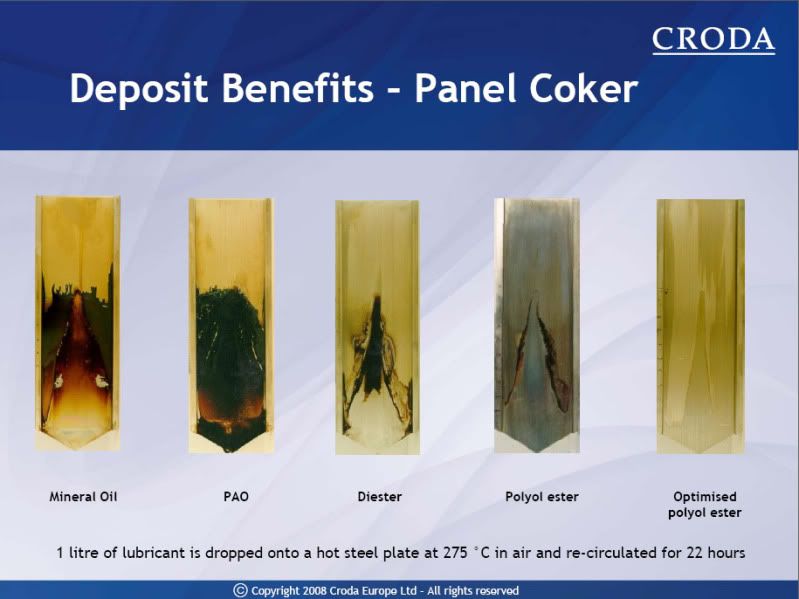
5) Some oils degrade quickly in a DI fuel-diluting turbo charged motor. Expert Terry Dyson warned us about this years ago. And the over 100 used oil analysis in the database for the Audi/VW 2.0FSI supports exactly what he said. Indeed the worst deposit evidence we have on the 2.0 FSI is from engines that ran OEM oils at OEM intervals, such as this one shown below Terry's quote (Mobil 1 0w40 at 10k intervals according to the manual). Also my favorite coking deposit slide I added on the end.
Originally Posted By: Terry
reb03, the Mobil 1 0w40 should not be run longer than 1000 miles to be safe.. Audi and BMW know they are having problems but are marketing tied to certain LARGE oil company that sponsors BITOG thus they cannot speak out about it.
TD
Originally Posted By: Terry
reb03, I have customers running BMW5w30, Mobil 1 0w40 all with the same effect, the wear control is good if we change the oil at 1000 mile intervals but the deposit formation from REAL volatility issues are slowly damaging the engines. I just worked a 07 335 Biturbo yesterday USING ASTM lab tests on the used oil and Mobil 1 0w40 went from VOA flash of 430+F to 280 F in 1150 miles, oil sheared to 12.1 cSt and fuel was at 1.99% by IR. Amsoil has not been tested in this engine yet. Because Amsoil is a traditional based PAO I predict similar results to the Mobil 1 0w40 which is still one of few Mobil 1 products that can perform reasonably well.
Terry

 (CRODA)
1) In regards to it being a design problem, yes it is, but it is so widespread and across so many manufacturers means that it is a reality that we are stuck with at present. Oil selection may help fight the deposits.
2) I believe the deposits are not due to the fuel alone (this test shows deposit buildup of different blends of fuel and fuel w/ various dosages of used oil). BTW, I realize fuel does not wash the valves on your engine but the partially reacted fuel, the part that does all the damage, does get into and degrade the oil and is present in the PCV gases (as are raw fuel and reacted fuel).:
3) Deposit formation does vary by oil type. It has been shown in the literature that deposits vary by oil type (the y axis shows amount of valve deposits, while x axis shows the oil type A, B, C, and the oil with 100 hours on it A100, etc.):
4) Deposits increase as the oils degrade over time (the y axis shows amount of valve deposits, while x axis shows the service interval of the oil in hours, f.e. e2/125 is 125 service hours on oil E2. Note that the deposits were cleaned off each time so these are independent runs).
5) Some oils degrade quickly in a DI fuel-diluting turbo charged motor. Expert Terry Dyson warned us about this years ago. And the over 100 used oil analysis in the database for the Audi/VW 2.0FSI supports exactly what he said. Indeed the worst deposit evidence we have on the 2.0 FSI is from engines that ran OEM oils at OEM intervals, such as this one shown below Terry's quote (Mobil 1 0w40 at 10k intervals according to the manual). Also my favorite coking deposit slide I added on the end.
Originally Posted By: Terry
reb03, the Mobil 1 0w40 should not be run longer than 1000 miles to be safe.. Audi and BMW know they are having problems but are marketing tied to certain LARGE oil company that sponsors BITOG thus they cannot speak out about it.
TD
Originally Posted By: Terry
reb03, I have customers running BMW5w30, Mobil 1 0w40 all with the same effect, the wear control is good if we change the oil at 1000 mile intervals but the deposit formation from REAL volatility issues are slowly damaging the engines. I just worked a 07 335 Biturbo yesterday USING ASTM lab tests on the used oil and Mobil 1 0w40 went from VOA flash of 430+F to 280 F in 1150 miles, oil sheared to 12.1 cSt and fuel was at 1.99% by IR. Amsoil has not been tested in this engine yet. Because Amsoil is a traditional based PAO I predict similar results to the Mobil 1 0w40 which is still one of few Mobil 1 products that can perform reasonably well.
Terry
Saaber1 -
I think Dyson is wrong in his assumption that BMW and Audi have their hands tied due to marketing arrangement. Instead I believe it's the result of the ACEA not moving on the issue. IIRC the oil used in all euro automobiles must meet the applicable ACEA spec first and shorter OCI's aren't part of that specification as it goes against one of their tenants which is to focus on the environment.
I think Dyson is wrong in his assumption that BMW and Audi have their hands tied due to marketing arrangement. Instead I believe it's the result of the ACEA not moving on the issue. IIRC the oil used in all euro automobiles must meet the applicable ACEA spec first and shorter OCI's aren't part of that specification as it goes against one of their tenants which is to focus on the environment.
Did Terry mentioned how redline oils handle DI engines?
My point was that oems can use an old spec oil in place of the new low saps stuff, why can't I use something inbetween? Newer and better than VW 502 1998, but not low saps? Edge, Ultra, Mobil 1 High Mileage, even SynPower...?
.....VW 502 is a current spec, not sure why you keep referring to it as an old spec.
VW mid-full SAPS oil for gasoline engines IS VW 502.
Although introduced many years ago it is not a stand-alone spec ( VW 504-507 LL 03 is not even API rated) and has "evolved"....that is, not all 502 oils are the same. I would not consider Mobil 1 0W-40 or Shell Helix Ultra as old pec oils.
VW mid-full SAPS oil for gasoline engines IS VW 502.
Although introduced many years ago it is not a stand-alone spec ( VW 504-507 LL 03 is not even API rated) and has "evolved"....that is, not all 502 oils are the same. I would not consider Mobil 1 0W-40 or Shell Helix Ultra as old pec oils.
- Status
- Not open for further replies.
Similar threads
- Replies
- 103
- Views
- 66K
- Replies
- 12
- Views
- 9K
- Replies
- 10
- Views
- 4K
- Replies
- 43
- Views
- 37K
- Replies
- 17
- Views
- 11K