Re: Study PAO VS Esther [Re: Feffman]
stenerson Offline
Registered: 08/26/09
Posts: 454
Loc: NH
According to the article poly ester have poor hydrolytic stability. How would that effect an engine oil?
_________________________
2004 Dodge 1500 4x4 5.7 Hemi 101k miles
2000 Dodge Caravan 3.3 136k
9 years using Mobil 1 15w50. 9 months on PP.
Now RP.
Top Reply Quote Quick Reply Quick Quote Notify
#1637244 - 10/19/09 10:44 AM Re: Study PAO VS Esther [Re: stenerson]
vxcalais Offline
Registered: 07/14/07
Posts: 747
Loc: Melbourne, Australia
Originally Posted By: stenerson
According to the article poly ester have poor hydrolytic stability. How would that effect an engine oil?
Would it mean that if you had a very small coolant leak, or high combustion fluid type bi products, you would be knackered ???
_________________________
Ride - Holden Calais VX GMV6 3.8litre 01'Delo 400 Multigrade
Other - Toyota Corolla 06'Oil whatever Toyota chucked in
Top Reply Quote Quick Reply Quick Quote Notify
#1637378 - 10/19/09 12:58 PM Re: Study PAO VS Esther [Re: stenerson]
saaber1 Offline
Registered: 11/28/07
Posts: 1722
Loc: Pacnw
Originally Posted By: stenerson
According to the article poly ester have poor hydrolytic stability. How would that effect an engine oil?
It doesn't:
"Redline's reply is correct. Hydroscopic refers to a liquid's capacity to absorb and solubilize water. Higher molecular weight esters will only solubilize 0.1 to 0.2% water, and even this will be released under vacuum and heat.
Tom NJ"
http://www.bobistheoilguy.com/forums/ubb...780#Post1625780
Also here is a good article on Esters FYI:
http://www.bobistheoilguy.com/forums/ubb...994#Post1252272
_________________________
"when 5W30 is cold, ...the oil is 35 weight (5+30),...20 w 50 starts at 70 and warms up to 50"
- Kyle, auto mechanic & VP Speedline Motorsports, INTL
Top Reply Quote Quick Reply Quick Quote Notify
#1637415 - 10/19/09 01:30 PM Re: Study PAO VS Esther [Re: saaber1]
Tom NJ Offline
Registered: 07/28/06
Posts: 845
Loc: New Jersey
Saaber1 is correct - it doesn't - but for a different reason.
Hydroscopicity, a liquid's capacity to absorb and solubilize water, is different than hydrolytic stability, a liquid's capacity to react with water.
Esters are not considered very hydrolytically stable, but they vary according to structure, and the conditions needed to break them are pretty severe. The net effect in motor oils is not significant - you may see a rise in TAN but not the corrosive type.
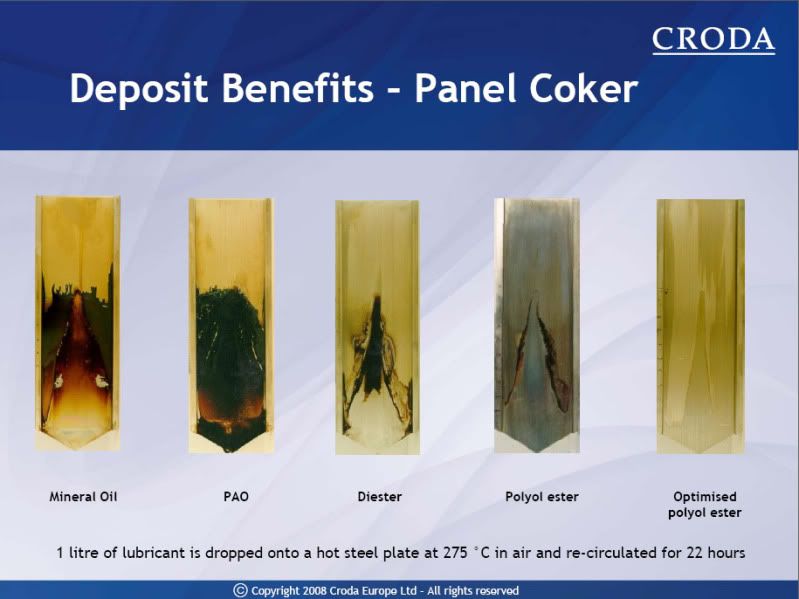
Polyol esters are more hydrolytically stable than diesters, which were used for many years in synthetic motor oils without problems. Advanced POEs are quite hydrolytically stable. Nearly 40 years of ester use in motor oils have not demonstrated any performance issues with respect to their hydrolytically stability.
Tom NJ
Top Reply Quote Quick Reply Quick Quote Notify
#1637540 - 10/19/09 03:04 PM Re: Study PAO VS Esther [Re: Tom NJ]
labman Offline
Registered: 03/14/03
Posts: 8706
Loc: Nothern USA
Esters will react with anything with an acid or hydroxyl including water. However, not very fast except at high temperatures. By the time the temperature gets high enough for much to react, most of the problem things will have evaporated off. Glycol from the coolant could be a problem. Who know what strange new esters could form.
Mixing polyol and dibasic acid esters could lead to polyesters forming. I used to use them to make paint resins. So watch frankenmixes and coolant leaks. Otherwise, as stated, they have an excellent record.
Top Reply Quote Quick Reply Quick Quote Notify
#1637682 - 10/19/09 05:24 PM Re: Study PAO VS Esther [Re: labman]
Bruce T Offline
Registered: 04/20/04
Posts: 408
Loc: Oklahoma City
Wow, great discussion. I didn't know that polyol esters could react with diesters or antifreeze. That's something to watch.
Top Reply Quote Quick Reply Quick Quote Notify
#1637887 - 10/19/09 08:11 PM Re: Study PAO VS Esther [Re: labman]
Tom NJ Offline
Registered: 07/28/06
Posts: 845
Loc: New Jersey
Originally Posted By: labman
Mixing polyol and dibasic acid esters could lead to polyesters forming. I used to use them to make paint resins.
True, but the POE and diester types used in synthetic lubricants will not generally transesterify except at temperatures beyond car engines. It would be a concern for jet engine lubricants, but no such mixtures are used there. Even if polyesters (we called them complexed esters) are formed, they are also stable, just higher in viscosity. Complexed esters are widely used in synthetic lubricants - great physical properties such as pour point and VI, but not so good for high temperature coking.
Advanced POEs are branched at specific locations on the carboxylic acid moiety, thus stearically hindering water attack at the ester linkage. This also reduces the methylene hydrogens which improves high temperature oxidative stability and coking. Properly structured these are the cream of POEs for high temperature use. Overkill for car engine oils, but the darling of the latest generation jet engine oils and industrial chain lubricants.
Tom NJ
Top Reply Quote Quick Reply Quick Quote Notify
#1637902 - 10/19/09 08:28 PM Re: Study PAO VS Esther [Re: Tom NJ]
rcy Online content
Registered: 02/14/04
Posts: 1125
Loc: Burlington, Ontario, Canada
Originally Posted By: Tom NJ
True, but the POE and diester types used in synthetic lubricants will not generally transesterify except at temperatures beyond car engines. It would be a concern for jet engine lubricants, but no such mixtures are used there. Even if polyesters (we called them complexed esters) are formed, they are also stable, just higher in viscosity. Complexed esters are widely used in synthetic lubricants - great physical properties such as pour point and VI, but not so good for high temperature coking.
Advanced POEs are branched at specific locations on the carboxylic acid moiety, thus stearically hindering water attack at the ester linkage. This also reduces the methylene hydrogens which improves high temperature oxidative stability and coking. Properly structured these are the cream of POEs for high temperature use. Overkill for car engine oils, but the darling of the latest generation jet engine oils and industrial chain lubricants.
Tom NJ
I understood everything right up until the word 'true', then you lost me. tongue2
Edited by rcy (10/19/09 08:32 PM)
Top Reply Quote Quick Reply Quick Quote Notify
#1638071 - 10/19/09 10:50 PM Re: Study PAO VS Esther [Re: rcy]
Tom NJ Offline
Registered: 07/28/06
Posts: 845
Loc: New Jersey
Originally Posted By: rcy
I understood everything right up until the word 'true', then you lost me. tongue2
LOL
Oops, sorry. Layman's language:
- Diesters and Polyol esters can swap parts if the mixture gets too hot, and wind up growing into a larger ester.
- The larger ester is still good stuff.
- Advanced polyol esters can be built in a way that blocks water from getting to their weak spots.
- In addition to blocking water, some of their other parts get stronger and better resist attack by oxygen.
- By fixing and strengthening the weaker parts, the ester is more stable and cleaner.
- These super strong ester are loved for real high temperature uses like jets.
Tom NJ smile2
Top Reply Quote Quick Reply Quick Quote Notify
#1638144 - 10/19/09 11:42 PM Re: Study PAO VS Esther [Re: Tom NJ]
labman Offline
Registered: 03/14/03
Posts: 8706
Loc: Nothern USA
I would still never put a mixture of di or tri basic acids and glycols or polyols both it a crankcase.
Of course, the scientific thing is to look problems.
Top Reply Quote Quick Reply Quick Quote Notify
#1638285 - 10/20/09 01:22 AM Re: Study PAO VS Esther [Re: rcy]
JohnBrowning Offline
Registered: 05/02/03
Posts: 9448
Loc: USA
Actualy POE has proven to protect engine bearing when a coolant leak occurs no matter what type of base is being used for the coolant. POE is not so hydrolytic that it is a problem in automotive applications our even in boat applications. If you where had a device that say set in the middle of a lake or water fall and did not have any way of producing heat to burn off water vapor then some and only some types of Ester's would have problems. I think POE can pick-up and retain .02% water by volume but again the engine heat drives off water vapor and we have never seen a Redline report that had any water issues except in one Buick 3.8 I think that had a coolant leak and even then Redlines POE base stock was credited with saving the bearings!
So do not over think stuff real world application data like what we have in the used oil analysis section is worth fair more then overly simplistic generalized summations of the basic qualities of base stock's. IF water was an issue you would think all those jet engines runing ester's and flying through rain and clouds would be an issue but it is not!Same thing could be said for satalites and the space shuttle! If water was an issue the cold vaccum of space would make it show up in a hury.
You have to remember this stuff was meant for guys working in a factory trying to keep all the machines happy and healthy. Hydraulic systems are super sensitive to moisture one drop of water in a hydraulic line can ruin the anti-corrosive additives in the hydraulic fluid. So if you have a fluid that that is prone to pciking up more water then old GII type hydraulic fluids you need to know about it. You can add line dryers and you can periodically vacuum dehydrate the fluid to extend it's life and take advantage of the other properties that the POE has to offer.
Short of 4-Wheeling I doubt anyone has had to gravity separate water from their crankcase on a regular basis or their diff but large machinery that is powered by electric motors or pneumatics does not have the heat of an internal combustion engine to drive off the water so it collects in the machinery and hence in the oil.I started working on machinery while still in college. My roommate was an electronics major and I took him to a job one day. I realized what was wrong on a machine and mentioned it to my friend and his boss and from that day on I had a job and one of the most advanced factories in Michigan until I went to work for GM after I graduated college.So youhave to understand who the audience is in this article it is not really being written for the automotive enthusiast. Like wise I am sure that at your house you do not have a policy or procedure inplace to protect bulk lubricants from contamination. Different needs for different audience!
In a car ester POE,TPe and Diesters all work great their cost is the reason why they are seldom seen. Amsoil used to use Diester's but PAO will get the job done and it does it at far cheaper cost's. This means they get to make more money off the oil then they would if they went with 100% Diester like they used to. Their is nothing better about PAo it is all about PROFIT and PRICE POINT! PAO is more then up tot he job in 99% of internal combustion engines as long as you use an AN,Ester or Mineral oil to cary the additives and creat some seal swell!A $10-$16 a quart oil would not sell well on Walamrts shelfs or at AutoZone!
https://bobistheoilguy.com/forums/posts/1638528/