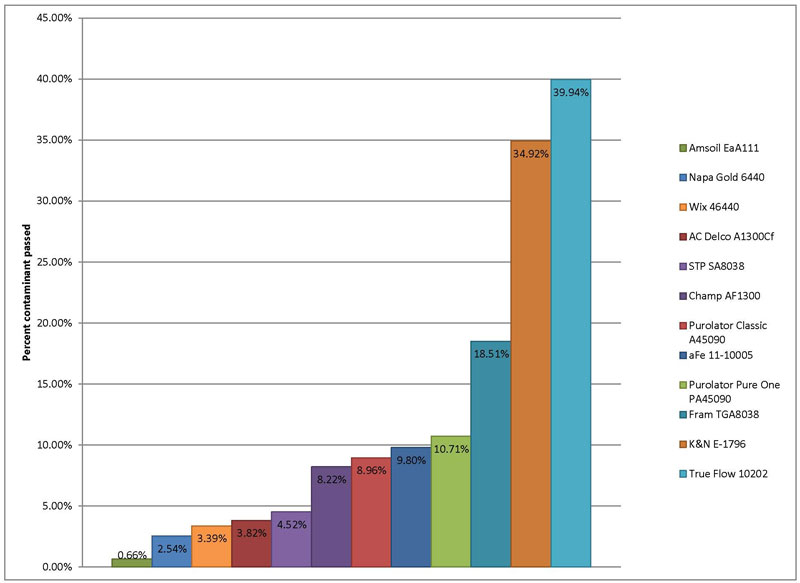
Air filter study

Status
Not open for further replies.
May I recommend the AFE DRY PRO S?
lol.gif
 
^Finally got one on the way, thanks!
banana2.gif


It looks 3x better than the K&N in this test, at least.

I'm going to start a thread and post some pics later about the 'dusty' conditions in my engine bay near the air intake routing. I think I may have OCD creeping in, but want to clean it all up before putting the new filter in.
grin2.gif
 
From this test and others I have seen, I am beginning to draw only 1 conclusion. Oiled media air filters are pure hype... just saying.

I also have to admit that I have confidence in Wix and Purolator products, including their air filters. In this test, and most tests I have seen for that matter, they do not disappoint! The pure1 results were a little disappointing for me but only because of the high premium that come with pure1 air filters.
 
Originally Posted By: AMC
From this test and others I have seen, I am beginning to draw only 1 conclusion. Oiled media air filters are pure hype... just saying.

I also have to admit that I have confidence in Wix and Purolator products, including their air filters. In this test, and most tests I have seen for that matter, they do not disappoint! The pure1 results were a little disappointing for me but only because of the high premium that come with pure1 air filters.


Well, you know, why throw on oil if the media was enough to do the job? Dust doesn't get caught, only larger particles.
 
the iso test dirt was not used in this air filter test..and private parties that do these tests often scew these tests.so to me these kind of airfilter studies don't mean squat....common sense is what i use on occ....to push air through a thick paper filter just does not make sense for flow....either way, no filter is 100% or your engine could not breathe..in any filter these particles not a factor and are way smaller then bearing clearances..so i would not worry if one usess a paper filter or a k&n.. why engine oil is dark after driving you will never get a way from that.i use the k&n because of super flow...i just want a engine with optimal decreased internal drag...i think you all are beating a dead horse.
 
Last edited:
I just had a Magnaflow muffler replaced with a stock muffler, and I replaced a K&N air 'filter' with a NAPA Gold filter on my 2006 Colorado 3.5L. And guess what?

I can't go over 25 MPH anymore......NOT!!!!

Actually, I can hear myself think while driving, my ears don't ring anymore when I get home from work, and the low end torque on my truck has increased making day to day driveability much better. Oh, I may have lost 10 HP @ 6k rpm,
crazy.gif
but seeing as I am not one of those idiots that drives around in 1st gear all day, who cares? And now I have an air filter that actually does it's job. Life is good.
 
I got an aFe Pro Dry S in the mail today and it's a far better constructed filter than the K&N.

That was my first impression when I held both, and did some basic side by side comparisons. I showed it to my dad and to my wife. They compared them both and saw the K&N passed more unfiltered light in various places of the media and the overall media was on the 'minimal' side while the Pro Dry S was solid.

It was like getting a true synthetic air filter for the app, like I had wanted before in something like an Amsoil EaA but they didn't offer any for my app. I also don't want to get away from stock in this known to be finicky VX, in order to use a cone filter, etc.

Some other differences:

The gasket and filter media on the aFe product is definitely more stout, providing are more robust seal where gasket mates to the media. Though to me, the K&N didn't have issues there.

I have only had this K&N for about 25,000 miles and performed one cleaning at about 15,000 miles in. I did it per the instructions with the correct 'recharge kit' from K&N. Today, when I held it up to various sources of light, it passed too much for my taste. To the point of making the aFe look like the best thing since sliced bread for engine protection.

Now, there is an issue of 'over cleaning' that K&N says most of it's users do(like myself, I'm guilty), K&N claims to let it 'fill up' as if to imply it will satisfy my efficiency desires at that point. I give that marginal plausibility with the cringe of 'not for me' creeping up.

If you talked with me 2 years ago, I would have agreed with boxcartommie22. 'Its not letting in that much more' crowd, but I now consider filtration efficiency to be more important than airflow as long as it's not to the point of a meaningful restriction.

The 'performance' gains ARE minimal, and it IS at a sacrifice of efficiency. For extended drains, I think that's the cutoff point for me. The ability for ingested dirt or dust to increase Si values and rely on my oil filter to do the job on fine particles that 'could' increase wear don't give me peace of mind.

The potential small gains of 2 or 3 HP in my app somewhere between 4,000-6,000 RPM, is not worth it to me trying to perform extended oil changes at the risk of 'elevated' silicon values. I value filtration more now, but the good thing is the Pro Dry S scores well in airflow anyway over stock paper filters, which do the job but require more frequent replacing once their medias get impregnated over time. The K&N gives me no magical increase in fuel economy. The Pro Dry S is hassle free and for my 'drop in' replacement/stock setup, simply fills what I consider to be more valuable.

In my app, I didn't have extreme ingestion, etc, it's a curiosity and 'why not try it and see what changes' approach. Sure, one must take into account variables, but I don't even need a used oil analysis for me to know the new air filter can't possibly let in 'more' than the K&N 'did'.

49.gif


It made my day. Best all-around stock replacement filter for a Civic. Definitely.
 
i like afe filters too..i do like k&n because they do exhaustive work on tests and r&d and they filter using the iso standards like most all air filters are tested...k&n filter 96.9%-99%.
 
The only thing I can suggest, aside from the testing methodology used to create this chart being flawed in the first place, is that perhaps the Classic versus the Pure One for the application tested isn't representative of the line as a whole. Not every filter in a filter line has the exact same efficiency.
 
Originally Posted By: Izb
I understand nothing.
According to those tests,
Purolator Pure One (99.5% http://www.purolatorautofilters.net/products/air_filters/Pages/pureoneairfilters.aspx )
is passed twice more than
Purolator Classic (96.5% http://www.purolatorautofilters.net/products/air_filters/Pages/purolatorairfilters.aspx ) ?


percentage.jpg


Where did you get that garage test data?
Here ... ?
http://www.gmtruckcentral.com/articles/air-filter-study.html

As sayjac said in the other thread [ https://bobistheoilguy.com/forums/posts/3153376/ ], the guy also showed the PureOne oil filter was worse than the Classic at filtering ... go figure.
http://www.gmtruckcentral.com/articles/oilfilterstudy.html

I'm gonna trust a company like Purolator and testing to ISO standards before some dude's garage testing.

http://www.bobistheoilguy.com/forums/ubb...376#Post3153376

http://www.bobistheoilguy.com/forums/ubb...478#Post3153478
 
Iirc, the purolator had a seal defect. Which led to a poorer rateing then it should have been. I thank it was said way down in the break down of the test. A 2nd test was not done because of time and cost constrants.

With that being the case the p1 would have scored much better.
 
In accordance with ISO 5011, filtration efficiency is calculated averagely across the filter lifespan until filling up the filter. GMTRUCKCENTRAL’s test showed only an initial filtration efficiency, it is (initially) ten times more than the average, and then improved dramatically during the first 500km.

For example, what is better: Wix air filter (initial efficiency on 5 microns 96.61%, ISO 5011 efficiency 98%) or Purolator Pure One (initial efficiency on 5 microns 89.29%, ISO 5011 efficiency 99.5%)? What do you prefer and why?
 
Last edited:
Originally Posted By: Izb
In accordance with ISO 5011, filtration efficiency is calculated averagely across the filter lifespan until filling up the filter. GMTRUCKCENTRAL’s test showed only an initial filtration efficiency, it is (initially) ten times more than the average, and then improved dramatically during the first 500km.

For example, what is better: Wix air filter (initial efficiency on 5 microns 96.61%, ISO 5011 efficiency 98%) or Purolator Pure One (initial efficiency on 5 microns 89.29%, ISO 5011 efficiency 99.5%)? What do you prefer and why?


A good answer! Also, the test methodology is suspect. It "reflects" an initial test but does really match up to one. A true ISO initial test involves measuring the efficiency under specific conditions, which IIRC mean taking the efficiency measurement at a specific restriction over the clean state which is before the effcieincny curve begins to rise dramatically.

The test and accompanying info has a lot of good stuff in it and shows some useful generalities about air filtration, but I would caution against using it as a way to measure brad vs brand. The Spicer air filter test from 2004 (google it) is still the gold standard because it was done according to ISO 5011 protocols. Unfortunately, it didn't cover many different brands and by now many of those individual part numbers may have changed specification.
 
Originally Posted By: michaelluscher
I just put one of those PureOne's on my Taurus.
15.gif
57.gif
33.gif
27.gif


I recently put a PureOne in my Buick. I don't think you made a bad choice at all. The filter for my Buick looked VERY high quality and from what i read on the web i think it will filter very well over the life of the filter.
 
I just bought and installed a pureone few hours ago..98 corolla. $32 Had a dealer one i bought back in april or my..started turning off grey black. what id id notice..was the dealer one looked very well put together, and different designe..it dosnt have the same flat pleats like the pure one does..thicker, white, and cotton lookin material, where the pure one was blue and no cottony stuff...
what efficiency are toyota denso air filters rated at? the pureone box says 99.5% efficient with the 5011 test..
 
Different type of media. The Toyota one is a lofted synthetic media. We don't have efficiency figures for that filter but GENERALLY lofted synthetic media is both highly efficient and has a high capacity as well as good flow. Not to say the Pure One, probably a cellulose or cellulose blend media, is a bad filter. Just to roads to the same destination.

The rating on the Puro box is a plus. It was very likely an ISO 5011 test done on coarse dust. The Industry "standard" for air filters is around 98 % for "average" filters, to the P1 is a bit above average (that statement comes from comparing what specs I can get and having gotten that number from several engineers in the field). The difference between 98 and 99.2 is more than you would think.

Say your engine breathes in 10 pounds of dust. With a 98 % filter, that means 0.2 pounds of dust has passed the filter. With a 99.2 % filter, only .008 pounds gets by. It's really not that linear because filter efficiency changes (improves) as the filter loads up and the ISO 5011 test is a final efficiency test taken just as the filter reaches it's maximum rated restriction. Still, within the filter's first 10 percent of operation it moves pretty close to that final number.
 
Originally Posted By: Jim Allen
With a 99.2 % filter, only .008 pounds gets by.


That should be .08 pounds.
 
Status
Not open for further replies.
Back
Top Bottom