
Additional cylinder protrusion for spark plugs

Status
Not open for further replies.
Joined
Apr 19, 2010
Messages
13,666
Location
Frisco, TX
My OE plug is FGR7KQE0. But Bosch also lists FGR7DQP as an "OEM equivalent" (a commonly available platinum one). The differences, from what I decipher in their part number guide, are that the OE plug is non-platinum and has a 1mm taller electrode. I also don't know what the trailing 0 is for the OE plug, perhaps just that it is a custom plug.

What benefit would it have to make the electrode 1mm taller for the OE plug? I doubt that Bosch and Audi did this without cause. Perhaps testing showed better performance or emissions?

NGK was the other OE plug, part BKR6EQUA. The "OEM equivalent" is listed as BKR6EQUP (again a more mainstream platinum version). They make no mention of electrode position in their part number deciphering guide. The trailing A simply denotes a custom design, much like Bosch. Not sure in what way it is custom.
 
we would need to know more details about the ignition setup and cylinder head design to decipher their offerings. Usually the stock plug selection is hard to beat for best overall performance.

But there may be a special need for this extra tall design. I'll be watching this thread for an answer.
 
Originally Posted By: dparm
My OE plug is FGR7KQE0. But Bosch also lists FGR7DQP as an "OEM equivalent" (a commonly available platinum one). The differences, from what I decipher in their part number guide, are that the OE plug is non-platinum and has a 1mm taller electrode. I also don't know what the trailing 0 is for the OE plug, perhaps just that it is a custom plug.

What benefit would it have to make the electrode 1mm taller for the OE plug? I doubt that Bosch and Audi did this without cause. Perhaps testing showed better performance or emissions?

NGK was the other OE plug, part BKR6EQUA. The "OEM equivalent" is listed as BKR6EQUP (again a more mainstream platinum version). They make no mention of electrode position in their part number deciphering guide. The trailing A simply denotes a custom design, much like Bosch. Not sure in what way it is custom.

The difference is that when they made the platinum version , it is a generic fit and they did not want to risk hitting a piston top so they shaved a mm off. The 2 "oem" plugs you listed are older copper core designs. Either is fine for 30000 miles. The platinum version is a 50000-100000 mile plug. There will be no difference in performance . Its a spark plug of equal heat range. Myself, I would stick with the original bosch oem copper plug. German car= German plug.
 
"Engine management was by way of a Bosch Motronic ME 7.1.1 electronic engine control unit (ECU), utilising a Bosch 'E-Gas' drive by wire electronic throttle, and powering eight individual spark coils with longlife quad-electrode Bosch spark plugs. Ignition timing is a mapped direct ignition, with cylinder-selective knock control with the aid of four knock sensors"
 
I'm not here to make this into a debate about brand loyalty. I'd like this to be a technical discussion.
 
Well it's been done for years by us rodders. We commonly index plugs to point in certain directions to get a bit better burn, did you know that moving the electrode back into the head changes its temp? Can sometimes help with detonation/preignition issues.

And btw, I did not intend to [censored] in your thread, just struck me as an interesting point that the most bad mouthed plug on the net is used in this app.
 
NGK used to be built under license from Bosch...so if anyone thinks the differences are significant, they're wrong.

And like I speculated, Audi probably did it for a reason. I'm sure that in this motor there is some performance benefit to the different location. Perhaps the 5V/cyl arrangement works better with that or something.
 
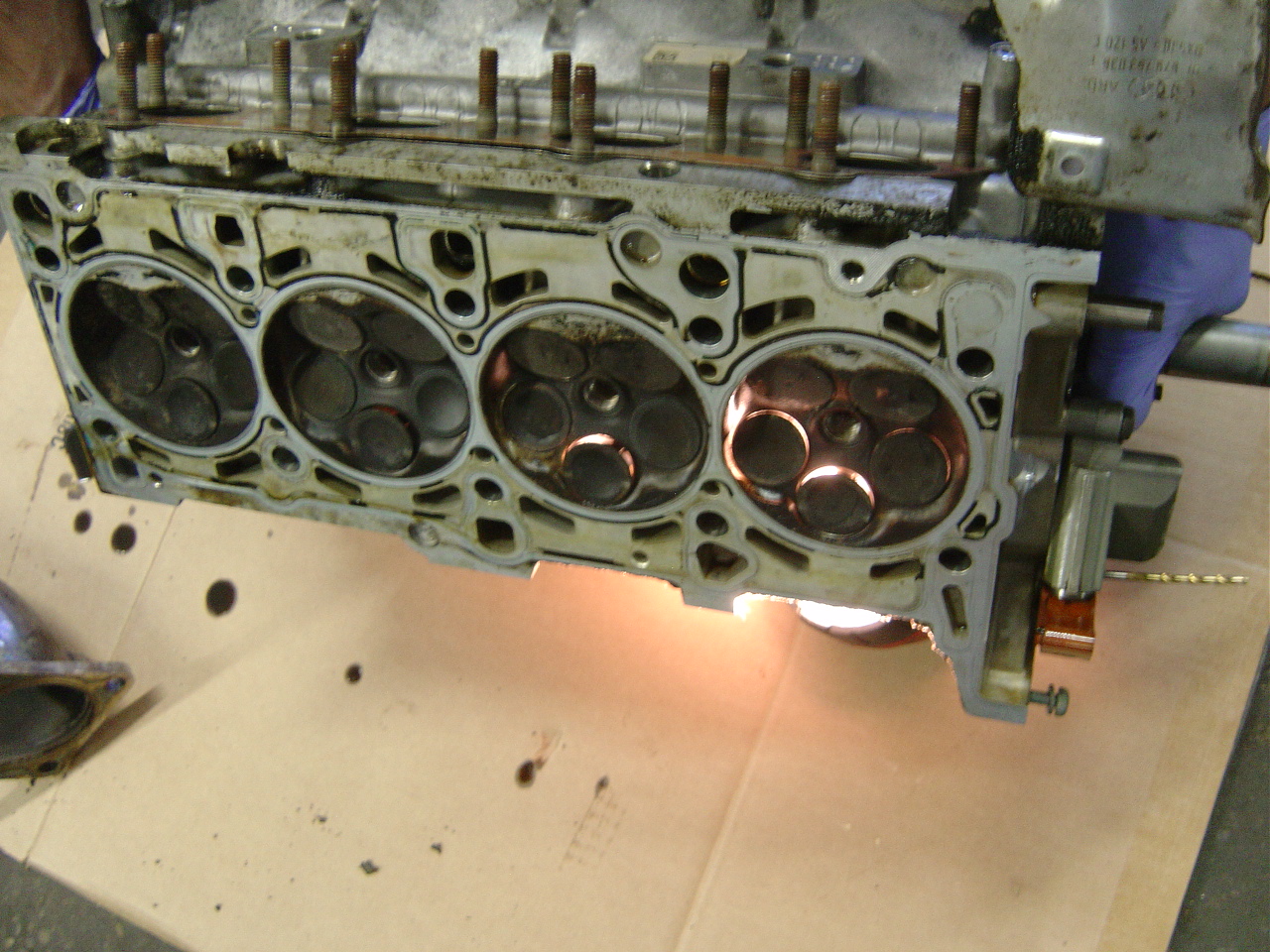
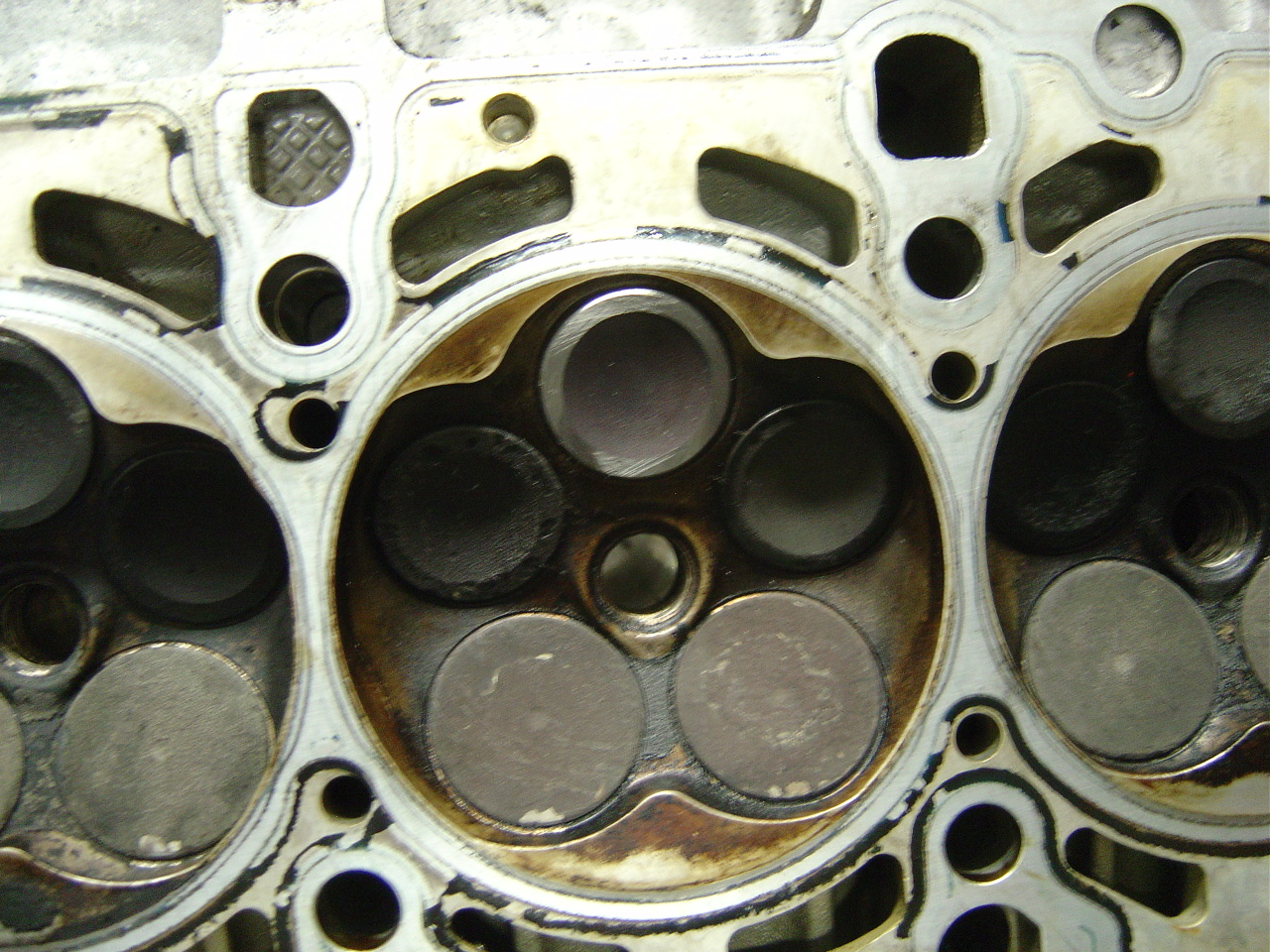
Pic of the head, btw:


3613588824_3974949655_o.jpg


4107928625_4db3d94ee6_o.jpg
 
been a long time since I've seen one of those. One fantastic flowing head, but the leak down must be killer after a few miles!

The plug location is a perfect one. I seriously doubt there's any real difference between the plugs you described.
 
The location of the spark gap in the combustion chamber has a large influence on how the ignition kernel starts and propagates within the combustion chamber. This affects power & emissions. My guess is that with the symmetrical chamber on my engine and the plug located in the center, there is some benefit having the gap further into the chamber.

Steve, pre-ignition is caused by a plug with a temp range that is too hot or ignition timing too advanced. That's what testing is for. :-)
 
Originally Posted By: dparm
My OE plug is FGR7KQE0. But Bosch also lists FGR7DQP as an "OEM equivalent" (a commonly available platinum one). The differences, from what I decipher in their part number guide, are that the OE plug is non-platinum and has a 1mm taller electrode. I also don't know what the trailing 0 is for the OE plug, perhaps just that it is a custom plug.

What benefit would it have to make the electrode 1mm taller for the OE plug? I doubt that Bosch and Audi did this without cause. Perhaps testing showed better performance or emissions?

NGK was the other OE plug, part BKR6EQUA. The "OEM equivalent" is listed as BKR6EQUP (again a more mainstream platinum version). They make no mention of electrode position in their part number deciphering guide. The trailing A simply denotes a custom design, much like Bosch. Not sure in what way it is custom.

The 1 mm protrude normally enables better power due to the combustion concentrated nearer to the piston top and the plug will experience hotter temperature on the application.
Denso in the past always recommend taller plug for Honda engine in Asia (IK20L rather than IK20), however not sure if this also require higher octane to run optimally.
 
The tip of the plug will vary in operating temp as it is shrouded or unshrouded by the head casting itself. I have never seen any power changes other than the increased timing we could sometimes run on an engine with the plug indexed further into the head.

But few of us ever saw that many valves in the head, either!
 
Originally Posted By: SteveSRT8
OMG, you said Bosch Plus 4!

Here comes the thundering herd!


There were (are still??) Bosch plugs in copper (also silver?) with 3 (and I believe even some with 4) ground electrodes to fit older VW 8 & 16 valve engines.
 
Originally Posted By: mechtech2
Unless there are clearance problems, the longer plugs would be my preference, every time.


That's a common misconception. While it seems like a sound idea there are a ton of variables here.

In very high performance apps I have personally seen improvements in resistance to preignition by indexing the plug back closer to the head or even recessing it a bit. I'm talking several more degrees of timing.

If you have a head design susceptible to preignition/detonation having the plug jutting out further is sometimes not a good idea. But you can't simply say one way is better than the other without some dyno time/testing on your particular head design.
 
Most engine developers now use laser scanning of the combustion process to see exactly what happens. Then they play optimizing games. Generally, the combustion chamber design is optimized with some assumption about the plug location. Once they have the head design, then they tweak the plug location a bit to see if there is any improvement. This is usually minimal anyway, according to my father (used to work in spark plugs for Bosch).


Again, it still stands that Audi had a special 1mm longer version installed. I doubt it was arbitrary. But they do say the off-the-shelf one is acceptable too.
 
Last edited:
Originally Posted By: SteveSRT8
Originally Posted By: mechtech2
Unless there are clearance problems, the longer plugs would be my preference, every time.


That's a common misconception. While it seems like a sound idea there are a ton of variables here.

In very high performance apps I have personally seen improvements in resistance to preignition by indexing the plug back closer to the head or even recessing it a bit. I'm talking several more degrees of timing.

If you have a head design susceptible to preignition/detonation having the plug jutting out further is sometimes not a good idea. But you can't simply say one way is better than the other without some dyno time/testing on your particular head design.


This is my point. With better combustion, you should retard the over advanced timing. it is much better to get your combustion right, and use less advance. Why stay married to ineffectual advance curves??
 
Then the situation is this: the OEM ones are not eligible for the current rebate and cost more. They're not platinum either (yttrium nickel), though I change often enough that it's probably not an issue.

It's basically $50ish for all 8 of the OEM after coupons and whatever, or about $25ish for the OEM "equivalent" because you're getting $8 back.
 
Status
Not open for further replies.
Back
Top Bottom