Specs such as crankshaft to bearing clearance has not changed in 70 yrs

You are using an out of date browser. It may not display this or other websites correctly.
You should upgrade or use an alternative browser.
You should upgrade or use an alternative browser.
(0w-20) - I can't believe I'm saying this...
- Thread starter tpattgeek
- Start date

- Status
- Not open for further replies.

OVERKILL
$100 Site Donor 2021
Originally Posted By: Gokhan
Originally Posted By: OVERK1LL
Not always. Mobil 1 0w40 has a NOACK of 8.8%, which is incredibly low by anybody's standard, and especially for an oil with such a spread to it!
Sounds like Mobil 1 0W-40 is a mostly PAO-based oil. Impressive NOACK, but that's how PAO-based oils (such as Amsoil Signature Line) are. Mobil 1 0W-40 seems to be a great oil if you're comfortable with its high HTHS viscosity or if your engine requires high HTHS viscosity. It has great ZDDP, moly, and initial TBN as well.
But then I said "within a given oil line." I wouldn't consider Mobil 1 0W-40, which is a high-HTHS-viscosity oil, in the same line as Mobil 1 0W-20 and 0w30 and expect all their NOACK to be similar. Chances are that 0W-20 and 0w30 have a lot of Group III in the mix and have NOACK around 12%.
Fair enough, but with an MRV of 9,200 at -40C, that points to the 0w20 NOT having a lot of GIII in it

I'll contact Mobil and see if they'll give me the NOACK for them.
Originally Posted By: OVERK1LL
Not always. Mobil 1 0w40 has a NOACK of 8.8%, which is incredibly low by anybody's standard, and especially for an oil with such a spread to it!
Sounds like Mobil 1 0W-40 is a mostly PAO-based oil. Impressive NOACK, but that's how PAO-based oils (such as Amsoil Signature Line) are. Mobil 1 0W-40 seems to be a great oil if you're comfortable with its high HTHS viscosity or if your engine requires high HTHS viscosity. It has great ZDDP, moly, and initial TBN as well.
But then I said "within a given oil line." I wouldn't consider Mobil 1 0W-40, which is a high-HTHS-viscosity oil, in the same line as Mobil 1 0W-20 and 0w30 and expect all their NOACK to be similar. Chances are that 0W-20 and 0w30 have a lot of Group III in the mix and have NOACK around 12%.
Fair enough, but with an MRV of 9,200 at -40C, that points to the 0w20 NOT having a lot of GIII in it
I'll contact Mobil and see if they'll give me the NOACK for them.
Originally Posted By: OVERK1LL
Fair enough, but with an MRV of 9,200 at -40C, that points to the 0w20 NOT having a lot of GIII in it :grin
Ah, if that's the case, it's more than likely mostly PAO.
NOACK and MRV are inversely proportional to each other for a given type of basestock (such as PAO). If a PAO basestock has low NOACK, it has (relatively) high MRV and if it has low MRV, it has (relatively) high NOACK. I personally would prefer a PAO basestock with low NOACK rather than low MRV. That's because NOACK is what ultimately determines the quality of a basestock (how long it takes for the oil to cook under use), unless you demand cold starting in extremely cold temperatures.
Fair enough, but with an MRV of 9,200 at -40C, that points to the 0w20 NOT having a lot of GIII in it :grin
Ah, if that's the case, it's more than likely mostly PAO.
NOACK and MRV are inversely proportional to each other for a given type of basestock (such as PAO). If a PAO basestock has low NOACK, it has (relatively) high MRV and if it has low MRV, it has (relatively) high NOACK. I personally would prefer a PAO basestock with low NOACK rather than low MRV. That's because NOACK is what ultimately determines the quality of a basestock (how long it takes for the oil to cook under use), unless you demand cold starting in extremely cold temperatures.
OVERKILL
$100 Site Donor 2021
Originally Posted By: Gokhan
Originally Posted By: OVERK1LL
Fair enough, but with an MRV of 9,200 at -40C, that points to the 0w20 NOT having a lot of GIII in it :grin
Ah, if that's the case, it's more than likely that it's mostly PAO.
NOACK and MRV are inversely proportional to each other for a given basestock (such as PAO). If a PAO basestock has low NOACK, it has (relatively) high MRV and if it has low MRV, it has (relatively) high NOACK. I personally would prefer a PAO basestock with low NOACK rather than low MRV. That's because NOACK is what determines the quality of a basestock (how long it takes for the oil to cook under use) unless you demand cold starting in extremely cold temperatures.
Yes, I'm quite sure it is geared toward cold start performance given the advertised claims about it.
I've fired Imperial Oil off an e-mail regarding NOACK for both the AFE grades, so I'll let you know what I hear back.
Originally Posted By: OVERK1LL
Fair enough, but with an MRV of 9,200 at -40C, that points to the 0w20 NOT having a lot of GIII in it :grin
Ah, if that's the case, it's more than likely that it's mostly PAO.
NOACK and MRV are inversely proportional to each other for a given basestock (such as PAO). If a PAO basestock has low NOACK, it has (relatively) high MRV and if it has low MRV, it has (relatively) high NOACK. I personally would prefer a PAO basestock with low NOACK rather than low MRV. That's because NOACK is what determines the quality of a basestock (how long it takes for the oil to cook under use) unless you demand cold starting in extremely cold temperatures.
Yes, I'm quite sure it is geared toward cold start performance given the advertised claims about it.
I've fired Imperial Oil off an e-mail regarding NOACK for both the AFE grades, so I'll let you know what I hear back.
Originally Posted By: Gokhan
Originally Posted By: OVERK1LL
Fair enough, but with an MRV of 9,200 at -40C, that points to the 0w20 NOT having a lot of GIII in it :grin
Ah, if that's the case, it's more than likely mostly PAO.
NOACK and MRV are inversely proportional to each other for a given type of basestock (such as PAO). If a PAO basestock has low NOACK, it has (relatively) high MRV and if it has low MRV, it has (relatively) high NOACK. I personally would prefer a PAO basestock with low NOACK rather than low MRV. That's because NOACK is what ultimately determines the quality of a basestock (how long it takes for the oil to cook under use), unless you demand cold starting in extremely cold temperatures.
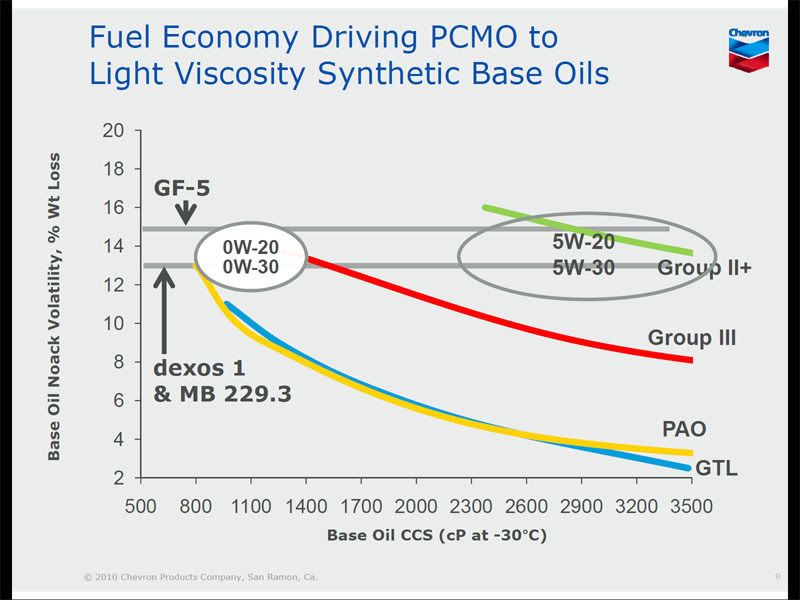
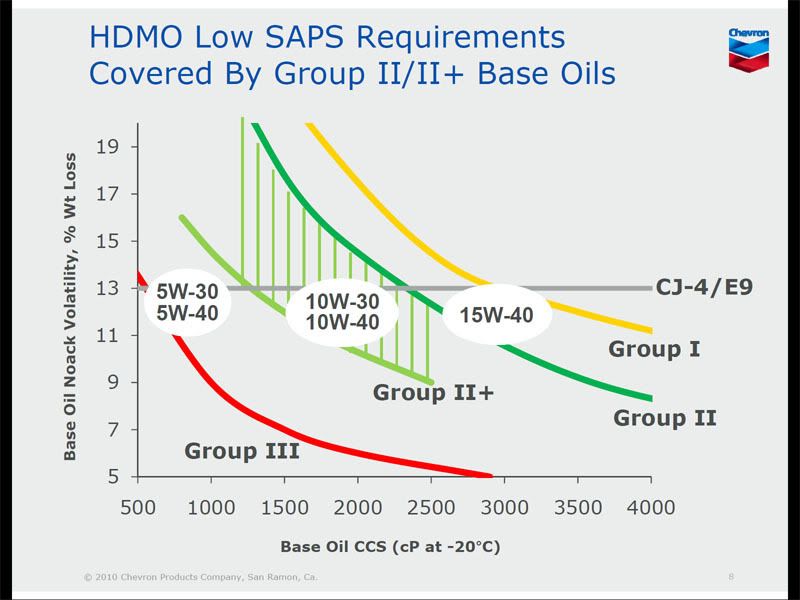
By the way, here's the graphic illustration of this point, from the API Chevron reference on quality of oil basestocks. As you see in the graphs, for a given type of basestock (such as PAO), NOACK volatility and cold-cranking viscosity are inversely related. Therefore, if you pick up a PAO basestock with a very low cold-cranking viscosity, you sacrifice the NOACK volatility:
Originally Posted By: OVERK1LL
Fair enough, but with an MRV of 9,200 at -40C, that points to the 0w20 NOT having a lot of GIII in it :grin
Ah, if that's the case, it's more than likely mostly PAO.
NOACK and MRV are inversely proportional to each other for a given type of basestock (such as PAO). If a PAO basestock has low NOACK, it has (relatively) high MRV and if it has low MRV, it has (relatively) high NOACK. I personally would prefer a PAO basestock with low NOACK rather than low MRV. That's because NOACK is what ultimately determines the quality of a basestock (how long it takes for the oil to cook under use), unless you demand cold starting in extremely cold temperatures.
By the way, here's the graphic illustration of this point, from the API Chevron reference on quality of oil basestocks. As you see in the graphs, for a given type of basestock (such as PAO), NOACK volatility and cold-cranking viscosity are inversely related. Therefore, if you pick up a PAO basestock with a very low cold-cranking viscosity, you sacrifice the NOACK volatility:
OVERKILL
$100 Site Donor 2021
Those charts are great! Thank you


Originally Posted By: tpattgeek
When I mentioned I switched to 0w-20 a couple of years ago, he said that could definitely make it noisier. He said it obviously won't affect or damage anything, but he did recommend going back to 5w-20. He said the newer model Civics that actually call for 0w-20 have "tightened up" specs, and that the older ones (e.g. 2007) are designed for 5w-20.
If an engine in a 2006-2009 Civic, which has THE SAME ENGINE / engine code as a 2011+ Civic can't be "back spec'd" to use 0w20, what hope is there for all the older engine's dating back into the 1999s which have now been back spec'd to use 5w20s, etc?

Those engine's weren't designed for THINNER oils, yet the manufacturers say it's ok to use it, yet a newer Civic can't go to a 0w20 from a 5w20, which is essentially THE SAME VISCOSITY?!
I'm so lost...
For the record, i've used 0w20 in my 07 Civic EX during this past winter and didn't notice any increased engine noise. Used 0w30 prior to that and did notice quieter engine operation once it warmed up vs the 20 grade

When I mentioned I switched to 0w-20 a couple of years ago, he said that could definitely make it noisier. He said it obviously won't affect or damage anything, but he did recommend going back to 5w-20. He said the newer model Civics that actually call for 0w-20 have "tightened up" specs, and that the older ones (e.g. 2007) are designed for 5w-20.
If an engine in a 2006-2009 Civic, which has THE SAME ENGINE / engine code as a 2011+ Civic can't be "back spec'd" to use 0w20, what hope is there for all the older engine's dating back into the 1999s which have now been back spec'd to use 5w20s, etc?
Those engine's weren't designed for THINNER oils, yet the manufacturers say it's ok to use it, yet a newer Civic can't go to a 0w20 from a 5w20, which is essentially THE SAME VISCOSITY?!
I'm so lost...
For the record, i've used 0w20 in my 07 Civic EX during this past winter and didn't notice any increased engine noise. Used 0w30 prior to that and did notice quieter engine operation once it warmed up vs the 20 grade


0w20 is a great diagnostic tool for bad gaskets, seals and valve clearance issues.
Originally Posted By: Gokhan
Originally Posted By: OVERK1LL
That's because NOACK is what ultimately determines the quality of a basestock (how long it takes for the oil to cook under use), unless you demand cold starting in extremely cold temperatures.
NOACK is one factor than determines the quality of a base oil but an oil's natural VI is ultimately more important. The fact is the two attributes tend to go hand in hand.
The recent move to 0W-20 oils by the Japanese OEM's has nothing to do with extreme cold performance but rather a very low start-up viscosity at more typical start-up temp's. To an engine even 80F is a cold start. I explained further in the following thread:
http://www.bobistheoilguy.com/forums/ubb...212#Post2545212
Originally Posted By: OVERK1LL
That's because NOACK is what ultimately determines the quality of a basestock (how long it takes for the oil to cook under use), unless you demand cold starting in extremely cold temperatures.
NOACK is one factor than determines the quality of a base oil but an oil's natural VI is ultimately more important. The fact is the two attributes tend to go hand in hand.
The recent move to 0W-20 oils by the Japanese OEM's has nothing to do with extreme cold performance but rather a very low start-up viscosity at more typical start-up temp's. To an engine even 80F is a cold start. I explained further in the following thread:
http://www.bobistheoilguy.com/forums/ubb...212#Post2545212
I think you're way over-thinking this-just adjust the valves and the noise will almost certainly go away. I don't buy the 120k adjustment any more than I buy lifetime fluids on some transmissions... I think it's an attempt to make the vehicle seem more"maintenance free".
I did a valve adjustment on a 2003 CR-V with 60k miles on the clock, and most of them needed adjustment. It quieted down things considerably. It's my guess that's what you have going on.
I did a valve adjustment on a 2003 CR-V with 60k miles on the clock, and most of them needed adjustment. It quieted down things considerably. It's my guess that's what you have going on.
Originally Posted By: LeakySeals
0w20 is a great diagnostic tool for bad gaskets, seals and valve clearance issues.
..really? If one begins to leak on it = near gone?
By the way, the OM states to adjust the valve-lash every 15,000 miles on the VX.

0w20 is a great diagnostic tool for bad gaskets, seals and valve clearance issues.
..really? If one begins to leak on it = near gone?
By the way, the OM states to adjust the valve-lash every 15,000 miles on the VX.
Sure. everything is always good when you bring your car in for warranty service to the stealer.
wait until after your warranty expires then everything will need repairing.
Take your car to a trusted engine shop and let them tell you what that noise is. Sometimes we cant tell either but most engine shops will be honest
wait until after your warranty expires then everything will need repairing.
Take your car to a trusted engine shop and let them tell you what that noise is. Sometimes we cant tell either but most engine shops will be honest
Originally Posted By: ltslimjim
Originally Posted By: LeakySeals
0w20 is a great diagnostic tool for bad gaskets, seals and valve clearance issues.
..really? If one begins to leak on it = near gone?
By the way, the OM states to adjust the valve-lash every 15,000 miles on the VX.
That`s a friggin PITA!
Originally Posted By: LeakySeals
0w20 is a great diagnostic tool for bad gaskets, seals and valve clearance issues.
..really? If one begins to leak on it = near gone?
By the way, the OM states to adjust the valve-lash every 15,000 miles on the VX.
That`s a friggin PITA!
Last edited:
Originally Posted By: ltslimjim
Originally Posted By: LeakySeals
0w20 is a great diagnostic tool for bad gaskets, seals and valve clearance issues.
..really? If one begins to leak on it = near gone?
Really..try a run. No, it = dont use.
Originally Posted By: LeakySeals
0w20 is a great diagnostic tool for bad gaskets, seals and valve clearance issues.
..really? If one begins to leak on it = near gone?
Really..try a run. No, it = dont use.
Originally Posted By: tpattgeek
... When I mentioned I switched to 0w-20 a couple of years ago, he said that could definitely make it noisier. He said it obviously won't affect or damage anything, but he did recommend going back to 5w-20. He said the newer model Civics that actually call for 0w-20 have "tightened up" specs, and that the older ones (e.g. 2007) are designed for 5w-20.
That doesn't make sense. A 0W-20 is the same when hot as a 5W-20 oil.
... When I mentioned I switched to 0w-20 a couple of years ago, he said that could definitely make it noisier. He said it obviously won't affect or damage anything, but he did recommend going back to 5w-20. He said the newer model Civics that actually call for 0w-20 have "tightened up" specs, and that the older ones (e.g. 2007) are designed for 5w-20.
That doesn't make sense. A 0W-20 is the same when hot as a 5W-20 oil.
Most newer engines have tighter specs than years ago but in your case i dont think that is the problem
Originally Posted By: CATERHAM
Originally Posted By: Gokhan
Originally Posted By: OVERK1LL
That's because NOACK is what ultimately determines the quality of a basestock (how long it takes for the oil to cook under use), unless you demand cold starting in extremely cold temperatures.
NOACK is one factor than determines the quality of a base oil but an oil's natural VI is ultimately more important. The fact is the two attributes tend to go hand in hand.
The recent move to 0W-20 oils by the Japanese OEM's has nothing to do with extreme cold performance but rather a very low start-up viscosity at more typical start-up temp's. To an engine even 80F is a cold start. I explained further in the following thread:
http://www.bobistheoilguy.com/forums/ubb...212#Post2545212
Caterham: have you found, used, tested any Sustina product yet?
Originally Posted By: Gokhan
Originally Posted By: OVERK1LL
That's because NOACK is what ultimately determines the quality of a basestock (how long it takes for the oil to cook under use), unless you demand cold starting in extremely cold temperatures.
NOACK is one factor than determines the quality of a base oil but an oil's natural VI is ultimately more important. The fact is the two attributes tend to go hand in hand.
The recent move to 0W-20 oils by the Japanese OEM's has nothing to do with extreme cold performance but rather a very low start-up viscosity at more typical start-up temp's. To an engine even 80F is a cold start. I explained further in the following thread:
http://www.bobistheoilguy.com/forums/ubb...212#Post2545212
Caterham: have you found, used, tested any Sustina product yet?
- Status
- Not open for further replies.
Similar threads
- Locked
- Replies
- 197
- Views
- 8K

- Replies
- 122
- Views
- 4K
- Replies
- 10
- Views
- 1K

- Replies
- 88
- Views
- 2K
