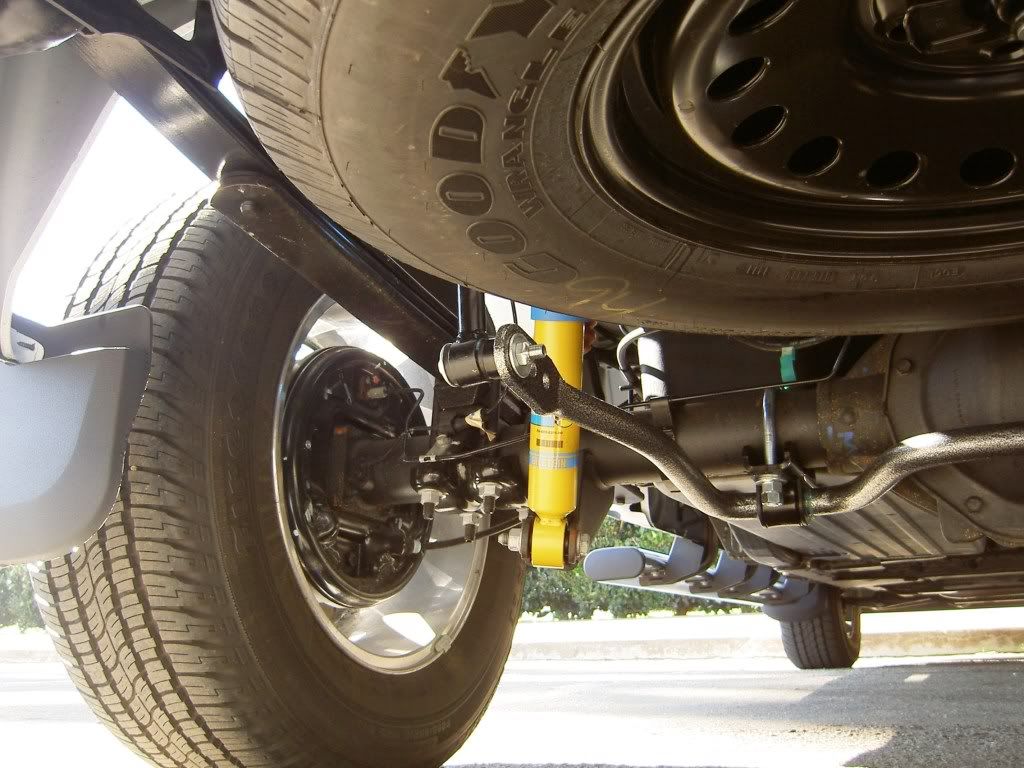
I installed a Tahoe/Suburban rear swaybar on my Silverado for real cheap and it makes a world of difference when cornering or when on freeway off/on ramps. I've been driving various pickups for several years and I hate the excessive body roll having to slow down excessively on turns or highway ramps. It's the first time I've installed one on a pickup since GM SUV parts can be swapped over to a pickup and be obtained cheap from the junkyard (aside having to do a few modifications.) SUV's have them to combat excessive body roll due to being heavier and a high center of gravity. If carrying heavy loads in a pickup it would be beneficial to have a rear sway bar for stability. On the previous trucks I've always fought the thought to install a rear swaybar but were too cost prohibitive.

You are using an out of date browser. It may not display this or other websites correctly.
You should upgrade or use an alternative browser.
You should upgrade or use an alternative browser.
Why don't pickup trucks have rear swaybars?
- Thread starter wirelessF
- Start date
- Status
- Not open for further replies.
Originally Posted By: Srt20
Some do
You stole my response.
Some do
You stole my response.
wirelessF
Thread starter
Originally Posted By: Srt20
Some do
I've seen some on some Ford Superdutys and even some Ford Rangers. I haven't seen one OE equipped on half-tons or quarter-tons.
Some do
I've seen some on some Ford Superdutys and even some Ford Rangers. I haven't seen one OE equipped on half-tons or quarter-tons.

Standard equipment on the Ram 1500's.
Ed
Ed
I've seen OE rear anti-roll bars on 1/2 ton Dodge Hemi variants about the size of my pinky.
Quick and inexpensive to fit an aftermarket (e.g., hellwig) rear bar to any pickup.
Dramatically improved chassis dynamics and crosswind stability imho.

Quick and inexpensive to fit an aftermarket (e.g., hellwig) rear bar to any pickup.
Dramatically improved chassis dynamics and crosswind stability imho.
If they didn't come OEM with them like on my Dodge 1500, I add them quick. Funny the 2wd 73-87 GM duallies had them, but the 4wd did not. It wasnt hard to swap one to my 84 K-30, just had to make longer end links. I got a Hellwig kit for my 2002 4wd GM dually. They do make a world of difference, especially when loaded up.
Adding a sway bar is a wonderful upgrade, but a bit tricky to optimize the ride quality versus the reduction of body roll.
It can drastically change the behavior of any vehicle without one, and it goes both ways. I for one am a bit skeptical of the aftermarket, but I do know of some friend's vehicles with a competent and effective rear sway bar addition.
BTW, it was standard on my Ram 1500...
It can drastically change the behavior of any vehicle without one, and it goes both ways. I for one am a bit skeptical of the aftermarket, but I do know of some friend's vehicles with a competent and effective rear sway bar addition.
BTW, it was standard on my Ram 1500...

You have to look at how the suspension is supposed to work in the first instance.
When I started playing with cars in the 80s, they were late 65s, early 70s sedans with IFS, live rear axles, and no bars. Sway bars always made them better...playing bar diameters was an easy way of moving over/understeer.
Could be done with clever springs.
As I moved into late 70s stuff, they came with bars, which left me a choice of increasing spring rates, or increasing bar rates...My preference was softer springs and more bar (one of my Toranas, I kept the stock spring rates, and went from 18mm front to 26mm, 12mm rear to 22...was wicked on corrugated dirt roads, but turned so well)
Bars, as has been mentioned make for poor articulation in trucks...in the last mentioned Torana, I would get crossed up and wheel spinning in friend's driveways when they were that artistic looking steep spiral down to a change of direction, slight up, and onto a flat parking surface...the bar would unload the inside wheel.
Which is why light trucks don't have them...they need articulation, and need both wheels loaded to provide traction.
But, and there's always a but, when you look at a cement truck, they are narrow wheelbase, very very high CoG...and have a massive rear anti roll bar, to stop the lean and sway.
My Nissna has a coathanger front bar, and big leaf springs (rated to a tonne carry), and is very predictable. I don't think I want more bar, nor want to add one to the back.
If I permanently affixed a rooftop tent, and other high loads, I would be tempted to emulate the cement truck and add bar for the highway, but would lose articulation to the camping areas.
When I started playing with cars in the 80s, they were late 65s, early 70s sedans with IFS, live rear axles, and no bars. Sway bars always made them better...playing bar diameters was an easy way of moving over/understeer.
Could be done with clever springs.
As I moved into late 70s stuff, they came with bars, which left me a choice of increasing spring rates, or increasing bar rates...My preference was softer springs and more bar (one of my Toranas, I kept the stock spring rates, and went from 18mm front to 26mm, 12mm rear to 22...was wicked on corrugated dirt roads, but turned so well)
Bars, as has been mentioned make for poor articulation in trucks...in the last mentioned Torana, I would get crossed up and wheel spinning in friend's driveways when they were that artistic looking steep spiral down to a change of direction, slight up, and onto a flat parking surface...the bar would unload the inside wheel.
Which is why light trucks don't have them...they need articulation, and need both wheels loaded to provide traction.
But, and there's always a but, when you look at a cement truck, they are narrow wheelbase, very very high CoG...and have a massive rear anti roll bar, to stop the lean and sway.
My Nissna has a coathanger front bar, and big leaf springs (rated to a tonne carry), and is very predictable. I don't think I want more bar, nor want to add one to the back.
If I permanently affixed a rooftop tent, and other high loads, I would be tempted to emulate the cement truck and add bar for the highway, but would lose articulation to the camping areas.

Originally Posted By: splinter
I've seen OE rear anti-roll bars on 1/2 ton Dodge Hemi variants about the size of my pinky.
Quick and inexpensive to fit an aftermarket (e.g., hellwig) rear bar to any pickup.
Dramatically improved chassis dynamics and crosswind stability imho.
Don't you wish they could stay nice and clean like that all the time?
I've seen OE rear anti-roll bars on 1/2 ton Dodge Hemi variants about the size of my pinky.
Quick and inexpensive to fit an aftermarket (e.g., hellwig) rear bar to any pickup.
Dramatically improved chassis dynamics and crosswind stability imho.
Don't you wish they could stay nice and clean like that all the time?
gathermewool
Site Donor 2025
Originally Posted By: Shannow
You have to look at how the suspension is supposed to work in the first instance.
When I started playing with cars in the 80s, they were late 65s, early 70s sedans with IFS, live rear axles, and no bars. Sway bars always made them better...playing bar diameters was an easy way of moving over/understeer.
Could be done with clever springs.
As I moved into late 70s stuff, they came with bars, which left me a choice of increasing spring rates, or increasing bar rates...My preference was softer springs and more bar (one of my Toranas, I kept the stock spring rates, and went from 18mm front to 26mm, 12mm rear to 22...was wicked on corrugated dirt roads, but turned so well)
Bars, as has been mentioned make for poor articulation in trucks...in the last mentioned Torana, I would get crossed up and wheel spinning in friend's driveways when they were that artistic looking steep spiral down to a change of direction, slight up, and onto a flat parking surface...the bar would unload the inside wheel.
Which is why light trucks don't have them...they need articulation, and need both wheels loaded to provide traction.
But, and there's always a but, when you look at a cement truck, they are narrow wheelbase, very very high CoG...and have a massive rear anti roll bar, to stop the lean and sway.
My Nissna has a coathanger front bar, and big leaf springs (rated to a tonne carry), and is very predictable. I don't think I want more bar, nor want to add one to the back.
If I permanently affixed a rooftop tent, and other high loads, I would be tempted to emulate the cement truck and add bar for the highway, but would lose articulation to the camping areas.
I'll second this post and highlight two important parts:
1. Stability: stiffening the rear by adding a sway bar will effectively transfer overall grip to the front of the vehicle, making it more prone to oversteer, which, in the manufacturer's mind (and probably when it comes to a lot of drivers) provides for an unacceptable risk of unpredictable oversteer compared to stock understeer.
It does make the car feel better and, if done right for an application, can make the car feel more neutral, if that what you're going for, or tail-happy, if you're after that instead.
2. Independent suspension: a sway bar ties the left and right side together, so the on inclines at an angle or while going through ruts, etc., you're more likely to lift a wheel and possibly lose all traction.
You have to look at how the suspension is supposed to work in the first instance.
When I started playing with cars in the 80s, they were late 65s, early 70s sedans with IFS, live rear axles, and no bars. Sway bars always made them better...playing bar diameters was an easy way of moving over/understeer.
Could be done with clever springs.
As I moved into late 70s stuff, they came with bars, which left me a choice of increasing spring rates, or increasing bar rates...My preference was softer springs and more bar (one of my Toranas, I kept the stock spring rates, and went from 18mm front to 26mm, 12mm rear to 22...was wicked on corrugated dirt roads, but turned so well)
Bars, as has been mentioned make for poor articulation in trucks...in the last mentioned Torana, I would get crossed up and wheel spinning in friend's driveways when they were that artistic looking steep spiral down to a change of direction, slight up, and onto a flat parking surface...the bar would unload the inside wheel.
Which is why light trucks don't have them...they need articulation, and need both wheels loaded to provide traction.
But, and there's always a but, when you look at a cement truck, they are narrow wheelbase, very very high CoG...and have a massive rear anti roll bar, to stop the lean and sway.
My Nissna has a coathanger front bar, and big leaf springs (rated to a tonne carry), and is very predictable. I don't think I want more bar, nor want to add one to the back.
If I permanently affixed a rooftop tent, and other high loads, I would be tempted to emulate the cement truck and add bar for the highway, but would lose articulation to the camping areas.
I'll second this post and highlight two important parts:
1. Stability: stiffening the rear by adding a sway bar will effectively transfer overall grip to the front of the vehicle, making it more prone to oversteer, which, in the manufacturer's mind (and probably when it comes to a lot of drivers) provides for an unacceptable risk of unpredictable oversteer compared to stock understeer.
It does make the car feel better and, if done right for an application, can make the car feel more neutral, if that what you're going for, or tail-happy, if you're after that instead.
2. Independent suspension: a sway bar ties the left and right side together, so the on inclines at an angle or while going through ruts, etc., you're more likely to lift a wheel and possibly lose all traction.
My F-350 has one. So did my old F-150.
Originally Posted By: KD0AXS
My F-350 has one. So did my old F-150.
Strange - our 01 F350 4x4 with the heavy service rear suspension does not have a rear sway bar. Leaf springs are so stiff anyway ...
Originally Posted By: SteveSRT8
BTW, it was standard on my Ram 1500...
I think it would have to have one in order to avoid excessive body roll. You can get by without one with rear leaves, but on rear coils .. especially with a pickup ... I wouldn't want to not have a rear sway bar. I didn't like the way my Focus handled from the factory without the rear swaybar. Added a rear swaybar and it completely transformed the car.
Originally Posted By: horse123
You don't want a sway bar when you're trying to get traction off road.
When my father bought the F350, it kept getting stuck in the dirt parking lot where he worked. Even with a good set of studded tires, it would drop in a pot hole and that was that. He would disconnect the front (only) swaybar and it worked pretty well. What was funny was when he would bring it to the dealer to have it serviced they would replace the endlink bolt under warranty.
My F-350 has one. So did my old F-150.
Strange - our 01 F350 4x4 with the heavy service rear suspension does not have a rear sway bar. Leaf springs are so stiff anyway ...
Originally Posted By: SteveSRT8
BTW, it was standard on my Ram 1500...
I think it would have to have one in order to avoid excessive body roll. You can get by without one with rear leaves, but on rear coils .. especially with a pickup ... I wouldn't want to not have a rear sway bar. I didn't like the way my Focus handled from the factory without the rear swaybar. Added a rear swaybar and it completely transformed the car.
Originally Posted By: horse123
You don't want a sway bar when you're trying to get traction off road.
When my father bought the F350, it kept getting stuck in the dirt parking lot where he worked. Even with a good set of studded tires, it would drop in a pot hole and that was that. He would disconnect the front (only) swaybar and it worked pretty well. What was funny was when he would bring it to the dealer to have it serviced they would replace the endlink bolt under warranty.

I added a big rear bar to a 90 454SS truck I had years ago. While it did make the truck corner flatter, it did add greatly to chassis twist, making the truck jiggle over bumps. Roll center height comes into play too. Suspension designs with a high roll center really don't need a bar. You won't see a rear bar on a lot of race cars.
Last edited:
Originally Posted By: Miller88
Originally Posted By: KD0AXS
My F-350 has one. So did my old F-150.
Strange - our 01 F350 4x4 with the heavy service rear suspension does not have a rear sway bar. Leaf springs are so stiff anyway ...
Mine was the previous generation, a 1993. I think it had some sort of heavy suspension package. Along with the rear sway bar, it also had the dual shock suspension in the front.
Originally Posted By: KD0AXS
My F-350 has one. So did my old F-150.
Strange - our 01 F350 4x4 with the heavy service rear suspension does not have a rear sway bar. Leaf springs are so stiff anyway ...
Mine was the previous generation, a 1993. I think it had some sort of heavy suspension package. Along with the rear sway bar, it also had the dual shock suspension in the front.
Originally Posted By: wirelessF
Originally Posted By: Srt20
Some do
I've seen some on some Ford Superdutys and even some Ford Rangers. I haven't seen one OE equipped on half-tons or quarter-tons.
My Dakota has one. I think it was included with the towing package.
Originally Posted By: Srt20
Some do
I've seen some on some Ford Superdutys and even some Ford Rangers. I haven't seen one OE equipped on half-tons or quarter-tons.
My Dakota has one. I think it was included with the towing package.
- Status
- Not open for further replies.
Similar threads

- Replies
- 59
- Views
- 3K
- Replies
- 44
- Views
- 7K
- Replies
- 46
- Views
- 14K