Ultra vs new Platinum MSDS

Status
Not open for further replies.
Joined
Oct 16, 2010
Messages
2,525
Location
.
I previously posted this comment is what may now be a dead thread (or maybe it just wasn't interesting enough to warrant much comment), but I thought it was worth putting out there again.

The Feb 2014 MSDS for the new Platinum and the new Ultra Platinum describes product composition as follows (for 5w20, at least):

Ultra Platinum: Fischer-Tropsch derived base oil
Platinum: Synthetic esters, polyolefin (PAO?) and additives

We know both are made from natural gas, and like many, I assumed by all GTL was Fischer-Tropsch. But maybe Platinum results from a new, non Fischer-Tropsch process.

So Ultra looks as it did before the rebranding. But Platinum now looks to be an ester/PAO blend. Is Platinum taking us back to the good old days of true synthetics when real men only used ester/PAO based oils? But despite this apparent pedigree it is still not up to the Fischer-Tropsch standards, at least according to Pennzoil's marketing hierarchy? Despite what I'm sure is tons of Pennzoil internal testing, is Platinum so different that we should be wary of it pending real-world experience?
 
Originally Posted By: Danh
But Platinum now looks to be an ester/PAO blend.

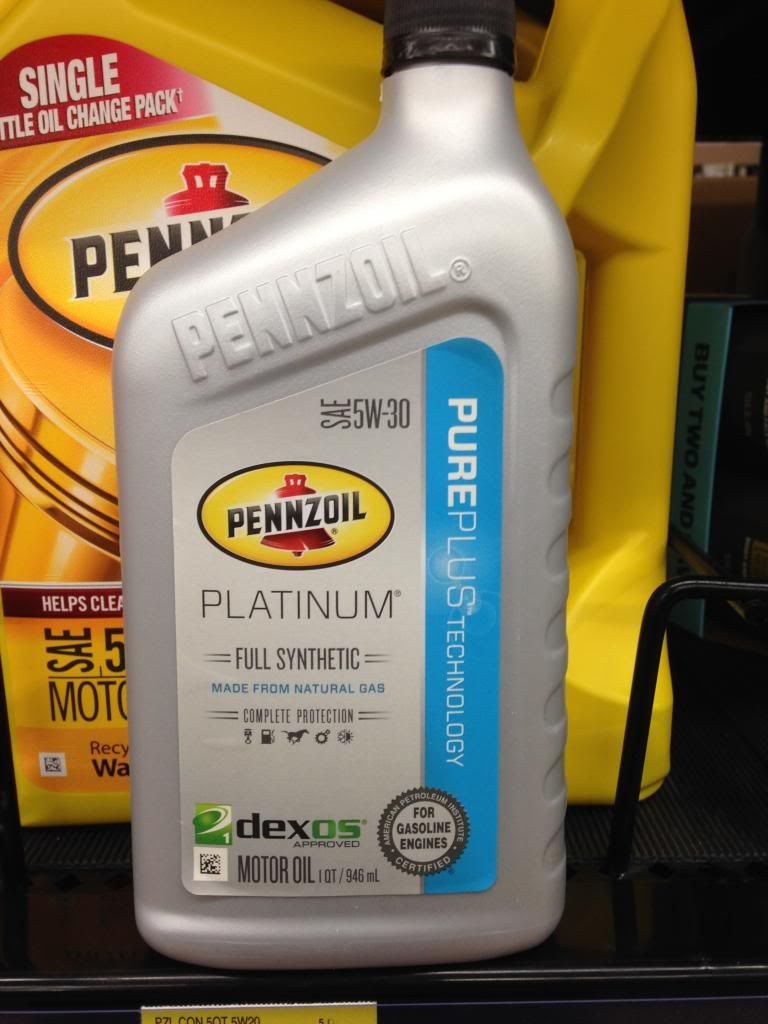
This would be in direct contradiction to what the new Platinum bottle label says - "Made from natural gas".

penz1_zpsea2580f7.jpg
 
Originally Posted By: Danh
Platinum: Synthetic esters, polyolefin (PAO?) and additives

Strangely, only the 5w-20 and 5w30 MSDS docs mention this. The others do not.
 
Originally Posted By: Quattro Pete
Originally Posted By: Danh
But Platinum now looks to be an ester/PAO blend.

This would be in direct contradiction to what the new Platinum bottle label says - "Made from natural gas".

penz1_zpsea2580f7.jpg


Pennzoil does says Platinum is based on a "Revolutionary Process". Maybe it's more revolutionary than we thought...
 
Post a question to the Pennzoil team in the sticky thread the mods setup just for this purpose. They will answer you directly. They will know better than any of us.
 
Originally Posted By: MotorsportsX
if this is the case, and platinum is even partially ester based... does that mean the ultra really is not the "better" oil...


You do know that pao isn't great in a lot of aspects right,additive solubility for 1. That means that it requires more to achieve a desired effect.
Gtl is at the minimum equal to pao on many levels and better in some too.
Pao isn't great for gaskets too
 
The new Platinum and Ultra Platinum are both GTL. Directly from the Platinum TDS, "PurePlus™ Technology is our patented, revolutionary gas-to-liquid process that converts natural gas to first-of-its-kind extremely high quality full synthetic base oil."

They might both contain some percentage of PAO and esters. I wouldn't worry about which one has more GTL, which one has more PAO, which one has more esters. It probably varies by product and grade.

Don't try too hard to determine 100% product composition from the MSDS, that is not the purpose of the MSDS. More than likely, the Platinum and Ultra Platinum MSDS look different only because they were authored by two different people
wink.gif
 
Originally Posted By: aquariuscsm
Pao is made from natural gas though,right? That`s what I read here years ago.


That is what I thought too.

Can somebody shed some light on this??
 
Originally Posted By: Danh

Platinum: Synthetic esters, polyolefin (PAO?) and additives

Just FYI, polyolefin is not necessarily the same as poly-alpha-olefin (PAO).
 
Just recently the the data sheet for the the new PP was here and it showed a NOACK of 10% IIRC. If that's the case, then Quaker State Ultimate Durability might be a better oil with a NOACK of 8.8% per PQIA.
Just an observation... and only if NOACK is a be all , end all.
 
Originally Posted By: aquariuscsm
Pao is made from natural gas though,right? That`s what I read here years ago.


PAO's are made from the gases via the cracking of crude oils.

Chevron PAO

PAO

Quote:
Many poly-alpha-olefins have flexible alkyl branching groups on every other carbon of their polymer backbone chain. These alkyl groups, which can shape themselves in numerous conformations, make it very difficult for the polymer molecules to align themselves up side-by-side in an orderly way. This results in lower contact surface area between the molecules and decreases the intermolecular interactions between molecules.[4] Therefore, many poly-alpha-olefins do not crystallize or solidify easily and are able to remain oily, viscous liquids even at lower temperatures.[5] Low molecular weight poly-alpha-olefins are useful as synthetic lubricants such as synthetic motor oils for vehicles and can be used over a wide temperature range.[1][5]
 
Originally Posted By: Quattro Pete
Originally Posted By: Danh

Platinum: Synthetic esters, polyolefin (PAO?) and additives

Just FYI, polyolefin is not necessarily the same as poly-alpha-olefin (PAO).


Just remember, the MSDS is not a recipe of ingredients so don't take the information as proof of a recipe.
 
Hi Quattro,

Right, I wasn't directing that at you but attempting to clarify some misconceptions here.

A polyolefin simply means "many olefins" or individual (alkenes) olefins connected together.


Olefins

Unfortunately, many MSDS writers are lazy and unless they state a specific CAS number we don't know exactly what they mean.

Some MSDS' are intentionally vague in order to protect Intellectual Property.
 
Originally Posted By: Quattro Pete
Understood. What I was trying to say is that when they mention polyolefin, that does not necessarily mean PAO. Correct?


Not sure what other polyolefin could be used as an engine lubricant, but I'll confess I'm out of depth here.
 
Originally Posted By: Quattro Pete
Originally Posted By: Danh

Platinum: Synthetic esters, polyolefin (PAO?) and additives

Just FYI, polyolefin is not necessarily the same as poly-alpha-olefin (PAO).


Right.

Polyolefin is a class of polymers and PAO is a subset of this class.
 
Originally Posted By: MolaKule
Unfortunately, many MSDS writers are lazy and unless they state a specific CAS number we don't know exactly what they mean.


Well, having written somewhere between 700 and 1200 MSDS between 2006 and 2012, I have to say I resent that statement. Although I'm sure the lab chemists thought everyone with a desk job was lazy. In actuality, the CAS numbers listed on the MSDS have little to do with laziness and a lot to do with OSHA regulations as prescribed in the Hazard Communication Standard, and the company's corporate requirements and procedures. And in all actuality, the software system that the company uses to generate the MSDS has a lot to do with it as well.

Originally Posted By: MolaKule
Some MSDS' are intentionally vague in order to protect Intellectual Property.


^^^THIS. They are left as vague as possible while still satisfying the company's legal and regulatory requirements. Unfortunately, many still consider base oils in this viscosity range to be strictly 'non-hazardous', so they don't get listed on the MSDS.

GHS was supposed to fix all these inconsistencies. Go take a look at a UK MSDS. That's what they're supposed to look like.
 
Status
Not open for further replies.
Back
Top Bottom